
One of the keys to personal and professional growth is how we handle feedback. A person who knows how to receive honest feedback will become a better person. A workplace or a team that has a culture of giving and receiving honest feedback is one that continually improves.
This may sound like common sense. And it is. Who would disagree that we need feedback? Nevertheless, there is often a gap between what we say and what we practice.
For example, when someone gives polite but honest criticism, we often resist it. Even when we ask for feedback, we inwardly hope that it is positive. And, when it isn’t, we argue. Eventually, others stop giving it.
In the case of leaders, this tendency can be destructive because it teaches subordinates not to be honest. The leader becomes surrounded by “yes-men,” who only give confirmation, compliments, and praise. Such leaders do not get the help they need to grow and improve.
And more so, a workplace devoid of honest feedback becomes unhealthy, one with a culture of fear, negativity, and resentment.
So, yes, the value of giving and receiving feedback may be common sense, but sometimes common sense is not so common.
In this post, we’ll focus on receiving feedback, and in a follow up post, we’ll cover how to give it.

I’m Frank Scavo. I cover issues and trends in enterprise technology, including lessons learned from a career of over 50 years. Subscribe for free to receive notification about new posts.
In my view, there are two main categories of feedback: (1) Feedback about our work and (2) feedback about how we work and behave.
Of course, feedback about our work depends on the type of work we do. But here are some general examples:
Editorial feedback is feedback on our writing, whether for publication, internal use, or clients. By this, I don’t mean copyediting—things like correction of spelling, punctuation, grammar, and fact checking, where there are objective standards, such as dictionaries, style guides, and authoritative sources. It’s easy to accept copyedit corrections. Here I am talking about developmental editing: providing feedback about what we say and how we say it. Is our writing clear, well structured, interesting , and persuasive? Does it meet the needs of the audience? Could it be strengthened in some way?
Public speaking is another example. Good speakers almost always practice their speech with a small group of associates, who can evaluate the content of the message. What is the main point? Is it interesting and engaging or is it obvious and boring? Is it well structured? Does it include relevant examples or stories that illustrate the message? Does it give the audience something to take away? There may also be feedback on how you speak. Do you speak too quickly? Do you repeat yourself? Are there verbal tics, such as hems and haws? Do you overuse certain words or phrases?
Regarding feedback on my work, I was greatly helped over the years by my late business partner, Dan Husiak. In my post, The Key to Compelling Communication, I shared how Dan gave me a polite but brutal evaluation of a presentation I was planning to give to a public audience. His feedback caused me to rewrite the entire talk, which led to good results for our business and benefits to me personally, to this day.
The second category of feedback—how we work and behave—can be more difficult to accept. For example, are we good listeners or is it difficult for others to get a word in? Do we deal with others in a way that is supportive or are we overly critical? Do we behave in ways that are inappropriate?
Despite their faults in practice, formal performance reviews are one place—but not the only place—where we can receive feedback about our work and our behavior.
To illustrate, I recently came across performance reviews from my first job in the mid-1970s as a programmer trainee at Macy’s NYC headquarters. At that time, Macy’s gave quarterly reviews to trainees so that new hires quickly got the feedback they needed to grow. This was a positive aspect of Macy’s HR practices.
My first review was good: all areas were noted as “very good” or “outstanding,” with just two points listed, at the midpoint, as just “satisfactory.”
But the second review, three months later, was a wake-up call. Now there were three points listed as “below standard!” And they were all in the human relations section, in other words, how I got along with others.
Read for yourself below.
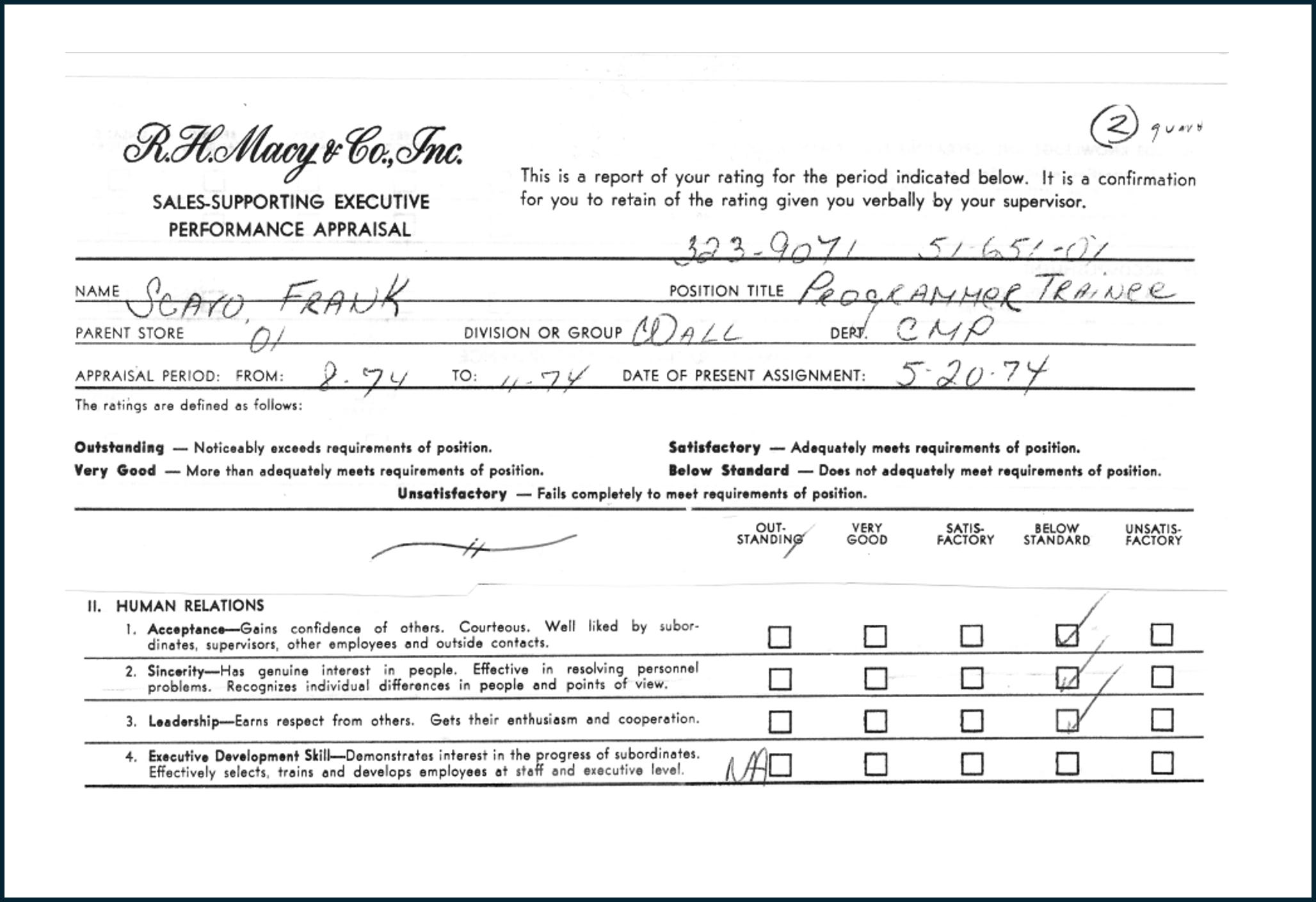
I don’t remember the conversation with my manager—only that I was stunned. I thought, is this how others perceive me? Do I really have a problem with how I work with people?
Fortunately, in subsequent reviews I saw improvements on these points, rising at least to “satisfactory.” Nevertheless, over the years, in other jobs and in my personal life, in formal reviews and in feedback from family and close friends, I saw that, yes, I need to soften my sharp edges. But, without feedback, whether formal or informal, I wouldn’t have seen myself as others saw me. And it started with my first performance review at Macy’s.
Feedback on how we work and behave can come from any source, from a manager, a designated coach or mentor, or a coworker just trying to help us. It can come from someone more senior in the organization, a peer, or even a subordinate.
We can use all the help we can get.
But why do we need feedback at all?
The first reason is to get outside the box of our own point of view. It can be difficult to see things from the perspective of others, whether it be our readers, our audience, or our co-workers. Those giving feedback are stand-ins for others. Being open to feedback gives us insights into how others perceive us and our work. There are thinking processes, such as lateral thinking, that can help us “think outside the box,” but it is much easier if we are open to others who may see things differently than we do.
Getting feedback leads to better outcomes. Our work products will be stronger. During the decades that I ran a research firm we had a saying: “Everyone needs an editor.” It doesn’t matter how good a writer you are. You may be a published author or the leader of an editorial group, but you still need feedback on your writing. Likewise, it doesn’t matter how eloquent you are as a public speaker. You need others to represent your audience. This does not mean that you are obligated to accept every bit of feedback that is given. But it does mean you should thoughtfully consider it. If this becomes your habit, your work products will be stronger.
Feedback also leads to more healthy relationships, how we work with others. You may be a strong project leader or group manager, but you still need feedback on how you deal with people. We are often blind to how others perceive us. Without feedback, we will be oblivious to how our behavior affects those around us.
Feedback is an essential factor for high-performing teams, where communication is open and honest and all members understand the roles and strengths of each other, as I covered in my post on the four stages of high performing teams.
A workplace that has a practice of giving and receiving honest feedback is one of psychological safety. The best leaders create a culture where everyone is comfortable speaking up, without fear of rejection or humiliation. Research over the past two decades has shown that this is the top factor in high performing organizations, as I covered in my post on psychological safety in the workplace.
Ultimately, feedback helps us grow as a person. This is the case, not only when we are young, but also as we grow older. I have a favorite saying, which I coined: “As you grow older you become more like yourself.” In other words, whatever faults you have only become worse as we age. If you are a critical person, you become more critical. If you monopolize conversations when you’re young, you tend to do so even more as you age. Our only hope is to receive honest feedback that can help us grow and do better.
If we are not open to feedback, as the Bible says, we are “like a man observing his natural face in a mirror; for he observes himself, goes away, and immediately forgets what kind of man he was” (James 1:23-34). In other words, we don’t change.
Therefore, feedback is a gift that, when received with humility and an open mind, yields many benefits.
Here are a few things I’ve learned about receiving feedback, whether in formal performance reviews or informal feedback.
Actively solicit feedback and indicate you are not just looking for affirmation. If you have a specific area where you think you may need help, you can say it. This gives the other party permission to be specific as well.
Welcome unsolicited feedback. Feedback can come from any direction or source. Don’t despise it but welcome it as an opportunity to improve.
Don’t “lead the witness.” Let the other party deliver feedback before you indicate how you think you could improve in a certain area. Otherwise, the other party might simply agree with you, especially if they are a subordinate.
Don’t limit feedback to areas where you think you need help. End the conversation with, “Is there anything else you’d like to share with me?” It might lead to something you hadn’t thought of.
Don’t be defensive. This is easier said than done, especially when the feedback is about how we behave. Put a lid on your ego and force yourself to be open. Slow down, ask clarifying questions, and really listen. For example, the other party may say, not so nicely, “You always cut people off when they are talking.” You can respond, “Can you think of a time when I did that recently?” When making a blanket statement like that, the other party is often thinking of something specific but may not want to say it.
Don’t take it personally. This, again, can be easier said than done. Ironically, those with a strong sense of self can sometimes receive feedback more willingly, because they are not threatened by criticism. On the other hand, those who are insecure often find it difficult to accept feedback that is negative, as it can reinforce their already weak view of themselves.
Be open even if the feedback isn’t delivered nicely. As mentioned earlier, the person giving feedback may be angry or irritated, making it easy to discount what they say. Rather, you should consider, “Putting aside how this was communicated, could there be something important for me to understand here about myself?”
Avoid an immediate negative reaction. Too often our first reaction is to find fault, whether with the feedback itself or how it was delivered. Rather, give it time to sink in. Sleep on it, and take advantage of the Zeigarnik Effect. Tomorrow you may see things differently.
Identify parts that are helpful. Even if most of the feedback is unwarranted, is there anything in it that is valid? The proposed solution may be wrong, but has the other party identified a problem?
Seek confirmation. If you believe the feedback is off the mark, rather than reject it, check with others. If others agree with you, you’re off the hook. But if they confirm the feedback is valid, then you have something to work on.
One final point: In working in a team, it’s tempting to withhold feedback in the interest of avoiding interpersonal conflict. But “storming” is a necessary phase in the four stages of high performing teams. Therefore, welcome feedback even if it’s uncomfortable.
Feedback applies to all areas of life, whether on the job, with family members, friends, neighbors, schoolmates, or any type of relationship.
For example, when I retired from employment in 2024, I revived my interest in Christian hymns and poems, old and new, both my own and those of others. I publish these on my other Substack, God’s Gift of Verse.
In this work, I’ve been blessed with several new collaborators. But, in working together I’ve realized that I still need to give and receive feedback. It’s not always easy when they critique my work, or I, theirs, whether our poetry, prose, or music. So, the lessons learned in the workplace still apply in this stage of my life.
Therefore, in every area and stage of our lives, we should learn to appreciate feedback as the gift that it is.
Have you had experiences along these lines? Let me know in the comments.
Image Credit: Talking People Sculpture by jhenning.
Did you enjoy this post?
If so, please like and comment on it so that Substack will promote it to others.
Please share with others to support my work.
Like this post? Browse my past posts.
Comments
Nothing yet. Say the first thing.
Sign in to join the conversation.