
Over the past few years, I have been sharing lessons learned from my long career in enterprise technology. These include the frameworks and methodologies that I’ve found most useful.
But these best practices are not just about how to do the work but also how we can best work together. In this post, I want to cover one framework that I’ve found particularly helpful. It’s called the DISC model of human behavior [1].
DISC is a framework you can use to better understand yourself in terms of your behavioral style, the roles you prefer, and how you like to communicate. It looks at what motivates you as well as what inhibits your effectiveness. And by understanding the DISC styles of those around you, you can learn how to work with them more effectively. In other words, it is a tool for teaming.
I like DISC because it is practical. You don’t need a degree in psychology to use it. It doesn’t try to psychoanalyze you or explain why you are the way you are. It is a behavioral profile, not a personality profile. Neither is it a tool for diagnosing mental illness or dysfunctional relationships. It is a way to understand the variety and range of normal behaviors, all of which have their positive attributes and, especially when under pressure, their negative attributes.
DISC is based on the work of psychologist William Moulton Marston in The Emotions of Normal People. The theory has been refined since first developed and has proven to be highly effective in helping people improve their work and personal relationships. A brief history of DISC is provided in the end notes [2].
This post summarizes the DISC model and its four styles of behavior. It also explains how to identify your personal style and that of those around you. Finally, we discuss how DISC can help you improve how you work with others.
I’m Frank Scavo. I cover issues and trends in enterprise technology, including lessons learned from a career of over 50 years. Subscribe for free to receive notification about new posts.
The DISC model measures an individual’s personal behavioral style in two dimensions, as shown in Figure 1.
The vertical axis (sometimes called the “tempo axis”) measures your action orientation, from active and outspoken at the top to cautious and reflective at the bottom. Those toward the top tend to be fast-paced, assertive, dynamic, and bold. Those toward the bottom tend to be moderate-paced, calm, methodical, and thoughtful. Of course, few people are all one way or the other but somewhere in between.
The horizontal axis (sometimes called the “focus axis”) measures your task orientation, from those who are questioning and skeptical on the left to those who are accepting and warm on the right. Those toward the left tend to be more logic-focused, objective, reserved, and challenging toward new ideas or changes. Those toward the right tend to be more people-focused, empathizing, agreeable, and receptive. As with the vertical axis, most people fall somewhere on the range.
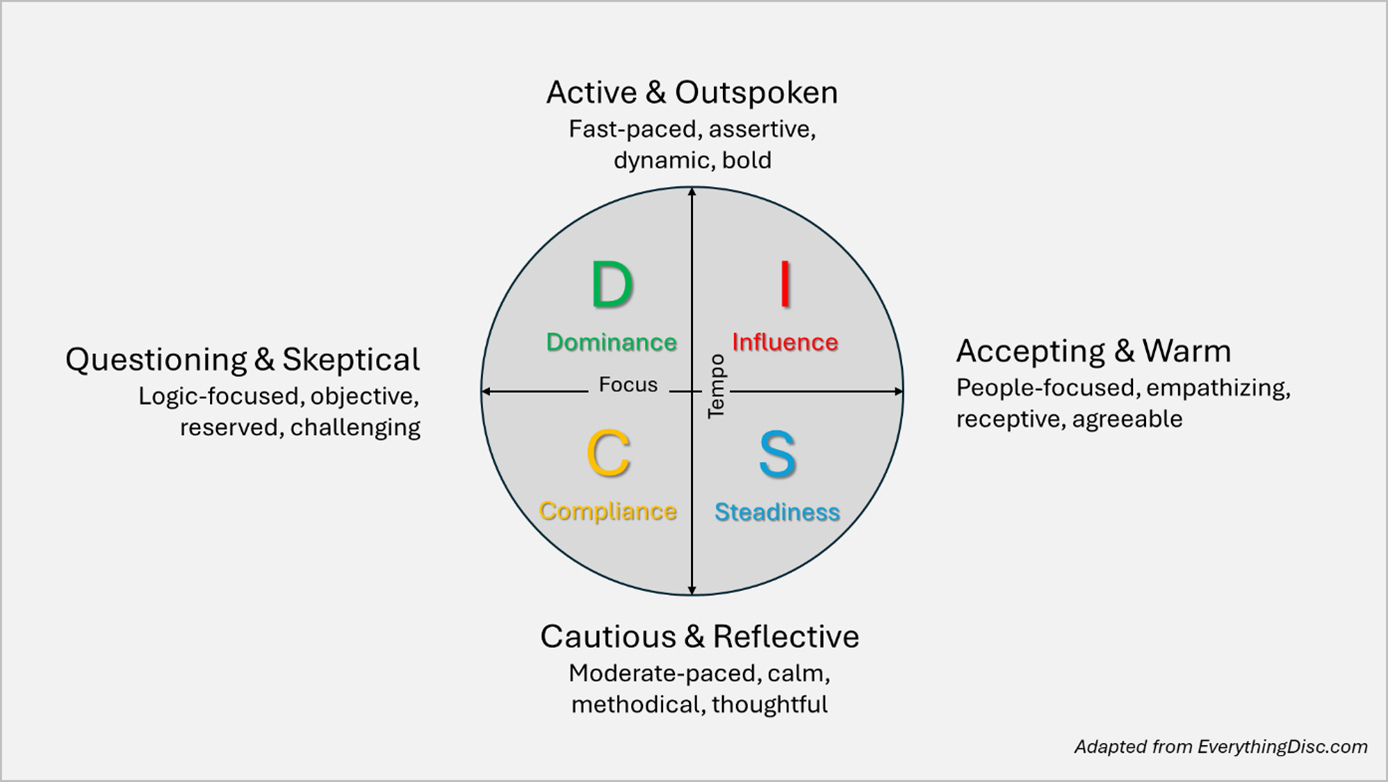
So, the intersection of the two axes results in four behavioral styles: D (Dominance), I (Influence), S (Steadiness), and C (Compliance, or Conscientiousness).
Based on Figure 1, what do you think your primary DISC style is? If you work for an organization that has a formal DISC program or have worked for one in the past, you should already know [3].
But if you haven’t been part of a formal DISC program, no problem. There are several free DISC assessments as well as paid assessments available on the internet [4]. While the free versions are not as detailed as the paid assessments, they still can give you a quick read of your DISC profile, which should be enough to get you started.
Nevertheless, even without a formal assessment, you can probably guess your primary style. Here’s how:
First, think about how you behave in a certain environment, such as at work, at home, or in social situations [5].
Using Figure 1, decide where you fall on the vertical (tempo) axis. Do you tend to be more active and outgoing, or do you tend toward the cautious and reflective side? In other words, do you like to take the lead and give direction? Or are you more likely to go along with what others decide?
Next, do the same for the horizontal (focus) axis. Are you more on the questioning and skeptical side, or more on the accepting and warm side? In other words, do you prefer to work on tasks or activities, especially those that you can do alone? Or are you more of a “people-person.”
Now put the two together. For example, if you’re toward the top on the vertical axis and toward the left on the horizontal axis, you are a D. Top and toward the right, you’re an I. Bottom and toward the right, you’re an S” Bottom and toward the left, you’re a C. This would be your primary style.
You may also want to identify your secondary style. For example, if you think you might also have some tendency toward the right side of the horizontal axis, which could mean your secondary style is I. So, if your primary style is D, your combined style would be DI [6].
And not only can you predict your own style, but with a little practice you can predict the styles of those around you.
To get a better feel for the four primary DISC profiles, let’s look at a couple of illustrations. You may be able to see yourself in these characters.
Here is an entertaining video imagining four individuals on an elevator. (If the video does not display or play below, you can watch it on YouTube.)
Ms. Dominance: She’s the one who presses a button and when it doesn’t respond, presses it again and again. “D-styles are dominant, direct, and results-oriented people who want to control their environment.”
Ms. Influence: She’s the person who walks on the elevator and begins chatting with everyone, whether she knows them or not. “I-styles draw energy from people and love to engage.”
Ms. Steadiness: She’s the one holding the door for everyone to be sure they can get on. She’ll even take the stairs if it appears there’s not enough room for everyone. “She’s stable, steady, and keenly aware of her surroundings.”
Ms. Conscientiousness: She estimates the body weight of those on the elevator to see whether they might exceed the maximum weight posted. “She knows the rules, obeys the rules, and wants everyone else to do the same.”
Inspired by that short video, I made up my own illustration with a foursome that plays regularly on municipal golf courses. And since the preceding video imagined four women, my illustration imagines four men. (These are composite characters of golfers I’ve actually met over the years.)

See if you can guess which player is which DISC style:
Doug: He likes to make the tee time each week so he can resolve any scheduling issues himself. He’s also the guy who proposes the betting game. He’s competitive and hates to lose.
Ivan: He got paired up with the group three years ago and invited himself to play with them regularly. He celebrates everyone’s good shots. He knows the names of the other players’ wives and kids, even though he’s never met them. If a new guy is added to the group, he’s chatting with him during the entire round and at the end they’re exchanging phone numbers. He likes to say, “You can never have too many friends.”
Steve: He prefers to play the same two or three courses, so he knows how to play every hole. He’s happy to go along with whatever Doug suggests for a betting game. Ivan loves him because he laughs at his jokes. Clyde likes him because he doesn’t argue about rules. When he sinks a long putt, he smiles but doesn’t get too excited. The other players call him “Even Steven.”
Clyde: He’s the guy who keeps score for the group and calculates the winnings of the betting game. He carries The Rules of Golf in his bag but doesn’t need to: He has it memorized and quotes chapter and verse when someone breaks a rule. He’s been calculating 17 statistics on his every round since 1999 and keeps a spreadsheet to plot his trends.
Finding your DISC profile and that of others around you is the first step. Now you can use these insights to work together in a more effective way [7].
First, understand that there is no right or wrong style, no good style or bad style—just different styles. Each has its pluses and minuses. And by understanding ourselves and others we can develop a mutual understanding of how best to communicate and work together.
For example, my primary style is D, and my secondary style is C. On the vertical (tempo) axis I tend to be active and outspoken, fast-paced, assertive, dynamic, and bold. I like to be in control. On the horizontal (focus) axis, I tend to be questioning and skeptical, logical, objective, and analytical. I like to know what the rules are, follow them, and expect others to do the same.
On the negative side, I can be impatient with those who are not moving as quickly as I am (as one manager told me nearly 50 years ago). I can be irritable and rub people the wrong way, especially when under pressure. I am uncomfortable when I feel like I’m not in control. I don’t like being told what to do, especially when I don’t agree with the direction. I find it difficult to hide my opinion.
So now, knowing my natural DC tendencies, how should I deal with others?
When dealing with another D, our mutual bias toward action is common ground. But we should work to have a good collaboration and not always be competing with one another [8].
When working with a C, we have the analytical focus in common. But my coworker may need more time to think through the implications of any proposal. I will need to more patiently explain the logic of my thinking and avoid being pushy or rush any decision.
When dealing with I styles, we share a bias to action, but I need to take advantage of their enthusiasm to draw in others. At the same time, I can use my conscientious side to take care of the details that I-styles can sometimes miss.
When working with an S, I need to remember my coworker’s need for stability and continuity. Those with an S-style want to know how any change will affect them and those who are close to them. In times of change, they do not like to be rushed. They will want to be sure that I care for them and those around them.
These are just a few examples, using myself as a case study. If you have the opportunity to receive DISC training, you’ll learn more about how to deal with people with each style. But even without that training, you can use the sources I’ve listed in the end notes to teach yourself.
In using DISC, here are a few things to avoid.
Expecting others to tolerate you. Don’t use your DISC style as an excuse for bad behavior. “You know I’m a D—I only care about results. Just do it.” Or, “Sorry, I’m a C. Show me where that’s in the employee handbook.” Your DISC profile is not an immutable characteristic, like your eye color. DISC can help you understand how you typically react when under pressure, but it doesn’t mean you are obligated to act that way. Sometimes, you just need to put a lid on your natural tendencies.
Stereotyping others: Avoid labeling others according to their DISC style. “She’s a D, always needs to be in charge,” or “He’s a typical C, Mr. Rule book,” or, “She’s an S, always resisting change.” Although DISC can identify a person’s natural tendencies, like you it’s possible for them to change their behavior.
Focusing on the behavior of others. Don’t expect or demand that others change. The only thing you can control is yourself. Use your understanding of DISC styles to adjust your behavior to best accommodate the styles of others.
Assuming others are like you. When it comes to interpersonal relationships, the golden rule (“Do unto others as you would have them do unto you”) does not apply. Rather, “treat others as they would like to be treated.”
[1] There are many other behavioral profiling and personality assessments. The most popular is Myers Briggs, and academic studies show commonalities between it and DISC. Nevertheless, I prefer the DISC model in that it is simpler and focuses on observable behavior instead of inward personality. In other words, DISC focuses on how you tend to act rather than why you act that way. Here is a good comparison DISC vs Myers Briggs.
[2] A brief history of DISC may be found at this link.
[3] I have been fortunate in my career to have gone through formal DISC training twice. My first exposure was with the SI Firm I helped build in the 1990s. There, my associate Dee Long was the in-house DISC coordinator. Later in our work together at Strativa and Computer Economics she continued to help me understand and apply DISC. Then when I sold both firms in 2020, Dee and I went to work for the buyer. There, she started and managed their DISC program. So, I had a chance to see how DISC had been refined over the previous two decades. (And thanks also to Dee for reviewing and helping me with this post!)
[4] Here are four free DISC assessments available on the internet. Take one or two of them to get your own profile. (Some readers have had problems with some of these tests. If you do, just try a different test.)
Some paid assessments include.
Wiley’s Everything DiSC®. This is the most popular DISC assessment program. It is only available through partners, which can be found through the Find a Partner link.
White Label DISC is a platform that allows consulting firms to offer their own DISC assessment and consulting services. It can also be used by end-user organizations to set up and manage their internal DISC programs. You can also purchase individual assessments without signing up for an ongoing subscription.
Take Flight Learning offers DISC assessments, training, and certification programs based on its DISC model of four birds (eagles, parrots, doves, and owls) to stand for the four DISC styles.
[5] It is helpful to do your DISC assessment with a general area of your life in mind, such as at work or in family relationships. For example, you may have a strong driving D-style at work, while at home you may be more relaxed and compliant. Most people have a consistent DISC style in all areas of their lives, but it can vary depending on the environment. So, thinking about a specific area of your life will make it easier to take the assessment.
[6] Most people are some combination of two styles, one primary and one secondary, usually next to each other, such as DC or CD, DI or ID, IS or SI, SC or CS. For example, I am a DC: my primary style is Dominance with a secondary style of Conscientiousness (or, Compliance). Rarer are those with a secondary style kitty-corner to their primary style, such as a DS or IC. Rarer still are those individuals who are equally divided between all four styles.
[7] In this post, I’m looking at how the DISC model is useful at work. But it is also helpful in other relationships, even marriage. My wife and I have both taken DISC assessments. I am a DC and she is an SC, a style that works well with me. Her steadiness calms my dominance, and we match up well with our mutual attention to detail.
[8] My late business partner, Dan Husiak, and I both had the same DISC profile: DC. It was helpful in that we were often on the same wavelength: action-oriented and analytical. But, we learned that we both couldn’t be dominant. We sometimes had to let the other take the lead, depending on the area. At the same time, we also had to come to agreement and not just dictate to each other. Still, that secondary C style sometimes led us to analysis paralysis. I covered that in an earlier post (read the section on “Too Much Planning”).
Photo Credit: Pixabay.
Did you enjoy this post?
If so, please like and comment on it so that Substack will promote it to others.
Please share with others to support my work.
Like this post? Browse my past posts.
Comments
Nothing yet. Say the first thing.
Sign in to join the conversation.