
Over the past 30 years, one of my most popular posts was on the issue of what I call “technical bankruptcy.” This post is a refresh of that 2017 post, including an interview I did on the subject along with a link to the full research report that is still available for download.
I’m Frank Scavo. Here I cover issues and trends in enterprise technology, including lessons learned from a career of over 50 years. Subscribe for free to receive notification about new posts.
Developing an IT strategy for some organizations can be difficult because of the presence of legacy systems. Legacy systems that are old, out-of-date, and difficult to maintain are a huge obstacle to innovation. As a result, business leaders become increasingly frustrated by their inability to roll out new strategic applications, connect with customers, analyze business performance, or become a digital business.
In recent years, it has become popular to describe organizations with out-of-date legacy systems as being in “technical debt” [1]. But I would take this a step further. If an organization ignores the need to update the system for too long, it can lead to what I refer to as “technical bankruptcy.”
We can define technical bankruptcy as a situation where the organization cannot, or finds it exceedingly difficult to, pay off the technical debt. It does not mean that the organization is in financial bankruptcy but rather that its systems are broken or extremely difficult and costly to upgrade.
In our work with clients, we have gained insights into these challenges and we conducted a survey to quantify the problem [2]. The result is a report, Avoiding Technical Bankruptcy in Legacy Systems (Click the link for the free download). Although the report was published some years ago, the essential findings have not changed and the problem, in fact, may have gotten worse.
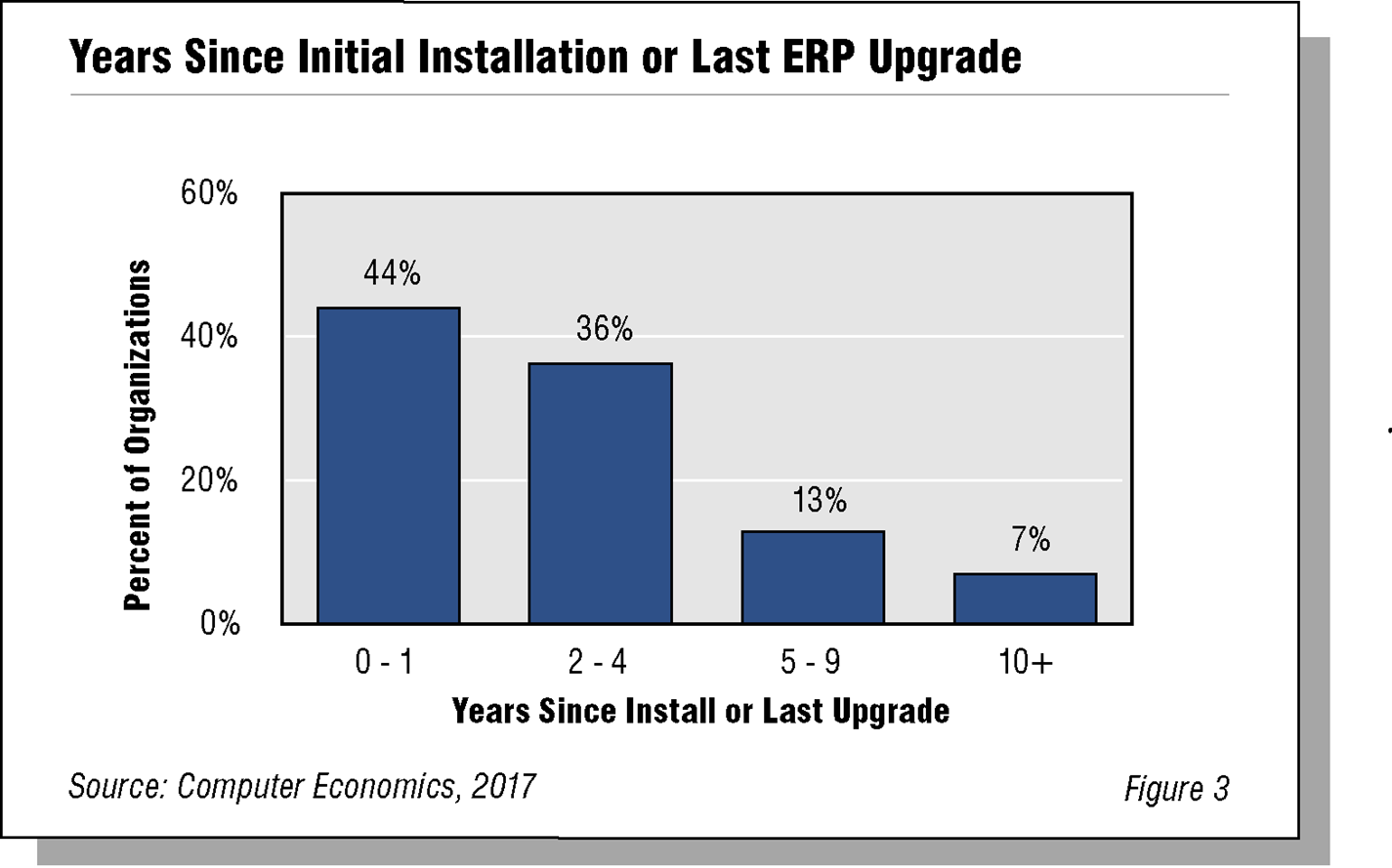
Figure 3 from the full report shows the magnitude of the problem as it applies to ERP systems. A small but significant percentage (7%) of organizations had not upgraded their ERP systems for 10 or more years. These are likely to already be in technical bankruptcy. But the 13% of organizations that had not upgraded their systems in the five-to-nine-year time frame are in the danger zone: Technical debt is growing, and if the organization does not undertake a major upgrade, it risks falling into technical bankruptcy.
What are typical signs that a legacy system has reached the stage of technical bankruptcy? We found five characteristics:
Extensive modifications, extensions, and interfaces.
Poor understanding of the system by users and IT alike
Direct involvement of IT personnel in business processes.
Legacy system atrophy as shadow IT emerges.
Upgrade or replacement is hard to justify.
In the full report, we explore the symptoms of technical bankruptcy and the devastating effects that it has on the organization. We continue by quantifying the scope of the problem specifically for ERP systems, using our research data on the typical age, frequency of upgrades, and extent of modification of these systems.
We conclude with recommendations on how to avoid technical bankruptcy and, for organizations that have reached this stage, strategies for getting out and staying out of technical bankruptcy going forward.
Shortly after publication of the report, I did a short interview with James Maguire about it:
You can also download the full report from the link below:
Avoiding Technical Bankruptcy in Legacy Systems:
[1] Software developers also use the term technical debt when developers take shortcuts that get the job done for the time being but will require refactoring or further development downstream. But in this post, I am using the term in relation to commercial software that has fallen out of date with newer versions.
[2] The survey was conducted and the report published by my research firm, Computer Economics, which I sold in 2020 to Avasant. The free report is still available on the Avasant website.
Did you enjoy this post?
If so, please like and comment on it so that Substack will promote it to others.
Please share with others to support my work.
Like this post? Browse my past posts.
Comments
Nothing yet. Say the first thing.
Sign in to join the conversation.