

You have a good idea. You’ve thought it through, and you bring it to a manager or senior colleague whose support you need.
The meeting goes fine. They listen. They nod.
And then... nothing changes. It’s not your idea. It’s not your English. It’s how you framed the conversation.
In American workplaces, small language choices shape the role the other person plays — critic or collaborator, order-taker or partner.
Two small shifts, backed by research, change that role:
👉 Ask for advice, not just feedback.
👉 Ask for a real commitment, not just a deadline.
No stronger English. No bolder personality. Just the right words.
In some workplace cultures, authority does most of the persuading. Ideas move top-down, and getting something done means finding the right decision-maker and presenting your case clearly.
U.S. workplaces often work differently. Seniority still matters — but so does how you involve others. Strong communicators make colleagues feel their judgment matters, and that they have a stake in the outcome.
That takes a particular kind of language.
Let’s start with a word change that sounds small but can change the tone of an entire conversation.
When you need a senior colleague’s support, you might say:
“I’d love to get your feedback on this.”
Or:
“I wanted to get your thoughts on our approach.”
Or:
“Can I get your reaction?”
These phrases are perfectly professional. But according to Jonah Berger — an Associate Professor of Marketing at the Wharton School of the University of Pennsylvania and the author of Magic Words — there’s a more effective option:
“I’d really value your advice.”
The difference is subtle, but important.
Here’s what Berger’s research found: people who ask for advice are judged as more competent — not less — by the person they’re asking.
📝 Competent = having the skills and ability to do something well. “She’s seen as highly competent by her manager.”
This surprises most people. Our instinct says asking for help signals weakness. But something different happens in the other person’s mind.
When you ask for advice, they don’t conclude you’re unsure — they conclude you’re smart enough to value their experience. Instead of evaluating your idea, they help shape it.
That changes their role in the conversation.
Compare:
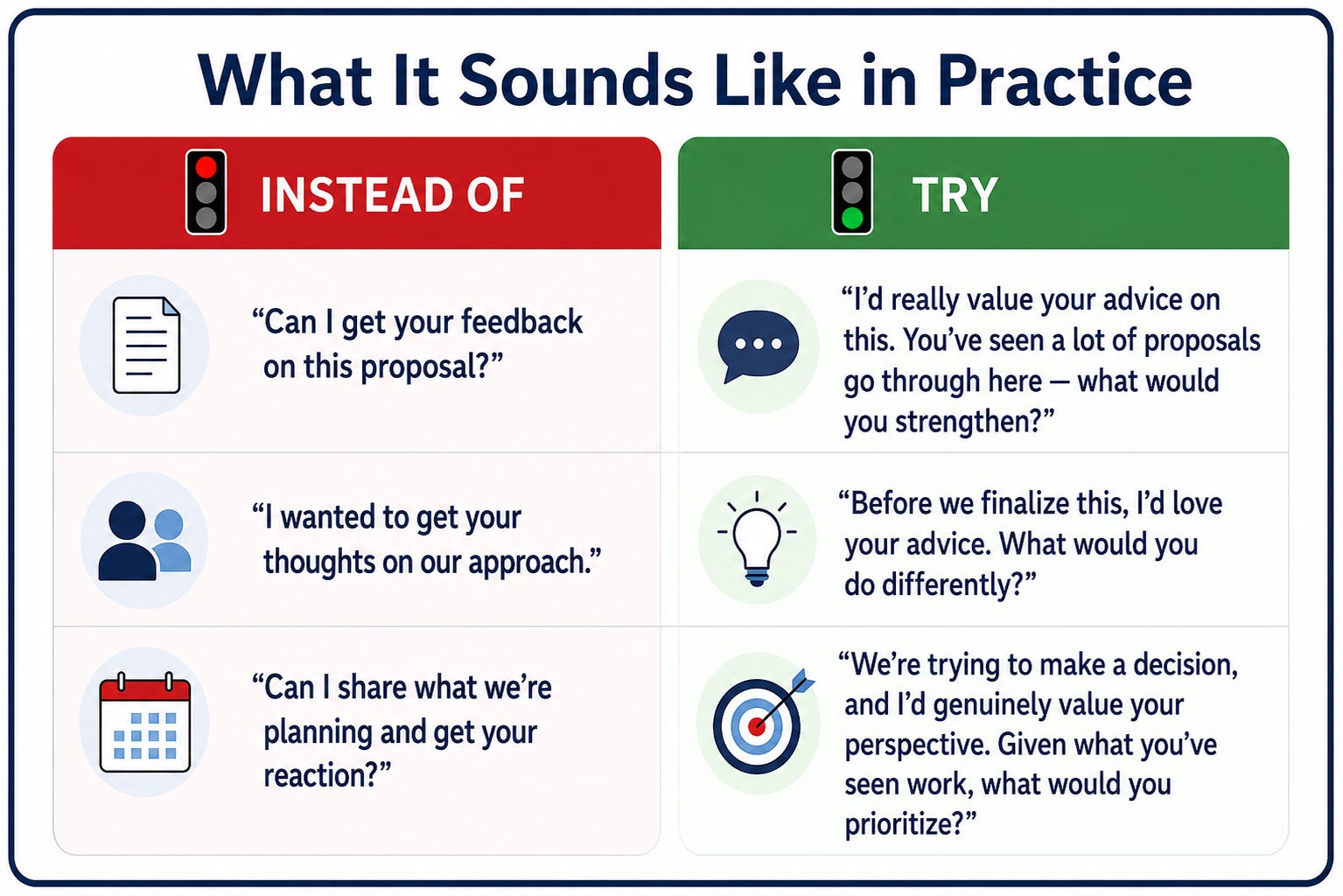
❌ “I’d love to get your feedback on this.”
✅ “I’d genuinely value your advice. Given what you’ve seen work here, what would you prioritize?”
In the first version, the other person is an evaluator.
In the second, they are contributing their judgment — and once someone has helped shape an idea, they tend to feel more invested in what happens next.
📝 Invested in = having a personal interest in the success of something — “Once the director helped shape the plan, she became more invested in the outcome.”
Do not simply replace the word feedback with advice and stop there.
This is too broad:
“Can I get your advice?”
A specific question is much easier to answer.
Try:
“Given what you’ve seen work here, what would you prioritize?”
“What would you strengthen before we present this?”
“What would you want us to get right before we move forward?”
“If you were in my position, what would you watch out for?”
Specific questions invite useful judgment. They also make it clear why you are asking this particular person.
She needs support from Richard, a senior director who has been skeptical about changing the current process.
Priya’s first instinct is to request a meeting and say:
“Hi Richard — I’d love to share the new onboarding process we’ve developed and get your feedback.”
There is nothing wrong with that sentence. But Priya tries a different approach:
“Hi Richard — we’re at a decision point on the new onboarding process, and I’d genuinely value your advice before we move forward. You’ve seen a lot of process changes here. What would you want to make sure we get right?”
Richard responds differently than Priya expected. Instead of immediately evaluating the idea, he starts talking about what he has seen work in the past. He identifies two potential problems and suggests a way to address one of them.
By the end of the conversation, Richard is no longer simply reviewing Priya’s idea. He has contributed to it.
Two weeks later, when the process is presented to the wider team, Richard mentions the idea positively.
What if Richard hadn’t come around?
📝 Come around = to change your opinion and start agreeing, after initially disagreeing or being unsure — "He was against the idea at first, but he came around after seeing the results."
Not every advice request produces instant buy-in. If Richard had stayed skeptical, the right move isn’t to argue back. It’s to close the same way you opened: “That’s really helpful — let me think through how to address that before we move forward.” You’ve still built the relationship, even without agreement in the room.
Did Priya manipulate Richard? No. She genuinely wanted his judgment, and she asked for it directly. That is the important part.
What changed between Priya’s first message and her second?
Her first message asked Richard to evaluate the idea.
Her second asked him to help shape it.
Think of one person whose support you need at work.
Try this formula:
“We’re at a decision point on [topic], and I’d genuinely value your advice. Given [what they know or have seen], what would you [specific question]?”
For example:
“We’re at a decision point on the rollout, and I’d genuinely value your advice. Given your experience with previous launches, what would you want us to get right before we move forward?”
Try writing your own version in the comments — I’ll reply to a few and tell you honestly how they sound.
I’d genuinely value your advice → a warm, direct way to ask for someone’s professional judgment
Given what you’ve seen → acknowledges the other person’s experience before asking a question
Decision point → a moment when an important choice must be made
What would you prioritize? → asks which issue or action should receive the most attention
Invested in → personally interested in the success of something
What would you want us to get right? → a natural way to ask about the most important factors for success
The words are only part of it. How you say them matters too.
If you say “I’d genuinely value your advice...” in a way that sounds too rehearsed, it can come across as fake. Say it naturally. Then pause — and really listen to the answer.
How formal you sound depends on who you’re speaking to. With a peer, something more casual works well: “I’d really love your take on this.” With a senior leader, “I’d genuinely value your advice before we move forward” fits better.
Same idea, different level of formality. Match your language to the person.
Choose the phrase that best uses the advice technique.
1️⃣ You need a senior colleague’s input before finalizing a proposal.
A. “I’d appreciate your feedback before we finalize.”
B. “Could you take a quick look and let me know if you see any issues?”
C. “I’d genuinely value your advice. Given your experience with proposals like this, what would you strengthen?”
D. “I’d love to hear your thoughts before we move forward.”
2️⃣ A director has handled several product launches. You are preparing for your first one.
A. “Can you give me some feedback on the launch plan?”
B. “What do you think of the plan?”
C. “Let me know if you see any problems.”
D. “Given the launches you’ve led, what would you want us to pay particular attention to?”
3️⃣ You want your manager’s genuine input on a client proposal.
A. “I’m pretty happy with this but wanted to run it by you.”
B. “I’d really value your advice. You’ve seen a lot of these proposals — what would you strengthen before we send it?”
C. “Could you review this when you have a moment?”
D. “Do you have any feedback?”
4️⃣ You’re negotiating pricing with a vendor for the first time and want a colleague’s genuine input before the call.
A. “Any tips before I get on the call?”
B. “You’ve negotiated vendor contracts before — what would you push back on if you were me?”
C. “Let me know if you have thoughts.”
D. “Wish me luck on this call!”
✅ Answer key
1 → C — All four options are professional, but C clearly asks for advice, acknowledges experience, and asks a specific question.
2 → D — The speaker gives a clear reason for asking this particular person and invites them to use their experience.
3 → B — This goes beyond a general reaction. It asks for judgment and gives the manager a specific question to answer.
4 → B — This points directly to the colleague’s relevant experience and asks a specific, answerable question. A, C, and D are too vague or don’t actually invite advice at all.
You’ve now learned one shift that changes the role another person plays in a conversation.
But what about when you need a report by Friday, a decision by Wednesday, or a colleague who actually follows through on something they already agreed to?
That takes a different kind of language.
In the paid section, we’ll look at:
📅 How to get a real commitment to a deadline instead of simply announcing one, backed by an influential piece of behavioral research
💬 The question structures that invite a clear yes or no — and the one situation where you should never disguise a requirement as a question
🎯 How to follow up after a missed deadline without sounding angry or passive-aggressive
🌍 Mini-case — Marcus and Ahmed use both techniques together in a single high-stakes conversation
⚖️ The ethics of persuasion — including a genuinely debatable question I want your take on
🧠 A full quiz, “spot the mistake” practice, and answer keys
A paid subscription is $8/month, and it gives you access to the full lesson, including the complete Persuasion Playbook, examples, practice activities, and answer keys.
If you want the language for getting clearer commitments at work, subscribe below and keep reading. 👇
Comments
Nothing yet. Say the first thing.
Sign in to join the conversation.