
This Independence Day, we're lighting up more than the sky, we're lighting up your vocabulary! In this post, we explore the deeper meaning behind the Declaration of Independence, learn 10 powerful American idioms, walk through a workplace dialogue on scheduling around the holiday, laugh a little (yes, King George makes a guest appearance), and finish with a quick quiz to test what you've learned.
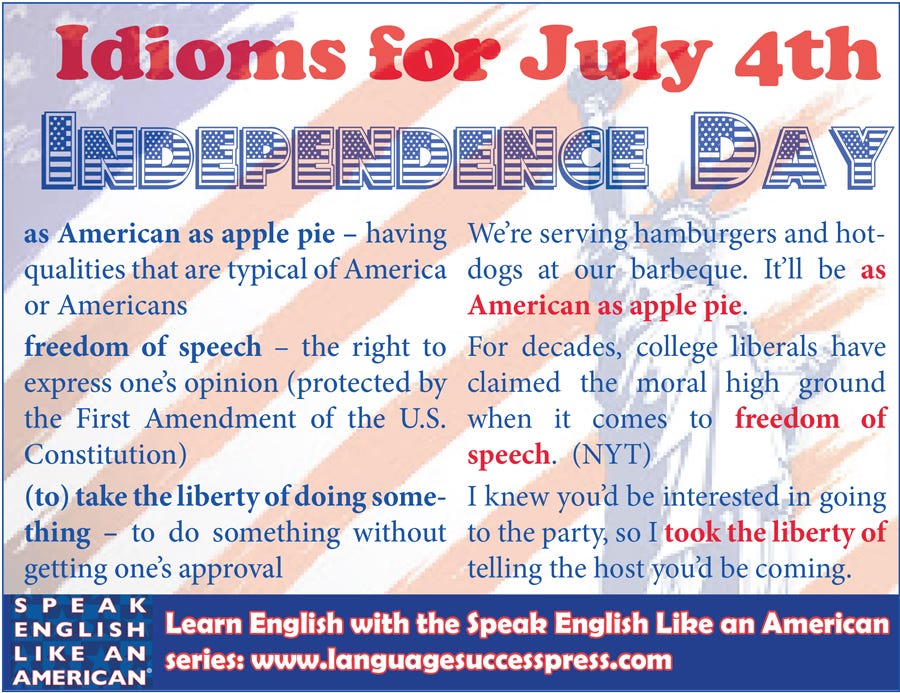
How do Americans celebrate this day and mark their independence from Britain (which they declared on July 4, 1776)? Fireworks light up the sky in almost every town, backyard grills work overtime on burgers and hot dogs, and plenty of neighborhoods still turn out for a small-town parade. Some families head to the lake or the beach, others just gather in the backyard with lawn chairs and cold drinks, waiting for it to get dark enough for the fireworks to start. Red, white, and blue shows up on everything from flags to popsicles, and it’s one of the few holidays where staying up late to watch the sky is basically required.
This year carries a little extra weight, too. 1776 to 2026 marks 250 years since the Declaration of Independence was signed, a milestone often called the semiquincentennial. Expect bigger fireworks displays, extra events and exhibits in many cities, and a general sense that this Fourth of July is a bit more of an occasion than usual.

If you work with a US-based team, expect things to slow down this week. July 4th falls on a weekday this year, and American offices treat are closing on Friday and not fully back to normal until the following Monday (many people will take Monday off as well, as a vacation day). Emails may go unanswered for a few days, and meetings scheduled for late this week are often the first to get pushed.
Here’s what that can sound like in practice:
Maria (based in Madrid) and Tom (based in Chicago) are trying to schedule a project call.
Tom: Hey Maria, are you free Friday afternoon to go over the contract details?
Maria: Friday is tough for me, but more importantly, isn’t that the holiday in the US?
Tom: Good catch. Yeah, we’re off Friday for the Fourth of July. Most of the team is taking the long weekend and will be off Monday too.
Maria: No problem, let’s push it to next week then. Does Tuesday work?
Tom: Tuesday’s good. I’ll be OOO through Monday, but I’ll circle back with you first thing Tuesday morning.
Maria: Sounds good. Enjoy the long weekend!
Tom: Thanks, you too. Talk soon!
Phrases:
Are you free …? — a simple, direct way to ask about availability
Good catch — a way to acknowledge that someone noticed something important or easy to miss
We’re off — not working that day The long weekend — a weekend extended by a holiday, usually Friday or Monday off Let’s push it to next week — let’s reschedule for later
OOO — short for “out of office,” very common in work emails and Slack
I’ll circle back — I’ll follow up or return to this topic later
Now let’s read an article and learn 10 American idioms and expressions. These phrases will help you understand not only the language, but also the deeper feelings behind this important holiday. At the end, take a quick quiz to test what you’ve learned.
Read the Article Here & Then Return
Did you read the article? Great, now we’re ready to review the vocabulary from the article:
Meaning: With deep respect
Many Americans speak of the Declaration of Independence with reverence, honoring its ideals.
She speaks with reverence about her grandmother, who raised her during difficult times.
Meaning: An idea or plan that is unrealistic or unlikely to happen
Our third quarter financial targets feel like pie in the sky given how far behind we are.
Thinking we can all retire at 45 without saving money is just pie in the sky.
Meaning: Talking about something at length, often overly so
The article notes that the Declaration isn't just waxing on and on about freedom.
He kept waxing on and on about his new car until we all got bored and zoned out.
Meaning: On the edge of a very bad or dangerous situation
The startup was teetering on the brink before the last round of funding came through.
After missing her third rent payment, she was teetering on the brink of losing her apartment.
Meaning: Deeply impressed, in love with, or enchanted by
The drafting committee was smitten by Jefferson’s powerful writing.
Adam was completely smitten by Emily after their first date.
Meaning: Deep and unlimited passion for liberty or independence
The Declaration is seen as a symbol of America’s boundless love of freedom.
Anti-Trump protesters marched with signs showing their boundless love of freedom and justice.
Meaning: Preventing someone from speaking out or expressing themselves
The king was accused of stifling the voice of justice.
The new law was criticized for stifling the voice of independent journalists.
Meaning: To feel sorrow or sadness about something
Jefferson invites readers to grieve at the injustices listed in the Declaration.
People across the world grieved at the news of devastating hurricane.
Meaning: Divided into groups that strongly oppose one another
The king is blamed for having split the people into antagonistic parties.
The online debate quickly split the group into antagonistic parties.
Meaning: Damaged or weakened relationships
The Declaration of Independence suggests that the relationship between the colonies and Britain had become strained, with frayed ties replacing their once-shared identity.
After Ella and Sophia both discovered that the other was talking about them behind their backs, their friendship was hanging by frayed ties.
1. What emotion does the author say is often overlooked in the Declaration of Independence?
A. Excitement
B. Anger
C. Sadness
D. Pride
2. Why did Thomas Jefferson feel overwhelmed when writing the Declaration?
A. He didn’t think his writing was good enough
B. He was afraid of the war and division it would cause
C. He wanted to impress the British king
D. He had little time to write it
3. According to the article, how did many colonists view themselves before independence?
A. As enemies of Britain
B. As proud Americans
C. As members of the British Empire
D. As French allies
4. What does the author suggest about America today?
A. It has no connection to the past
B. It is stronger than ever
C. It may be facing a similar kind of division and uncertainty
D. It no longer values independence
C. Sadness
B. He was afraid of the war and division it would cause
C. As members of the British Empire
C. It may be facing a similar kind of division and uncertainty

King George III brushing up on his American English. If only he'd had Speak English Like an American in 1776… things might've gone differently! And those of us in the USA would be eating biscuits and going on holiday!
💬 Your Turn:
Which idiom was new for you? Have you heard any of these phrases used at work? Leave a comment, or share something about one of your country's holidays!
👉 And don’t forget to subscribe for more fun, smart English learning posts!
Discover our ESL Books & Apps!!
Thanks for reading Speak Business English Like an American Newsletter! This post is public so please share it.
Comments
Nothing yet. Say the first thing.
Sign in to join the conversation.