
You studied English for years. You passed the tests. You got the job. Your grammar is correct, your vocabulary is strong, and your emails are clear and professional.
So why does something still feel a little off?
Why do your American colleagues’ emails sound warmer and more natural than yours? Why do you occasionally feel as though you’re speaking a slightly different version of English from everyone around you?
Here’s something nobody tells you when you start working in a U.S. workplace: there are two versions of professional English. The English you were taught — and the English Americans actually use at work.
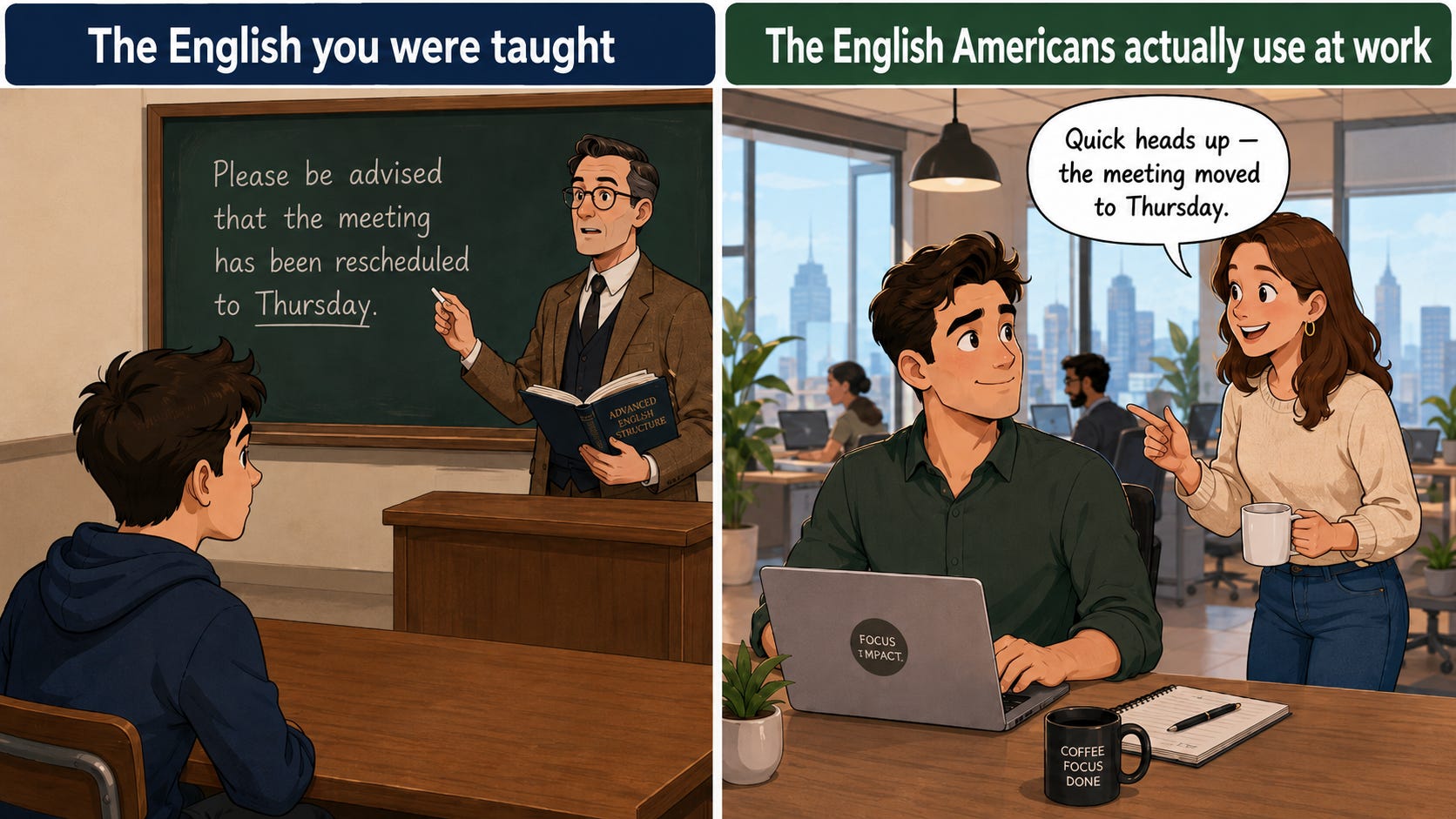
The gap between them isn’t about grammar. Your grammar is probably fine. It’s about register.
📝 Register = the level of formality in your language — how formal or casual your words sound in a particular situation.
Using the wrong register is a little like wearing a suit to a beach party. There’s nothing technically wrong with what you’re wearing — although you may feel a little overheated! — but somehow, you don’t quite fit the setting.
In English classrooms and textbooks, you were probably taught fairly formal English: complete sentences, polite phrases, and professional vocabulary. All of it correct. And much of it more formal than the language Americans use with one another at work every day.
Let me show you what I mean.
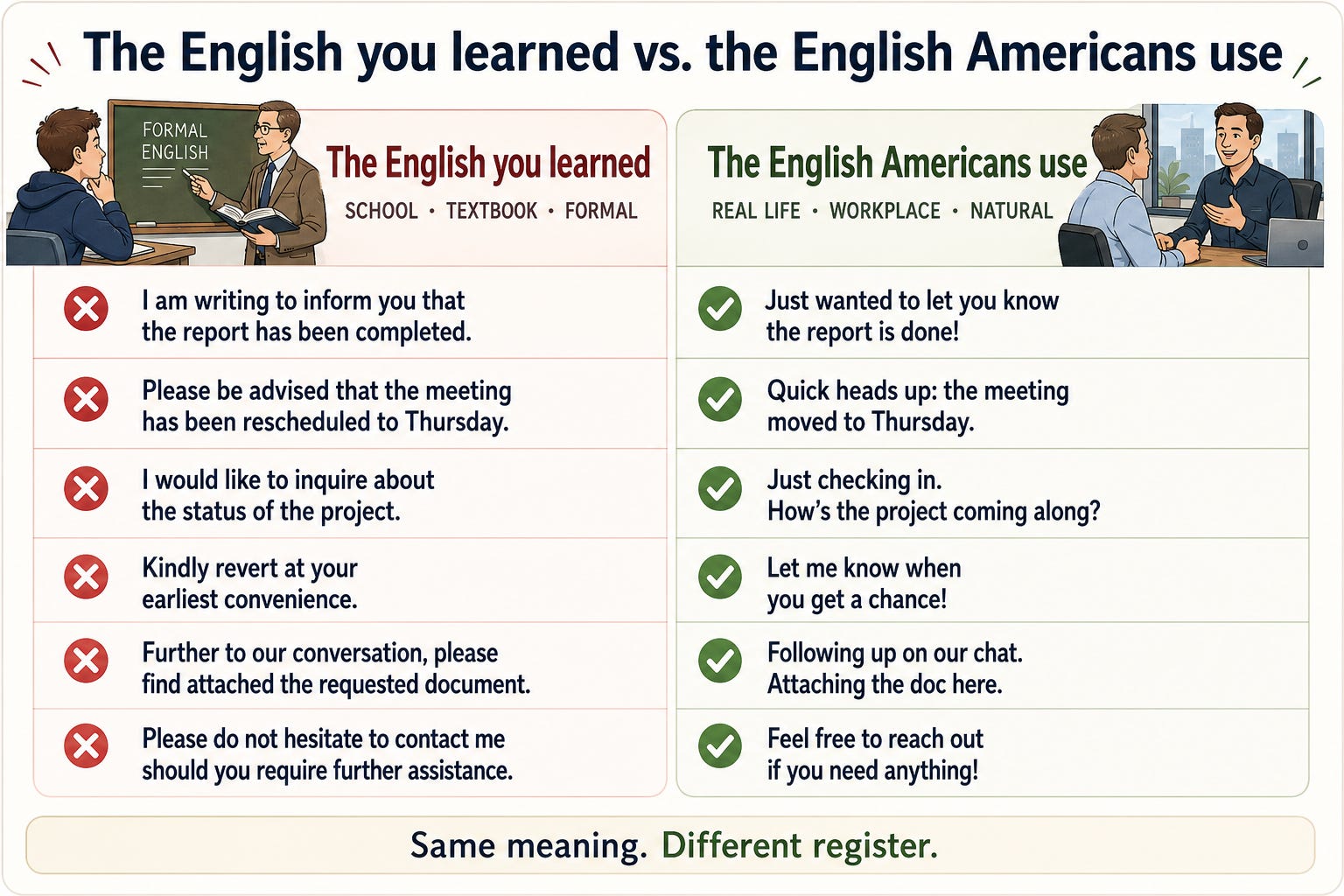
Notice a few things. The natural versions are usually shorter. They use contractions such as I’m, it’s, you’re, that’s, and don’t. They also use small, warm phrases like just wanted to, quick heads up, feel free to, and when you get a chance.
Most importantly, they don’t try very hard to sound impressive. They try to be easy to receive.
That last point is worth sitting with for a moment. In many U.S. workplaces, ease is a social signal. When your language feels warm, direct, and easy to respond to, it can tell the other person: I’m approachable. I’m comfortable here. We’re colleagues.
Formal language can sometimes — completely unintentionally — communicate the opposite: distance.
Valentina is a financial analyst from Colombia working at a mid-size investment firm in Miami. She has been with the company for six months. Her English is strong; she studied it for years and has always been told that her written English is excellent.
One afternoon, she needs Ryan, a colleague on her team, to review a spreadsheet before she sends it to a client.
She writes:
Dear Ryan,
I hope this message finds you well. I am writing to request that you kindly review the attached spreadsheet at your earliest convenience, as it is required for a client deliverable. Please do not hesitate to contact me should you have any questions or require further clarification.
Best regards,
Valentina
Ryan replies:
Looks good.
That’s it. Two words.
Valentina stares at the reply. Was he annoyed? Was he too busy? Did she somehow create distance?
She didn’t do anything wrong. Her email was perfectly grammatical and professionally structured. But it sounded like a formal business letter. Ryan, who sits ten feet away from her and exchanges casual messages with everyone else on the team, responded briefly and coolly.
Now imagine that Valentina had written:
Hey Ryan — would you have a chance to take a quick look at this spreadsheet before I send it to the client? Just want to make sure everything looks good on your end. Thanks so much!
Same request. Completely different feeling.
Ryan doesn’t feel as though he has received a formal request. He feels like a colleague asked him for help. And that is the register gap.
🧠 Pause and reflect
Think about your own emails. Do you write phrases like I am writing to inform you, I would be grateful if you could, Please do not hesitate to, or at your earliest convenience?
There is nothing grammatically wrong with these expressions. But in everyday U.S. workplace communication, you may sound more formal than you realize.
And here’s the important part: the gap between textbook English and everyday U.S. workplace English is not disappearing. In many workplaces, communication is becoming shorter, warmer, and more conversational.
So how do you close the gap without sounding sloppy, overly casual, or unprofessional?
🔒 That’s what we’re doing next.
📧 Email upgrades — formal phrases you may have learned and what Americans are more likely to write instead
💬 Slack and Teams English — why treating a Slack message like an email can make you sound stiff
🗣️ Meeting language — how to disagree, raise concerns, and join a conversation naturally
☕ Everyday workplace conversations — the phrases Americans use in quick, informal interactions
🧰 Three language tools that immediately make your English sound warmer and more natural
✅ A practical quiz to test your register instincts — including a Spot the Mistake exercise
The English you learned got you here. Now let’s add the English that helps you sound natural and comfortable in the room.
Paid subscribers get the full Register Playbook plus access to the complete archive — every post in this series, organized and ready to use whenever you need it. New issues land in your inbox every week.
All of this for just $8 a month — less than a cup of coffee, and a lot more useful at your next meeting.
👇 Upgrade to keep reading and unlock the full Register Playbook.
Comments
Nothing yet. Say the first thing.
Sign in to join the conversation.