
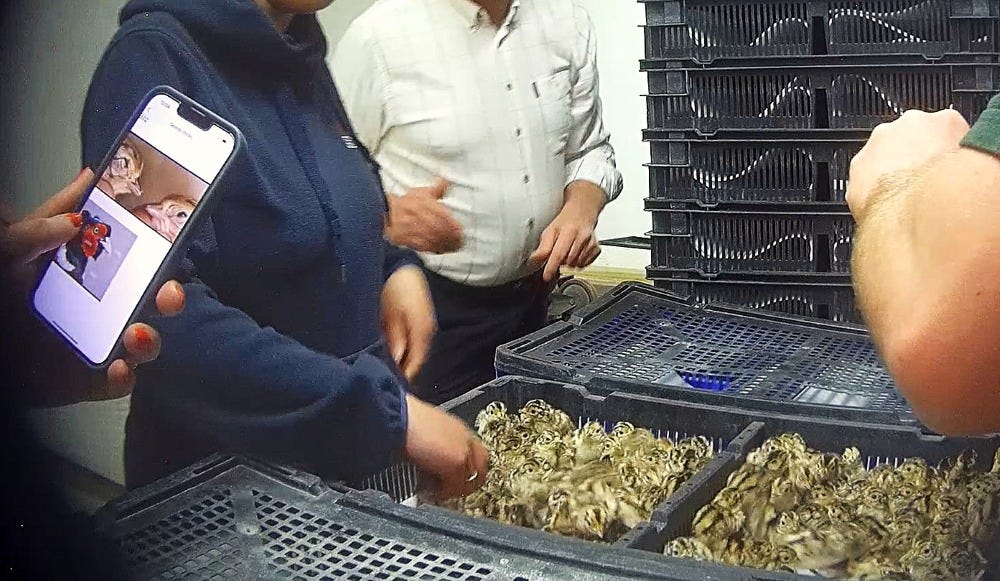
Over the past few months we have been publishing analysis of undercover footage obtained on so-called ‘game farms’ across England. We began by looking at the sheer scale of the shooting industry, then how adult birds (not every bird, but far too many) are sometimes treated, and the enormous numbers of eggs collected and washed - and in some cases dumped unlawfully in open-air trailers.
Recently we looked at very young chicks being ‘sexed’ and sorted. But we didn’t explain why and what happens to the birds the industry doesn’t want…
Sorting
Sorting takes place when chicks are very young, and it has two functions on a farm where birds are being bred for the gun. The first is sexing - ie sorting males from females. The second is checking for weak or unhealthy birds.
A breeding operation exists to produce eggs - and those eggs are laid only by females. A male is needed to fertilise them, but because farms typically rotate one male pheasant among eight females, only a small number are ever needed. The rest are, in the industry's own accounting, surplus. While it depends on the individual farm’s requirements that year (and how Avian Flu has impacted imports of chicks from continental hatcheries), as many as half of every hatch on a so-called ‘game farm’ may be killed within hours of being born. Not for any reason connected to their health. They are killed because they are male, and a male pheasant will never lay an egg.
‘Unhealthy birds’ - ie birds that because of deformity or ill-health will not survive the rigours of egg production without costly intervention - won’t add to the farm’s bottom line so will be disposed of too. They won’t be treated, cared for, rehabilitated, or set carefully aside for something else - to use the words of one of the senior workers talking in the undercover footage we’ve posted below, they will be put “straight in the bin”.
The question the industry would rather we didn’t ask: what happens to the chicks the farm doesn’t want?
The typical method of ‘disposal’ is maceration. The chicks are dropped from trays, usually fully conscious and often with piles of other ‘waste’ like eggshells, into a high-speed mechanical shredder. They are literally ground up alive.
We are saying ‘usually’ because undercover footage from one farm the investigative team visited suggested that it may leave the chicks to die in the trays after sorting: every chick thrown into the macerator was (as in the screenshot below) already dead. This practice was different from what was observed at other farms, but as we can’t be certain this is a regular practice, we are not naming the farm at this point.
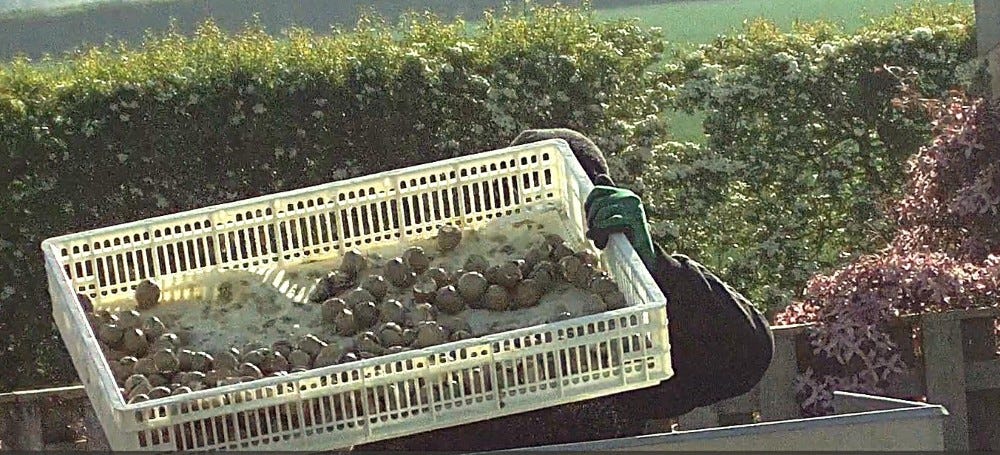
Typically, the shooting industry likes to disguise the actions they know the public will be incensed by with softer words: ‘processing’, ‘dispatch’, ‘culling’, and the like.
But strip away the euphemisms and what remains is a machine being used to kill live animals at industrial speed within days of hatching, simply because those animals were worthless to the business that bred them.
Maceration might sound like some sort of fringe practice dreamt up by rogue operators, or a historical anomaly. Far from it. It is current, and it is written into UK law.
The Welfare of Animals at the Time of Killing (England) Regulations 2015 (WATOK 2015) - which sounds like so much of the oxymoronic legislation that benefits the shooting industry - explicitly permits maceration, gas killing, or cervical dislocation as lawful ways to kill chicks under 72 hours old. In typically cold, remote words, it states that “The killing of surplus chicks…in hatchery waste must be as rapid as possible.”
It’s also worth knowing that under UK law (and this advice was last updated in March 2026), a staff member working on a farm does not need a WATOK licence “to kill surplus chicks or embryos in hatchery waste” - in other words, the specific licences required to carry out animal slaughter under WATOK 2015 are not required if you’re a temporary or casual worker being employed on a ‘game farm’ for the summer and part of your role is going to be dumping live chicks into a machine that grinds them up. In-house training is all you need…
At this point, it’s a fair question to ask how on earth a ‘game farm’ trains someone to work on the macerator anyway. Practice? Repetition? Just pick the person who doesn’t mind throwing helpless birds into a meat grinder? There really is no answer that reflects well on the industry or the people involved.
Shooting industry bodies will tell you maceration is ‘humane’ - ie ‘showing kindness, care, and sympathy toward people or animals’. Their loose interpretation of ‘humane’ totally ignores the fear and stress of the conveyor belt and the sorting facility, but it is used because (the industry will tell you) death is instantaneous.
That claim rests entirely on the operator being properly trained, and the system functioning as intended, every time, on every bird, without exception.
That’s the sort of ‘quality assurance guarantee’ that industrial-scale processing rarely earns. It is the sort of ‘quality assurance guarantee’ that unlawfully leaves a chick to die in a trailer full of broken eggshells, after all.
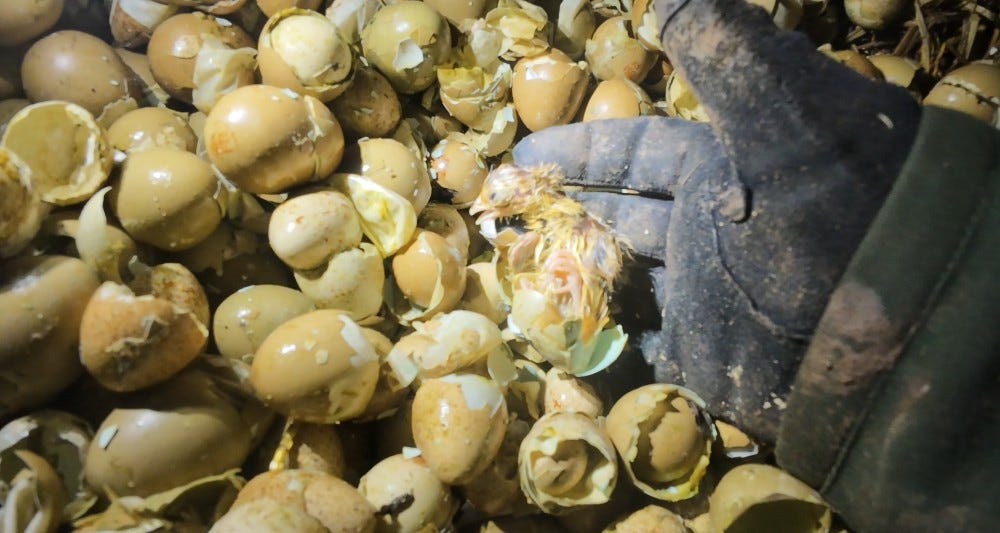
Forget any noble concepts like ‘humane’ or ‘welfare’. This industry is not organised around the wellbeing of the birds it breeds. It is organised around egg output. Killing day-old chicks is where that logic leads. Maceration is a cost calculation, made by an industry whose business model depends on maximising eggs and minimising anything that doesn’t produce them.
It is simply cheaper to destroy ‘unwanted’ chicks than integrate them into the system.
The truth is that the chicks going into the macerator were never seen as animals to be cared for. They were a byproduct to be disposed of by whoever is at hand on the day.
Video and images recorded by an undercover investigative team in 2025.
We are working to END BIRD SHOOTING. This suffering has to stop. Please share this article. Share our socials. Follow us for updates.
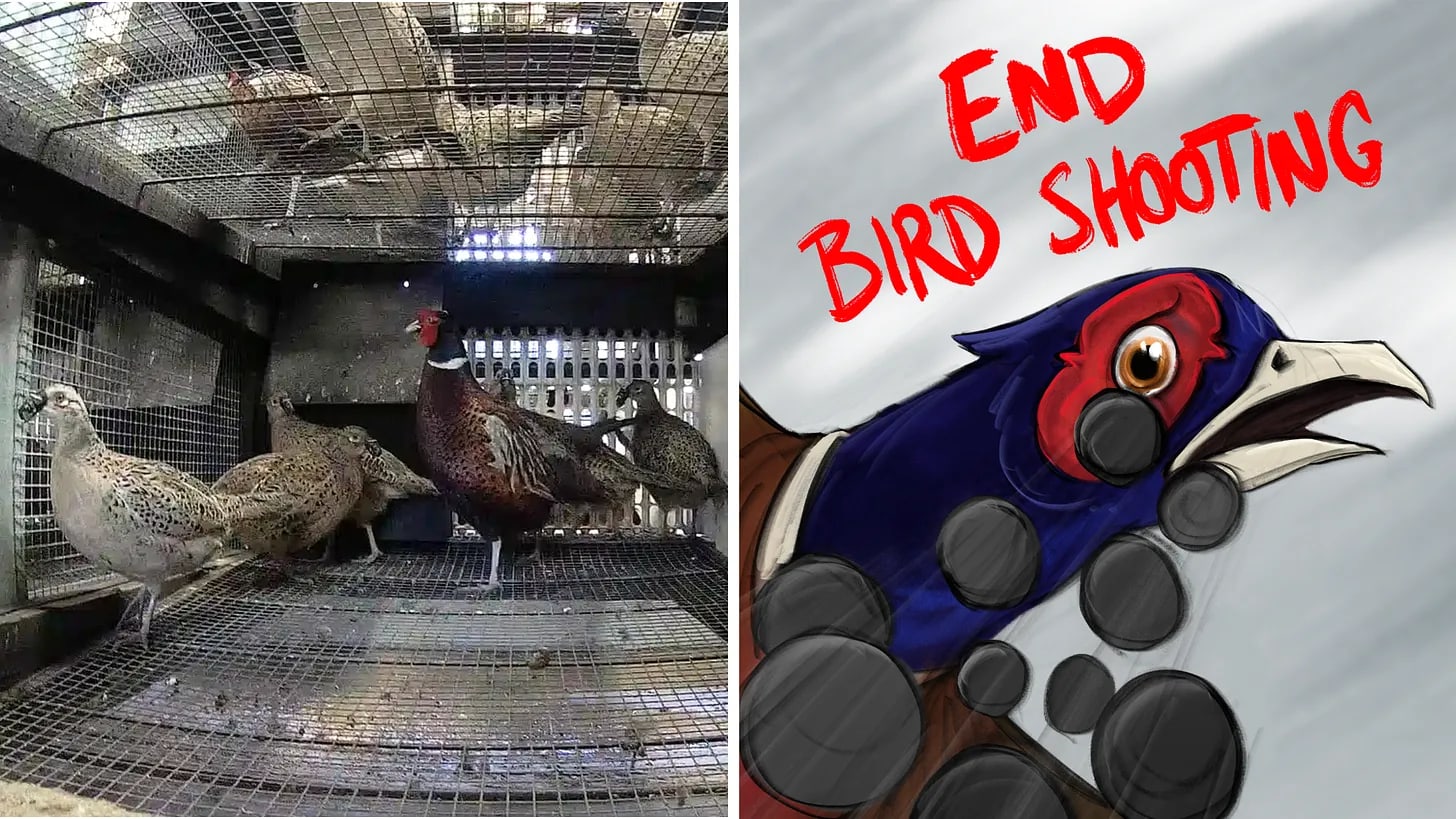
Over the coming months our campaign will look at the shooting industry at every level. We will highlight the suppliers — the farms, hatcheries, importers and breeders producing tens of millions of birds under conditions that would provoke public outcry if applied to any other animal. We will expose the providers — the estates and syndicates that take those factory-farmed birds and sell the experience of killing them as leisure. And we will look at the clients — the paying guns who are fully aware of the wildlife crime, the trapping of native predators, and the mass suffering involved, and who have decided that none of it is reason enough to stay away.
This industry survives because suppliers supply, providers provide, and clients pay. We intend to examine them all.
We are at the beginning of something. Months of undercover work. Hundreds of hours of footage. Farms across the UK exposed. But we are only just getting started.
Many of you have already become a Game Changer, standing with us as we take this fight forward, week by week, piece by piece, until the public, the media and the politicians can no longer look away. We are extremely grateful
We are reaching a larger audience all the time, though, many of whom won’t know that Game Changers help us fund investigations, take on staff, and make us more effective. So we are going to repeat the call here - this is just the beginning, please be a part of it.
Comments
Nothing yet. Say the first thing.
Sign in to join the conversation.