
THE SPY ANALYST BRIEFING
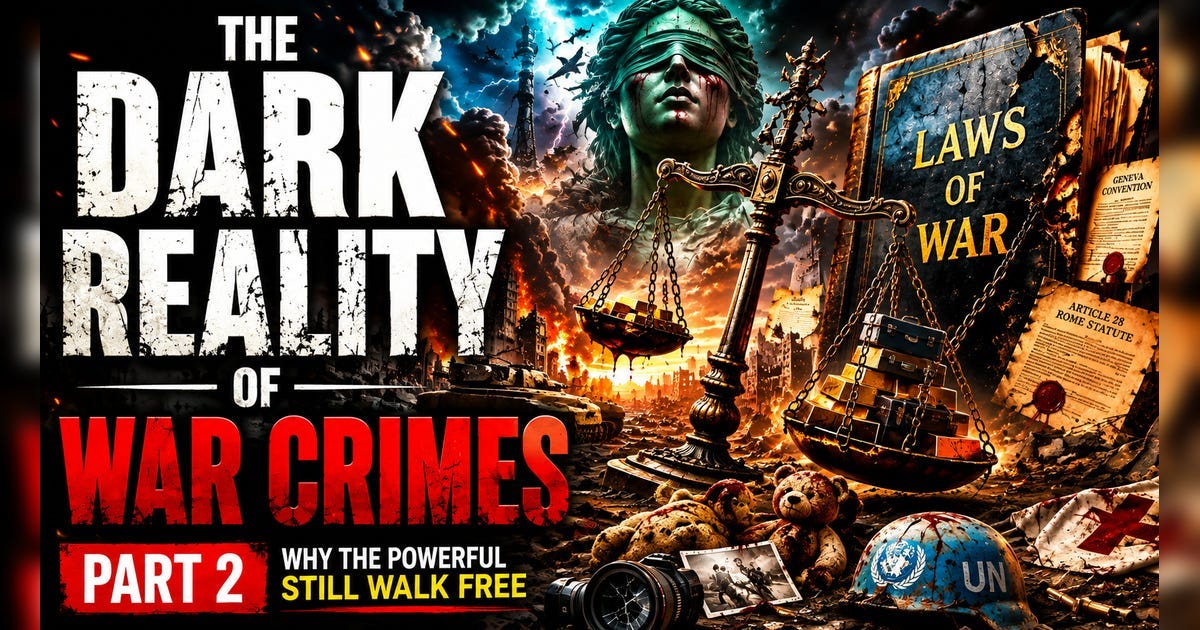
Inside the Secret History of War Crimes—and Why the Powerful Still Walk Free
By The Spy Analyst · Regular Contributor
Presented in collaboration with The Empathic Revolutionary
Legal proceedings and current-conflict figures in this article are updated through July 2026.
Every war claims to have a conscience.
A code. A limit. A line that even soldiers agree not to cross.
The weapons change. The uniforms change. The propaganda becomes faster, sharper, and more sophisticated. But the fundamental question has remained the same for centuries:
What is one human being allowed to do to another in the name of war?
And beneath that legal question sits an even more important moral one:
What should one human being ever be willing to do to another—law or no law?
The world has spent more than 550 years trying to answer the first question. It has held trials, written military codes, negotiated treaties, built tribunals, and created an international court.
The result is the most detailed rulebook war has ever known.
Civilians cannot be deliberately targeted. Prisoners cannot be tortured or executed. Starvation cannot be used as a method of warfare. Hospitals, humanitarian workers, and cultural property are protected. Commanders can be held responsible for crimes committed by the forces under their control.
The rules exist.
The problem is what happens when the accused is powerful enough to ignore them.
But there is another problem too: the law is not the outer boundary of human conscience.
Something does not become right simply because a treaty has not prohibited it yet. It does not become moral because a court lacks jurisdiction, because investigators cannot prove intent, or because political power prevents prosecution.
The law tells us what the existing system may be capable of punishing.
It does not get the final word on what humanity should accept.
This is the second and final part of our investigation into the dark reality of war crimes. Part One examined what war crimes are and how they are identified. This briefing follows the paper trail from a nearly forgotten trial in 1474 to the international courts, arrest warrants, and battlefields of today.
The history reveals something uncomfortable: humanity’s failure was never simply a failure to write laws.
It was—and remains—a failure to enforce them consistently, and a willingness to hide moral cowardice behind legal language whenever power demands it.
Before we begin, four legal concepts will make the history easier to understand.
Command responsibility means that commanders and civilian superiors may be held responsible for crimes committed by people under their authority when they knew, or should have known, what was happening and failed to prevent or punish it.
Distinction requires parties to distinguish between military targets and civilians or civilian objects.
Proportionality prohibits an attack when the expected civilian harm would be excessive in relation to the concrete and direct military advantage anticipated.
Forcible transfer generally means compelling civilians to leave their homes without legitimate justification. International law recognizes narrow exceptions for civilian safety or imperative military reasons, but those exceptions cannot become a blank check for emptying communities and making displacement permanent.
Keep those principles close. They appear again and again because the names and flags may change, but the underlying questions do not.
And remember: these terms describe the minimum standards governments have managed to place on paper.
They are a legal floor.
They are not the ceiling of human morality.
Long before “war crime” existed as a formal legal category, a military governor named Peter von Hagenbach was placed on trial.
Hagenbach governed territories in the Upper Rhine on behalf of Charles the Bold, Duke of Burgundy. He was accused of allowing murder, rape, unlawful taxation, and other abuses against civilians under his authority.
In 1474, an ad hoc tribunal composed of judges representing different political entities convicted and executed him.
The proceeding did not operate under modern definitions or protections. But it is remembered as an early attempt to establish a revolutionary idea:
A commander could be answerable for atrocities committed under his rule.
Think about how radical that was in the fifteenth century.
Hagenbach was not being judged simply because he had lost a battle. The proceeding asked whether authority carried responsibility—and whether obedience to a powerful superior could excuse cruelty inflicted on civilians.
The law would spend centuries developing the answer.
Being the boss does not create innocence. When someone has the authority to prevent atrocities and chooses silence, that silence is not neutrality.
It is a decision.
One trial. Five centuries of consequence.
In the seventeenth century, Dutch jurist Hugo Grotius helped build the intellectual foundations of international law.
His work was part of a broader effort to establish that war was not a moral void. Prisoners, civilians, and people who had surrendered remained human beings with protections that did not depend entirely on the generosity of a king.
The principle is simple enough to understand without a law degree.
A person may be fighting you one moment. But when that person drops a weapon, becomes wounded, or surrenders into your control, the relationship changes.
They are no longer an active threat.
If you torture or execute them after that moment, you cannot cleanse the act by calling it war.
That is murder wearing a military uniform.
By the nineteenth century, moral philosophy was becoming written military law.
During the American Civil War, the Lieber Code established rules for Union forces governing military necessity, prisoners, torture, and the treatment of civilians. It was not a universal treaty, and it reflected the limitations of its era, but it became an important step in codifying the conduct of war.
The Hague Conventions later brought states together to negotiate rules governing weapons, military occupation, combat, and the treatment of people affected by war.
But the system contained a fatal weakness.
The states writing the rules were often the same states expected to investigate, judge, and restrain themselves.
There was no permanent international criminal court. Enforcement depended on governments, military authorities, and the political settlements imposed after the fighting ended.
The rules existed.
The power to enforce them did not.
In 1859, Swiss businessman Henry Dunant witnessed the aftermath of the Battle of Solferino.
Tens of thousands of soldiers were dead, wounded, or missing. Many of the wounded had been abandoned without adequate medical treatment, water, or shelter.
Dunant was not a general. He was not a judge. He did not command an army or represent a government.
He was a witness who refused to treat what he saw as normal.
His account, A Memory of Solferino, helped inspire the organization that became the International Committee of the Red Cross. It also helped produce the first Geneva Convention in 1864, which required armies to care for wounded soldiers regardless of which side they served.
That convention did not end battlefield cruelty. But it established a principle that would become central to humanitarian law:
A wounded enemy is still a human being.
After the Second World War, states adopted the four Geneva Conventions of 1949. They protect wounded and sick troops on land, wounded and shipwrecked forces at sea, prisoners of war, and civilians under enemy control. Common Article 3 also established minimum protections in conflicts not fought between states.
The conventions and their later protocols form the foundation of the modern law of armed conflict.
One man’s refusal to look away did not solve war.
It helped change the legal treatment of millions of people caught inside it.
Never underestimate what begins when one witness refuses to accept that suffering is normal.
After the devastation of the First World War, the Treaty of Versailles proposed prosecuting individuals accused of violating the laws and customs of war.
On paper, this looked like a turning point. The world had witnessed chemical weapons, industrialized killing, and suffering on a scale few had imagined possible. Accountability appeared to be the logical next step.
In practice, enforcement was weak. Political negotiations overtook legal ambitions. Many proposed trials never occurred, and the proceedings that did take place produced limited results.
The pattern was already visible:
Write the law loudly. Enforce it cautiously. Negotiate exceptions when power demands them.
A law without enforcement risks becoming little more than a statement of aspiration.
The consequences of that failure would become clear within a generation.
After the Second World War and the Holocaust, the Allied powers created tribunals at Nuremberg and Tokyo.
Senior officials were prosecuted for crimes against peace, war crimes, and crimes against humanity.
The tribunals established principles that permanently changed international law. But before treating Nuremberg as a clean victory of justice over evil, we must confront the contradiction built into it.
The victors created the courtroom.
The victors chose the defendants.
And the conduct of the victors was not placed in the same dock.
In August 1945, the United States dropped atomic bombs on Hiroshima and Nagasaki.
Ask yourself honestly:
Were these attacks only against military forces—or were they attacks against entire cities?
The people beneath those explosions were not simply units on a battlefield. They were shopkeepers, schoolchildren, patients, grandparents, laborers, mothers, and infants. Entire neighborhoods were erased in seconds. Survivors continued dying from burns, injuries, and radiation long after the initial flash disappeared.
By the end of 1945, an estimated 100,000 to 140,000 people had died in Hiroshima and another 60,000 to 70,000 in Nagasaki. Many were civilians. The effects continued taking lives for years. The ICRC documents the human consequences here.
Defenders of the bombings argue that they forced Japan’s surrender and prevented an invasion that might have killed even more people.
That argument remains part of the historical debate.
But the existence of a strategic argument does not dissolve the moral question.
If leaders can justify the mass slaughter of civilians by invoking some greater future danger, then there is no limit at all. How many children must be burned alive before “national security” is recognized as the justification used to legitimize atrocity?
The law may debate jurisdiction, precedent, proportionality, or which rules applied in 1945.
The human conscience faces a simpler image:
A city full of people disappeared beneath a weapon no human being could control once it was released.
In March 2026, that history returned to the room in a startling way.
While sitting beside Japanese Prime Minister Sanae Takaichi, Donald Trump was asked why the United States had not warned its allies before attacking Iran. He defended the importance of surprise and responded:
“Who knows better about surprise than Japan? Why didn’t you tell me about Pearl Harbor?”
Trump did not explicitly mention Hiroshima or Nagasaki. But once Pearl Harbor is invoked as political currency in defense of another surprise attack, the moral chain becomes impossible to ignore. Reuters documented the exchange.
Pearl Harbor becomes the answer to Iran.
Pearl Harbor becomes the historical wound still available for use eighty-five years later.
And hovering behind it are Hiroshima and Nagasaki—the ultimate warning about what happens when nations allow one act of violence to become the moral permission slip for the next.
If “they surprised us first” or “they struck first” becomes enough to justify whatever follows, then every atrocity can be presented as a response.
There will always be an earlier attack.
There will always be an older grievance.
There will always be another grave to point toward.
That is how violence escapes judgment: not by denying what happened, but by insisting that someone else started the chain.
No law should be allowed to make that morally acceptable.
One of Nuremberg’s most important principles concerned superior orders.
A soldier or official could no longer assume that “I was following orders” automatically erased personal responsibility. Nuremberg Principle IV held that acting under government or superior orders does not relieve responsibility when a genuine moral choice was possible.
Coercion, knowledge, intent, and the ability to refuse can matter legally. But the moral center is clearer:
A uniform does not turn a human being into a machine.
An order does not transform murder into something righteous.
Obedience was never innocence. It was always a choice wearing a uniform.
Nuremberg proved that senior officials could be prosecuted—but largely after their government had been defeated and the victors had taken control.
The law could now be enforced.
The powerful still determined who would be held accountable.
Modern humanitarian law does not prohibit war itself. It regulates how parties conduct it.
The rules prohibit direct attacks on civilians, hostage-taking, torture, rape, intentionally starving civilians, and attacking people who are wounded, detained, or otherwise no longer participating in combat.
Hospitals, medical workers, schools, religious buildings, humanitarian operations, and cultural property receive protection.
The law also contains exceptions and thresholds. A civilian building may lose protection if it is used for military operations. Even then, attackers remain bound by distinction, proportionality, and precautions.
Those distinctions matter when determining individual criminal responsibility.
But legality and morality are not identical.
A government may find a lawyer willing to argue that a building had military value. A commander may calculate that expected civilian deaths were not legally “excessive.” A court may conclude that prosecutors failed to prove intent beyond the required threshold.
None of those outcomes requires the public to call the underlying suffering acceptable.
Legal systems must draw technical lines because courts impose criminal punishment. Human beings are still entitled to ask whether an action was cruel, reckless, unnecessary, or morally indefensible—even when a prosecutor cannot convert that judgment into a conviction.
The law is necessary because power must have limits.
The law is insufficient because power also shapes the limits the law is willing to recognize.
We should understand the technical rules.
We should never hide behind them.
The International Criminal Court was established to prosecute individuals accused of genocide, crimes against humanity, war crimes, and aggression.
For the first time, humanity had a permanent international criminal court rather than one created only after a particular conflict.
But the ICC was born with a critical limitation:
It has no police force.
The court can investigate, issue warrants, conduct trials, and impose sentences. It cannot independently enter a country and make an arrest. It relies on states to surrender suspects.
Some of the world’s most powerful countries—including the United States, Russia, and China—are not parties to the Rome Statute. Other governments defend the court when it investigates their enemies and attack its legitimacy when investigations reach their allies.
The architecture of justice exists.
Its reach still depends on political will.
That contradiction became impossible to ignore on November 21, 2024, when the ICC issued arrest warrants for Israeli Prime Minister Benjamin Netanyahu and former Defense Minister Yoav Gallant.
The judges found reasonable grounds to believe they bore criminal responsibility for alleged crimes including starvation as a method of warfare and the crimes against humanity of murder, persecution, and other inhumane acts. The chamber also cited alleged responsibility for intentionally directing attacks against civilians.
An arrest warrant is not a conviction. That distinction should be stated accurately.
But accuracy cuts both ways.
The warrants are not meaningless political statements to be discarded whenever they become inconvenient. They are judicial orders issued after judges reviewed evidence submitted by the prosecution. The ICC’s official announcement explains the findings.
The test of the international system is not whether it can produce another document.
It is whether powerful governments will honor that document when enforcement threatens a political ally.
If warrants bind only the isolated and defeated, the court is not administering equal justice.
It is documenting the hierarchy of power.
The attacks committed by Hamas and other Palestinian armed groups on October 7, 2023, included deliberate attacks against civilians and hostage-taking. These acts violated international law and demand accountability.
Nothing that followed can erase those crimes.
But those crimes cannot erase the humanity or legal protections of Palestinian civilians.
This is one of the most important principles in the entire law of war: a crime committed by one party does not give another party permission to retaliate without limits.
Collective punishment is not justice.
Revenge is not self-defense.
“They struck first” cannot become a moral blank check.
If it could, there would be no such thing as a war crime. Every atrocity in history could be defended as a response to an earlier atrocity.
International law was built to close that door.
Human conscience should have closed it long before.
In August 2025, the Integrated Food Security Phase Classification confirmed famine in Gaza Governorate. Its assessment described catastrophic conditions involving starvation, destitution, acute malnutrition, and death.
The IPC assessment is available here.
Food, water, medicine, farmland, fishing access, humanitarian deliveries, and civilian infrastructure are not secondary details.
They are the architecture of survival.
A population does not need to be killed only by missiles. It can be destroyed slowly through hunger, dehydration, untreated illness, displacement, and the collapse of everything required to sustain life.
Sometimes the deadliest weapon is not the one that explodes.
It is the gate that never opens.
In September 2025, the Independent International Commission of Inquiry established by the UN Human Rights Council concluded that Israeli authorities and security forces had committed genocide against Palestinians in Gaza. Israel rejected the commission’s finding.
The commission’s report can be read here.
This was the conclusion of an official investigative body. The separate case brought by South Africa before the International Court of Justice has not yet reached a final judgment on the merits.
The ICJ’s procedural record is here.
That distinction identifies which institution made the finding.
It does not erase what the commission found.
Genocide requires specific intent to destroy, in whole or in part, a protected group. That is a demanding legal standard.
But demanding proof must never become a ritual through which the world watches destruction accumulate forever while insisting it is still too early to speak.
There is a point where caution becomes avoidance.
There is a point where procedural language stops protecting truth and begins protecting power.
And there is a point where the world must look at starvation, mass displacement, ruined hospitals, dead children, and a society stripped of the physical conditions required to survive—and decide whether its moral vocabulary has become too frightened to describe what it sees.
In Ukraine, the flags and alliances are different.
The principles are not.
A June 2026 report from the UN Human Rights Monitoring Mission documented systematic and repeated Russian attacks on Ukrainian electricity and heating infrastructure during the 2025–2026 winter.
The attacks produced widespread power cuts and left hundreds of thousands of civilians without heat and hot water while temperatures fell below minus 20 degrees Celsius.
The mission concluded that the attacks appeared to violate fundamental principles of international humanitarian law governing hostilities.
Its findings also documented the execution of at least 16 captured Ukrainian prisoners of war between mid-November 2025 and January 2026. Nearly all released Ukrainian prisoners interviewed by the mission described torture or other ill-treatment in Russian captivity.
The same report recorded allegations of torture or ill-treatment of Russian prisoners during the initial stages of Ukrainian captivity. That finding cannot be discarded simply because it complicates the preferred narrative of one side.
Consistency is the entire point.
If torture is a crime when an enemy commits it, it remains a crime when an ally commits it.
If attacks on essential civilian infrastructure are condemned in one country, the same moral outrage must exist in another.
If prisoners deserve protection under one flag, they deserve it under every flag.
The law does not ask whom you support before deciding whether a prisoner can be tortured.
Neither should your conscience.
The UN report shows what accountability often looks like while war continues: investigators interview survivors, verify deaths, document attacks, compare evidence, and preserve a record for proceedings that may take years.
The complete monitoring report is available here.
Documentation is not justice.
But without documentation, the powerful get to rewrite the crime after the witnesses are gone.
War does not destroy only bodies and buildings.
It destroys memory.
Cultural property—historic monuments, museums, religious sites, manuscripts, archaeological sites, and works of art—carries the identity of people who lived before us and the inheritance of people not yet born.
In March 2026, UNESCO reported that the Golestan Palace in Tehran, a World Heritage site, had been damaged by debris and the shock wave following an airstrike near Arag Square, inside the site’s buffer zone.
UNESCO reiterated that cultural property is protected under international law and said it had communicated the coordinates of significant sites to the relevant parties. UNESCO’s statement is available here.
The available report does not establish that the palace itself was deliberately selected as the target.
But that does not make the damage morally insignificant.
A civilization’s memory should not become acceptable debris simply because a strike was aimed somewhere nearby. “It was not the intended target” may matter in a courtroom. It does not restore shattered glass, damaged mirrorwork, destroyed manuscripts, or the history carried inside them.
Military campaigns ask civilians to accept too much as incidental.
Homes become incidental.
Hospitals become incidental.
Children become incidental.
History itself becomes incidental.
The law may decide whether a particular incident can be prosecuted.
Humanity must decide how much irreversible destruction it is willing to normalize before the law catches up.
Environmental destruction is one of war’s quietest legacies.
A refinery burns for days. Smoke enters the atmosphere. Chemicals contaminate soil and water. Agricultural land becomes unusable. Civilians continue suffering long after the governments responsible declare the operation finished.
The term ecocide is increasingly used to describe severe and deliberate environmental destruction.
Ecocide is not currently a separate offense listed in the Rome Statute. The statute does recognize certain environmental attacks as war crimes in international armed conflict when the expected damage is widespread, long-term, severe, and clearly excessive compared with the anticipated military advantage.
That is a demanding legal threshold.
But the absence of a standalone offense does not make the destruction right.
Law often arrives after the wound.
For centuries, slavery was legal. Colonial plunder was legal. Women could be treated as property under legal systems written by men. Entire peoples were displaced through documents bearing official seals.
Legality has never been a reliable synonym for morality.
When soil is poisoned, rivers are contaminated, farmland is destroyed, and future generations inherit disease from a war they did not fight, the moral reality does not depend on whether lawmakers have agreed to use the word ecocide.
A burned refinery may disappear from the news cycle within days.
Poisoned land can remain for generations.
The law’s delay does not make the damage less real.
It reveals how far the law still has to go.
Autonomous weapons present another challenge.
Weapons capable of selecting and engaging targets without further human intervention are already being developed and deployed. Artificial intelligence is also being incorporated into surveillance, targeting recommendations, and military decision-support systems.
There is not yet a universal treaty categorically prohibiting all autonomous weapons.
That is a statement about the current law.
It is not a moral defense.
The absence of a prohibition does not mean humanity should accept machines making final decisions over who lives and who dies. It may simply mean technology has moved faster than the conscience—or courage—of the institutions meant to regulate it.
Existing humanitarian law still applies. Commanders and operators cannot transfer legal responsibility to an algorithm. The International Committee of the Red Cross has called for binding rules prohibiting unpredictable autonomous weapons and systems designed or used to target human beings directly. Its position is explained here.
But the moral question comes first:
Should any machine be given the authority to identify a human being, classify that person as a target, and end that life without a conscious human decision at the final moment?
Our answer should not depend on whether diplomats have completed a treaty.
The danger is not only that machines will make mistakes.
Human beings will use machines to create distance from decisions they no longer want to feel responsible for.
The language will sound clean: algorithmic recommendation, target profile, automated assessment, confidence threshold.
The result will still be a human body.
Technology does not erase responsibility.
It gives responsibility somewhere new to hide.
After more than five centuries, the pattern is impossible to ignore.
The law is strongest when governments cooperate, evidence survives, suspects can be arrested, and political alliances do not obstruct proceedings.
It becomes weakest precisely where it is needed most: when the accused controls territory, commands armed forces, possesses powerful allies, or can punish the institutions that challenge them.
This does not mean international law has achieved nothing.
The Geneva Conventions have protected lives. Tribunals for the former Yugoslavia and Rwanda convicted senior perpetrators. National courts have prosecuted international crimes. The ICC has created consequences that would once have been unthinkable.
The rulebook matters.
But the enforcement gap is real—and the most powerful nations routinely live inside it.
They invoke international law against enemies and discover its “complexities” when an ally is accused.
They demand investigations of rival governments and condemn investigations that reach their own leaders.
They speak of civilian protection while supplying the weapons that make civilian survival impossible.
Sometimes the language of protection becomes camouflage for the very conduct it claims to oppose.
That hypocrisy is not an accidental flaw around the edges of the system.
It is one of the system’s defining features.
No war is ever holy.
Not the wars fought within the rules. Not the wars fought outside them. Not the wars wrapped in religion, civilization, democracy, security, resistance, or national survival.
War can defeat an army. It can destroy a government. It can force a surrender.
But war itself does not create peace.
It creates the silence in which peace must somehow be rebuilt—after families, cities, futures, and trust have already been destroyed.
And we, the global audience… Watch.
We sit in front of televisions and phone screens. We drink coffee. We scroll between footage of rubble, advertisements, political arguments, and children’s graves.
The image disappears.
Our day continues.
For the people inside that image, it does not.
Before choosing a side in any conflict, ask yourself one simple and deeply uncomfortable question:
Who is actually suffering? And what, specifically, did they do to deserve it?
It is easy to surrender to despair and surrender, with it, the responsibility to resist.
What can one reader do against armies, governments, intelligence services, and global institutions?
One person cannot enforce an international warrant. One social-media post will not stop a bombing campaign. Sharing an article will not suddenly open a border crossing.
But that does not make public attention meaningless.
Power depends on language.
A massacre becomes a “security operation.”
Starvation becomes a “humanitarian situation.”
Forced displacement becomes “population movement.”
A destroyed neighborhood becomes a “target area.”
A dead family becomes “collateral damage.”
The first act of resistance is refusing to let language erase the human beings underneath it.
Call a massacre a massacre.
Call starvation starvation.
Call injustice injustice.
Describe allegations honestly. Identify findings accurately. Demand evidence—but never use the demand for evidence as an excuse to ignore what has already been documented in front of the entire world.
Apply the same standards to allies and enemies.
Do not condemn civilian deaths only when the perpetrator carries the wrong flag. Do not excuse torture because the victim belongs to the wrong side. Do not treat one group’s children as innocent and another group’s children as strategically unfortunate.
Support credible humanitarian and accountability organizations. Ask elected officials whether they support investigations when those investigations involve political allies—not only adversaries.
And when you vote, ask what your vote is helping governments do in your name.
Language cannot bring the dead back.
But language determines whether the living understand what happened—and whether the same machinery will be allowed to operate again.
Precision matters.
But precision is not the same as emotional distance.
War crimes are never justifiable — not by any cause, not by any ideology, not by any flag, not by any history of grievance on either side.
Recognize them for exactly what they are. Name them precisely, without euphemism. And stand against them — loudly, consistently, and without selective outrage.
Trace the history from 1474 to today and the pattern becomes clear.
An early tribunal asks whether a commander can be responsible for crimes committed under his authority.
Grotius and other thinkers argue that war does not erase the humanity of prisoners and civilians.
The Lieber Code and Hague Conventions turn moral principles into written rules.
Henry Dunant witnesses Solferino and refuses to accept abandoned suffering as normal.
Versailles demonstrates that ambitious laws mean little without political will.
Nuremberg establishes that superior orders do not automatically eliminate personal responsibility—while exposing how rarely the conduct of victors enters the same courtroom.
The atomic bombings of Hiroshima and Nagasaki force humanity to confront what happens when strategic reasoning is permitted to swallow entire cities.
The four Geneva Conventions create a detailed framework protecting people who are not—or are no longer—taking part in combat.
International tribunals prove that senior perpetrators can sometimes be prosecuted.
The ICC creates a permanent court capable of issuing warrants for leaders who once appeared untouchable.
And still, the same flaw returns.
A court can issue a warrant. It cannot force every government to honor it.
An investigator can document a crime. Documentation cannot guarantee prosecution.
A treaty can define a legal obligation. It cannot make a powerful state apply that obligation consistently.
And an action can remain morally indefensible even when no court is prepared—or empowered—to punish it.
The missing ingredient was never simply another law.
It was the courage to apply the law already written—and the conscience to recognize wrong even when the law remains silent.
That is the true lesson of the rulebook nobody follows.
International law is enforced against the weak and negotiated around the powerful. This is not an occasional breakdown. It is the system operating according to power. States with enough military, economic, and political leverage can violate treaties, obstruct investigations, shield allies, ignore rulings, and still present themselves as guardians of a “rules-based order.”
Rules that bind only the weak formalize hierarchy.
Either the rules bind the states strong enough to defy them, or they bind no one at all.
Humanity must never surrender its moral judgment to the limits of what governments recognize, courts can punish, or institutions find convenient to condemn.
Empathic Philosophy is an independent inquiry into human existence, consciousness, social life, power, institutions, legitimacy, social order, collective behavior, civilization, and the conditions under which fundamental transformation becomes possible.
Human beings do not exist to serve systems. Systems exist to serve human beings.
About The Empathic Revolutionary
The Spy Analyst investigates the power structures, intelligence operations, propaganda, and geopolitical interests hidden beneath current events.
Subscribe to The Spy Analyst to receive every new investigation directly in your inbox. Subscribers can also join The Spy Analyst’s private chat through Substack on the web or in the app.
This supporter-only investigation follows the evidence behind alleged efforts to obstruct international accountability—from recorded conversations and bipartisan political pressure to the ICC warrants, the prosecutor’s removal, and the US laws protecting powerful officials.
It will examine:
The recorded Netanyahu–Graham conversation
The effort to place “the cloud” of misconduct allegations over the ICC prosecutor
The senators recruited to pressure the court
The bipartisan letter and its timing
The ICC allegations of starvation as warfare, murder, and persecution
The prosecutor’s removal
H.R. 23 and the American Service-Members’ Protection Act
The UN Commission of Inquiry’s genocide finding
This is not another collection of headlines. It is the evidence trail explaining how accountability is obstructed when it reaches the powerful.
The Spy Analyst is sustained by readers—not advertisers, political institutions, or corporate sponsors.
A contribution of $5 or more unlocks:
The Smoking Gun Exposé when released
All current supporter-only investigations
Future supporter-only content
Complete premium briefings
No recurring charges
Make a one-time contribution
Explore premium investigations
Choose the membership track that best matches your interests:
🕵️ Spy in Plain Sight — $3: Learn the analytical framework of an intelligence operative.
🇮🇳 India in Plain Sight — $5: Structural analysis of Indian national security, politics, and India’s place in the geopolitical order.
🌍 Geopolitics in Plain Sight — $7: Briefings on great-power conflict and the deeper structures of global power.
🔴 The Spy Analyst Deep State — $12: Every tier, the complete archive, Early Warning Signals, and the most advanced premium investigations.
A limited-time 50% founding-member discount is available on the membership page. See the page for current rates and terms. Cancel at any time.
The Spy Analyst’s paid memberships are handled through Buy Me a Coffee rather than Substack. Readers in India can also contribute through UPI.
🇮🇳 UPI in India:
devjariwala139@oksbi🌍 Card, Apple Pay, or Google Pay: Buy Me a Coffee
Larger contributions of $200 or more: Contact thespyanalyst@gmail.com for appropriate local bank-transfer details.
Every contribution helps fund independent research into geopolitical conflicts, intelligence operations, propaganda, covert power, and the money connecting them.
The Spy Analyst is an independent intelligence publication examining geopolitical conflict, propaganda, covert power, and the institutions shaping current events.
Its work goes beyond headlines and official narratives to reveal who benefits, how power operates, and what may come next.
The global order is being rewritten in real time. Most people are reading the press release. We are reading the blueprint.
Comments
Nothing yet. Say the first thing.
Sign in to join the conversation.