
We divide the world into good people and bad people as though moral character were a fixed identity. Character is formed and revealed by how we act under pressure. When uncertainty and fear make integrity costly, our choices expose what we truly serve.
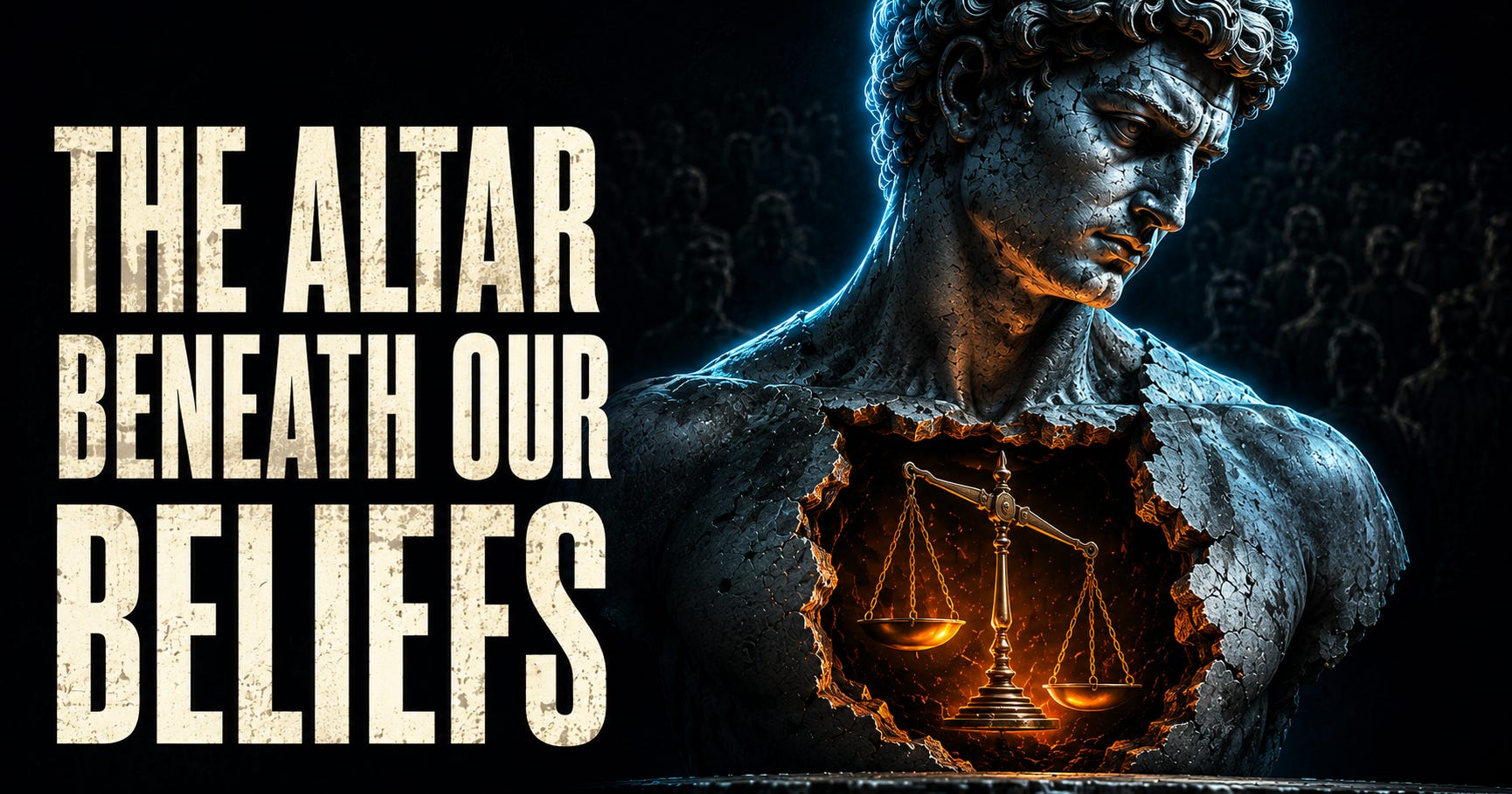
Everybody worships something, including those who are not religious. Worship is whatever occupies the center of a life: a higher power, a nation, a family, success, safety, the approval of peers. We keep hidden altars where we place our love, fear, and hope. We may not notice which one governs us until two loyalties come into conflict.
Uncertainty exposes the difference. When events resist our expectations, when we cannot tell who is right or what comes next, discomfort presses us to react. A person devoted to control may meet chaos with anger or denial. Someone who depends on recognition may reject a truth that threatens their image. We rush to judgment and seize the first confident answer, turning people into villains or heroes to escape the anxiety of not knowing. Or we withdraw and wait for someone else to decide. Stated convictions are easy to maintain when circumstances are clear. Uncertainty shows what remains when clarity is gone.
So what do we actually put first? When we say we live for freedom, equality, family, or faith, do our choices honor that ideal, or do we discard it when it becomes costly? If our real loyalty belongs to comfort, ideology, or the need to be right, then we must either continue in that direction or change it.
Consider a small, unwitnessed test. A cashier hands you too much change. No one appears to be watching. You can pocket it and keep walking. What you do in that pause is not settled by the values you would recite if asked. It is settled by the value that wins when honesty costs you something. Choices like this prepare us for larger ones.
Changing direction is hard because violating our own standards hurts. Psychologists call the strain created by conflict among our actions, beliefs, and self-understanding cognitive dissonance. Imagine someone who prides themselves on honesty but finds their job pressuring them to lie, or a citizen committed to justice who confronts evidence that their own side has acted unjustly. The facts threaten the person they believe themselves to be. They can bring their conduct closer to their values, or bend their account of reality to protect their self-image.
Bending reality is easier. We select the evidence that favors our side and ignore the rest. Confirmation bias lets us feel right without changing. It also prevents us from seeing what our conduct has become. The alternative is to remain uncertain long enough to consider that we may be wrong, or that the world is more complicated than we assumed. Until our values survive that discomfort, they are professions rather than commitments.
Goodness is not a fixed trait. It is a continuing practice, enacted choice after choice. Every day presents small crossroads. In conversation, at work, at home, and in the information we pass along, we move toward what we believe is right or toward what is easier, more selfish, or more harmful.
We prefer to think of identity as solid: *I am a good person. I am compassionate.* But character is formed by conduct. No past failure condemns us forever if we change direction, and no past goodness excuses what we do next. Someone with a history of selfishness can act selflessly today. Someone with a history of courage can choose cowardice. One act does not contain an entire life, but it belongs to the life being made.
We cannot control everything that happens to us. We remain responsible for our response within the limits imposed on us. Even under pressure or ambiguity, we are deciding what kind of person to become. In a crisis, the decision to help or turn away, to speak or remain silent, may come in an instant. That instant draws on countless earlier choices. Character is not the identity we claim. It is the pattern our decisions create.
The same point exposes the fantasy that an outside force will repair the moral world while we remain unchanged. We tell ourselves that a great leader, a movement, or a technological breakthrough will solve our problems. Waiting for external salvation becomes an excuse to neglect the choices that remain ours. No public figure can make those choices for us. Just laws also depend on people willing to uphold them. Moral change usually consists of ordinary people acting with integrity when doing so carries a cost. No one else can assume that responsibility for us.
Much of life lies beyond individual control. We are born into a world we did not choose. Political and economic structures, social pressures, accidents of birth and timing constrain what is possible. One person’s kindness will not end a war. One act of courage will not dismantle an unjust institution. Against forces of that scale, individual choice can seem irrelevant.
Fatalism turns constraint into total powerlessness. It also releases us from having to examine what we could have done. We inherit conditions we did not make, but those conditions do not dictate every response. Even under severe constraint, some room for action may remain: the journalist who tells the truth under censorship, the soldier who refuses to fire because conscience forbids it, the whistleblower who speaks despite the risk. None controls the entire system. Each answers for the part that passes through their hands.
This argument can be corrupted. “It all comes down to your choices” is often used by comfortable people to explain another person’s suffering: the poor should have chosen better; the trapped should have tried harder. That turns responsibility into blame and ignores the limits on another person’s agency. Responsibility concerns what someone could do within their actual circumstances, given the options genuinely available. It grows with freedom and power. Those with more room to choose bear more responsibility for what their choices produce.
For most of us, the present moment is where our influence lies. We may not control a company’s culture, but we can decide whether to add to its cruelty. We may not end online misinformation, but we can decide whether to share a rumor or examine it first. Each yes or no contributes something, however small, to the system around it. Calling ourselves helpless leaves whatever power we have unused. The past restricts the next move. It does not make it for us.
Conscience registers the distance between what we do and who we claim to be. Are we as kind as we say? As fair? As brave? The answer lies in what we do when one of those values costs us something. When we fall short, conscience reminds us that we knew another response was possible.
Admitting this is painful. It is easier to blame someone else or redescribe the act as justified. These defenses reduce guilt by distancing us from what happened. We become both defendant and lawyer, constructing an argument for our innocence. The excuse offers relief, but it also protects the conduct from correction.
”Everyone cheats a little.” The harsh words were for their own good.
Given the circumstances, “I had no choice.”
We can instead face the conflict without rushing to acquit ourselves. The feeling of hypocrisy may be accurate: in that instance, we betrayed our own standard. ”Perhaps I have not been as honest as I believed.” Moral change begins when that admission alters what we do. The decisive struggle often occurs in private, when no one else can challenge the story we tell ourselves. If we lie there, our public principles mean little.
The crowd offers another way to avoid judgment. We are social creatures, and uncertainty makes other people’s confidence attractive. A group that claims to know what is right, or a leader who promises clarity, can spare us the burden of deciding. We surrender our judgment and mistake the result for conviction.
It may begin with a community united behind a cause or citizens rallying around a confident leader in a crisis. Once conscience is surrendered, the crowd’s certainty becomes difficult to resist. *If everyone around me believes this, how could we all be wrong?* People then condone what they might have refused alone because exclusion feels more immediate than wrongdoing. Online, shared outrage draws thousands into attacking a stranger without pausing for empathy or evidence. In workplaces, one domineering personality sets the moral tone while others comply to avoid conflict. Under propaganda or cult leadership, the same impulse produces far worse results.
The longing for a savior—a strongman, an ideologue, even an algorithm said to have the answer to everything—often joins two desires: escape from uncertainty and escape from responsibility. Letting someone else decide what is true and who deserves blame provides immediate relief. The price is obedience. Communities, leaders, and faith can strengthen conscience, but an authority that treats doubt as betrayal is trying to replace it. When a movement forbids questions, we should examine what it is asking us to excuse. A crowd may speak with one voice, but no one’s responsibility disappears into it. Each person still has to answer the question: “Is this right?”
Societies face moral choices too. A nation, company, or community can act humanely or cruelly, and we often speak of the group as if it possessed a single mind: “They decided this. They failed at that.”
Collective action, however, emerges through many individual acts by leaders and citizens, managers and employees, voters and bystanders. Institutions have histories, incentives, and momentum, but people sustain or resist them. Collective responsibility reaches individual shoulders, though the burden is not equal.
Consider a policy that causes harm: a war conducted in our name, a law that separates families, an economy that leaves whole communities in despair. It is tempting to say, “I did not do that; the system did.” No individual controls the outcome. But participation raises questions that cannot be handed back to the system. What did we support? What did we tolerate after our conscience objected? When did we remain silent because speaking carried a cost? These questions do not make each person guilty of every wrong. They ask what part each person played. If we take pride in a nation that claims to stand for justice, we also bear some responsibility for confronting the distance between its claims and its conduct.
Our choices travel farther than we see. What we buy, share, vote for, and say about people we have never met enters the conditions of other lives. The clothes we purchase may support fair labor or concealed exploitation. The information we circulate may build understanding or deepen division. We cannot know or control every consequence, but ignorance of the whole does not erase responsibility for the part we could reasonably examine. A society’s character is formed through millions of decisions.
None of us controls the result. Each of us contributes to it.
Who we are is revealed by what we choose, especially when life is hardest to read. Goodness never becomes automatic. We can be generous yesterday and selfish today, truthful in one moment and evasive in the next. Virtue is not a possession that survives regardless of conduct. It must appear again in what we do now, under these conditions, at this cost.
Uncertainty readily supplies excuses: The situation was unclear. Someone else sounded certain. I could not know everything. We often cannot know everything, and responsibility should not pretend otherwise. But incomplete knowledge does not excuse our failure to look carefully, question the story we prefer, or act as honestly as the circumstances allow. Moral life takes place under partial knowledge. Responsibility begins in the way we respond to it.
No past choice settles every future one. A person who has acted dishonorably can choose honesty now. A community that has caused harm can acknowledge it and make amends. A good history can also become cover for present failure. Character remains unfinished as long as another choice remains. The past may restrict what can now be repaired, but it cannot choose in our place.
Courage is often quiet. It may mean refusing revenge, admitting error, helping a stranger when indifference is safer, or speaking truth in a conversation full of falsehoods. These are ordinary decisions in which comfort and integrity make competing claims. Repeated over time, they form a life. Multiplied across lives, they form the moral character of a society.
What we worship is disclosed not by the altar we name but by what we protect when clarity fails and a cost appears.
We will choose badly at times. The relevant question is whether we admit the part that was ours or hide it behind uncertainty, obedience, and excuse.
We do not control the whole story. We decide what we serve in the part of it placed in our hands.
Independent writing about power, conscience, and the human consequences hidden beneath political narratives.
Support The Empathic Revolutionary and receive full access to the archive.
What do you protect when certainty fails and integrity becomes costly?
Share your response!
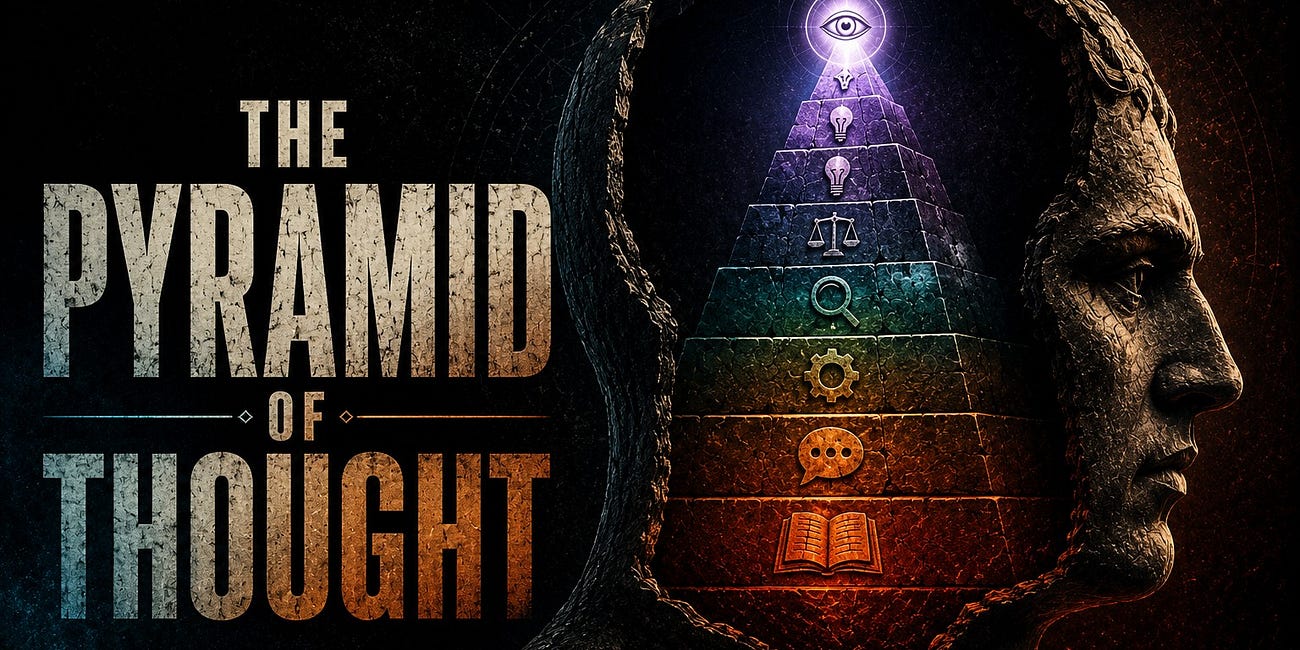
The Pyramid of Thought
·
Jul 9
Each post develops the larger framework. Subscribe for the next one; paid access unlocks the full archive from the beginning
Comments
Nothing yet. Say the first thing.
Sign in to join the conversation.