
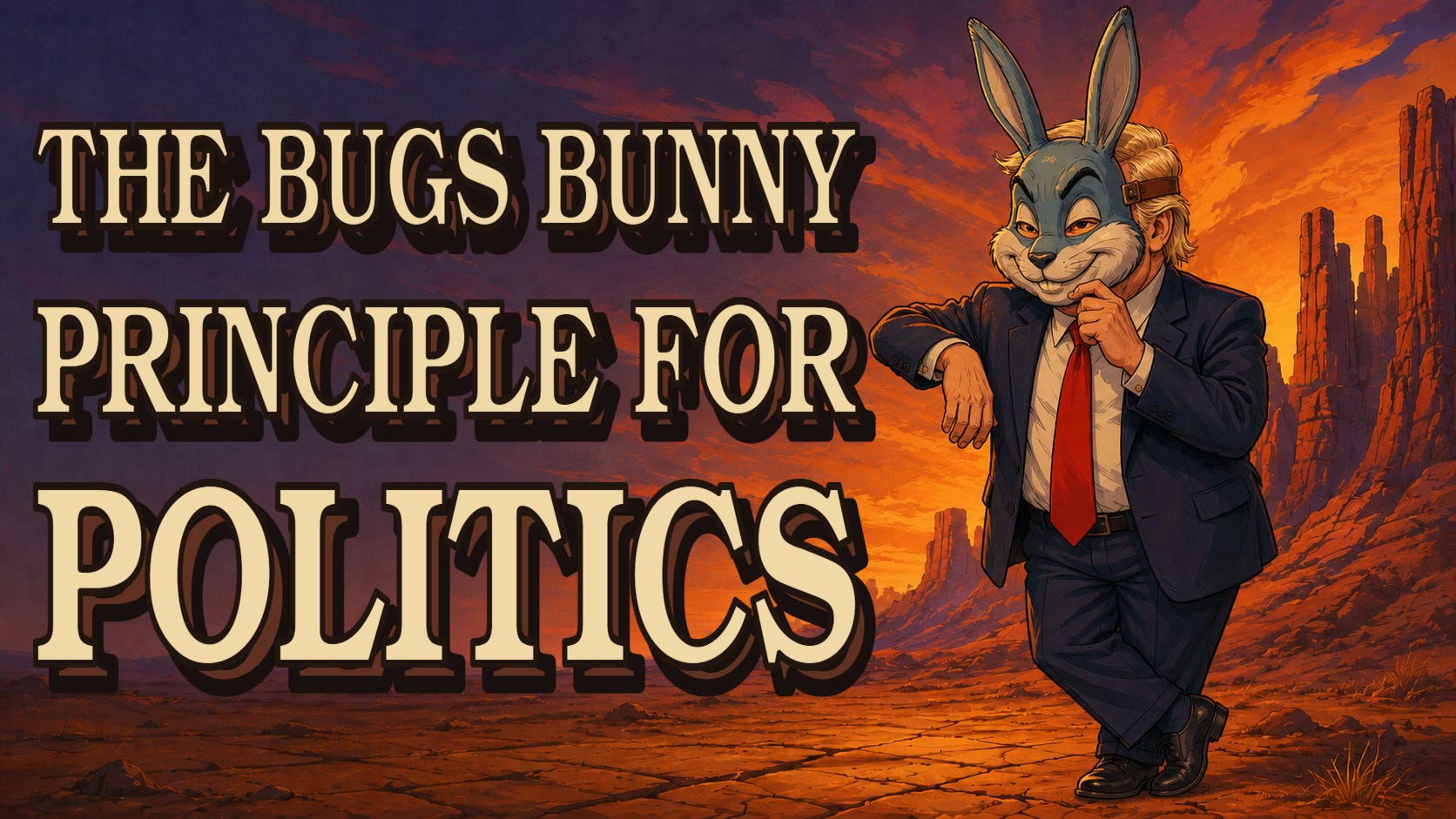
Imagine someone describing a scene from an old Bugs Bunny cartoon. Bugs puts on a dress, changes his voice, and pretends to be a woman to deceive an adversary. The scene is real and easily verified.
Now imagine using that scene as proof that cartoons are fundamentally organized around gender politics—or that everyone who watches them belongs to a political movement centered on gender identity.
The conclusion would be absurd. It would mistake one deliberately exaggerated scene for the meaning of an entire medium.
Someone wrote the scene. A studio animated and distributed it. Viewers remembered it because it was provocative, funny, or strange. Its existence proves only that it occurred. It tells us almost nothing about its social importance or what its audience believed.
The scene became prominent because it attracted attention.
Modern political reality is produced through the same confusion.
The media apparatus manufactures a hierarchy of importance by deciding what the public repeatedly sees, how it is framed, and what it is made to represent.
Most people never directly encounter “the nation,” “the left,” “the right,” or any other large social category. They encounter selected images: a short video, an inflammatory quote, a crime report, a protest confrontation, an offensive sign, or a politician’s most reckless sentence.
Those images may be completely real. The manipulation begins when their visibility is mistaken for their prevalence.
A protest involving thousands can be represented by the person who smashed a window. A movement containing millions can be represented by its most unstable supporter; a city by its worst crime; a religion by its cruelest adherent; a national conflict by its most emotionally useful footage.
The incident becomes a symbolic stand-in for people who had no involvement in it and may reject everything it represents.
Political media encourages the public to confuse factual existence with social significance. Once a clip is authenticated, the implied story about society is treated as proven. But an accurate fact can still be used to construct a profoundly deceptive picture.
If the Bugs Bunny scene were replayed across networks, clipped for social media, and debated by political leaders, it would acquire enormous cultural weight. It would feel representative because everyone had seen it. Familiarity would become evidence of importance.
Nothing about the scene would have changed. Only its position within public attention would be different.
That distinction is central to propaganda. Propaganda does not require imaginary events. It can operate through the disciplined arrangement of real ones.
Selection determines what enters public awareness. Repetition determines what remains there. Framing determines what it means. Emotional emphasis determines how urgently people react. Omission keeps competing interpretations from becoming equally visible.
A media system can mislead without fabricating a single frame of footage.
The mind does not evaluate public life like a statistical archive. It relies on what is vivid, familiar, emotional, and easy to recall. Through availability bias, a memorable example feels more common than an ordinary one.
Repetition strengthens the effect. A repeated claim becomes easier to process, and familiarity can make it feel more credible—a pattern demonstrated in research on the illusory truth effect.
Confirmation bias protects the interpretation. Supporting evidence is absorbed quickly, while contradictions receive greater scrutiny or are dismissed as partisan manipulation. Once the interpretation becomes part of group identity, questioning it can feel like disloyalty.
Fear, anger, and disgust intensify the process. When an image appears to threaten someone’s community, children, or way of life, questions of proportion feel like evasions. The audience chooses a side before establishing what the event represents.
Repetition also creates social proof. If every commentator is discussing the same incident, it must be important. If everyone within a political community is furious, anger becomes evidence of loyalty. The volume of reaction substitutes for proof of significance.
Algorithms deepen the distortion. Platforms reward whatever keeps people watching, clicking, arguing, and returning. No coherent political ideology is required. Commercial incentives alone make provocation more visible than ordinary life.
Politicians, media companies, advocacy groups, influencers, donors, and platforms pursue different goals, yet their incentives converge. They need enemies, audiences, engagement, loyalty, or urgency.
Each benefits from increasing the importance of the same selected scene.
This produces attention substitution, shifting public attention from material conflict toward symbolic conflict.
People experience falling wages, insecure employment, medical debt, unaffordable housing, weakened public services, and declining control over their working lives. These pressures are material, but their causes are distributed across institutions. Ownership, investment, labor law, tax policy, debt markets, consolidation, and political financing rarely appear in a single dramatic image.
Structural power is difficult to make visible because it operates through systems, incentives, and institutions rather than isolated events.
A provocative cultural incident is easy. It offers a recognizable antagonist, a moral drama, an emotional release, and a group to blame. Economic insecurity can then be interpreted through cultural resentment. The person struggling to pay rent is taught to see another struggling person as the cause of social decline because that person’s race, religion, language, gender, or political behavior has been made unusually visible.
Horizontal enemies become concrete. Vertical relations of power remain abstract.
Workers living under many of the same pressures are organized into hostile identities. Serious moral disagreements remain, but the media environment presents them as the primary explanation for declining security. Meanwhile, the institutions controlling employment, housing, credit, investment, media ownership, and political access receive less sustained attention.
Cultural conflicts and discrimination are real. Political manipulation works by controlling their scale, context, and position within public attention. A legitimate moral concern can be amplified, narrowed, or weaponized. Its victims become political symbols while the conditions governing their lives remain unchanged.
In professional wrestling, kayfabe presents staged characters, rivalries, and conflicts as authentic. The storyline may be planned and the hostility exaggerated, but the audience’s emotional investment is real. Even viewers who recognize the performance can become absorbed in its moral world. Political research on kayfabe has used this dynamic to explain investment in performances known to be partly artificial.
Electoral politics increasingly operates under similar conditions.
Candidates cultivate characters. Parties construct heroes and villains. Congressional hearings become dramatic confrontations. Partisan media turns policy disputes into recurring storylines. Political brands give audiences a role to inhabit, a side to defend, and an enemy whose defeat promises emotional resolution.
Real disagreement and managed spectacle can coexist. Political actors can hold genuine differences while exaggerating, simplifying, or selectively performing them for public consumption.
Two politicians may attack one another viciously over a cultural controversy while accepting many of the same limits around donor influence, privatization, labor power, or corporate access.
One party may meaningfully protect a targeted group while leaving the economic structures governing that group’s daily life largely intact. Another may openly attack that group while claiming to defend workers whose material power it has no intention of increasing.
Visible hostility remains a poor measure of structural opposition.
The performance organizes loyalty. Supporters learn whom to cheer, whom to fear, which injuries count, and which failures must be excused to keep the opposing side from winning. Politics becomes a struggle between branded identities, while arrangements that survive every election begin to look like neutral background conditions.
Kayfabe turns the selected scene into a continuing drama.
Hasbara operates at a different level.
The Hebrew word is commonly translated as “explanation,” though it can also mean advocacy, public diplomacy, or propaganda, depending on context. Politically, it refers to organized efforts by Israeli institutions and aligned advocates to explain, defend, and build international support for Israel and its policies.
A historical review by a former head of Israel’s Government Press Office describes hasbara as public diplomacy supporting the implementation and marketing of policy. Israeli officials have likewise described it as a means of pursuing diplomatic, economic, and strategic objectives. (Knesset statement)
Hasbara does more than attract attention. It supplies the moral grammar through which attention is interpreted.
Strategic messaging establishes where the story begins, which vocabulary appears reasonable, whose fear receives priority, which violence counts as the initiating event, and which appears only as a response.
A frame can foreground real attacks against Israeli civilians while relegating occupation, displacement, blockade, military asymmetry, or Palestinian civilian suffering to the margins. It can center security, self-defense, necessity, and complexity until structural violence appears unavoidable or beyond moral judgment.
The foregrounded facts may be true. The distortion arises from the hierarchy imposed upon them.
A government’s declared purpose does not settle the moral character of its actions. The suffering of one population cannot erase the suffering, rights, or humanity of another. Strategic framing makes those distinctions harder to sustain under emotional pressure.
The three mechanisms are distinct.
The Bugs Bunny analogy reveals how selected content is mistaken for representative reality.
Kayfabe shows how managed conflict generates genuine allegiance.
Hasbara shows how organized framing protects legitimacy by determining how events are morally classified.
In coverage of Israel and Palestine, all three can operate together. An event is selected from a much larger history. Political performers turn it into a simplified confrontation. Media organizations circulate the most powerful images. Hasbara supplies an interpretation centered on security, identity, and legitimacy.
Other state, corporate, partisan, and ideological messaging systems perform the same general function of strategic framing. The name changes. The mechanism remains recognizable.
The result is a manufactured hierarchy of importance.
A single offensive statement can dominate debate while decisions affecting millions of workers pass with little scrutiny. A confrontation at a protest can define a national movement while changes in ownership, taxation, labor law, housing policy, or public infrastructure remain background noise.
The selected scene becomes more emotionally real than the system surrounding it.
Exceptional behavior appears widespread. Individuals become symbols of entire populations. Economic decline is interpreted through cultural blame. Partisan identity grows stronger while recognition of shared material conditions grows weaker.
The consequences extend beyond misunderstanding.
People who believe their neighbors are the primary threat to their survival become easier to govern through fear. They direct pressure sideways rather than upward. They defend institutions that harm them because those institutions appear to offer protection from a more visible cultural enemy. They accept worsening conditions as the price of preventing the other side from gaining power.
The spectacle preserves obedience by preventing shared recognition.
A population cannot coordinate around common pressures it has been trained to interpret as personal failures or the work of rival groups. Workers cannot recognize their shared position while each group is taught that another group’s existence, language, beliefs, or visibility is the cause of insecurity. Political solidarity becomes morally suspect because every potential ally has already been represented by the worst image associated with their identity.
The cartoon logic has completed its political work. A single selected scene is made to stand in for a much larger reality. The public is divided around the meaning attached to it, while the institutions that selected, amplified, and profited from the conflict recede from view.
Resisting this manipulation begins with a simple recognition: reality is always larger than what has been selected for public attention.
The Bugs Bunny Principle rests on a crucial distinction. What happened and what that event has been made to represent are not the same thing.
When media systems control selection, repetition, framing, and moral emphasis, they do more than report reality. They shape the political reality through which people decide what matters, whom to fear, whom to blame, and which forms of power remain invisible.
A scene can be completely real while the larger political reality constructed around it is profoundly false.
Independent writing about power, conscience, and the human consequences hidden beneath political narratives.
Support The Empathic Revolutionary and receive full access to the archive.
If you have a thought, a question, or a different perspective, I’d genuinely like to hear it. Leave a comment or join the subscriber chat below.
Comments
Nothing yet. Say the first thing.
Sign in to join the conversation.