
I’ve gone back and forth about whether or not I should write this article. Firstly because I find talking about money repulsive, especially if it’s to tell someone else how much you make. Yuck.
Secondly, writing this post was embarrassing. It felt like grabbing a microphone and telling the whole street how I’ve continually had people take chances on me, only for me to let them down. In the end, I wrote it anyway, because there are lessons embedded within my story, and I believe they can help others.
I hope you enjoy.
It’s late 2021. I’m living in Los Angeles with a pair of roommates, one of whom is in business school at USC. The mornings, which I spend seated at the kitchen table, typing furiously in Microsoft Word, he spends just a few feet away, eating breakfast on the sofa while watching CNBC.
“Hey, Emma,” he says one morning, waving a hand in front of my face. I pull off my headphones and give him a questioning look. “Check it out. They’re talking about romance books.”
I look over at the TV. He’s right: on screen, the CEO of Barnes & Noble is sitting in his office with a pair of ear buds in, talking about TikTok—an app I’ve used to scroll but never posted on before.
“There has been an explosion in reading since the pandemic,” the CEO is saying. “During lockdown, people started reading more, but they also started talking about what they were reading, particularly on TikTok. There’s a whole subculture called Booktok, and as it has grown, we’ve seen a corresponding growth in book sales.”
I stare at the screen. The CEO keeps talking, running through stats and figures, but I’m no longer listening to him.
At this point in my life, I’ve been trying to publish a book for years. I’ve queried literary agents, received dozens of rejections, signed with one agent, sent out a book (an early version of How to Hide in Plain Sight), had it rejected by 15 editors, reworked it to be a YA novel, had it rejected by 15 more editors, watched as my agent slowly stopped responding to my emails, sent her a new book called The Sunken City, had her tell me that she wasn’t interested in representing it, and finally parted ways with her, finding myself back in the agent querying trenches. Woof.
But what about this TikTok thing? Could it change my odds?
I don’t know it yet, but this moment—and the decision that followed—will change my whole life. It will set me on a course that will lead from not being able to get a single agent or editor to look twice at my work, to signing with my dream agent and getting not one but two book deals, totaling over $500,000 in advances.
But… it will also be the thing that causes all of that success come crumbling down around me. It will set me on a path that leads right back where I started: self-publishing a book no one else is willing to take a risk on.
What follows is an abbreviated—and embarrassingly honest—look at how it all went down.
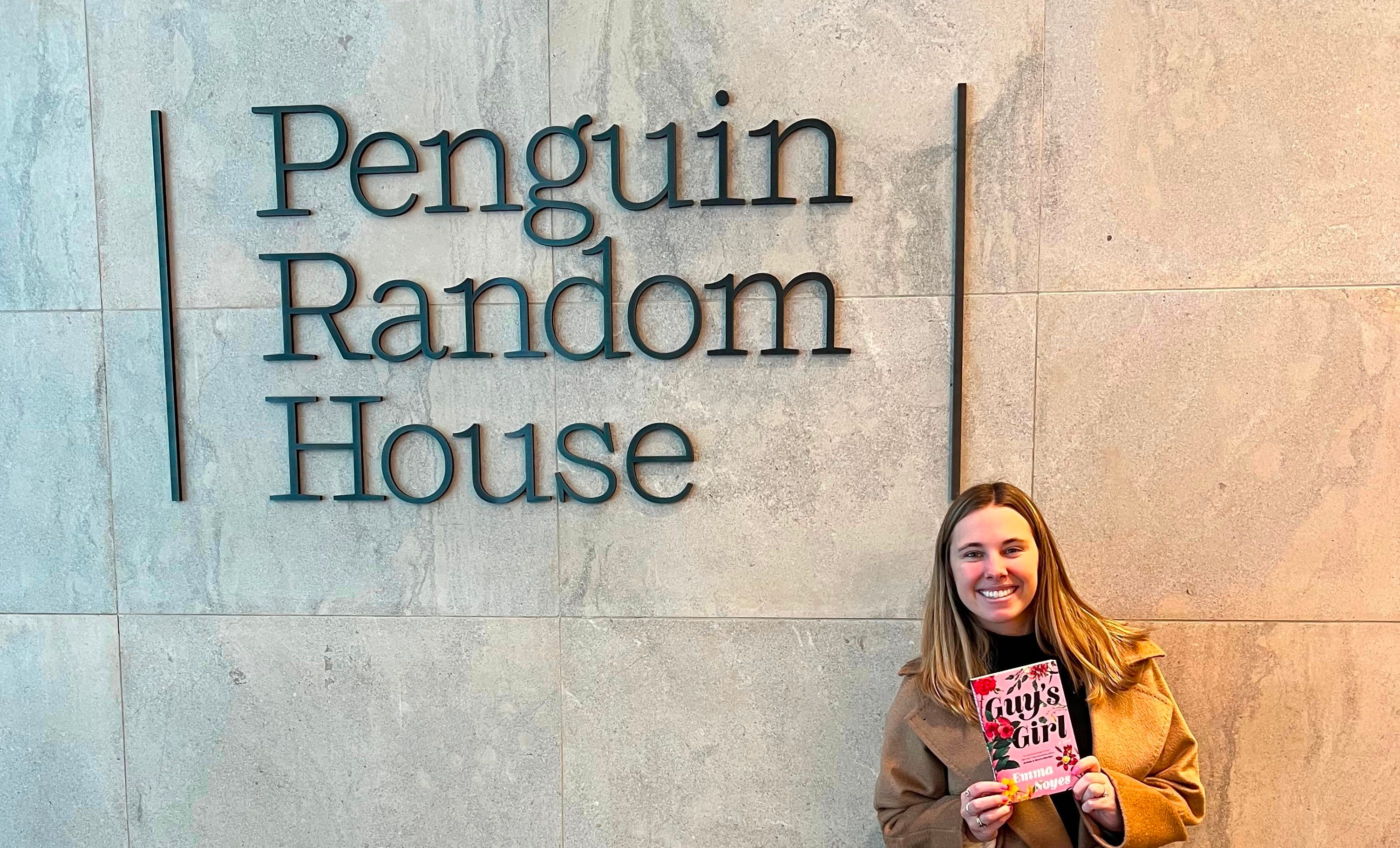
On the day I watch that CNBC broadcast, I’m fresh off a particularly gnarly relapse in my eating disorder. The relapse was brought on by the end of a very long, very confusing not-quite-relationship. The breakup sent me into a depressive spiral, during which I started binging and purging again—in secret, of course.
The only thing that got me through that period of time was writing. I wrote about bulimia. I wrote about sadness. I wrote about recovery. I wrote about love. And I gave the main character a happy ending that I didn’t get. The result was a full book, purged out of me (both literally and metaphorically) in a little under two months. I titled it Guy’s Girl.
By the time I moved in with my two roommates, I was back on the road to recovery. Now, several months later, seated at my computer watching that broadcast, I’m doing even better. I’ve been purge-free for several months and am in weekly sessions with a counselor and nutritionist. I’ve gone through hell, but hey—at least I have a book to show for it!
As mentioned earlier, I once had a literary agent, but after the book we sent to editors was rejected thirty different times, she slowly stopped responding to my emails. Now, we’ve officially parted ways, which means I’ll have to find a new agent if I want to publish Guy’s Girl. I also have The Sunken City, a YA romantic fantasy that I wrote while How to Hide in Plain Sight was out on submission, which my previous agent said she wasn’t interested in representing.
After seeing that CNBC broadcast, I form a plan. It goes like this:
I’ll go back into the hell that is querying literary agents, this time with the manuscript for Guy’s Girl. It will take weeks to query, and even more before I start hearing back—if I hear back from them at all.
In that downtime, I’ll create a TikTok account, crank at it as hard as I can, and self-publish The Sunken City.
I choose The Sunken City for self-publication because it fits within the genre of books that are performing well within the self-pub market at the time. Remember, this was 2021—just a smidge before the massive romantasy boom that has consumed the trad publishing industry today. Still, the category is already doing well; the Barnes & Noble CEO said as much on live television.
In a perfect world, this strategy will gain me both followers and readers. Maybe even enough to catch the eye of a literary agent and, eventually, a publishing house. It’s a long shot, but it’s worth a try.
I’ll spare you the boring details about growing my TikTok channel (because let’s be honest, social media is boring). Suffice to say, I post. And I post. And I post. I make videos about writing, about Los Angeles, about my roommates, about my boyfriend, about The Vampire Diaries. I throw hundreds of ideas at the wall, hoping that, eventually, one of them will stick.
Some do. In fact, so many stick that, by February 2022, I have over 150,000 followers.
This is it! I think. Now, agents will have to pay attention to me!
Never mind that most of those followers are only on my page to watch my Vampire Diaries parodies or find out if I’ll end up dating the roommate who built my bookcase while shirtless. Never mind that I’ve just published The Sunken City and it only got four downloads, all four of whom were probably my mother. Don’t pay attention to that!
Pay attention, instead, to the agents who are finally responding to your query. Pay attention to the email that lands in your inbox from your literal dream agent, who says she read Guy’s Girl and absolutely loves it. That she wants to represent you.
You laugh. You cry. You stop talking in the second person, because it’s getting annoying at this point.
Again, I’ll skip over the details of submitting to editors, because that’s not what this article is supposed to be about. (Although, I’m realizing I could write an entire post about querying agents and submitting to editors. Should I do that?) Let’s just say this: now that I have a social media following, things move faster. Much faster. In July 2022, I sign a two-book deal with Berkley Publishing. Then, impossibly, in May 2023, I sign a second book deal, this time for a YA romantasy series with Wednesday Books. Taken together, the advances for those deals constitute over half a million dollars.
HUH???
I’m going to pause here and say: I don’t like talking about money. It’s gross. I have a visceral ick even as I write this. But. BUT! In this particular case, it teaches a very important lesson:
Getting a big advance does not mean that your book will be a bestseller.
After I sign those book deals, I celebrate. I’ve done it. I’ve achieved a goal that I never thought would be achievable—and I did it twice. For an unfathomably large sum of money. It’s one of the most exciting periods of my life.
And then, the excitement wears off, and I have a full-blown panic attack.
How am I ever going to earn out these advances? I’m 27 years old. I don’t know anything about the traditional publishing industry. Are my books even good? Are they good enough to move 500,000 copies, which is how many I would need to sell for my publisher to make back their money, thus making myself seem like a “good investment”? Because I may not know much about publishing, but I know that big publishers are corporations. They care about ROI. If I turn out to be a bad investment, why would they sign me for another book in the future? Why would anyone sign me?
Three years later, I can tell you this: I was right to be worried.
The first thing you need to understand is that the publishing landscape changes quickly and constantly.
For example: when I sold Guy’s Girl, contemporary romance was performing really well. By the time it came out, though, romantasy had blown contemporary out of the water.
And again: when I sold the Soul of Shadow series, YA fantasy was seen as a “hot” market. But we waited two and a half years between signing and publication. That’s a long time. By July 2025, when the first book came out, everything had changed. YA wasn’t as “hot” anymore. New Adult/spicy books for younger audiences are selling much better than old-fashioned YA (which my series is—there’s no open-door spice in it). It’s much more difficult to blow up as a YA book than as an adult or NA book.
Reading trends change rapidly, and with the added factor of social media, the speed is only ramping up.
And let’s not even bring up AI. Good lord. I’m shuddering just thinking about it.
I read a great Substack post recently about the state of the publishing world right now, and all the changes that are sweeping through it. I’m going to paste it below so you all can read it, too:
The second thing you need to understand is a lesson that I learned slowly and painfully over the course of the eight book releases: followers do not equal book sales.
I wish it did. I’m sure my publisher wishes it did, too. But it doesn’t. Followers are a vanity metric. Sure, it looks nice to have a big number next to your name, but it doesn’t mean anything. Not unless that number consists of people who come to your page specifically for your writing.
For me, that wasn’t the case. Not at all. People came to my page for the roommate who built my bookshelf, my Swedish boyfriend (now husband), my Vampire Diaries parodies and videos about the cast, and my older brother Henry, who the Internet decided was hot (gross). All of those things were fun to film, but they had nothing to do with my writing.
Which meant that, when I posted about my books, no one cared. And no one purchased.
Between my disengaged audience and reader trends that weren’t at all in my favor, my books didn’t sell well. They weren’t total flops, but they weren’t amazing. And I needed amazing, if I wanted to earn out and start making my publishers any real money.
Now, imagine this: you sign on to have five books published. The advances are large. You think: I’m an author now! This will be my job for the rest of my life! But your books don’t earn out. They don’t even come close to earning out. And you realize, with painful slowness, that no publisher is going to take a chance on an author who hasn’t made her past publishers any money. The years press onward, and the advances drain slowly (or not so slowly) out of your bank account. The future is barreling toward you. One day, an amount of money that once seemed impossibly large will run out. And if you have no other book deals lined up after that, what will you do?
My anxiety comes to fruition. My agent and I send out my next book, my very first spicy adult romantasy, Prince of the Sun, to almost twenty editors. I’m nervous, but I tell myself: it’s fine. I’ll be fine. I have a track record. Someone will pick it up.
Crickets.
No one is interested. Weeks pass, then months, and we hear nothing. Eventually, we get one very polite rejection, but that’s it. As far as I know, none of the other editors have even glanced at it.
At this point, I start to panic. Writing books is the only thing I know how to do. I left the corporate workforce after only two and a half years, and I didn’t look back. If I want to find a new job, I’ll be starting from scratch. Which is okay, and quite possibly something that I will need to do one day. But I’m not ready to give up on the writing dream just yet.
Which leaves me with only one option: going right back to where I started.
Self-publishing.
I made the decision to self-publish Prince of the Sun a little over two weeks ago. My agent pulled the submission, my editor at Wednesday Books OK’d a release date of August 4th (right between books two and three of the series I’m publishing with them), and that was it. It was done.
At first, it felt like defeat. I made a go at the traditional publishing world, and it didn’t work out. I wasn’t good enough.
But then I hit the ground running, doing everything on my own to get ready to launch this book. I found a cover artist. I found a map artist. I found a copyeditor. I found someone to design the interior of the book. I started building out a marketing and publicity campaign.
And you know what? I’m having a blast.
Because even if, from the outside, it looks like I’m right back at the beginning, I’m not. Not really. I now have five years of experience navigating the publishing world. I know exactly what I want to do with this book. And I didn’t actually wait until my advances had run dry, which means that I have money to put into it (which is good, because self-publication can be quite expensive—but that’s a whole other article).
Most important of all—unlike when I published The Sunken City, I have a real audience now. Not one who is there for Vampire Diaries parodies; one who read and loved at least one of my eight past books. That audience may not be huge—they may not be moving tens of thousands of copies—but they’re there, and they’re lovely, and they represent real people who enjoy reading my words. That’s all I wanted, when I first started this journey.
As I’ve worked toward self-publishing Prince of the Sun, I’ve felt my excitement for my career reignite. I’m spending less time worrying about the sales of my traditionally published books and more time being creative. I’m even writing more, starting an entirely new project. It has been, frankly, wonderful.
And if it doesn’t work out in the end, if Prince is a big flop and my advances finally run out and I have to get an entirely new job, I will. I’ll deal with that when it comes. And I will keep writing, and I will keep trying to have those words read by people, because really that’s all being an author is.
I see now that my story is not one of “successes and failures”; it is merely a long, bumpy road, peppered with U-turns and switchbacks, but it’s all leading to the same place: onward.
Links to my books:
No posts
Comments
Nothing yet. Say the first thing.
Sign in to join the conversation.