
Recently, I wrote a post called, “Once, I had a book deal for half a million dollars. Now, I’m back to self-publishing.” It’s all about my journey into the world of traditional publishing—and back out again.
In the comments, several people asked if I could say more about my journey querying literary agents. This article is for them.
In March 2020, shortly after lockdown began, my mom told me I should try to publish a book.
My response? “Don’t be ridiculous, Mom. I couldn’t be an author. Authors are celebrities; I’m just a normal person.”
I was 25 years old. I was working an office job at the same company I’d worked for since college graduation. And although I had a fully-written novel on my computer (an early version of How to Hide in Plain Sight, though it had a different title back then), I didn’t think anyone, outside of family and friends, would ever read it; I didn’t think it was good enough.
Eventually, though, with a lot of cajoling from my mother, I decided to try.
When I decided to try and get How to Hide in Plain Sight published, I knew nothing about the book industry. I didn’t know what querying literary agents even meant, let alone how to do it. So, I threw myself into the research process, trolling blogs and forums to figure out what I should do.
Now, it’s been six years since I started querying. I’m sure a lot has changed since then, especially with the explosion of BookTok and the advent of Satan… er, I mean, ChatGPT. But this is how I did it—once in 2020 and again in 2022, after I left my first agent.
Before you even begin looking for agents, you need a query letter. This is the blog post I relied upon when crafting my query letter. It’s clear, concise, and filled with excellent advice. It’s also updated fairly regularly, so I doubt it’s too out of date (even if I am!).
When it came to finding specific agents to target, I started off by trying QueryTracker, which several websites said touted as the best of the best for finding the right agent. Personally, I found it clunky and not at all intuitive. I stopped using it after a week.
If you can afford the $25 per month needed to subscribe, my absolute favorite resource is Publisher’s Marketplace. PM is the Bible for agented book deals. You can see almost every book deal, domestic and international, since 2008. Everything is tagged by genre, which means you can filter and see which agents are actively selling books within your genre. Debuts are also marked as such, so you can see who is taking on (and actually selling) books by debut authors.
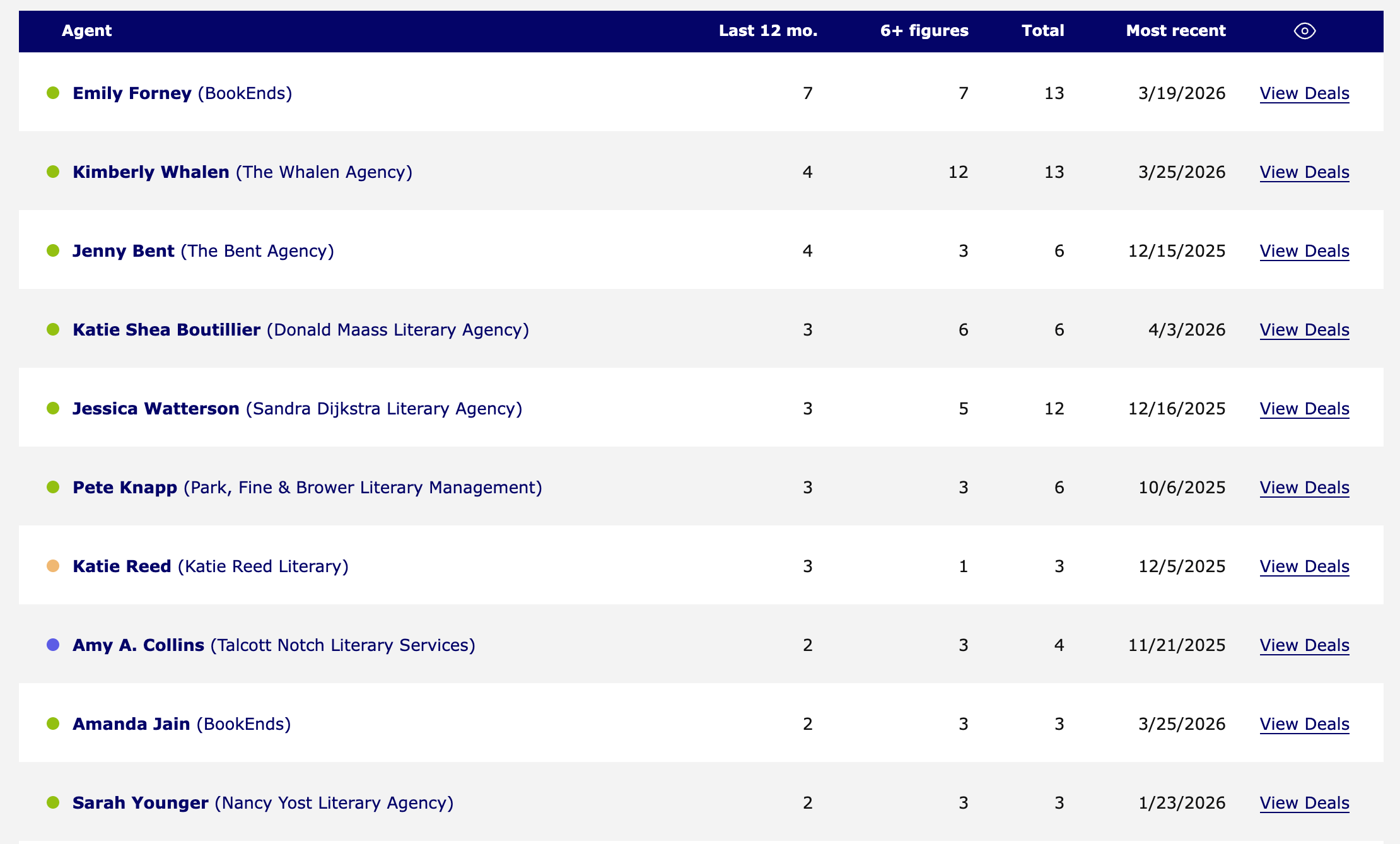
When I was querying, I would go into Publisher’s Marketplace, click on DEALS > DEALMAKERS > BROWSE TOP DEALMAKERS, select “Agents” and choose my “Category” (genre), and hit BROWSE. This spits out a list of the “Top 100” agents for that space, which is ranked based on how many deals they’ve done in the last 12 month—meaning you know that agent is actively selling books.
For example, here is a screenshot of the Top 10 agents for the “Romantasy” category as of today, April 21st, 2026:
Once I had my list of target agents, I visited each agent’s individual website to see how they like to be reached out to. Every agent has different guidelines. Some want to be emailed, some only accept queries through QueryManager submission forms, some want to see the first page of your manuscript, some the first ten, some the first three chapters, some no material at all.
Before submitting, I tailored my query letter to each agent. Do not skip this step. Agents want to see that you’ve researched them and decided to query them specifically. They don’t want to think you’re just copy-paste reaching out to everyone. Publisher’s Marketplace is also excellent for this step. You can click into each agent, browsing their recent deals to find a title they’ve sold in the past that is most similar to your own manuscript.
It’s important to know that nothing in publishing happens overnight. Not finding an agent, not finding an editor, and certainly not releasing a book, especially if you do so via the gigantic, unwieldy dinosaur that is the traditional publishing industry.
What follows is a very condensed version of how I signed with my current agent. Even condensed into bullet points, this story is still long and winding, which is a great metaphor for publishing in general.
August 2020: I start querying How to Hide in Plain Sight. Over the course of two months, I send hundreds of emails and QueryManager submissions. I get a few manuscript requests, but it’s mostly silence.
September 2020: The rejections start to roll in. A lot of them. Like, a lot.
October 2020: My first expression of interest!
November 2020: I sign with a real literary agent! HUZZAH!!
March 2021: After months of revisions, we send the book out to 15 editors. This is it! My life is about to change forever!!! (Oh, silly, naive Emma.)
April - May 2021: We get 15 rejections back.
June - July 2021: We rework the book to be YA instead of adult and resubmit to 15 YA editors.
August - September 2021: We get 15 more rejections back.
At this point, I’m feeling quite down. After 30 rejections, it doesn’t look like this book is going to sell, and my agent is taking longer and longer to respond to my emails.
But! I have a second book! It’s called The Sunken City, and it’s my first attempt at a fantasy novel. I send it to my agent, asking if she would read it and consider representing it. After several months (and many unanswered emails), it becomes clear that she isn’t interested in representing it.
I start to panic. My best friends, who have watched all of this happen from afar, tell me that I need to split up with my agent. You deserve an agent who is truly excited to represent you, they say. Go find a new one. But this idea horrifies me. Querying was terrifying the first time around. I never even thought I’d find one person who wanted to represent me; what are the odds I could find a second?
But my friends are right. Of course they are. After several weeks of hemming and hawing about what to do, I eat my fear, and I strike back out on my own.
At this point, I make another important decision; I create a TikTok account. You can read more about that decision in the post below, but in a nutshell: I heard the Barnes & Noble CEO say on live television that TikTok was the future of books, and I jumped right on the bandwagon.
Now, back to the timeline.
October 2021: I begin querying Guy’s Girl. At the same time, I post furiously on TikTok, praying that I will eventually have a video go viral.
November 2021: My first video goes viral. My follower count jumps to 60,000 almost overnight. (These were the early days of TikTok, when one viral video could gain you that many followers.) I am shocked and confused and excited. I continue querying agents, now able to add to my bio that I have a substantial social media following.
December 2021: I finalize all the materials for self-publishing The Sunken City: a gorgeous cover made by a freelance designer, a formatted interior from someone I hired on a very helpful website called Reedsy, PDFs and epub files and dimensions that fit IngramSpark and Amazon KDP.
Early January 2022: First manuscript request from an agent for Guy’s Girl.
January 22, 2022: I self-publish The Sunken City. Despite my ever-growing TikTok following, the book sells approximately six copies in its first week. This is the first hint of a lesson that will take me far too long to understand: that followers do not equal book sales.
February 2022: My first offer of representation for Guy’s Girl!
After the first offer of rep came in from an agent, I quickly email every other agent I’d queried, letting them know about the offer. Eventually, I signed with Kim, my agent to this day.
I adore Kim. She is smart, funny, and a fierce champion of my work—not to mention the fact that she actually replies to all of my emails, no matter how well or how poorly my books are selling. She also has absolutely no prejudice against self-published/hybrid authors; in fact, she loves championing them, and when I made the decision to step back from traditional publishing for my next book, Prince of the Sun, she was nothing but supportive (as was my editor Vicki, god love them both.)
I think back to the version of me who was afraid to leave my first agent, and while I completely understand her fear, I am so grateful that she found the courage to bet on herself and strike off out into the unknown—because better things were waiting for her.
If you are an aspiring artist reading this post, I hope that, if nothing else, that is what you take away from my story: you are your own best champion, and no one will advocate for you unless you first do it for yourself.
Links to my books:
No posts
Comments
Nothing yet. Say the first thing.
Sign in to join the conversation.