
For my article Can Americans Even Afford a Burger Anymore?, click here. For my article, Our Food System is Fragile, Fractured and F-Bombed, click here.
An October 2025 report from members of MI6 and MI5 as part of the UK Joint Intelligence Committee was buried by the UK government for being ‘too negative.’ Hiding the facts didn’t work, and the report was finally made public under duress in January of this year.
The report was officially published by the Department for Environment, Food and Rural Affairs (Defra) and was in collaboration with the Joint Intelligence Committee, which oversees the country’s security services in addition to providing input across government. The results of this report might make one wonder if MI6 and MI5 have me on speed dial. At the very least, it might make one think that some of the highest ranking British intelligence officials are reading this Substack.
Here’s why.

Credit: Laurie Nevay, Secrect Intelligence Service Building, SIS, the headquarters for MI6. CC BY-SA 2.0 via Wikimedia Commons
The report states that the UK faces “national security risks from ecosystem collapse,” and that “biodiversity loss is a global threat… including crop failures, intensified natural disasters and infectious disease outbreaks.
“Ecosystem degradation is occurring across all regions and ecosystems. The average size of monitored wildlife populations declined by 73% between 1970 and 2020. Populations of vertebrate species have declined by an average of 68% since 1970. Freshwater ecosystem species populations have shown the largest losses, falling 84% in the same period.
“The rate of extinction is tens to hundreds of times higher than the average over the past 10 million years. It suggests that a sixth mass extinction may be underway.
“With current trends, global ecosystem degradation is highly likely to continue to 2050 and beyond. There is a high degree of uncertainty around the timing and pathways of ecosystem degradation, given the number and complexity of the drivers involved.
“Food production is the most significant cause of terrestrial biodiversity loss. As the global population grows, reaching 9.7 billion by 2050, the impact of food production on natural systems will intensify and it will become even more challenging to produce sufficient food sustainably [due to the natural resources needed to produce food, which are being destroyed by the same system].”
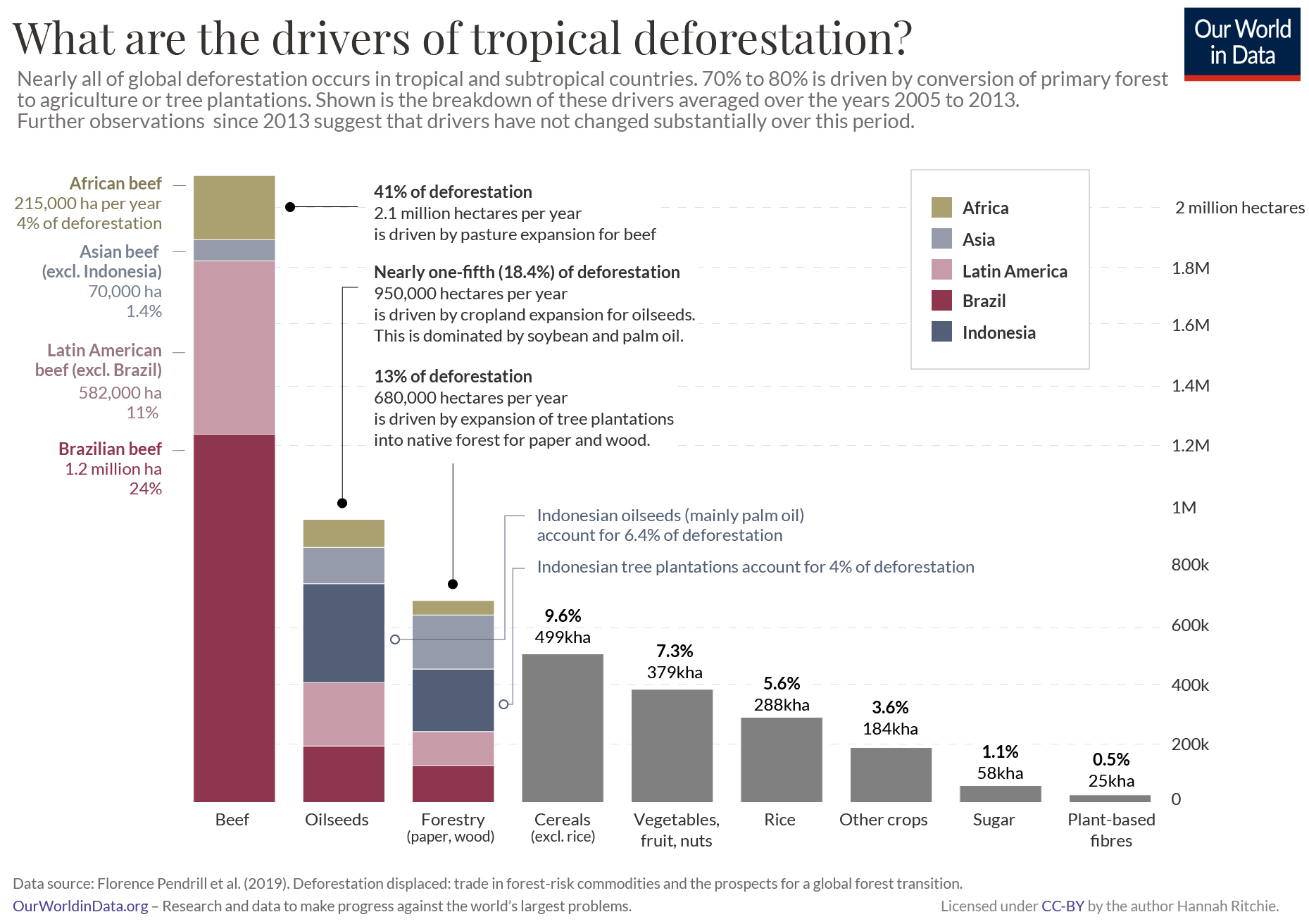
Our World in Data chart showing that 41% of the global tropical deforestation is from the beef industry.
The impacts from the above Catch-22 are that, “Migration will rise as development gains begin to reverse and more people are pushed into poverty, and food and water insecurity. A one-percentage increase in food insecurity in a population compels 1.9% more people to migrate.
“Serious and organised crime (SOC) will look to exploit and gain control over scarce resources. More people pushed into poverty will mean more opportunities for SOC to exploit (for example, people trafficking and black markets in scarce food, pharmaceuticals, and critical minerals).
“Non-state actors including terrorist groups will have more opportunities resulting from political instability – for example, acting as mercenaries or pseudo-governments. They may gain control over scarce resources.
“State threats become more severe as some states become more exposed than others to food and water insecurity risks.
“Pandemic risk will increase as biodiversity degrades, people move between countries and transfer of novel diseases between species becomes more likely.
“Economic insecurity becomes more likely. Nature is a finite asset which underpins the global economy. It would take resources of 1.6 Earths to sustain the world’s current levels of consumption.”
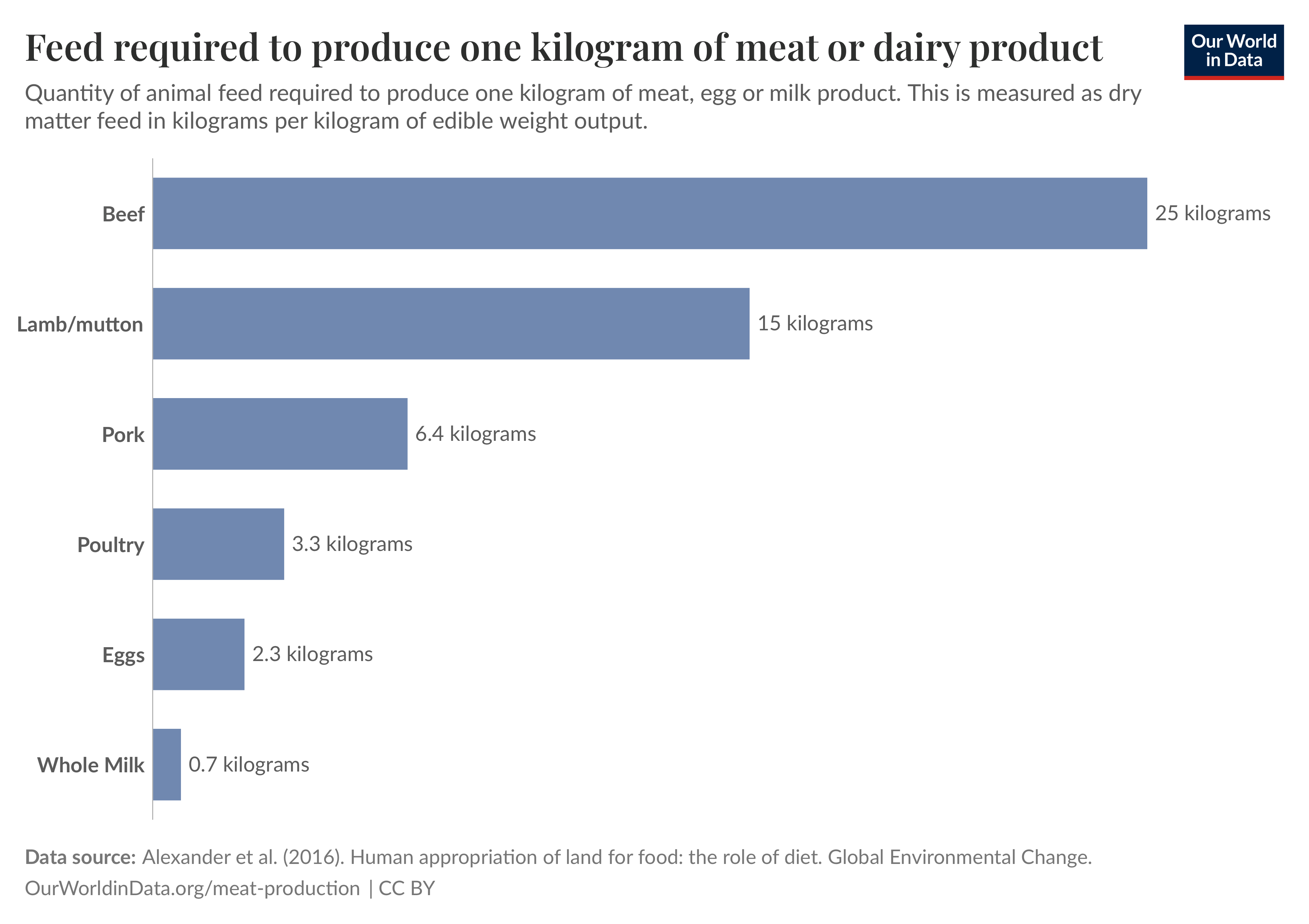
Our World in Data graph showing the disproportionate natural resources needed to get protein from animals. 25kg of feed is needed to get 1kg of beef. This is otherwise known as a bad investment, unless you are an investor willing to invest $2.50 to get $.10 back. If this is the case, you’ll be out of money soon, just as we will be out of natural resources soon if we don’t start innovating for a more efficient way to get protein.
It goes on to say, “The total annual value of ecosystem services to the UK was £87 billion in 2022 (3% of GDP).” Thus, the impact is not only on those thrown into poverty and food insecurity, but on the economy as a whole.
There is more. “Geopolitical competition will increase as countries compete for scarce resources including arable land, productive waters, safe transit routes, and critical minerals.
“Political polarisation and instability will grow in food- and water-insecure areas and as populations become more vulnerable to natural disasters. Disinformation will increase.
“Conflict and military escalation will become more likely, both within and between states, as groups compete for arable land and food and water resources. Existing conflicts will be exacerbated.”
Further, it states that the, “Ecosystem degradation or collapse will challenge the UK’s food security.
“The UK relies on global markets for its food and for fertiliser. The UK imports 40% of its food from overseas, with over 25% coming from Europe. The UK is heavily reliant on imports for fresh fruit, vegetables and sugar. Animal farming at current levels is unsustainable without imports – soy from South America makes up 18% of produced animal feed. Nearly 50% of packaged products contain imported palm oil. The UK is not self-sufficient in fertiliser – for both nitrogen and phosphorus it is partially reliant on imports. Global phosphorus production is dominated by China and Morocco.
“The UK is unable to be food self-sufficient at present, based on current diets and prices. Full self-sufficiency would require very substantial price increases for consumers, as well as improvements in efficiency, waste reduction and resilience across the food system, including agricultural production, food processing, distribution and consumption. The UK does not have enough land to feed its population and rear livestock: a wholesale change in consumer diets would be required. It would also require greater investment in the agri-food sector so that it is capable of innovating in sustainable food production.” In other words, the UK can’t risk such global political tensions due to dwindling natural resources caused by an inefficient food system.
“UK food production is vulnerable to ecosystem degradation and collapse. Biodiversity loss, alongside climate change, is amongst the biggest medium- to long-term threat to domestic food production – through depleted soils, loss of pollinators, and drought and flood conditions. Ecosystem collapse would place the UK’s agriculture system under great stress, leaving it struggling to pivot to the new approaches and technologies that would be required to maintain food supply.” In a bizarre, unfortunate twist, the way we create food today disproportionately uses natural resources, destabilizing the ability to create food in the future.
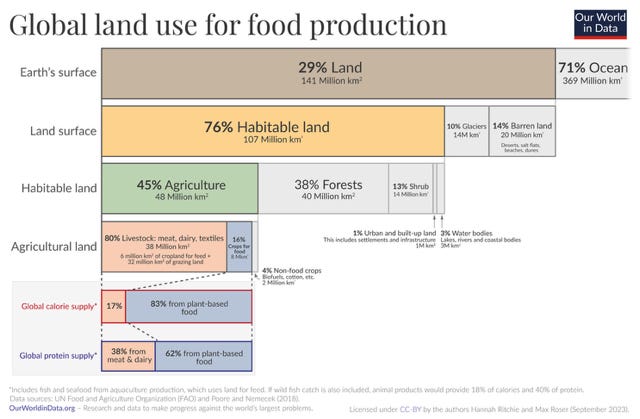
Our World in Data chart showing that of 76% of the the earth’s land is habitable. 45% of that is given to agriculture. 80% of that agriculture land is given to animals which returns only 17% of our calories needed. This is more bad investing, but helpful to understand how our limited natural resources are used so that we can strategize other ways to receive protein that are more efficient. The best way to do this is to cut out the expensive middle man: the animal. The silver lining here is we also see that 16% of our agricultural land is given to growing plants, including plant proteins, and this provides us with 83% of our calories. This is known as a good investment.
“Ecosystem degradation or collapse affecting major food-producing regions would increase resource scarcity and drive up global food prices. There is high uncertainty about how this would play out. The geopolitical response, as well as the extent and timing of ecosystem collapse, would determine whether and how quickly global markets are able to respond. Collapse of production in two or more breadbasket regions would almost certainly significantly drive up global food prices, potentially limiting the UK’s ability to import food, impacting household food security and restricting diets.
“Significant disruption to international markets as a result of ecosystem degradation or collapse will put UK food security at risk. Global scarcity would drive greater state intervention in supply chains, and securitisation of and conflict over food and water.
“Some technologies exist that could help, but need significant research, development and investment to have a chance of working at scale. Protecting and restoring ecosystems is easier, cheaper and more reliable. The time required to develop and scale technologies is unknown without further research. Both existing (plant pre-breeding, regenerative agriculture) and emerging technologies (AI, lab-grown protein [known as cultivated meat], insect protein) offer potential solutions.”
While I haven’t written about the rise in organized crime, black markets for critical food resources, increased human trafficking and more climate change refugees due to food shortages, here are links to my articles that do investigate many of the themes of this report:
Food inflation, pandemic risk, antibiotic risk, insect protein, investing in food solutions: plant-based, hybrid, fermented and cultivated proteins for both food security and biodiversity loss/climate change reversal, our food system as a biodiversity loss driver, thus further putting our food system at risk, reversing biodiversity loss with rewilding , rising healthcare costs and the implications, national security risks, growing population with diminishing natural resources due in major part to an inefficient food system, destabilizing economic impact and more.
For the full UK report, see here. Cambridge Professor Paul Behrens discusses the report here. (10-10:30 and 14-18:00 discuss solutions to bolster food security. Spoiler alert: all three revolve around addressing animal agriculture and, no, eating chicken isn’t the answer.)
Also, one thing is clear to me from this UK Joint Intelligence Committee report. It doesn’t matter if nations like the U.S. and Canada could potentially be food sufficient because the increase in global food and climate refugees to these “secure” places makes them just as vulnerable to destabilization.
This is why my next article will be Financing Food Fast. We can no longer have our heads in the sand.
Just ask MI6.
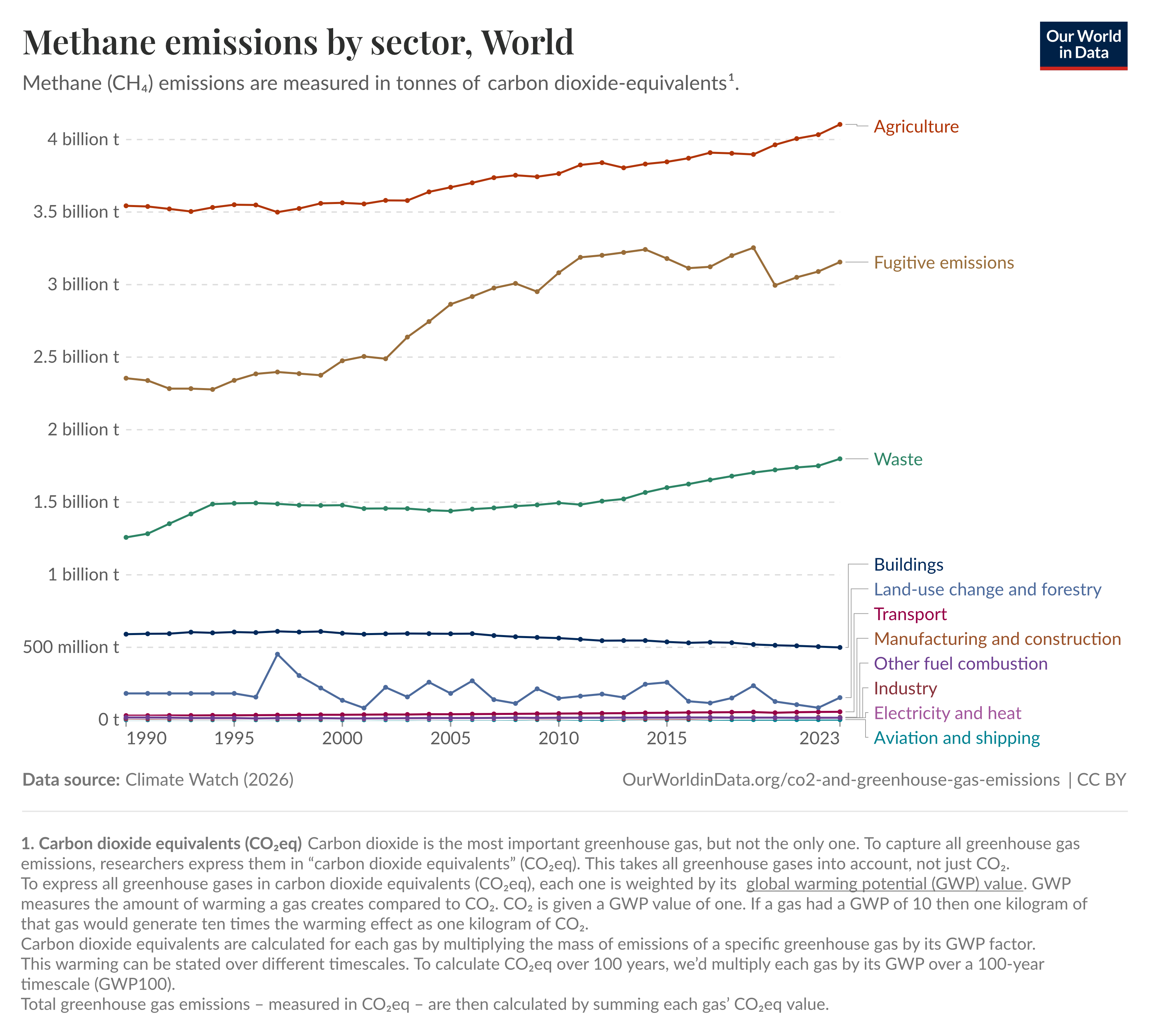
Our World in Data Chart showing the methane release from agriculture, which as we know from above charts, is primarily animals. The release is actually more than shown when it is combined with food waste and land-use change and forestry, which are separate lines in the chart.
###
For press and consulting inquiries, you can reach me at elysabeth@ElysabethAlfano.com .
What I am reading: I suggest FoodFix by Helena Bottemiller Evich if you want to stay updated on the madness that is strategy-barren, food politics.
I also suggest The End of the World Is Just the Beginning by Peter Zeihan, and Merchants of Doubt: How a Handful of Scientists Obscured the Truth on Issues from Tobacco Smoke to Climate Change, by Naomi Oreskes and Erik Conway.
Thanks for reading today and see you next Thursday.
Elysabeth
#
Subscribe to my Substack. Follow me on LinkedIn. Live and interactive content coming soon-ish. Potentially.
This Substack goes dark on all major holiday weeks and if the Cubs are in the World Series.
About Elysabeth Alfano
Elysabeth Alfano is a business and policy advisor on efficient food system transformation. She speaks globally on the intersection of food security, resiliency, efficiency, and our global food supply system, including recently at the United Nations Global Compact Leaders Summit, COP27, COP28, SXSW, BloombergTV, FintechTV, Bloomberg Radio, WGN Radio, WGN-TV and more. She has written for Sustain Finance, Chartered Alternative Investment Alliance (CAIA) and Advisorpedia among other publications. She has hosted two podcasts, The Plantbased Business Hour and Upside & Impact, for the New York Stock Exchange’s podcast platform. She is the former CEO of VegTech™ Invest which was the Advisor to the food systems ETF, EATV.
No posts
Comments
Nothing yet. Say the first thing.
Sign in to join the conversation.