
I have rarely seen my father so happy. He liked clericot: red wine mixed with grapes, melon, and other fruits with a touch of sparkling water. He usually drank it when he was in a good mood. That afternoon was special because it was one of the few times that, almost by magic, I managed to score a goal during a morning football match. We won 3–1. One of the goals had been mine. A header.
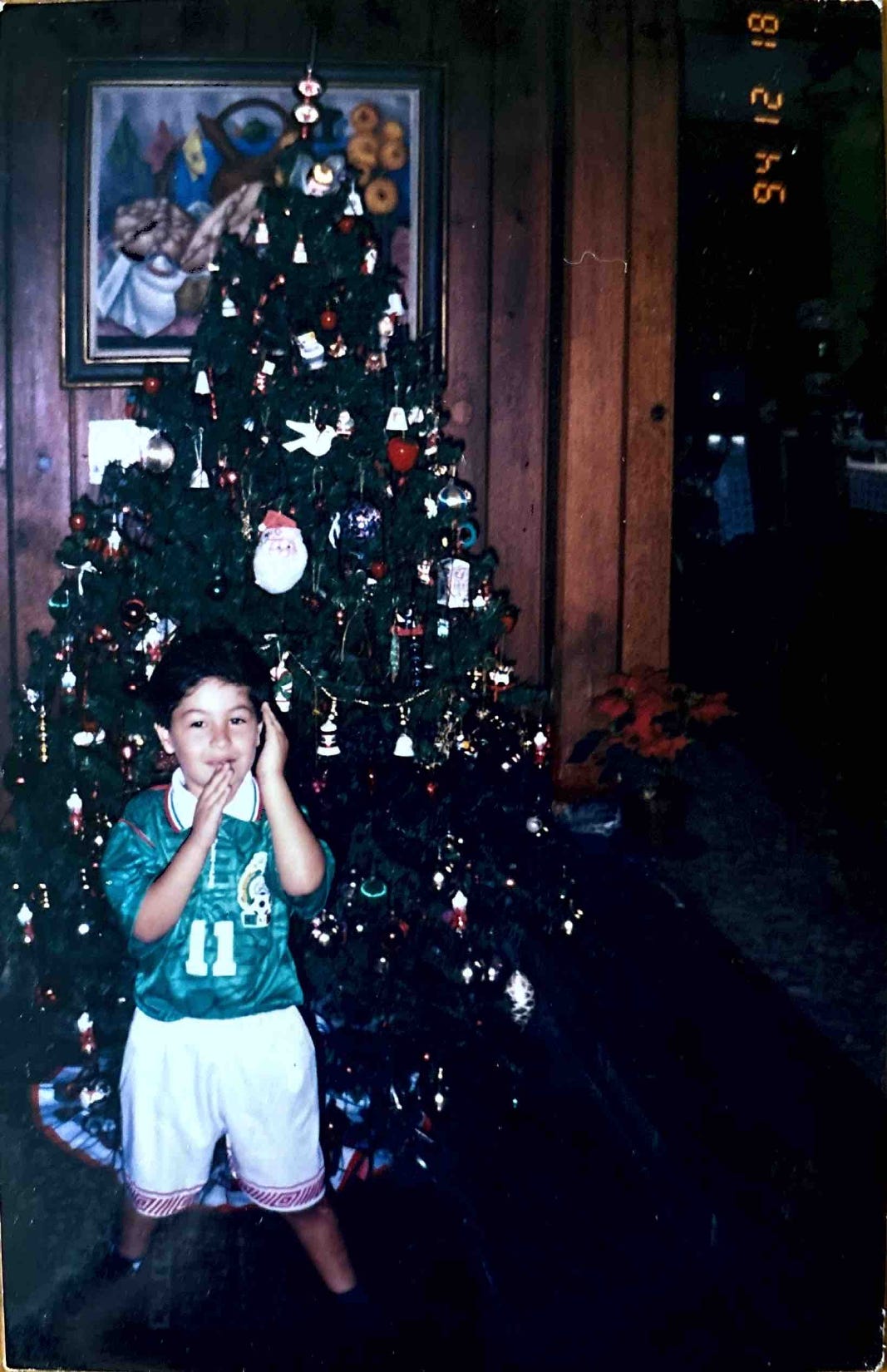
This is me, wearing my Mexican national team jersey at my grandmother’s house.
I only remember the ball coming toward me. I did not move at all. I simply stood there, motionless, watching the ball rise slowly until it became impossible for the goalkeeper to stop it. Then came the commotion. My teammates rushed toward me. They hugged me. Some hit me lightly on the head as a gesture of affection. I also heard distant shouts of excitement followed by: “Well done, son!” The match ended and my parents — especially my father — seemed genuinely happy.
When we arrived home, my father opened a bottle of wine and eventually prepared a pitcher of clericot. I helped him in the kitchen of our apartment while we cut the fruit and poured the wine. There, my father became more cheerful, as if he were an impostor version of himself. He was affectionate, empathetic. He seemed to want to hug me all the time, to tell me how proud he was of me.
“What a goal you scored!” he said.
I do not remember clearly what happened afterward. I think he did hug me and told me how much he loved me.
My mother did not like my father drinking, especially when he went out with friends until late at night and returned home drunk. She preferred him at home drinking clericot while we watched a film together. There was something about clericot that, unlike beer or rum, kept him in a sort of lucidity: a drunkenness that allowed him to display his emotions in a “regulated” way. Neither too loving, nor too effusive, nor too violent.
My father liked alcohol, or perhaps alcohol wanted to consume him.
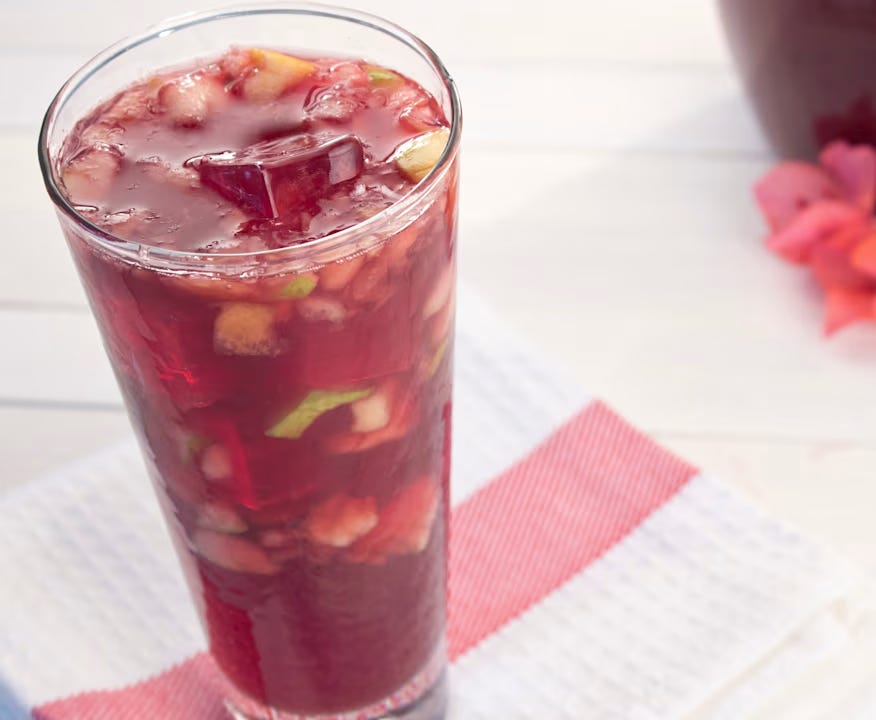
Clericot: a refreshing drink perfect for the summer season. Just be careful: it’s a deceptively strong cocktail. After three glasses, you might start feeling a little tipsy.
My father also played football on Sundays with his childhood friends. When I was fifteen or sixteen, he took me to football pitches in Tultitlán, in the State of Mexico. Beyond the outskirts of Mexico City, those pitches still coexisted with cornfields, milpas, and a rural atmosphere that had not yet been fully swallowed by pavement and sidewalks crowded with street vendors.
On those fields, men in their forties and sixties played football as if they were in the Premier League. Passion, fury, and fights between teams formed part of that football atmosphere. Men in their sixties would put on ointments, bandages, and knee braces just to be able to play twenty minutes. Entire families came to watch their relatives play. I was no longer playing with children my own age; I was playing with men whose greatest illusion was lifting the Sunday trophy before drinking caguamas with their friends afterward.
Because those football fields extended far beyond the grass and goalposts. Beside them were small shops whose main income came from the men who stayed drinking afterward, whether they won or lost, at least a couple of caguamas.
My father had a nickname: “El Paletas.”
“We call him that because your grandmother had a popsicle cart,” one of his friends once told me, a man who also had a nickname I can no longer remember.
“You’re Paletitas now,” they baptized me.
My father’s football team was made up of friends, friends of friends, and acquaintances brought together to complete the eleven players. The first time I played with them, I was extremely nervous. One player from the opposing team — grey-haired and furious — spent most of the match pulling my shirt whenever the referee was not looking. I tried to lose my marker, thinking my speed would be enough, but every time I touched the ball he managed to kick my legs, pinch me, and whisper threats under his breath that he was going to “beat the shit out of me” after the match.
It was not unusual for matches to end in attempted fights every two or three games, whether against the opposing team or among teammates themselves. Sunday football was, for many of them, the only place where they could unload the storms of work and family life they carried throughout the week.
And even so, I wanted to keep going to those matches with my father.
It was one of the few times I could interact with him, get to know him beyond the paternal figure. There I could see him as his friends saw him: as a teammate, a player, someone different from the silent man at home. Even after my parents separated, I continued accompanying him to football matches.
We spoke little. Mostly about football.
About Cruz Azul.
We bought the newspaper Récord to talk about how the team had played — the team we both supported. Every so often we went to the Estadio Azul, the old home of Cruz Azul. As a child, I thought that stadium belonged to the club. Later I discovered, with surprise, that Cruz Azul — whose cooperative owned a cement company — did not actually have its own stadium.
In 2018 Cruz Azul moved to the Estadio Azteca, the giant stadium of Santa Úrsula. For many football fans, that stadium forms an essential part of modern football history for having hosted figures such as Pelé in 1970 and Maradona in 1986. In 2024 they temporarily returned to the Estadio Azul due to renovations ahead of the 2026 World Cup. Later, because of conflicts between the stadium owners and the club’s management, they moved again to the Estadio Universitario, home of Pumas UNAM.
For several months the team remained unbeaten and won the CONCACAF Champions Cup. But that successful run also intensified the rivalry with Pumas, who eventually decided not to renew the agreement allowing Cruz Azul to continue playing at Estadio Universitario. Once again, the team had to move. This time to the Cuauhtémoc Stadium in Puebla, two hours away from Mexico City.
They practically played the entire tournament as visitors.
Despite the difficulties, they remained near the top of the league under the coach, Nicolás Larcamón. However, after several winless matches, he was dismissed shortly before the playoffs. Joel Huiqui, former club player and coach of the under-21 team, unexpectedly took charge.
For many supporters, it seemed to announce yet another tragedy.
Joel Huiqui was remembered, among other things, for the famous “muertinha”: the moment he prevented a goal by using his hand inside the penalty area before pretending to lose consciousness on the pitch. And yet, against all expectations, he led Cruz Azul to the final against Pumas.
The press began calling it “The Final of Obsession,” feeding the narrative that both fan bases were obsessed with defeating one another. One of the most frequent attacks against Cruz Azul was reminding them that they did not even own a stadium. A giant club condemned to live permanently in borrowed homes.
Additionally, the team had developed a pattern of heartbreaking failures over the years: just as victory seemed within reach, in the final moments of decisive matches, something would collapse and they would lose spectacularly. This tendency eventually became known in Mexico as “cruzazulear” — to fail at the exact moment success appears inevitable. In 1916 Freud wrote a text called Some Character Types Met with in Psycho-Analytic Work, where he discusses people who fail precisely when they are about to obtain what they most desire. Sometimes I think he could have been writing about Cruz Azul.
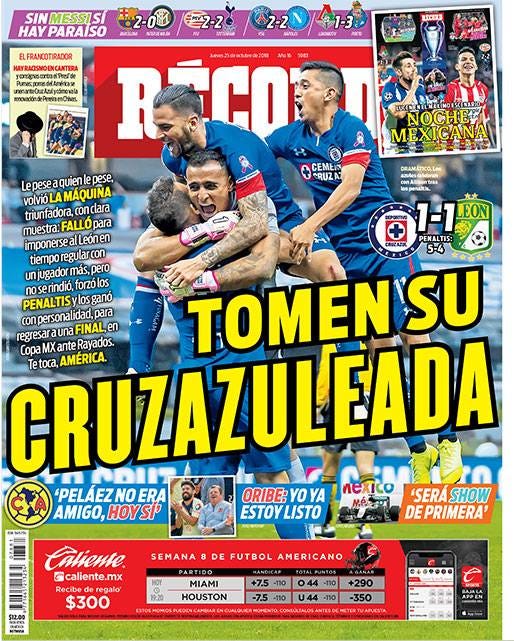
According to Larousse Latinoamericana, cruzazulear means: “To keep winning, only to lose everything because of a mistake.”
Last Sunday, however, the team managed to overcome everything: playing as visitors, constantly changing stadiums, arriving with an unexpected manager, and carrying the collective fear of “cruzazulearla.” They became champions in the final minute.
It was the third time I had seen Cruz Azul become champions.
The first was in 1997. I remember very little: blurred images of sitting beside my father watching the match, blood running down the forehead of Cruz Azul player Carlos Hermosillo before taking the decisive penalty.
The second time did not happen until 2021.
Twenty-three years had passed.
Over time, my father gradually lost interest in the team, perhaps becoming accustomed to Cruz Azul never winning championships. Even so, throughout my childhood and adolescence, much of our conversations revolved around football.
I have not spoken to him in four years. Since moving to Dublin, we have exchanged only a few phone calls.
When my parents separated, my father moved into a house he was still paying off. Later he quit his job and used his severance pay to buy a van where he began sleeping. Eventually he sold the house to a friend, who still occasionally allowed him to stay there, though my father preferred sleeping in the van because he could park it close to work.
My father had become nomadic too. I still have a photo on my phone that he sent me years ago from inside the van. His hair had already turned grey.
It is one of the first questions people ask you when you arrive in another country. Your accent betrays you. But at the same time, the question is usually nothing more than a way to start a conversation. It is either that or talking about the weather.
When I arrived in Dublin, I was certain of my origins: I come from Mexico, from Mexico City. Yet over the years, that sense of identity has slowly begun to shift. Where am I really from?
Living almost five years in Dublin, the relationships I have built here and my coexistence with other migrants have forced me to rethink my identity from an uncomfortable place. Over time, I have realised that many of us live in a state of permanent temporariness. We do not own homes. Our immigration status constantly reminds us how provisional our lives here can be. The racialisation of migrants also reminds us, in different ways, that we always have one foot outside this island.
But returning to Mexico does not mean returning unchanged. Going back means going through another process of adaptation, relearning codes, and discovering that the place you left no longer exists in the same way.
One of the few spaces where I have found a sense of belonging has been playing football in Dublin. Perhaps because football had always been that for me: a way of temporarily inhabiting a place. The fields of Tultitlán, the Estadio Azul, conversations with my father, caguamas after matches, clericot in the kitchen of our apartment. Temporary spaces where it seemed possible to build something resembling a home.
Football and cooking have ultimately become my safe places.
Cooking for others in Ireland, sharing dishes with a rising community, sitting around a table after work or after a football match, has made me think that much of the migrant experience consists of trying to reconstruct small atmospheres of belonging. Provisional spaces where affection, language, football, or food allow us to suspend — even if only for a few hours — the feeling of foreignness.
I think about my father sleeping inside a van. I think about Cruz Azul constantly changing stadiums because it still has not built one of its own.I think about myself planning the next menu for Fondita Mestiza. For God’s sake! Even Fondita Mestiza is a nomadic project!
Perhaps that is why football and food continue to obsess me so deeply. Because both allow us to construct something resembling a home even when everything around us feels temporary.
Sometimes I think my father, Cruz Azul, and many of us have learned to live this way: constantly displaced, building provisional affections, trying to turn borrowed places into homes.
In Dublin, many migrants live in temporary rooms within a city shaped by a housing crisis. Some leave. Others stay a little longer, though never completely. Perhaps that was what the sociologist Zygmunt Bauman meant when speaking about liquid modernity: that even the things that once appeared solid — homes, teams, relationships, countries, identities — end up existing in a constant state of transit.
And even so, we continue cooking. We continue playing football.
We continue trying to build small forms of belonging in temporary places.
No posts
Comments
Nothing yet. Say the first thing.
Sign in to join the conversation.