
At the age of ten, I had already graduated as a nutritionist. Every four or five months my parents would take me to a new specialist to treat my obesity. I remember those white rooms: some used blackboards, others sheets of paper, and others would speak for long periods about the importance of following a strict diet. There were also those who prescribed dubious pills, injections, and even some who intertwined nutrition with religion. My father argued that my weight gain was due to spending too much time playing video games and that I should dedicate myself more seriously to football, swimming, or perhaps another sport. My mother was the one most visibly distressed by my gradual weight gain and declining school performance.
At school, we had homework diaries where we wrote down our weekly assignments, but teachers also recorded each student’s behavioural misconduct. Sometimes my teacher would even attach an extra sheet detailing the exact nature of my misbehaviour that day. When my mother reviewed the notebook, she rarely hid her disappointment or frustration at the latest complaint written by the teacher. Naturally, punishments and scoldings followed. “That’s just how the Ortiz family is,” my mother would say during family gatherings whenever one of us “rebelled” against a figure of authority. As if it were both a blessing and a curse, being “rebellious” was considered part of my character.
A teacher once told me that I needed to stay quiet and behave properly; only then, she said, would I stop eating so much.
The mouth, a fragment of the body, becomes our first contact with the world. The baby encounters the world through the mouth. Beyond maternal nourishment, the child also feeds on the language provided by the mother. Je est un autre (“I is another”), wrote the French poet Arthur Rimbaud, suggesting that the poet should become a visionary and transcend rationality itself. The subject is traversed by voices, histories, bodies and memories — other subjectivities equally shaped by language. Gloria Anzaldúa writes: “Wild tongues can’t be tamed, they can only be cut out.” Meanwhile, the Chilean poet Nicanor Parra states: El pensamiento muere en la boca (Thought dies in the mouth).
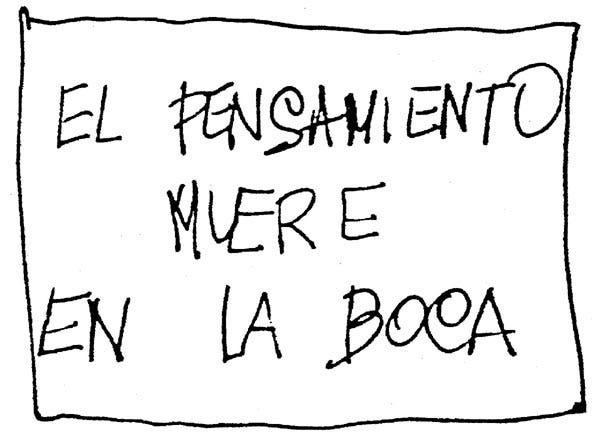
“El pensamiento muere en la boca”, by Nicanor Parra, 1972.
In the neighbourhood where I grew up, there was a man who would regularly ride through the streets in the afternoons with a large basket of sweet bread attached to his bicycle. Every time I saw him pass while I played football with my friends outside, my mouth would water. A voracious desire would make my entire body tremble at the mere thought of eating a vanilla concha. At the time, each pastry cost four pesos, so all I had to do was go upstairs to my apartment, search through the closet where my parents kept money inside a black bum bag they had bought as a souvenir in Acapulco, and take a twenty-peso bill. That way I could buy not just one sweet bread, but an entire bag containing four or five sweet breads.
The sensation of eating that exquisite pastry resembled the moment Marcel Proust describes in In Search of Lost Time, when the narrator tastes a madeleine and experiences an overwhelming aesthetic revelation. Knowledge also enters through the mouth. Certain dishes and flavours reactivate our vitality and transport us toward memories of profound happiness.
“No sooner had the warm liquid mixed with the crumbs touched my palate than a shudder ran through my whole body, and I stopped, intent upon the extraordinary thing that was happening to me…”

A basket full of Mexican sweet breads in all kinds of flavours and shapes
Guilt also enters through the mouth: “carbohydrates,” “too much sugar,” “you gained weight again” — voices constantly repeated until they began echoing inside my head every time I secretly ate sweet bread. Two crimes, like in Dos Crímenes by the Mexican writer Jorge Ibargüengoitia, where the protagonist is accused of crimes he did not commit. In my case, the crimes I had actually committed were stealing twenty pesos from my parents and breaking the latest nutritionist’s diet. Eventually my mother would discover bread wrappers beneath my bed or crumbs scattered across the sheets. More than anger, what I remember in her face was disappointment. She too had spent years living with the internal voices that told her she was fat, that she was never thin enough according to the standards imposed by society. Now her only child had inherited that burden.
Being Mexican and struggling with obesity is profoundly painful. Every celebration, birthday or holiday revolves around dishes specifically created for that occasion. Birthdays mean tacos de guisado, tacos dorados, pambazos, cake, sweets and soft drinks. Day of the Dead brings pan de muerto season, tasting the different sweet breads sold in bakeries, moles and street food. Christmas means eating every possible dish: spaghetti, turkey, romeritos, bacalao, and more turkey. Food in these gatherings also represents affection and care for loved ones. It may sound sentimental, but in these events food is indispensable to communion and to the collective aesthetic experience itself.
Then January arrives, and a large percentage of Mexicans promise themselves they will join a gym, start dieting and change their lives. These are surveilled bodies. Yet sometimes the authority no longer comes from outside, but from a subject who exploits and disciplines himself. In The Burnout Society, Byung-Chul Han describes a subject who exploits himself while believing himself to be free. This subject must remain proactive and productive even during leisure time — always “doing something useful.” The body becomes a project, an enterprise, an investment. Subjects are expected to exercise, attend therapy, eat healthily, maintain active social media accounts, participate socially, multitask, tolerate frustration, adapt constantly and think positively. Neoliberal thought also enters through the mouth.
“We don’t want our kids working in McDonald’s, we need foreign workers for those types of jobs, whether we like it or not, we’ve gone too posh.” These were statements made by Gerry “The Monk” Hutch, an independent candidate and gangland figure in Ireland. Later he retracted the comments, adding that he even had Indian friends and that they were welcome. This frontal rhetoric is often assumed to be how racism manifests itself, yet racism also unfolds horizontally throughout everyday life.
In her essay The Politics of Good Feeling, Sara Ahmed analyses contemporary Western multicultural societies as systems based on the management of public emotions. Central to her argument is the figure of the “happy migrant”: a racialised subject who successfully integrates into the nation as long as he aligns himself with its dominant cultural codes, actively participates in the economy and does not disturb the national imaginary too much. The ideal migrant is resilient, grateful, hardworking, emotionally functional, and quick to adapt. “Mexicans are very hardworking,” “They always give their best,” are phrases commonly heard inside the kitchens where many Mexican migrants work across Dublin.

La Cocina, a film that explores the precarity and labour exploitation experienced by migrants working in a New York kitchen.
The migrant who speaks too much, complains too openly or expresses discomfort risks losing his job. “If you don’t like it here, go back to your country,” or “There’s more racism elsewhere,” are common reactions toward migrants who attempt to articulate structural racism through labour exploitation, racial discrimination, domestic violence or economic inequality. Ahmed refers to this figure as the melancholic migrant: the migrant who refuses to transform pain into a narrative of personal success and self-improvement. The migrant can be angry — but not too angry; sad — but not too sad; political — but not too political.
In this sense, migrant experiences are often reduced to stories of success achieved through individual effort, erasing the historical, colonial and economic structures that produce inequality. As a result, the migrant body learns to self-regulate in order to minimise friction within public space. Even food participates in this negotiation: certain flavours, smells or collective ways of inhabiting the table must be moderated in order to successfully integrate into the European multicultural establishment.
Yes, the migrant can speak, but only as long as that speech remains emotionally functional, productive and non-threatening to the national imaginary.
No posts
Comments
Nothing yet. Say the first thing.
Sign in to join the conversation.