
A reflection shared in an Instagram post last week by the Food and Travel Journalist Vritti Bansal sparked controversy by raising the question of whether there is racism in Ireland, or whether Irish people can be racist. Many of the responses did not engage deeply with her argument; instead, they dismissed or even attacked the journalist herself.
Her argument is grounded in a recurring idea: that, having been colonised, it seems implausible to consider that Irish people could be racist towards other colonised societies or individuals. According to Vritti, this historical background may prevent Irish society from recognising its own positional privilege within Western contexts. These historical dynamics are not unfamiliar to me. In Mexico, similar processes have taken place, where the official narrative imposed by the state constructs a homogeneous vision of what it means to be “Mexican,” erasing other identities that have also emerged within the territory—often resisting the erasure of their own cultures and histories.
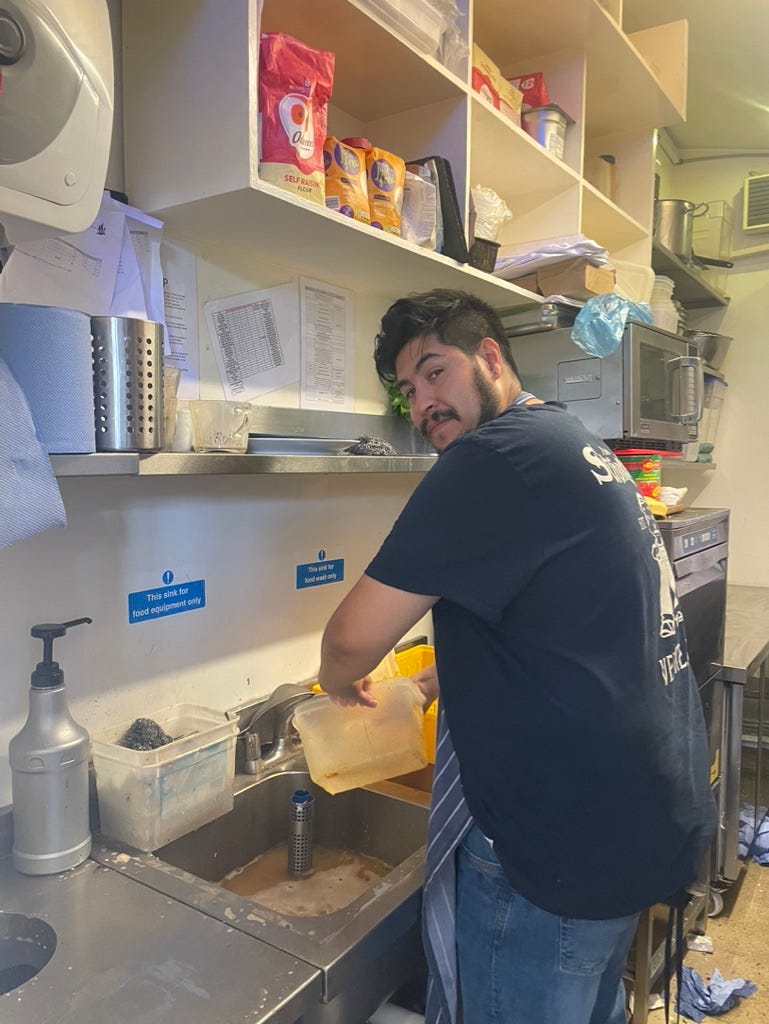
I left behind my psychoanalysis books and the practice of active listening behind the couch to wash the dishes of my neighbors in Ranelagh.
It has now been almost five years since I arrived in Ireland, and from the very beginning I was struck by the cultural and identity diversity of Dublin. The stories I had heard before arriving—about its streets, buildings, and people—turned out to be largely preconceptions shaped by a biased vision, formed through social media and Hollywood films that reproduce Irish stereotypes.
In reality, there is no single Ireland—there are multiple Irelands: different societies interconnected in both explicit and implicit ways. I arrived in just one of these circles, one that my own privilege allowed me to access through a Master’s degree at TU Dublin.
At the same time, due to the limitations of my visa, I quickly understood that where one comes from deeply affects both one’s development and access to these circles, some more privileged than others. “Childhood is destiny,” once said the founder of psychoanalysis, Sigmund Freud. In this case, it might be more accurate to say: A Visa Stamp is destiny.
Upon arrival, I became aware of the severity of Ireland’s housing crisis, the difficulty of finding a decent place to live and the absurdity of queuing alongside thirty others just to view a room or apartment. Fortunately, Andrea and I found a somewhat “decent” studio, at least providing us with a private space to build our daily lives.
But that relief was short-lived. We needed to find work—part-time, as our visa allowed only 20 hours per week—but first we needed a PPS number and a bank account.
Ranelagh was the first neighbourhood we lived in. But don’t be misled: our studio was inside a house where the landlord had divided the space as much as possible to maximise the number of rooms.
Shortly after, I found a job at a café across from the Beechwood Luas station, working as a kitchen porter—washing dishes, glasses, cutlery, and containers. The chef, Dejan—an economist by training who had migrated from Croatia in search of better opportunities—had become a master of brunch preparation for Ranelagh’s clientele.
It was in that role that I understood my place in this new society: I did not exist. My past as a professional, as a psychoanalyst and a teacher, held no relevance in this context. Meanwhile, I continued sending CVs for jobs as a Spanish or psychology teacher, to psychotherapy clinics, or even as a writer.
How naive I was. My identity had already marked my destiny.
Dejan would tell me, “One day you’ll be an expert kitchen porter—in two or three years.” Eventually, I came to understand that social structures organise bodies, identities, and passports. My accent, my nationality, my visa status—all of it revealed me. At times, I considered altering my CV, claiming I had Stamp 4, or even changing my surname to Smith or Locke. Perhaps then I would have better chances.
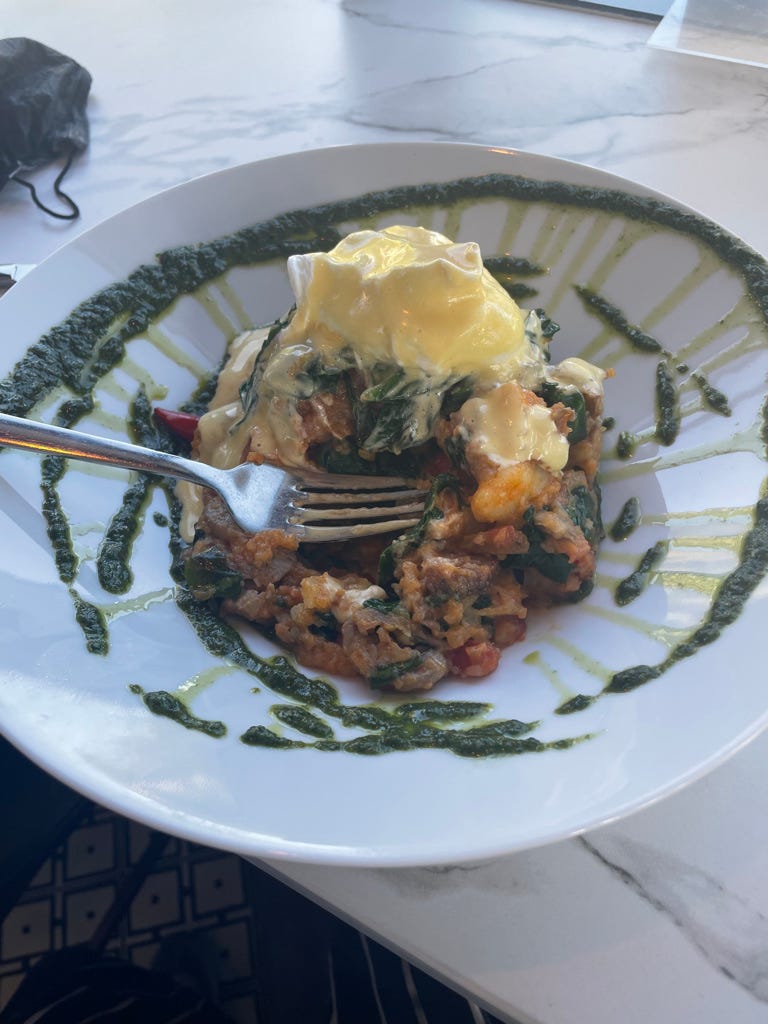
One of the advantages of being a kitchen porter was being able to combine different dishes from the menu into one. Thanks, Dejan!
At the same time, I was pursuing my Master’s degree, clinging to the illusion that I did not belong to the precarious world of migrant labour. I told myself that the kitchen porter phase would end—that it was a Kafkaesque nightmare, that I would not end up as a crushed insect beneath the weight of some Ranelagh bourgeois resident.
I would often see the filmmaker John Carney in the café, always writing on his laptop. Sometimes I imagined asking him if he needed a Latino extra—someone with brown features to provide comic relief in a tense scene. I thought as well that finishing my degree would finally allow me to find a job in my field.
At that time, I still did not understand that individual effort is not enough. That the labour market is a system of hierarchies, and that Western societies are shaped by colonialism, racialisation, and capitalism.
Racism is often understood as the act of pointing out the other based on skin tone or accent—its most visible form. It is here that I resonate with Vritti’s argument. Racism in Ireland does not necessarily manifest in overt ways, but it exists in other forms.
Migrants clean, wash, care for children. To be clear: migrants do the least desirable jobs. One only needs to glance into a restaurant kitchen to see which bodies circulate in that space. There is a clear division between those in the kitchen and those interacting with customers—those who “can speak English.”
This organisation reflects the logic of the coloniality of power, a concept developed by the sociologist Aníbal Quijano. It explains how power structures created during colonialism did not disappear with independence, but continue to operate in new forms. These systems classify and hierarchise individuals based on origin, race, language, accent, or passport, assigning their place within society, legality, and the labour market.
In this sense, a country that has been colonised, like Ireland, is not exempt from participating in racial dynamics. Following Vritti’s logic, a formerly colonised society can internalise Western structures and reproduce inequalities. A history of oppression does not prevent the reproduction of privilege; rather, the two can coexist in complex and often unrecognised ways.
Perhaps this is why the conversation sparked by Vritti felt uncomfortable—not because it lacked validity, but because it touches on a rarely examined area within Irish public discourse. In the food industry, in particular, these dynamics are visible yet rarely questioned.
Dublin’s kitchens are sustained by migrant bodies, performing physically demanding labour, often extending their working hours in pursuit of stability or sponsorship. At the same time, these spaces are sites where knowledge circulates—recipes, techniques, culinary traditions from different parts of the world. Ancestral knowledge is shared, adapted, reinterpreted.
Yet recognition—awards, stars, narratives of authorship—tends to fall upon those in positions of privilege: owners, visible chefs, brand representatives. In some cases, individuals who have never lived in or experienced the cultural contexts from which these practices originate.
In this sense, the kitchen is not merely a site of food production, but a stage where colonial hierarchies are reproduced, and potentially challenged.
Ultimately, this reflection does not seek to close the conversation, but to expand it. To become a thread that extends, connecting with voices that have been silenced or overlooked. Bodies that have been marginalised, racialised within an increasingly unequal context.
A world that will eventually be shaped—and perhaps governed—by artificial intelligence. And if anything is clear, it is that even this intelligence will not be free from the colonial structures that already organise our present.
No posts
Comments
Nothing yet. Say the first thing.
Sign in to join the conversation.