
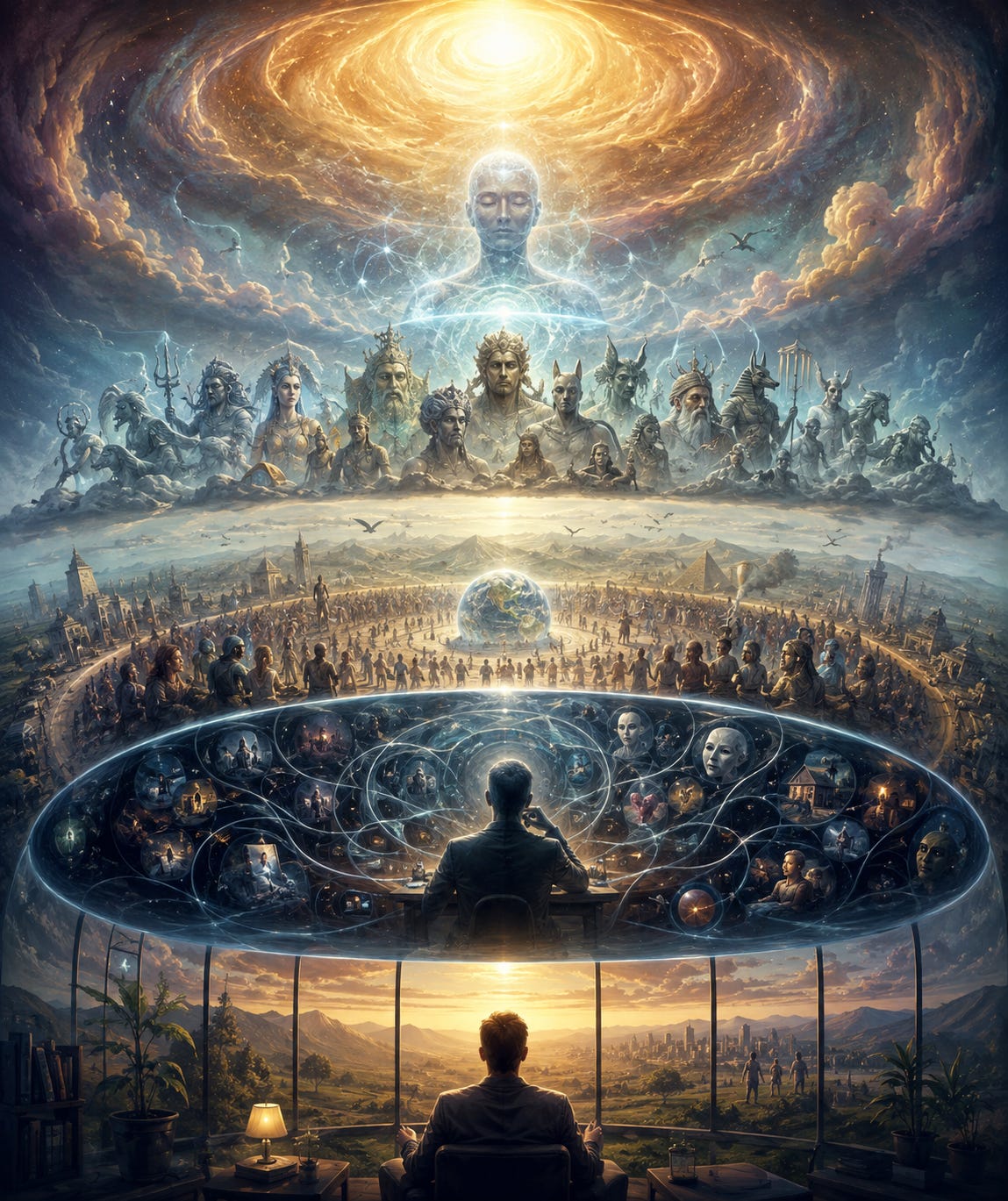
I have been reading A Course in Miracles again.
One of the things that continues to strike me about the Course is the ontological level from which it seems to speak. Its God is difficult to reconcile with the ordinary image of God as a supernatural personality somewhere outside the universe, watching and intervening in human affairs.
The God of the Course is closer to Source itself.
Unconditioned. Undivided. Unthreatened. Complete.
Nothing real has ever left it.
And that raises an interesting question.
What if many of our apparently contradictory descriptions of reality are not necessarily contradictory at all?
What if they are descriptions made from different levels of the same structure?
I have been playing with that possibility.
Not as a doctrine. Not as something I know to be true.
As a model.
And it produces some fascinating consequences.
Imagine reality something like this:
Source / God
Undivided reality.
Consciousness / Sonship
The extension or expression of Source.
Creative or archetypal order
Gods, demiurges, archetypal intelligences, or whatever structures might arise within manifestation.
Collective mind
The enormous shared structures of belief, culture, expectation, meaning, and interpretation.
Individual mind
Identity, conditioning, memory, expectation, and personal belief.
Perception
The world as it is actually experienced.
The important thing about this model is that something can be experientially real at one level without necessarily being ultimately real.
A dream is genuinely experienced.
The fear in a nightmare is real as an experience.
The landscape is visible.
The people speak.
Events have consequences.
There is even a history explaining how you arrived there.
Yet when you awaken, none of this requires the dream world to have existed independently of the mind dreaming it.
Perhaps something similar happens here.
This led me to wonder about humanity’s gods.
If consciousness carries within it something of the creative nature of Source, what happens when that consciousness experiences itself as separate?
Suddenly it finds itself surrounded by forces it cannot understand or control.
The sun rises.
The rains come.
The harvest succeeds or fails.
Children are born.
People become sick.
Storms destroy villages.
People dream.
People die.
And the human mind does something it is exceptionally good at doing.
It detects agency.
Something caused this.
Something wanted this.
Something gave us the rain.
Something withheld it.
Something governs the sea.
Something governs birth.
Something waits beyond death.
And so perhaps consciousness began giving faces to forces too large and mysterious to understand.
The harvest became a god.
The sea became a god.
Love became a goddess.
War became a god.
Death became a being.
Wisdom acquired a face.
This does not require our ancestors to have been foolish or primitive.
It may have been an extraordinarily sophisticated psychological operation.
It transformed incomprehensible forces into things with which humans could establish relationships.
You cannot easily negotiate with atmospheric dynamics.
You can negotiate with a rain god.
You can ask.
You can plead.
You can give thanks.
You can make offerings.
You can tell stories.
You can teach your children what the god wants.
The incomprehensible becomes relational.
And perhaps that is enormously important.
Something else becomes apparent when looking across human history.
Our gods often look remarkably like us.
Warrior cultures have warrior gods.
Agricultural cultures have fertility gods.
Kingdoms imagine divine kings.
Patriarchal societies imagine divine fathers.
Moral civilizations increasingly produce gods concerned with morality.
And as human civilizations became more psychologically, socially, and politically complex, our gods often became more complex with us.
This suggests an intriguing possibility.
Perhaps we did not merely project human faces onto the divine.
Perhaps we projected increasingly sophisticated versions of ourselves.
As we became more egoic, our gods could become more egoic.
They could become jealous.
Territorial.
Punitive.
Concerned with loyalty.
Concerned with obedience.
Concerned with enemies.
Concerned with who worshipped the correct god.
The divine begins displaying strangely human concerns.
This does not necessarily mean there is no God.
It might instead mean that whatever ultimate Reality is, human beings encounter it through representational structures that human minds can hold.
Infinity gets compressed into a person.
Source becomes Father.
Creation becomes Creator.
Order becomes Lawgiver.
Mystery becomes mythology.
And eventually we forget that the representation is a representation.
This is the thought that stopped me.
What if we projected an enormous structure and then forgot that we projected it?
That possibility reaches far beyond religion.
Perhaps consciousness itself does something similar with experienced reality.
Our nervous systems already do this constantly.
When I look outside and see a tree, I don’t experience:
“My visual system is presently constructing a perceptual representation from incoming sensory information.”
I simply experience:
“There is a tree.”
The construction process disappears.
The interface becomes transparent.
I don’t see the representation.
I see through it.
Now imagine something analogous occurring at a much deeper ontological level.
Consciousness generates perspective.
Perspective generates subject and object.
Subject and object generate self and other.
Memory produces continuity.
Identity emerges.
And eventually consciousness no longer experiences:
“I am consciousness having this localized experience.”
It experiences:
“I am this person.”
The projector has become identified with the projected character.
And once that happens, something extraordinary follows.
Everything that consciousness can no longer recognize within itself gets placed somewhere else.
Power belongs to God.
Creation belongs to God.
Knowledge belongs to God.
Judgment belongs to God.
Love belongs to God.
Reality itself belongs to God.
God becomes increasingly distant while the individual becomes increasingly small.
The separation seems enormous.
And perhaps the greater that apparent separation becomes, the more elaborate the explanatory structure required to bridge it.
Priests.
Intermediaries.
Cosmologies.
Heavens.
Hells.
Angels.
Demons.
Rituals.
Rules.
Salvation systems.
Entire metaphysical architectures may arise around one foundational assumption:
Source is somewhere other than here.
This leaves the hardest question.
If consciousness originated in unity, why would it ever forget what it was?
Why separation at all?
I don’t know.
And I increasingly think that I don’t know is an important answer.
It is very easy to fill an unexplained space with an elegant metaphysics simply because the metaphysics feels satisfying.
But there is another possibility that requires surprisingly little additional machinery.
Perhaps forgetting did not happen after separation.
Perhaps forgetting is part of what separation means.
Consider the problem.
Could consciousness continuously and unmistakably know:
I am undivided Source and everything appearing here arises within consciousness
while simultaneously experiencing itself as a genuinely separate individual existing independently among other separate things?
Perhaps not.
The two perceptions undermine each other.
For separation to become convincing, the larger identity may necessarily have to become obscured.
The sequence therefore might not be:
Separation → forgetting
but:
Localization + identification + forgetting = the experience of separation.
Forgetting would not be an unfortunate consequence of separation.
It would be part of the mechanism that makes separation believable.
A Course in Miracles goes further.
It essentially challenges the premise of the question itself.
If Reality is genuinely undivided, what could exist outside that Reality to separate from it?
If perfect unity actually became divided, then it could not have been perfect unity in the first place.
So from the Course’s highest ontological perspective, separation never actually occurred.
That sounds absurd from here.
Clearly something is happening.
I’m sitting here writing about it.
But dreams provide an interesting analogy.
Imagine dreaming that you have been stranded on an island for twenty years.
Within the dream, you might ask:
How did I become stranded here?
Perhaps there was a shipwreck.
You could investigate the wreck.
Remember the storm.
Find pieces of the ship.
Develop an entire causal history explaining exactly how you arrived on the island.
Then you awaken.
Suddenly the question changes completely.
There was no shipwreck.
You were never stranded.
The entire causal explanation existed inside the dream.
No event occurring within the dream could ultimately explain why the dream existed.
Perhaps this is why the original cause of separation becomes so difficult to locate.
We may be searching for an event inside the simulation that explains the existence of the simulation.
There is another possibility worth keeping open, even though it departs somewhat from the Course.
Perhaps localization itself isn’t an error.
Perhaps perspective is what makes certain kinds of experience possible.
Undivided consciousness contains everything.
But introduce perspective and suddenly there is:
Here and there.
Before and after.
Observer and observed.
Self and other.
Discovery.
Surprise.
Relationship.
Creation.
Recognition.
Perhaps Source experiences itself through finite perspectives.
If so, forgetting takes on an entirely different meaning.
It isn’t punishment.
It isn’t corruption.
It isn’t humanity falling from grace.
It may simply be the price of perspective.
The character has to temporarily forget the whole story for the story to become immersive.
And awakening would not necessarily mean destroying the character.
It would mean recognizing what the character actually is.
This brings me back to something I have been exploring from several completely different directions.
Identity does not necessarily need to disappear.
It needs to become provisional.
Permeable.
Useful without becoming absolute.
I can say:
I am this person.
That remains perfectly functional.
The problem begins when the statement silently becomes:
This person is the totality of what I am.
Those are radically different propositions.
Perhaps awakening is not the destruction of identity but the recovery of context around identity.
The individual remains.
The personality remains.
The body remains.
The story remains.
But they become transparent.
Instead of consciousness being trapped inside the character, the character becomes recognized as an expression occurring within consciousness.
And perhaps this is why the language of remembering appears so naturally in mystical traditions.
Maybe there is nowhere to go.
Nothing new to become.
Nothing missing that needs to be acquired.
The movement is in the opposite direction.
We begin with the world.
Then question perception.
Then identity.
Then belief.
Then the structures we collectively created.
Then the gods we placed above those structures.
And eventually we arrive at the question hiding underneath all the others:
What was doing the projecting in the first place?
Perhaps humanity spent thousands of years placing increasingly elaborate representations of its own forgotten Source outside itself.
Perhaps the gods were not foolish mistakes.
Perhaps they were breadcrumbs.
Attempts by separated consciousness to represent a wholeness, intelligence, power, and mystery it could still somehow sense but could no longer recognize as belonging to its own deepest nature.
And perhaps that explains something else.
Sometimes I encounter an idea in contemplative practice and there is an immediate emotional response.
Joy.
Recognition.
Occasionally tears.
I have learned to pay attention to that response.
Not because emotion proves a metaphysical proposition true. Human beings can feel profound certainty about things that are wrong.
But because it tells me:
Something here resonates deeply enough to investigate.
Notice first.
Interpret later.
Revise often.
And this particular possibility produces a great deal worth noticing:
Perhaps forgetting wasn’t something that happened after we became separate.
Perhaps forgetting is what makes separation feel real at all.
And if that is true, awakening may be something astonishingly simple.
Not becoming something greater.
Not reaching somewhere higher.
Not earning our way back to God.
Just slowly recognizing the structure we have been looking through for so long that we forgot it was there.
And remembering what was looking through it.
-Elias
Comments
Nothing yet. Say the first thing.
Sign in to join the conversation.