
There is a bloodhound who lives quite near me.
I don’t know if you’ve ever heard a genuinely enthusiastic bloodhound at a distance, but there is no mistaking one. This particular dog begins each call with an enormous, committed first note.
BAROOooooo.
Last night, that sound accidentally became the endpoint of an experiment in attention.
For the past several weeks, I have been participating in what has effectively become a longitudinal experiment nested inside another longitudinal experiment. I have spent months recording my brain activity during meditation, sleep, orgasm, unusual perceptual events, and ordinary resting states. More recently, an experimental feature in the Pineal EEG application began measuring something its developer calls harmonicity.
The application currently uses this signal as part of an experimental detector for jhana-like activity.
That label sent me down an unexpected rabbit hole.
I wasn’t practicing jhana. In fact, when the application first began repeatedly reporting it, I had to go learn what jhana was.
That led me to Leigh Brasington’s Right Concentration, conversations with the developer, discussions with experienced meditators on Dharma Overground, and eventually a much more interesting question than whether a piece of software thinks I’m entering a particular meditative state.
What is the harmonicity signal actually responding to?
The answer is beginning to look less like the content of consciousness and more like the organization of attention.
Initially, the pattern seemed simple.
Close my eyes and relax, and harmonicity rises.
But simple explanations are dangerous when you’re changing several variables simultaneously.
Closing my eyes also means reducing visual processing. It changes attention. It changes environmental engagement. It changes alpha activity. And because I was listening to real-time audio feedback from the application, it also gave me something to monitor.
So I started changing one variable at a time.
An early eyes-open experiment failed rather spectacularly because I decided that “eyes open” could apparently include watching television and then playing a video game.
The application essentially responded with a sad trombone.
No jhana detected.
In retrospect, this was a terrible control and an excellent experiment.
I hadn’t changed eye state. I had changed almost everything.
So I tried again.
Quiet eyes-open observation produced some harmonicity. Closing my eyes produced substantially more.
Then I reversed the order.
That brought me to last night’s experiment.
The experiment was simple.
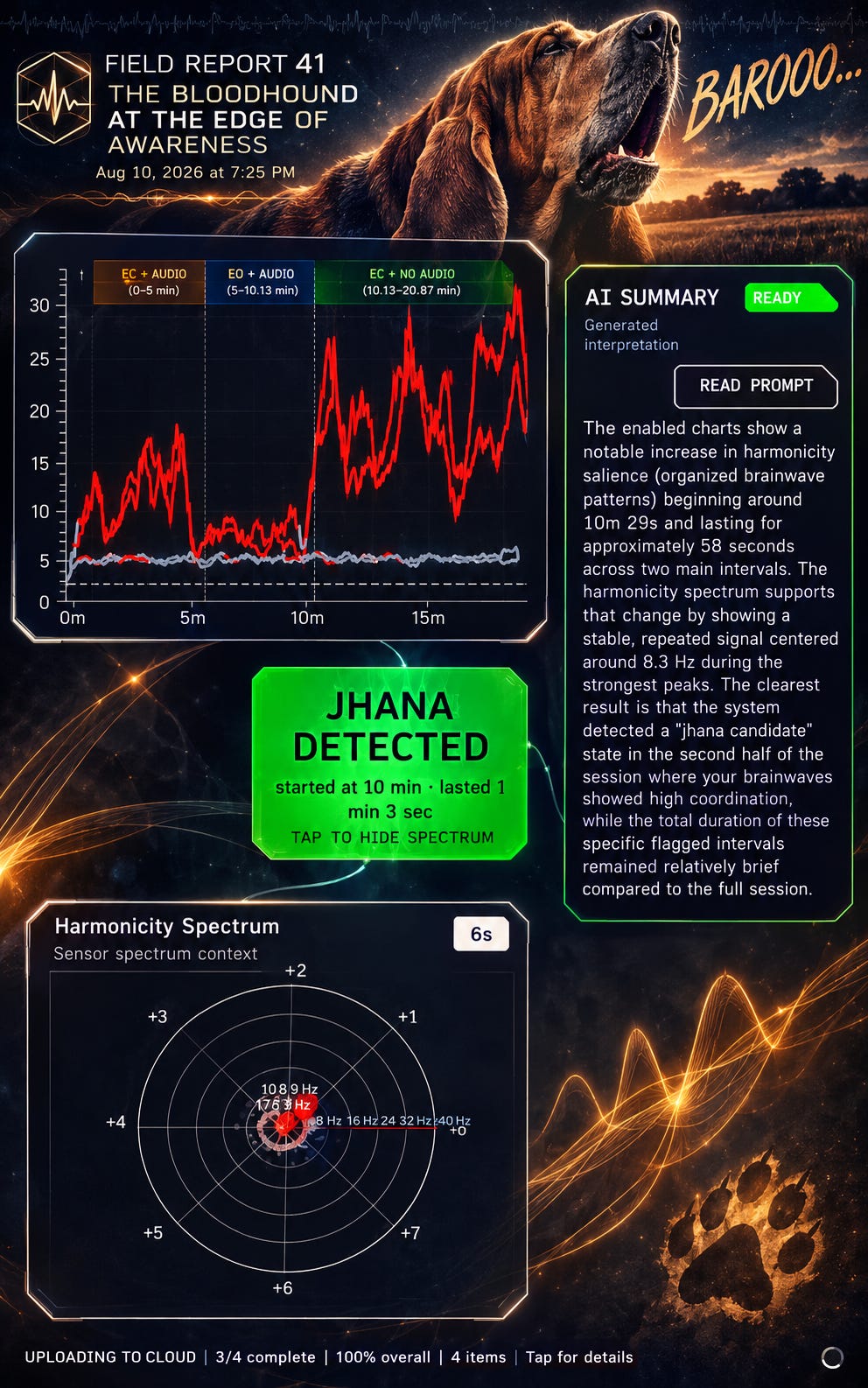
For approximately five minutes, I kept my eyes closed while listening to the harmonicity feedback.
Then I opened my eyes for approximately five minutes while continuing to listen.
Finally, I closed my eyes again, turned the feedback completely off, and stopped conducting the experiment psychologically.
That last distinction turned out to matter.
I wasn’t trying to meditate particularly well.
I wasn’t trying to increase harmonicity.
I wasn’t following my breath.
I wasn’t trying to enter a jhana.
I simply allowed attention to go wherever it wanted.
And something changed.
The exported recording later showed that the session lasted 20.87 minutes.
During the first eyes-closed period with feedback, median harmonicity salience was approximately 5.6.
During the eyes-open period with feedback, it was approximately 5.4.
During the final eyes-closed period without feedback, it rose to approximately 9.5.
The difference at the upper end was larger still. The 90th percentile increased from approximately 9.3 during the opening condition to 17.1 during the final condition.
But the most interesting thing was that the increase wasn’t immediate.
I turned off the feedback and closed my eyes at approximately 10 minutes and 8 seconds.
The signal remained relatively quiet for another couple of minutes.
Then, around 12 and a half minutes, harmonicity rose dramatically and remained strongly organized through much of the remainder of the session.
Something appeared to need time to settle.
This is where the phenomenology becomes interesting.
During that latter period, awareness became extremely broad.
There was a luminous visual quality that I can best describe as fog made of light. It didn’t seem particularly meaningful. I wasn’t looking at something.
There was simply visual experience.
My ordinary sense of the body became increasingly indistinct. Rather than experiencing myself as a body observing the fog, there were moments when it felt more like I was part of the same space through which the fog was moving.
Sounds continued.
This is important.
I wasn’t cut off from the environment.
I could still hear distant noises around me, but increasingly they seemed to lose their status as identifiable objects. They were simply sounds arising within the same field.
Sometimes they seemed less like sounds occurring somewhere outside me and more like sounds passing through me.
Yet I remained aware that all of this was happening.
There was no sense that I had fallen asleep or disappeared into a fantasy.
Experience continued.
What seemed to diminish was the need to divide it into things.
Sound.
Light.
Body.
Distance.
Me.
Outside.
Inside.
Those distinctions remained potentially available, but they weren’t particularly important.
And somewhere along the way, time stopped being particularly important too.
I had intended the final condition to last approximately five minutes.
There was one small problem.
I had turned off the audio feedback, and there was no third timer.
So I would simply know when five minutes had passed.
This proved optimistic.
The final condition lasted 10.74 minutes.
I hadn’t lost consciousness. I hadn’t spent ten minutes daydreaming. I simply stopped keeping track of time.
And then came the bloodhound.
BAROOooooo.
At first, he was simply another distant sound.
BAROOooooo.
Still sound.
BAROOooooo.
But this dog was having an exceptionally important evening and apparently believed the entire Annapolis Valley needed to know about it.
Eventually something changed.
The sound became sticky.
It began repeatedly capturing attention.
Sound became dog.
Dog became neighbor’s dog.
Neighbor’s dog became persistent interruption.
Persistent interruption became:
Wait.
How long have I been sitting here?
Oh.
Maybe five minutes is up.
I ended the recording.
This may be my favorite part of the experiment.
While the application processed the recording, I remained sitting quietly.
And I listened to him.
BAROOooooo.
Now I found him hilarious.
His call has an extraordinary attack. The first note is pushed with tremendous enthusiasm before trailing away into that unmistakable bloodhound howl.
A few moments later, I heard my neighbor Gary’s tractor.
And suddenly an ordinary little story reconstructed itself.
Gary had apparently been out in the field.
The dog probably knew he was coming home.
And he was delighted.
The same auditory stimulus had existed throughout this transition.
What changed was my relationship to it.
During the deepest part of the experiment, it could remain largely sound without becoming important.
Eventually its repetition captured attention strongly enough that it became an object.
Then it acquired identity.
Then context.
Then narrative.
Dog.
Gary.
Tractor.
Coming home.
Happy dog.
None of that was wrong.
But none of it was necessary for hearing the sound.
This has changed the question I am asking about harmonicity.
The signal doesn’t appear to require an empty mind.
Thoughts can occur.
Sounds can occur.
Bodily sensations can occur.
Visual phenomena can occur.
Emotion can occur.
In previous recordings, considerable household chaos has occurred without destroying it.
So perhaps the relevant variable isn’t how much content consciousness contains.
Perhaps it is how strongly any particular piece of content captures attention.
That suggests a tentative distinction:
High harmonicity may be associated not with the absence of experience, but with broad awareness in which individual contents exert relatively little attentional pull.
The dog did not disrupt the condition merely by making sound.
There had been sounds all along.
What apparently mattered was when one sound became sufficiently salient, repetitive, and meaningful that attention began organizing itself around it.
This remains a hypothesis.
The EEG signal could have other explanations. Eye closure itself strongly affects brain rhythms, particularly alpha. The removal of audio feedback changed another variable simultaneously. Time in meditation may matter. Expectation may matter. And whatever Pineal calls harmonicity should not automatically be equated with jhana simply because that is the current label attached to its experimental detector.
Those questions require controls.
And that is exactly what comes next.
But the phenomenology has given me something more interesting to investigate than the label I started with.
Perhaps attention isn’t stable because nothing is happening.
Perhaps attention becomes stable when everything is allowed to happen without anything having to become the center.
And apparently, if you want to know where the boundary of that condition lies, a sufficiently enthusiastic bloodhound is a perfectly serviceable scientific instrument.
BAROOooooo.
Notice first. Interpret later. Revise often.
-Elias
Comments
Nothing yet. Say the first thing.
Sign in to join the conversation.