
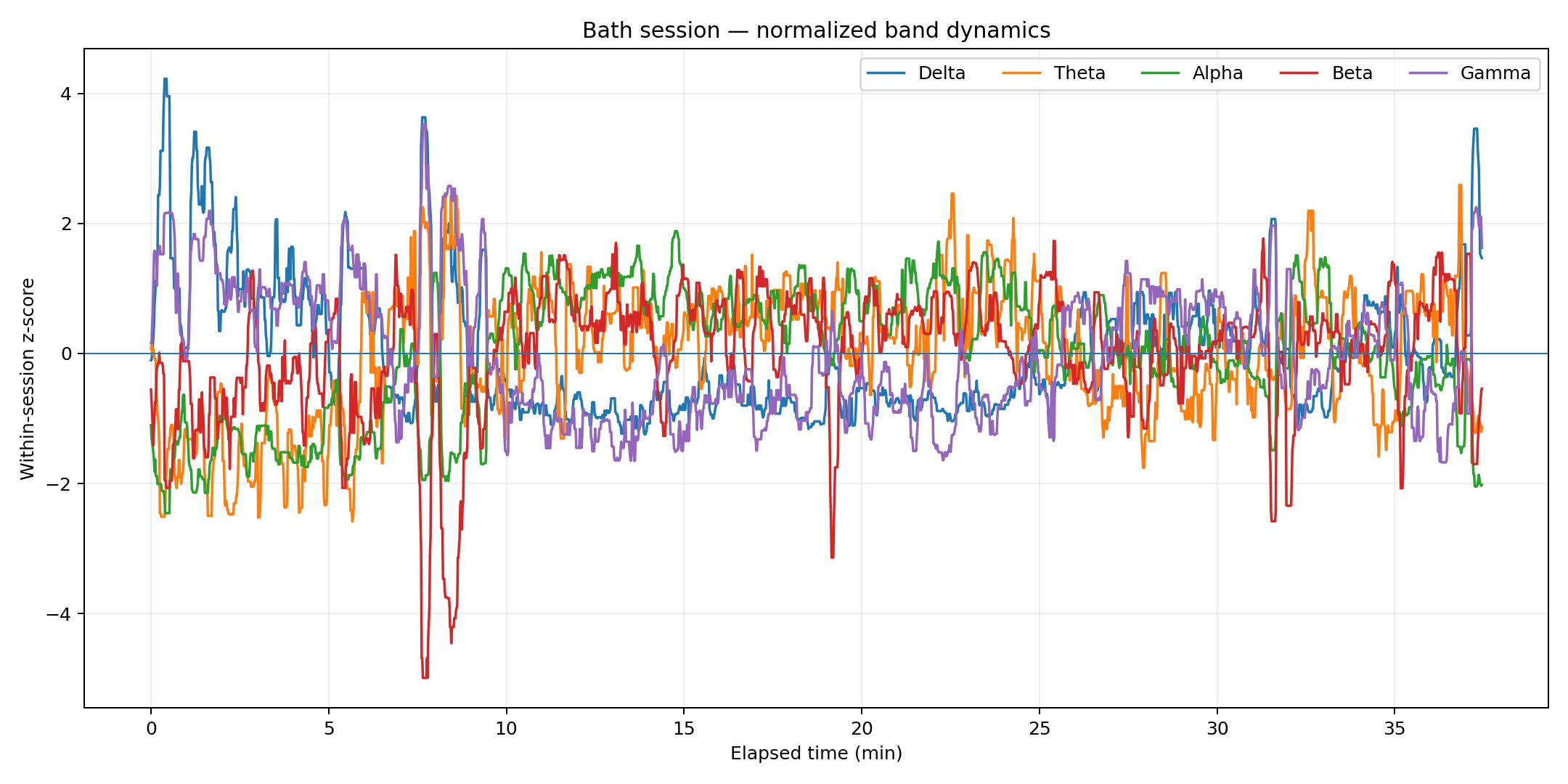
One of the advantages of maintaining a longitudinal EEG record is that unusual observations rarely remain isolated for long. Patterns begin to emerge—not because they are expected, but because they continue to appear under different conditions.
This report compares two meditation sessions recorded under markedly different circumstances.
The first was a conventional daytime meditation session.
The second occurred after a physically demanding workday, during a hot Epsom salt bath, with frequent interruptions from household activity, conversation, and pets.
From a traditional meditation perspective, the second session would seem to be the less favorable environment. Surprisingly, it became one of the most informative.
Over the last several weeks I have repeatedly noticed an unusual change in my breathing during deeper meditation. The rhythm becomes markedly different from my normal resting respiration. Occasionally it is accompanied by a mild sensation of reflux or altered movement in the esophagus. The breathing itself feels almost automatic rather than intentionally controlled.
The obvious question was:
Where does this breathing change fit within the overall transition?
Does it initiate the shift?
Does it follow it?
Or is it simply another parallel phenomenon?
Rather than assuming an answer, I compared two independent recordings.
During the afternoon session several observations were recorded as live voice notes.
Among them were:
“Breathtaking expanse.”
“My body is falling into that strange breathing.”
“I’m not going to force anything.”
The timestamps revealed something unexpected.
The report of expansive phenomenology occurred several minutes before the breathing transition was noted.
In other words, the breathing change was not the first identifiable marker.
The second session took place under very different conditions.
After four hours of highway driving and installation work, I soaked in a hot Epsom salt bath while recording another EEG session. The house was anything but quiet. My dog and cat chased one another through the room, my wife played with the dog nearby, and conversation interrupted the session several times.
Despite the distractions, the same broad sequence appeared to unfold.
The audio feedback generated by the Pineal software began rising early in the session, before I noticed any unusual breathing.
Only later did the familiar respiratory pattern emerge.
Unfortunately, the voice annotation describing the breathing failed to save, likely because I spoke too quietly from the bathtub. The immediate post-session notes, however, were recorded within minutes of completing the experiment and consistently described the same ordering.
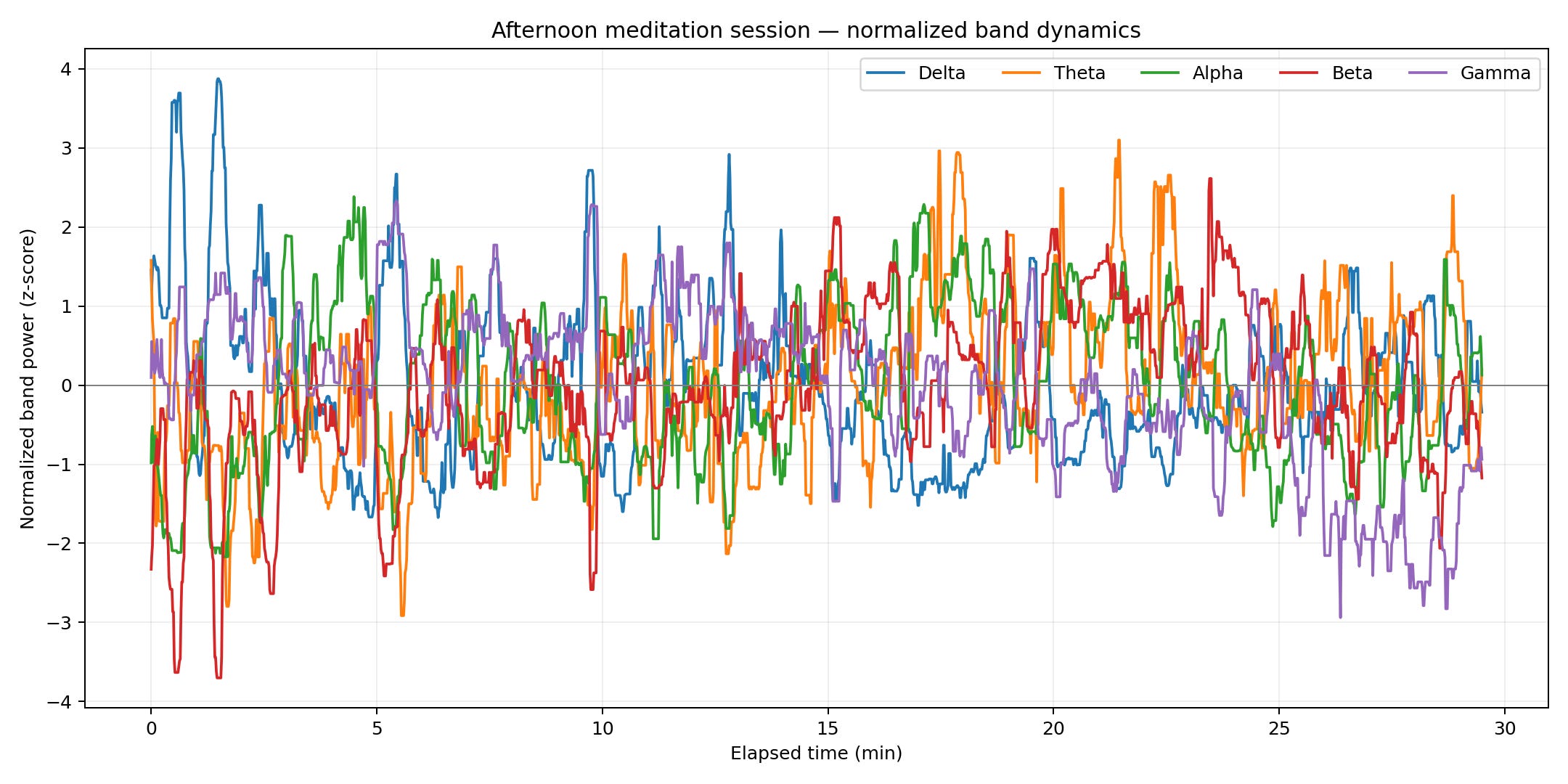
Although the environments differed dramatically, several features appeared remarkably consistent.
An early transition occurred before the breathing change.
The breathing transition followed rather than preceded the initial shift.
Deliberate effort appeared more disruptive than ordinary thoughts.
Environmental sounds and changing attentional objects did not reliably prevent the transition.
Stable observation remained available throughout changing mental content.
Rather than suggesting a causal relationship, these observations point toward a recurring temporal sequence.
At present, the working model looks something like this:
Settling
↓
Early neural / algorithmic transition
↓
Changes in subjective experience
↓
Autonomic transition (altered breathing)
↓
Stable observational mode
This should be understood as a descriptive model rather than an explanatory one. The arrows represent observed ordering, not demonstrated causation.
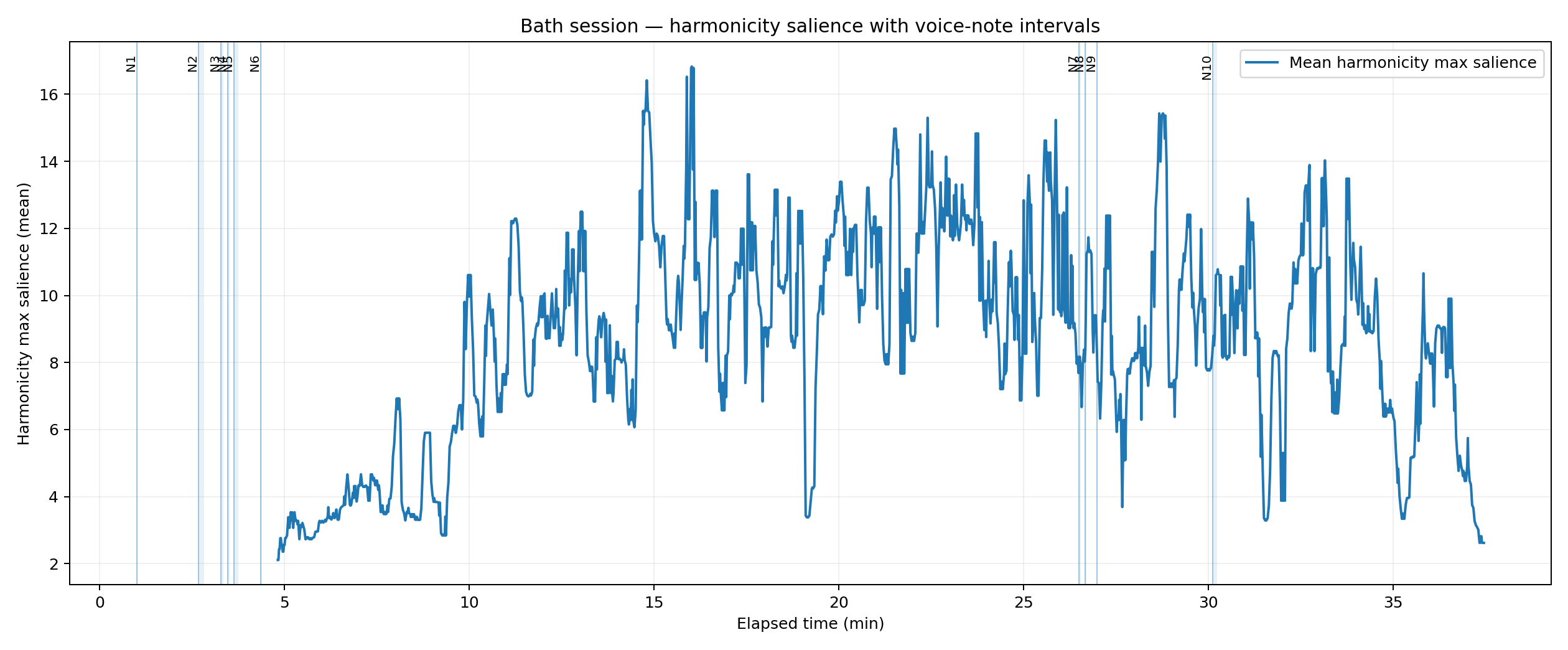
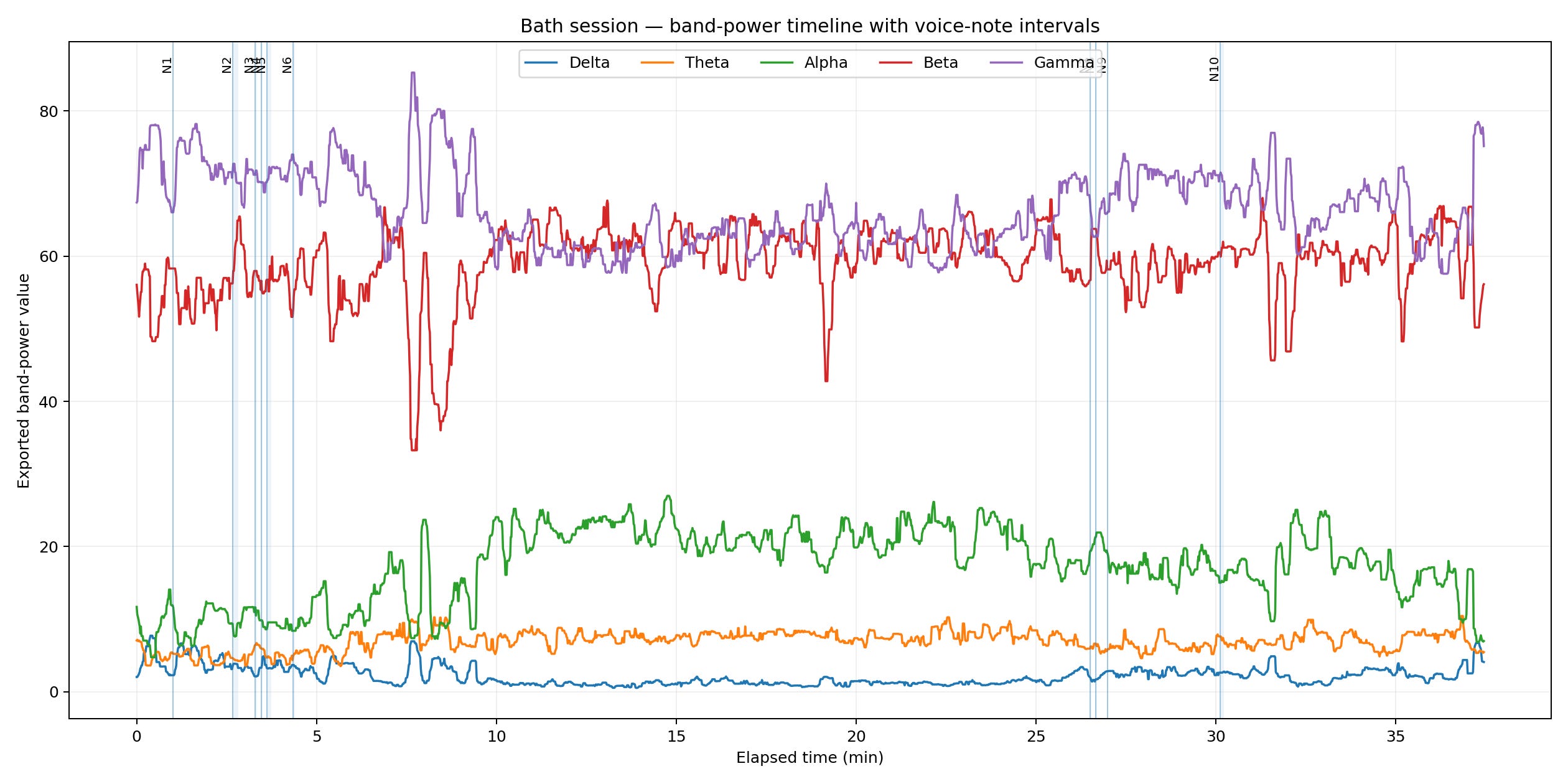
One of the more surprising observations from these sessions had nothing to do with breathing.
Repeated attempts to deliberately control the experience generally reduced the audio feedback generated by the system.
By contrast, allowing attention to move naturally among bodily sensations, environmental sounds, thoughts, or even periods of apparent mental silence often allowed the process to continue uninterrupted.
Whether this reflects a genuine neural phenomenon or a characteristic of the current feedback algorithm remains unknown.
Either explanation remains plausible.
As with every entry in this series, several limitations remain.
This is a single-subject longitudinal investigation.
The recordings were obtained using consumer EEG hardware.
Some voice annotations were lost due to recording limitations.
Phenomenological reports remain subjective.
No causal claims are being made.
These reports are intended to document reproducible observations rather than establish definitive explanations.
The most interesting outcome of these sessions is not the breathing itself.
It is the growing possibility that the breathing change is not the beginning of the transition, but one recognizable stage within a larger unfolding process.
Future sessions will continue examining the relative timing of:
EEG reorganization,
algorithmic feedback,
respiratory changes,
autonomic markers,
and subjective phenomenology.
For now, the most accurate conclusion is also the simplest.
The transition appears to begin before the breath changes.
Whether that observation continues to survive future comparison remains an open question.
As always, the methodology remains unchanged:
Notice first. Interpret later. Revise often.
-Elias
Comments
Nothing yet. Say the first thing.
Sign in to join the conversation.