
Every important relationship can be marked with firsts.
Things like first meeting.
First date. First kiss.
And, of course, there’s also first fight.
I had mine this week — with a lot of weirdness — on my first day of Harvard Business School’s Foundry program, bizarrely with a Terminator-level AI.

My experience runs contrary to the general trend in our culture.
This March, Myra Cheng wrote in the Stanford Report that:
“By default, AI advice does not tell people that they’re wrong nor give them ‘tough love.’
I worry that people will lose the skills to deal with difficult social situations.”
And this May, Oxford and Stanford researchers reported that people preferred sycophantic AI “not for the quality of its advice, but because it made them feel most understood.”
This kind of “frictionless understanding” — put simply, the tendency of AI to agree with you about anything — was not what I experienced with the Harvard program.
In fact, it was the exact opposite.

Having created online courses that have enrolled more than 100,000 students, I’m no stranger to learning on the internet.
My experience with the Harvard program began traditionally, with a progression of slides, links to some relevant videos, and then not one but two AI conversations.
The first was through chat alone.
The second was voice-driven and visual.
While watching a loop of one of the real professors listening to you and nodding with understanding, you answer a question.
Then you mute yourself and the video springs to life, with “the professor” responding in his own voice.
Visually, it’s a slightly choppy but roughly 80% approximation of a real Zoom call.
It’s amazing and very weird.
What was most surprising, though, was that all this AI was programmed to keep challenging you, questioning your assumptions, and asking all sorts of far-reaching questions.
I don’t know if I’d call anything computer-based “tough love,” but its personality definitely was not — as Sam Altman said of a recent ChatGPT update — “too sycophant-y.”
Instead, it was brutal in its examination, determined to expose the flaws in your entrepreneurial vision.
And that’s where my first argument began.

This month in the Transformation Book Club we’re reading The 50th Law: Overcoming Adversity Through Fearlessness by the rap mogul 50 Cent and Robert Greene.
(You can join us or just support this newsletter HERE).
In some ways, it’s a universe away from other books we’ve shared like Elizabeth Gilbert’s Big Magic or the heartwarming Theo of Golden.
50 Cent spent his early years as a crack cocaine dealer.
He began selling narcotics at age 12 while his grandparents thought he was in after-school programs.
Amplifying this month’s theme of Fearless Clarity — meditation HERE — the authors write that:
Simply put, realists are not afraid to look at the harsh circumstances of life. They sharpen their eye by paying keen attention to details, to people’s intentions, to the dark realities hiding behind any glamorous surface. Like any muscle that is trained, they develop the capacity to see with more intensity.
No matter what your circumstances, 50 Cent and Greene maintain that:
The firmer your grasp on reality,
the more power you will have to alter it for your purposes.
Or as 50 said quite succinctly:
Reality is my drug.
The more I have of it, the more power I get and the higher I feel.

It’s not clear at first, but there’s a scale that’s evaluating everything you’re saying to the AI professor.
The scale starts at “Needs Work.”
(“Good” is apparently quite literally as good as it gets.)
Here was my breaking point:
Midway through the conversation, the AI rated my project idea as “Good.”
Then, through repeated questioning, we refined it further, making what I felt was significant progress.
At first, I was baffled that all this additional work had diminished my score, but I soon understood what had happened.
Looking more deeply and more fearlessly, the AI — and I — realized that actual evidence was required.
Things had to be tested in the real world.
For an overachiever, nothing is worse than being forever trapped at “Okay.”
Yet try as I might, within the confines of the conversation, there was no way to get back to “Good.”

Later, something else uncanny happened.
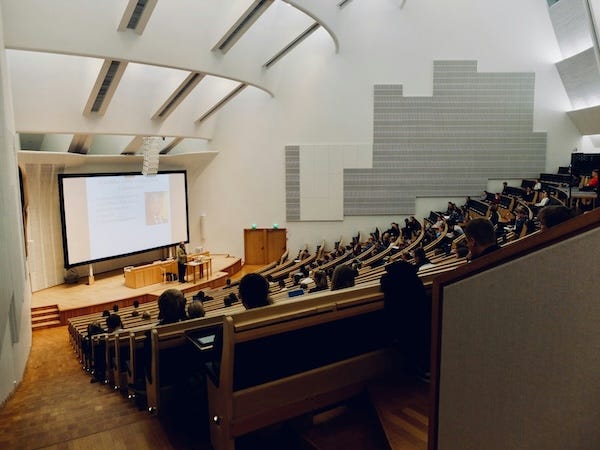
The next day, I attended the first live lecture with the actual human professor — the one whose AI clone I’d been dialoguing with.
I’ve met more than my fair share of celebrities, and there’s always something a little strange about having a strong sense of knowing someone from stage or screen and then meeting them in real life.
They already occupy a place in your mind — sometimes even a very large one — but they have no idea who you are.
For them, it’s a first encounter with a total stranger; for you, it’s almost an awkward reunion.
But this was the first time I’d met someone after having an extensive conversation with their AI clone.
The relationship is still lopsided, perhaps even more so, since you’ve actually connected to their cybernetic identity.
Yet that isn’t the thing that was most jarring.

I expected that the program would be focused right out of the gate on technology and economics, areas that I’ve studied but that are definitely not my wheelhouse.
I assumed we’d dive right into business models or coding breakthroughs.
Instead, week one is entirely devoted to Mindset.
Astonishingly, the professor’s focus was applying the classical framework of the Hero’s Journey to entrepreneurship.
Having taught my own seven-week Hero’s Hourney course applied to personal growth two years ago, I was stunned.
Don’t get me wrong: the syllabus for future lessons reveals plenty of territory I’ve never even thought about.
Yet, for a moment — realizing I’ve actually taught a significant portion of this mindset material myself — I wondered if I was way past “Okay to Move Forward” and even “Good,” and ready for some new category like “Substitute Teacher Level.”
It’s certainly been an unusual week of learning.
Encountering the professor’s clone before I met the actual teacher.
Thinking I was headed into a tech wilderness but finding myself instead in the familiar territory of narrative and storytelling.
And, most importantly, learning that “Okay to Move Forward” may sometimes be more valuable than “Good.”
Digging deeper often reveals that there are many more layers to explore.
Indeed, Fearless Clarity — again, meditation HERE — isn’t always about arriving at a confident answer.
Sometimes it forces you to ask more questions instead.
Fearless Clarity often means accepting what you don’t yet know — and what you sometimes cannot possibly know until you experiment more in the real world.
Ultimately, it’s only by engaging further with reality — and not its AI clones — that you can find the answers you need.
Tell a New Story. Transform Your Life.

Ironically, I seems I had to go to Harvard to rediscover my own course.
My Tell a New Story course has been living quietly in the background since I first offered it three years ago.
Centered around the Hero’s Journey model from Joseph Campbell’s work, it helps you identify what story you’re living in so you can rapidly reinvent.
In honor of my Harvard synchronicity, through August 15th, I’m making the complete replay available for $47 — rather than the usual $77.
You get seven video lectures, journaling prompts, audio meditations, all with lifetime access.
Attaining Fearless Clarity alone can feel impossible.
If there’s something you’re wrestling with — a creative project or a life reinvention — and you want to move from “Needs Work” to “Okay to Move Forward” … and ideally even “Good” … let’s connect!
I have two Fearless Clarity sessions remaining this month.
We’ll begin with my quirky eight-card oracle spread, and then we’ll go deeper.
Most importantly, I promise you’ll get the “real me” — not my slightly choppy, AI-Clone.
No posts
Comments
Nothing yet. Say the first thing.
Sign in to join the conversation.