
I’m about to become the villain in someone else’s story.
More accurately, I think there’s a 97% probability of that happening — not when I pull the proverbial trigger, but when I press SEND on the email I’ve been holding off on.
Fortunately, I’ve been helped by this month’s theme: Fearless Clarity — new meditation HERE.
You see, there’s someone who wants something from me, and I’m going to say “No.”
And in their version of events, saying no will almost certainly cast me as “The Bad Guy.”

It’s worth noting that their request, while significant, isn’t entirely outlandish.
Even so, I don’t believe giving them what they want is justified, much less required — or, frankly, even in their own best interest.
Still, having heard their litany of past villains, I’m pretty sure I’m going to become the next chapter in that ongoing saga.
(sigh)
Although I can survive this moment without proving that I’m actually the hero of the narrative, it strikes me that, all week long, I’ve also been obsessed with a fictional antihero.
Specifically, an assassin who is astonishingly underpaid.
I wrote about this more fully in my Science of Getting Rich Substack this week HERE.
Here’s a recap of what’s relevant:
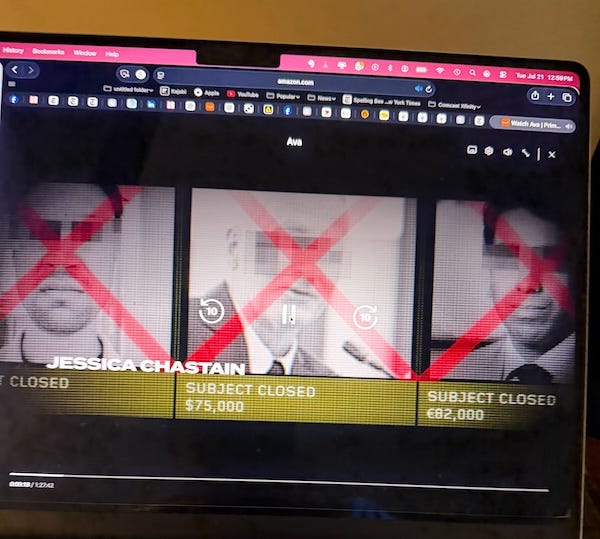
In my binge-watching breaks between project launches, I was deeply disturbed by the opening sequence of Ava, which stars Oscar winner Jessica Chastain as a hit woman with 41 confirmed kills.
The opening credits begin with a montage of Ava’s early life and military training, then display her victims, their eyes blocked out to obscure their identities, with price tags above them.
For each of these assassinations, she’s paid around $75,000.
Granted, that might be seen as a decent annual salary, but consider this:
On the next mission we see her undertake, her cover is blown and she’s forced to escape, taking down at least a dozen guards armed with machine guns.
In other words, she can’t exactly phone this in and collect a paycheck.
Second — and this to me is much more significant — she’s dramatically underearning compared to her (fictional) peers.
Take, for example, Maggie Q in The Protégé.

After Maggie Q and Samuel L. Jackson complete their first mission, they report back to their client as R&D Plumbing, saying “the leak has been fixed” and requesting the balance of their payment.
Seconds later, €7 million — or more than $8 million — is transferred into their account.
Never having hired an elite assassin, I’m simply assuming that this balance represents 50% of the total fee.
This means that for one hit, their characters made approximately $16 million versus Ava’s mere $75,000.
How is it that Ava the Assassin allows herself to be so grossly undercompensated, particularly when her life is also very much on the line?

Sidebar: the most fictional element might just be that the fee for instantly transferring millions is only €9!
Is Ava genuinely unaware of the value of her services — or is she willing to tolerate being underpaid because of what charging appropriately might make other people think of her?
Is she capable of gunning down a platoon of armed guards yet afraid to speak up for her economic self-worth?
It’s hard to think that a paid assassin might be caught up in the common trap of people-pleasing, but her ridiculously low pricing opens the doorway to broader questions about our own lives.
How often …
Do we actually fail to recognize our value?
Or do we recognize it but fear the social consequences of acting accordingly?
Are we undercharging — or buying approval?
Are we being generous — or avoiding the discomfort of saying no?
Exactly how much are we willing to sacrifice NOT to become the villain in someone else’s narrative?
In short, how fearless must we be to accept that not everyone will be happy with us?

This month in the Transformation Book Club — you can join us for just $5 a month HERE — we’re reading The 50th Law.
The book is written by an unlikely combination: hip-hop and pop-culture icon 50 Cent (Curtis Jackson) and Robert Greene, bestselling author of The 48 Laws of Power.
Early on, this guide to “mastering the hustler’s mindset” offers the following reevaluation of fear:
“Fear is the oldest and strongest emotion known to man, something deeply inscribed in our nervous system and subconscious.
Over time, however, something strange began to happen.
The actual terrors that we faced began to lessen in intensity as we gained increasing control over our environment.
But instead of our fears lessening a well, they began to multiply in number.
We started to worry about our status in society— whether people liked us, or how we fit into the group.
We became anxious for our livelihoods, the future of our families and children, our personal health, and the aging process.
Instead of a simple, intense fear of something powerful and real, we developed a kind of generalized anxiety.”
I found this particularly appropriate because the peak of my stress this week came not from the fear of being chased by a tiger but from the possibility of receiving a strongly worded email rebuke.

You can never go wrong with a Mary Oliver poem, but “The Journey” really speaks to me here.
Often what appears to be a straightforward professional transaction is secretly a demand for rescue — a voice crying, “Mend my life!”
Refusing that impossible task can make you the villain — at least in one person’s narrative.
The Journey
One day you finally knew
what you had to do, and began,
though the voices around you
kept shouting
their bad advice—
though the whole house
began to tremble
and you felt the old tug
at your ankles.
“Mend my life!”
each voice cried.
But you didn’t stop.
You knew what you had to do,
though the wind pried
with its stiff fingers
at the very foundations,
though their melancholy
was terrible.
It was already late
enough, and a wild night,
and the road full of fallen
branches and stones.
But little by little,
as you left their voices behind,
the stars began to burn
through the sheets of clouds,
and there was a new voice
which you slowly
recognized as your own,
that kept you company
as you strode deeper and deeper
into the world,
determined to do
the only thing you could do—
determined to save
the only life you could save.

Sometimes Fearless Clarity — again, new meditation HERE — is necessary because reality gets so jumbled.
There are both underpaid assassins in our lives and people demanding unreasonable rescues.
Bizarrely, sometimes they switch roles without notification.
Max Ehrmann’s prose poem Desiderata has a helpful line in this regard:
“As far as possible, without surrender,
be on good terms with all persons.”
That clause — “without surrender” — offers a vital clarification.
Fearless Clarity requires accurate evaluation: both an honest assessment of the situation and a recognition of the limits of our responsibility.
Sometimes that’s frightening not because we’re afraid of what we’ll see, but because seeing clearly can have a price tag.
Yes, there are days when Fearless Clarity requires an act of heroism, while on most days it merely requires allowing someone to recast you in their narrative.
Fortunately, you still get to be the hero in yours.
Tell A New Story. Transform Your Life.

Contemplating a new career as an assassin?
Let’s explore the situation you can’t see clearly — the decision, relationship, creative project, money question, or boundary that has you trapped in an imaginary courtroom – in a single session.
We’ll begin with an eight-card oracle spread — my quirky daily practice — then separate the facts from the fear and find your clearest next move.
I’m opening just four of these sessions this month.
No posts
Comments
Nothing yet. Say the first thing.
Sign in to join the conversation.