
Sometimes when the story you’re telling is too complicated, you really do need a break.
In my case, the story I was telling was in a screenplay, one I’m writing for an independent producer.
And it had indeed become WAY too dense — multi-layered, in fact — including a “movie within a movie” framework.
I was very much in need of this month’s theme — Fearless Clarity, meditation HERE.
On that note, in search of a rare book I’ve been craving, I headed to the reference department at my local library, essentially the safe space of my childhood.
I was anticipating being wrapped in a comforting blanket of book-loving nostalgia, getting lost inside a familiar space of dusty volumes.
Instead, I learned it was about to close its doors forever, its final hours only two days away.
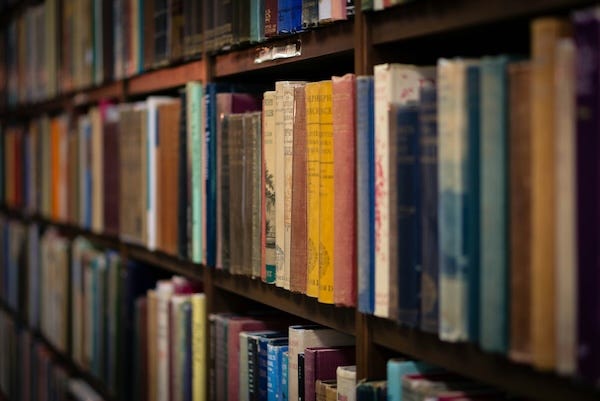
When you stop to think about it, libraries really are almost impossibly generous.
I can’t think of anything else in the world that just gives you invaluable things for free, politely asking you to return them when you’re done so others may also enjoy them.
My library — technically the Mary Cheney Library — has its own fascinating history.
In 1840, employees of Cheney Brothers — a company that would later become the nation’s largest silk manufacturer and the only one to oversee every stage of production except raising the silkworms themselves — hired someone to read aloud while they worked.
In 1850, the workers took it further and petitioned successfully for a library.
The current building — the one I grew up with — opened in 1937 and was named for Mary Cheney, who had a long history of generous, quiet philanthropy.
And last Saturday at 5pm, it closed its doors forever — and I needed to be there.
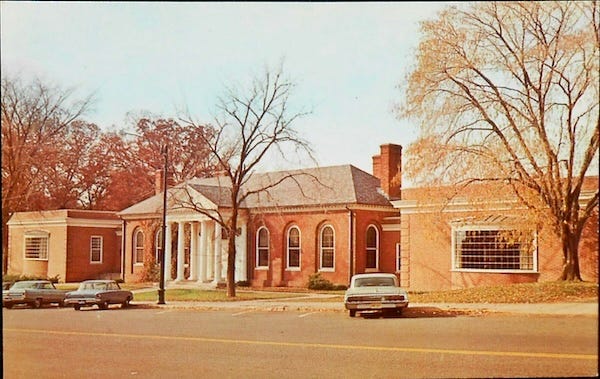
The actual library in the early 60s.
Let me share the book I was trying to get my hands on:
Off With Their Heads: A Serio-Comic Tale of Hollywood by Frances Marion.
Published in 1972, it occasionally appears on eBay for a couple hundred dollars.
In a rare moment of fiscal conservatism, I decided to see if there were any available in the Connecticut public library system first.
It turns out there are exactly two, each in a small library in opposite corners of the state.
An interlibrary loan — again, that impossible level of generosity — seemed a wise and prudent option.
Filling out the forms with the librarian, I reflected on why this book felt so compelling to me now.
You’ll recall from the beginning of this post that that I’m writing a screenplay with an indie producer.
From 1915 to 1939, Frances Marion was considered the world’s highest-paid screenwriter, male or female.
She wrote screenplays for nearly 200 produced films — still massively impressive, but remember that many of these were silents of varying lengths.
She also became the first screenwriter to win two Oscars.
I’d seen a documentary about her years ago, and I was struck by many things, but two in particular stood out:
Her effortless productivity and her generosity.
Both are illustrated in one hallmark story.

Although only the most ardent film buffs probably know her now, in her day Marie Dressler was a major movie star.
In 1911, when Frances Marion was starting out as a young reporter, she interviewed Dressler, who was already well known in vaudeville and entering the movie world.
They became lifelong friends, with Dressler introducing Marion to people in the still-new film industry.
Six years later, Marion wrote a film for Dressler, Tillie Wakes Up, a silent slapstick comedy.
Although that film and others were big successes, Dressler’s career had collapsed by the mid-1920s.
Her future looked incredibly bleak.
Frances persuaded studio head Irving Thalberg to cast her friend in The Callahans and the Murphys, which began an extraordinary comeback for Dressler.
Years later, Frances even co-wrote another comedy, Min and Bill (1930), which earned Dressler the Academy Award for Best Actress.
I admire not only that lifelong loyalty and respect, but also the fact that Frances was actually able to demonstrate them in such a practical way.
Rather than getting tied up in meta-layerings of narrative complexity like I’d been all week, Frances Marion simply sat down — at her manual typewriter, no less — and wrote something Oscar-worthy for her friend.
She didn’t get self-indulgent about her work, or allow herself to get tangled in writer’s block.
She knew her friend’s gifts and created something that framed them brilliantly.
As the kids say today,
“She understood the assignment.”
Honestly, don't we all need more pals like that?

I first encountered Frances Marion through a terrific short documentary called Without Lying Down.
Uma Thurman narrates, and Kathy Bates voices excerpts from Frances’ letters, diaries and memoirs.
You can watch it online HERE.
I’ve since learned that it’s based on the book of the same title by Cari Beauchamp.
According to the author, the book required the help of 30 libraries and librarians — and apparently she gained access to the Turner/MGM archives only on her 94th attempt.
It seems profoundly fitting that in the final hours of my childhood library I was searching for a book that exists partly because libraries and librarians helped rescue Frances Marion — the world’s highest paid screenwriter — from obscurity.
Oh, and in case you’re wondering about that title, Without Lying Down…
Frances Marion was quite gorgeous — see her pic below — and often turned down acting work.
Basically, she was no stranger to admiring men.
In fact, she married four times — including once to Fred Thomson, a dashing Western silent movie star.
Beautiful and witty, Marion supplied the title for both the book and documentary with one of her famous quips:
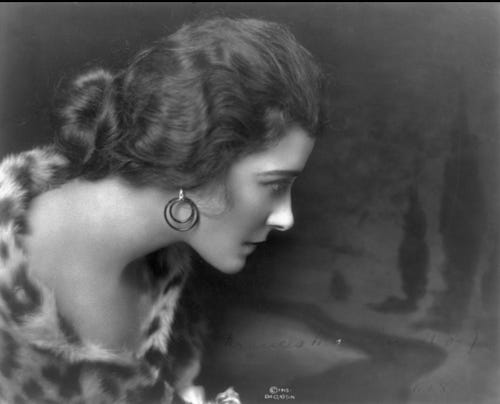
Frances in 1915 • I mean… come on… !
With the library closing in 20 minutes, I was assured that my interlibrary loan request for Frances’ autobiography, Off With Their Heads, would soon be fulfilled at another branch of the local system.
At the other end of town, this “new” one opened in 1895, finding its permanent home in May 1932.
Please note: I don’t want you to think bulldozers are coming for either building.
Both are historic landmarks.
And technically, the Mary Cheney Library is reinventing itself (and being renamed) as Connecticut’s first all-electric, net-zero public library.
At 75,000 square feet, it will be almost three times larger than the current building.
Like the idea of a library itself — and like Frances Marion’s example — this new incarnation seems impossibly generous.
I can’t wait to get lost inside.

If you’re having trouble figuring out the plot — whether in your creative project or in your life — I’m offering coaching sessions of different lengths.
Or if you know you want an 8-card Fearless Clarity oracle reading, feel free to:
No posts
Comments
Nothing yet. Say the first thing.
Sign in to join the conversation.