
A 14-year-old girl told her teacher she spent her free time “scrolling TikTok and thinking about boys.”
Four years later, she had built an LLM offering safe teen dating advice, an audience of one million followers, and a first-author research now under review at a major journal.
This fall, she starts at Stanford.
This is the story of a regular alpha school student.
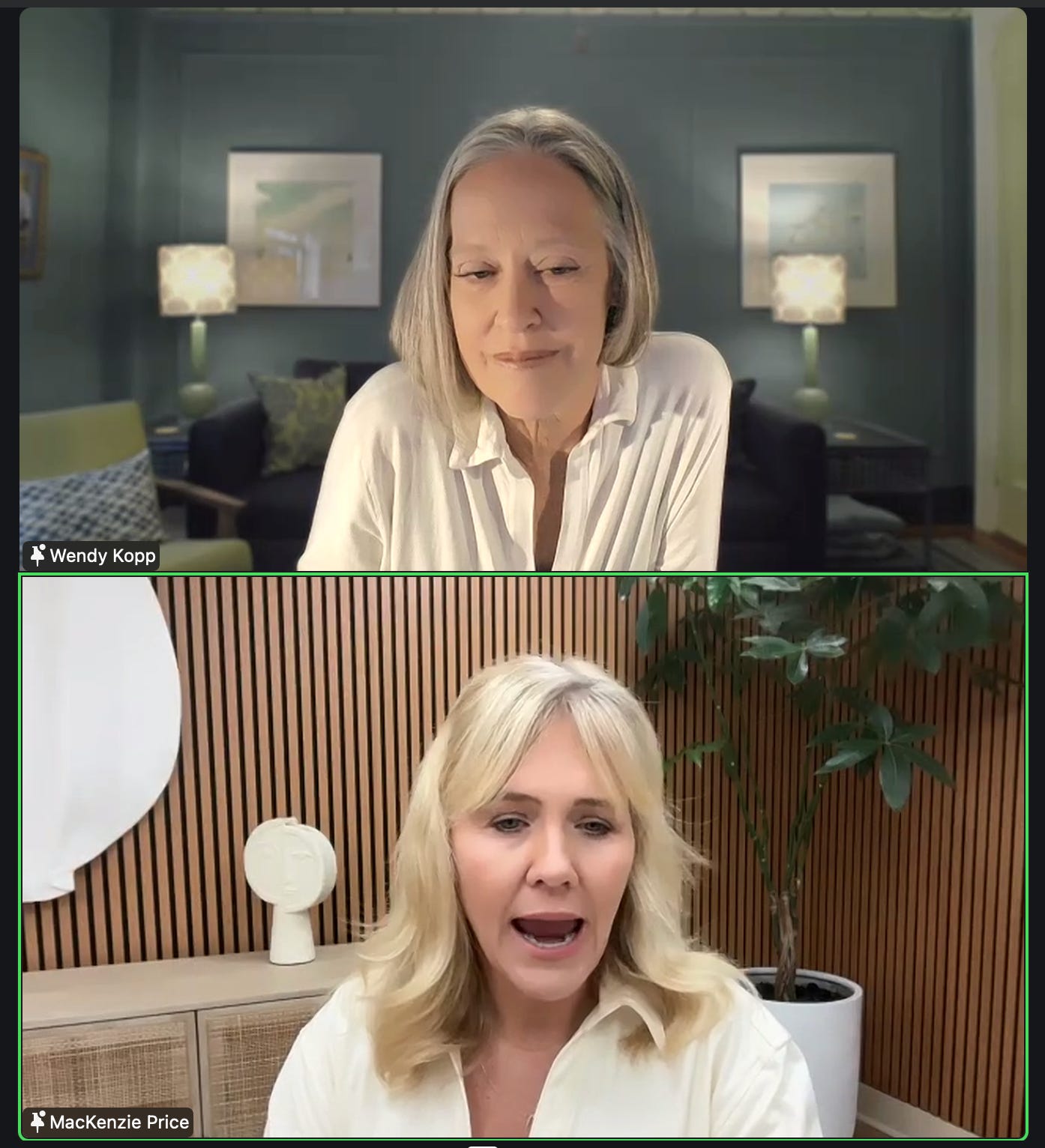
When I heard MacKenzie Price (founder of Alpha School) in conversation with Wendy Kopp (founder of Teach For All), I had to keep reminding myself this isn’t a thought experiment. It’s already operating in roughly 50 schools across the United States, with a free virtual charter in Arizona1, public school pilots underway, and new campuses opening in Kenya and Ecuador this fall.
Here is the day, distilled:
Morning: Limitless Launch (15 min). A group challenge. Often physical. Designed to build a growth mindset before any academics begin.
Core academic block (2 hours, in 25-min sprints). Students work one-on-one with an AI tutor (not a chatbot, MacKenzie is emphatic about this) that assesses precisely what each child knows and meets them at the exact level they need. A fifth grader struggling with multiplication can roll back to third-grade material. The fifth grader next to her can be doing geometry. Both progress at their pace, applying learning science principles (spaced repetition, immediate feedback, zone of proximal development).
Afternoon: Life skills workshops. This is where school stops looking like school. Students build businesses. Manage vending machines and food trucks. Run Airbnbs. Train for triathlons. Grow gardens, sell produce at farmers’ markets, donate proceeds to charities they researched themselves. A 11 years old runs a podcast called Quantumplations explaining quantum physics to her peers.
Guides, not teachers. Adults in the classroom don’t deliver content. They motivate, coach, and unlock. They earn a $100,000 minimum. Last year, 80,000 people applied. A fraction of a percent were hired.
Two design choices stand out. Students are paid (in a school currency redeemable at an in-school emporium) for hitting academic goals. The second is governance: town halls give students real authorship over community rules and standards. MacKenzie's observation here is worth sitting with: when kids own the culture, they hold themselves & each other to a higher standard.
Mastery instead of grades. No report cards. You move forward when you’ve mastered the material. You demonstrate grit by, say, learning to solve a Rubik’s cube, juggle three objects, and run a mile non-stop, a “test to pass” verified by a third party.
The result on standardised assessments (NWEA MAP) are impressive: students in the bottom 10th percentile show growth rates in the 80s and 90s. Students in the 99th percentile show growth rates in the 80s and 90s. Twice the learning, in a quarter of the time.
Here’s how MacKenzie puts it:
“We’ve taken a 200-year-old system that was designed to educate the masses to be obedient and compliant, and we’re using technology in a smart way so that AI does the one-to-one mastery tutoring, while the human in the room does what only humans can do: connect, motivate, and engage.”
That reframing matters. The fear with AI in education has always been replacement. Alpha’s bet is the opposite: AI handles the mechanical part of teaching that traditional teachers were never given enough time, data, or one-on-one bandwidth to do well and in a personalised way for each student. The human is freed up for the things teachers entered the profession for in the first place: the relationship or as she says: the coaching.
It’s also worth noting what the model is not. It’s not screen-time-as-school. Kindergarten and first-grade reading is daily one-to-one, pulled out with a certified specialist. Cursive is taught with pencils. Writing is taught from sentence to paragraph to essay to professional email to tweet. There’s a “How to Be a Spy” workshop teaching eye contact and conversational rhythm.
Three developments stood out to me as genuinely paradigm-shifting:
1. Kenya and Ecuador, opening fall 2026. A partnership with MrBeast, Starlink for connectivity, and philanthropic partners for food and wellness. The first real test of whether the model can travel into low-resource environments, and a test of whether scale follows pedagogy, or the other way around.
2. A Fortnite-style learning game, free to play. Built by the creators of Fortnite on top of Alpha’s learning platform. The pitch: as engaging as the most profitable video game in history, and capable of pushing players above the 90th percentile in academics. Pilots are already running. A wider rollout is targeted for August 2026.
3. Public schools and price-accessible private models. A major US city is launching public Alpha schools with superintendent backing. Texas families earning under $65,000 (and special-needs students) can access Alpha tuition-free through the state’s Education Savings Account programme. New private campuses are opening at $10,000/year, roughly a tenth of typical elite-private tuition in major US cities (in New York, the Alpha School tuition is $65,000/year).
There’s also a thread I find quietly profound: Alpha is partnering with organisations building LLMs trained on country-specific values and history. The model isn’t “export US curriculum”, it’s a framework that can carry indigenous knowledge, local language, and cultural context into the learning layer itself, says Price.
I can’t wait to see how the model will export and scale to low-income, vulnerable contexts. This will be a real moment of truth for the model.
I want to share this story because I genuinely think Alpha is the most interesting AI backed school experiment running right now. But I’d be doing a disservice to anyone reading this if I didn’t also flag what makes me uncomfortable.
Almost every number in this piece comes from Alpha itself. The “twice the learning,” the 99th percentile growth rates, the “top 1% in the country”, all self-reported, none independently audited, none published in a peer-reviewed venue.
Selection bias is doing enormous work. A school that costs $40,000–$65,000 a year, that only admits families “philosophically aligned” with the model and where 60% of students are on aid but still come from highly motivated households, that school will outperform almost any baseline, thus my impatience when it comes to the export of the model in Low and Middle Income Countries (LMICs) and more vulnerable, low-income populations in the US.
NWEA MAP measures one specific thing. These standardised assessments scores are impressive. But they measure procedural fluency (the layer AI tutors are demonstrably excellent at accelerating). They don’t easily capture whether a student can sit with a problem they’ve never seen before, form an argument from nothing, or revise a judgment they initially got wrong. Alpha’s “life skills afternoons” are genuinely impressive. But running a food truck or an Airbnb business and learning to hold productive confusion (the kind that comes from wrestling with a proof you don’t understand, or an ethical question that has no clean answer) are not the same skill. It’s worth being honest about that distinction. NWEA MAP does not measure conceptual depth, collaborative problem-solving, intellectual courage, civic capacity, or any of the less easy to measure skills that really matter.
It’s the most important question in AI-assisted education points to something uncomfortable: the effort of not-knowing might be precisely what forges the cognitive structures that make knowledge durable and transferable. When AI removes friction, it may also be removing the mechanism.
MacKenzie, if you’re reading this, I’d love to have it on the Education Futures podcast to discuss this!
Curious to hear from anyone working on similar models, particularly in Europe. Reach out to me on Linkedin.
Virtual charter schools generally underperform according to the CREDO 2023 study, it’s too early to know (Alpha’s virtual charter started in the Fall 2025) but I am very curious to know how this one is doing with its Alpha/AI component.
No posts
Comments
Nothing yet. Say the first thing.
Sign in to join the conversation.