
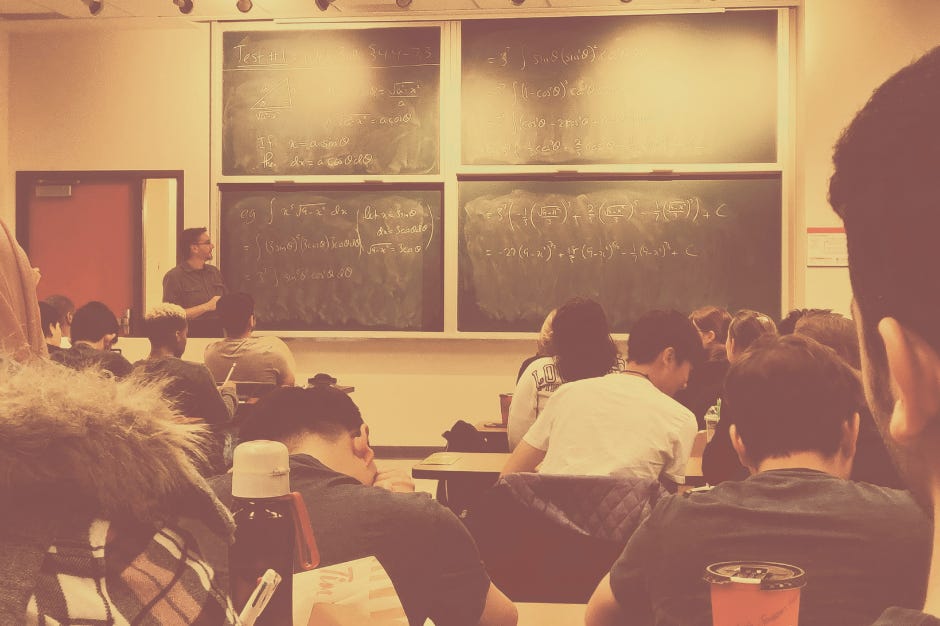
Higher education is currently facing major challenges. The university sector is grappling with a structural crisis driven by falling international student numbers, high inflation, and a reluctance among leadership to make bold changes. Yet, the prestige of universities remains strangely tied to their age rather than their innovation, leaving traditional institutions immune to the kind of disruption that forces other industries to adapt.
But change is here. The London Interdisciplinary School (LIS) and Minerva University are laying out compelling blueprints for how we can fundamentally redesign the university experience for an era dominated by complex problems and Artificial Intelligence.
Here is what the future of higher education looks like when institutions stop resisting the future and start designing for it.
For decades, we have organized education like a library: you walk down a corridor, pick a single discipline, like sociology, biology, or history, and stay there. While this made sense historically when knowledge had to be neatly stored in books and brains, it is woefully inadequate for today’s world.
As Ed Fidoe, founder of the LIS puts it, the challenges we face today, like climate change, inequality, and the ethics of AI, do not neatly organize themselves into single disciplines. To prepare students for reality, LIS flips the traditional model on its head by requiring students to start with a complex problem rather than a subject. To tackle an issue like AI and ethics, an LIS student will simultaneously learn law, data science, machine learning, and qualitative methods. By breaking down the barriers between quantitative skills (like coding) and qualitative skills (like anthropology or art), LIS ensures students graduate with a versatile toolkit rather than an artificial boundary around what they “can” and “cannot” do.
If LIS is reimagining the structure of a degree, Minerva University is rewiring the cognitive mechanics of how students learn. Education at Minerva is fundamentally about “far transfer”: the ability to learn a concept in one specific context and successfully apply it to a completely different, broader situation in the future.
To achieve this, Minerva doesn’t just focus on content; they relentlessly train “durable skills”. These are competencies like critical reasoning, systems thinking, and audience design (empathy in communication) that remain relevant no matter how much technology or job descriptions change.
Crucially, Minerva intentionally scaffolds these skills across a student’s entire four-year journey, rather than isolating them in standalone courses. For example, a student might practice “audience design” when writing an essay, again when presenting a psychology experiment, and yet again in an advertising class. By repeatedly encountering this skill in different contexts, students build a flexible proficiency they can immediately bring into the modern workplace.
Many traditional universities have panicked, engaging in an arms race to catch AI cheaters or retreating to handwritten exams, which Minerva’s Chief Academic Officer, Art Markman suggests is the wrong approach.
The philosophy at Minerva offers a brilliant analogy: If your job is to shoot free throws in a basketball game in front of 19,000 people, you would never pay someone else to do your practice for you. Institutions need to explain to students that their assignments are their “free throw practice,” essential for building their cognitive muscles. By shifting away from standard transcripts toward continuous feedback on core competencies, Minerva helps students understand that the goal is to become a “great thinker,” completely removing the incentive to cheat with AI. In fact, Minerva champions using AI as a tool to flip classrooms and provide immediate, consistent feedback to students, which is far more effective for learning than receiving a grade three weeks after an assignment is turned in.
LIS adds another profound layer to the AI debate. While large language models can surf the entirety of human knowledge, they cannot do the inherently political and human work of deciding which problems are actually worth solving. As AI automates execution, Ed Fidoe recognizes that the uniquely human skill will be problem discovery and prioritization.
The models pioneered by the London Interdisciplinary School and Minerva University reveal a shared truth: the purpose of a university is no longer just to transfer knowledge. It is to equip students with the durable skills to adapt, the interdisciplinary range to solve complex problems, and the wisdom to know which problems matter most.
If traditional universities want to survive the coming decades, they need to stop resting on the prestige of their centuries-old history and start evolving. The blueprints are already here.
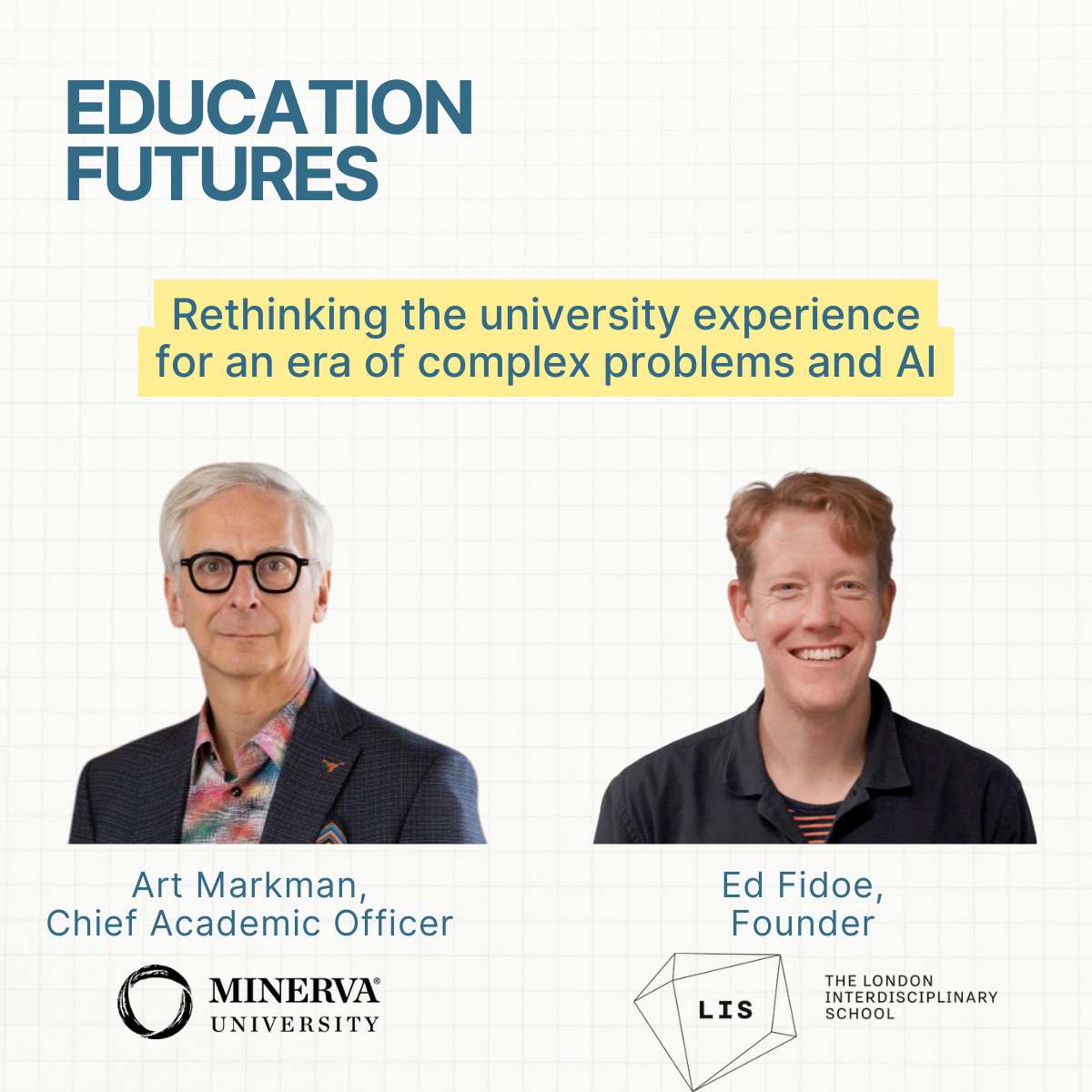
Listen to Art Markman, Chief Academic Officer at Minerva University on Spotify, Apple Podcasts and Youtube.
Listen to Ed Fidoe, LIS founder on Spotify, Apple Podcasts and Youtube
Do you know any other groundbreaking models in higher ed? We’d love to have them on the Education Futures podcast. Share their names in the comment section below.
No posts
Comments
Nothing yet. Say the first thing.
Sign in to join the conversation.