
The EdTech market is crowded. Estimates suggest that 412,000 of apps are classified as educational across the major mobile platforms, while US K–12 school teachers accessed 1,045 tools each month. Faced with such an abundance of products, how can a teacher or parent identify the tool that is most appropriate for a particular learner, purpose, and context? Fortunately, a growing number of initiatives are making this task more manageable by reviewing, comparing, and certifying EdTech tools from different perspectives.
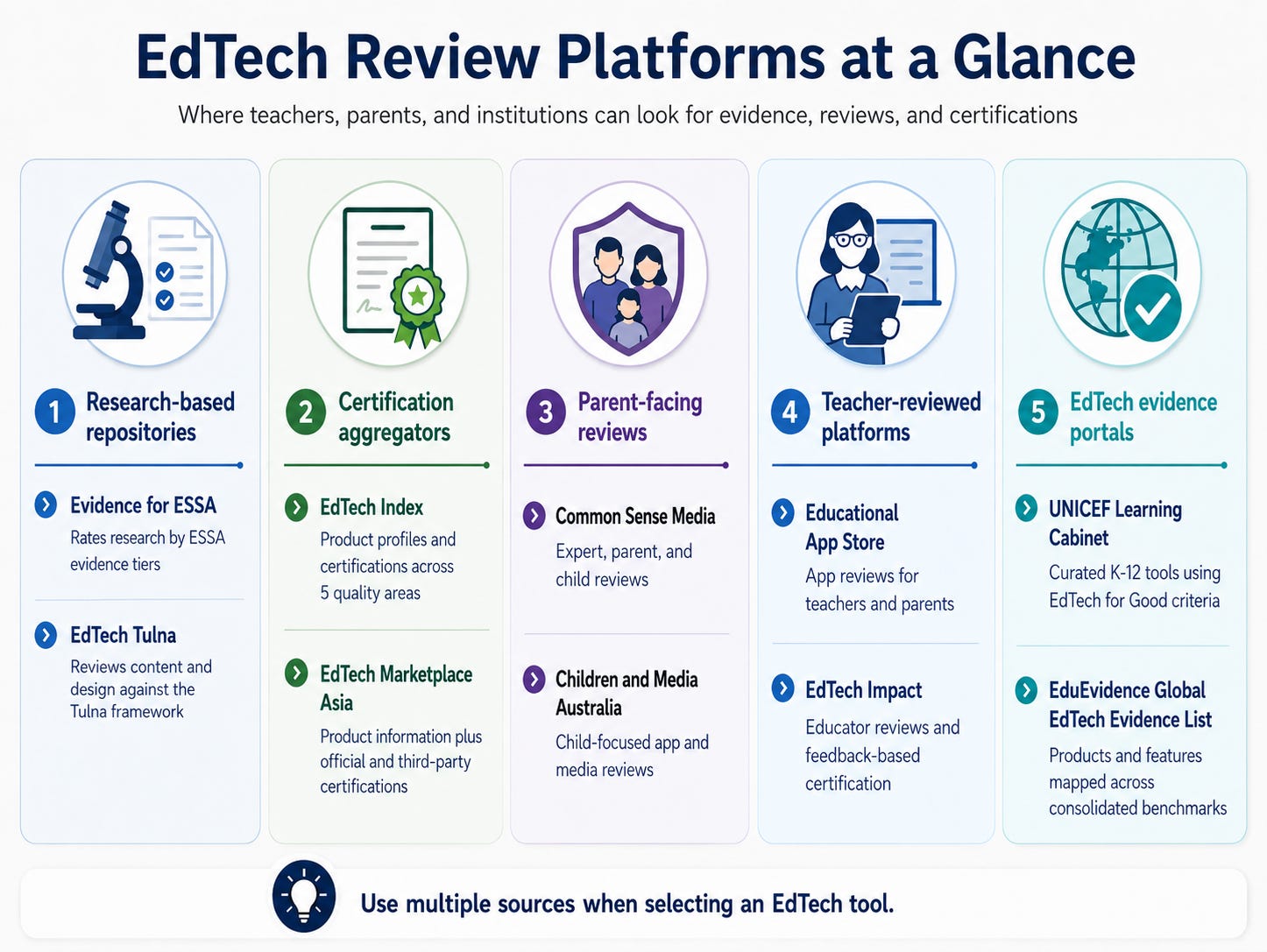
Research-based evidence repositories examine studies or assessments conducted on different EdTech tools according to a specific framework (e.g. the ESSA standards or the EdTech Tulna framework).
Evidence for ESSA is a review initiative developed by the Johns Hopkins University Center for Research and Reform in Education. It reviews research on educational interventions and rates the strength of the evidence according to the four evidence tiers established by the U.S. Every Student Succeeds Act (ESSA): Strong (Tier 1), Moderate (Tier 2), Promising (Tier 3), and Demonstrates a Rationale (Tier 4).
EdTech Tulna is an India-based, research-backed evaluation initiative developed in collaboration with Indian Institutes of Technology. Although not focused on outcomes and research studies, its independent evaluations assess products across content quality, pedagogy, and technology and design.
Less well known are assessments developed by individual researchers. One recent example is the EdTech Accountability Framework, developed by Will Ellis and published by Close Screens Open Minds.
Certification aggregators compile information on EdTech products alongside third-party certifications and quality indicators from multiple organizations, enabling educators and institutions to compare products against recognized badges.
EdTech Index compiles Edtech products working across five areas of EdTech quality defined by the EdTech Quality Collaborative: safe, evidence-based, inclusive, usable and interoperable. These areas map on certifications of these US organisations: 1EdTech, CAST, CoSN, Digital Promise, ISTE, SETDA and the international EduEvidence.
EdTech Marketplace Asia provides information on EdTech products such as their intended use, key features, and available official, third-party, certifications, to support informed decision-making by educators and institutions in Asia.
Parent-facing platforms provide information and reviews of children’s digital products and media nationally and they cover considerations such as age appropriateness, advertising, in-app purchases, privacy, safeguarding, and opportunities for adult–child interaction across a range of digital experiences, including but not limited to educational apps and EdTech products.
Common Sense Media provides expert reviews alongside parent and child ratings for US parents. Its reviews address educational value, age appropriateness, commercial content, privacy-related considerations, and potentially sensitive material. It also publishes guidance in Spanish.
Children and Media Australia provides parent-focused reviews of children’s digital media, including its Know Before You Load App Reviews, which are prepared by child development professionals and offer age suitability ratings and content descriptions.
Teacher review platforms compile educators’ experiences with EdTech products, providing practical insights into classroom implementation, including ease of use, alignment with teaching routines, training requirements, reliability, and compatibility with existing school systems. Examples include:
Educational App Store provides reviews and recommendations intended to help teachers and parents identify educational apps.
EdTech Impact allows educators and schools to review and compare products. The platform also offers a Recommended Certification based on recent, verified customer feedback, as well as a separate pedagogical-quality certification.
EdTech evidence portals provide access to research evidence, product information, certifications, and expert reviews related to educational technologies against multiple quality criteria. In addition to aggregating existing information, they apply an independent review process through expert reviewers affiliated with the platform, offering users a structured assessment of tools beyond basic product descriptions or certifications.
UNICEF’s Learning Cabinet is a curated global platform for K–12 EdTech solutions, particularly relevant to low- and middle-income country contexts. It assesses and curates tools using UNICEF’s EdTech for Good Framework, which evaluates dimensions including safety, learning impact, child-centred design, scalability, accessibility, and equity.
The EduEvidence Global EdTech Evidence List grew from a research-based evidence repository (that was supported by our Centre) into a structured directory of educational technology products that have undergone certification or validation processes. It assesses evidence across five dimensions (efficacy, effectiveness, equity, ethics, and environment; the “5Es”benchmarks) and uses an equivalence system to map different certification schemes onto shared Bronze, Silver, and Gold benchmarks. The list spans K–12, higher education, and workforce development solutions, and includes an endorsement category that links to relevant assessments from external platforms and frameworks, including those of UN agencies and various EdTech awards.
EdTech repositories and rankings can considerably reduce the burden of searching for an appropriate EdTech tool. However, their greatest value lies not in telling us which product is universally “best” but in helping us compare different forms of evidence and select tools that are appropriate for particular learners, educators, and educational contexts.
No posts
Comments
Nothing yet. Say the first thing.
Sign in to join the conversation.