
In my forthcoming book with Cambridge University Press titled The Great EdTech Pivot, I examine the evolution of EdTech from the inside out: its promises, progress, limitations, and the lessons that may help guide its future development.
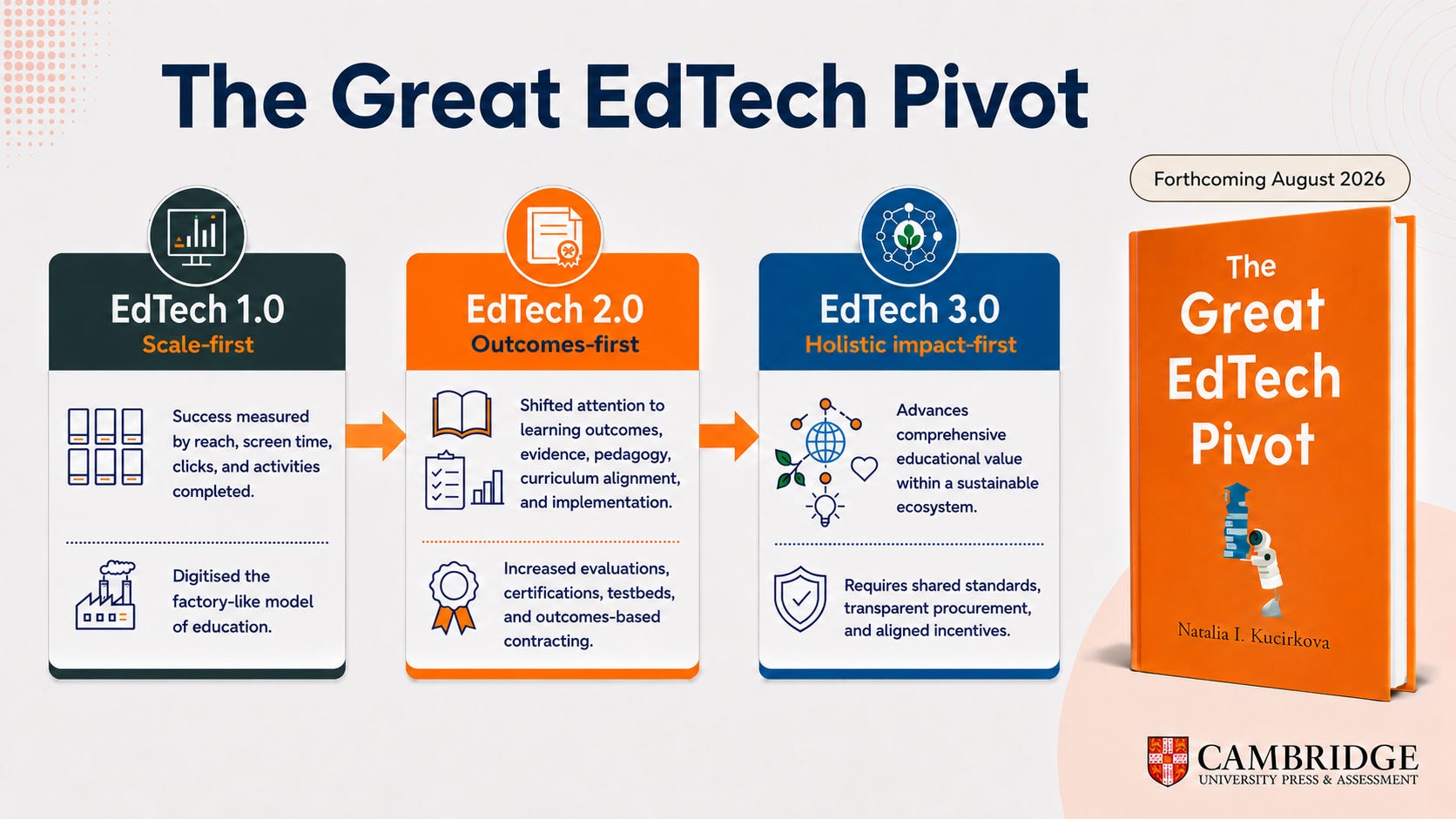
I argue that we may now be entering one of the most significant periods in EdTech’s development. I have simplified the EdTech evolution as follows:
EdTech 1.0 was built around engagement: keeping children on screens for longer, treating learners as customers, using persuasive design, and collecting data through approaches influenced by consumer technology.
EdTech 2.0 marked an important shift towards evidence and learning outcomes, with greater attention to questions such as: What works, for whom, where, why, and at what cost?
EdTech 3.0 moves beyond isolated products and short-term pilots towards more integrated, evidence-informed solutions, supported by shared standards, stronger ecosystems, and a commitment to lasting educational value.
The challenge is that AI is accelerating innovation faster than our collective ability to establish the norms, evidence systems, and accountability structures needed to support this transition.
This creates a risk of returning to some of the patterns associated with EdTech 1.0, where rapid adoption, fragmented claims, and engagement metrics may begin to substitute for more meaningful measures of learning.
So, how can innovation contribute to improving education for all?
Education is one of the most complex human systems we have, and yet EdTech has often sought to understand it through relatively simple metrics. At times, the ambition of EdTech has grown faster than the evidence available to support it. This has created a persistent methodological challenge: the things that are easiest to measure are not always the things that matter most.
Engagement is not necessarily the same as understanding.
Activity is not necessarily the same as learning.
Data is not necessarily the same as evidence.
The rise of AI makes this challenge more pressing. AI systems can generate vast amounts of information about learner behaviour, but without sound methodological foundations, there is a risk that increasingly sophisticated systems identify signals that appear as learning, but in reality are only capturing clicks, taps, or other forms of on-screen activity.
AI may therefore intensify one of EdTech’s longstanding challenges: distinguishing what is easy to measure from what is educationally meaningful.
This question has shaped my own research journey and remains central to the field: How can we build stronger evidence systems for understanding the educational impact of EdTech?
No posts
Comments
Nothing yet. Say the first thing.
Sign in to join the conversation.