

A New Scroll of LA Jewish News
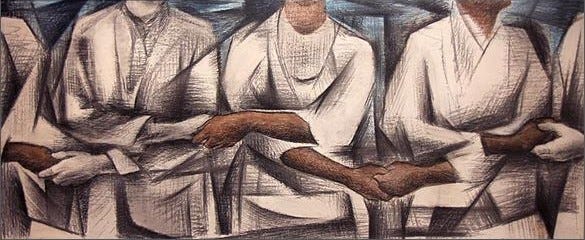
“Chans” by Edward Biberman, 1940.
Folks,
Juneteenth, a day when we celebrate the end of slavery in America, is a good day to take note of LA artist Edward Biberman’s 1940 work “Chains.” In the piece, Biberman shows us a different kind of chain, one depicting blacks and whites linked, standing arm in arm, as if in some kind of communal choir. Can you hear them singing? As we approach Shabbat, It is the continued desire for that kind of chain, for that kind of communal peace and understanding, that can bring us together today. Take a moment also to consider becoming a paid subscriber to
Shabbat Shalom.
Edmon J. Rodman
////\/\\\\
////\/\\\\
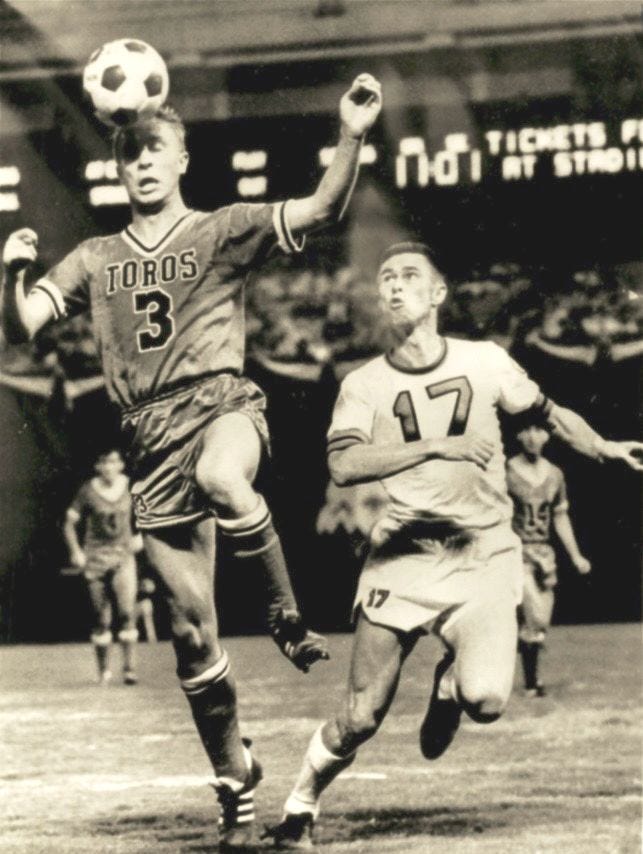
Los Angeles Torros in a 1967 match against the Atlanta Chiefs.
Edmon J. Rodman
In soccer’s more than 100-year rise in Los Angeles, culminating in this year’s World Cup games here, LA Jews have scored some winning goals. Beyond the sole player of Jewish heritage playing in the LA games, Matt Turner, goalkeeper of the Unites States Men’s National Team, LA has been home to a number of accomplished and successful Jewish teams, players, and coaches. Reflecting these achievements, The Southern California Jewish Sports Hall of Fame, over several decades, has inducted 13 soccer players including Steven Birnbaum of Irvine, who has played for D.C. United, Eli Marmur, who played on the Maccabee Athletic Club’s semi-pro Los Angeles Soccer Team, and Max Wozniak, the coach of LA’s first pro soccer team. On the management side of professional soccer, Bennett Rosenthal is the lead managing owner of The Los Angeles Football Club (LAFC) of Major League Soccer, and Brandon Beck is a co-owner. Beginning in 1926, when the city’s B’nai B’rith Lodge organized a soccer club to join the local league, Jewish athletes and fans have embraced the beautiful game. The B’nai B’rith Club, playing matches in their opening season against the L.A. Russians, and another squad called the Magyars, was a live tutorial demonstrating how immigrants, like those of today, brought their competitive spirits for the game with them. Suddenly, newspaper headlines like “Jewish Soccer Team Loses to Scotts,” sounded perfectly natural. By 1927, national Jewish interest in soccer grew when Hakoah (the power), an all-Jewish soccer club from Vienna drew 45,000 fans to a game played at the Polo Grounds in New York. Los Angeles that year saw the development of an A.Z. A. (American Zionist Association) team, as well as another local squad called the Halevi’s. With the rise of Zionism and tensions in Palestine in 1947, a Palestine Hapoel team, as part of a U.S. tour, played a game attended by 9,000 against local All-Stars in Gilmore Stadium in the Fairfax District. Even the trade unionists turned out. The early 1970’s saw the first matches of the Maccabee (MAH-KAH-Bee) Los Angeles Soccer Club, formed by a group of Israeli expatriates. Playing in the Greater Los Angeles Soccer League, and wearing blue-and-white jerseys emblazoned with a large Stars of David Over its 11-year run, the team won the league title seven times, and the U.S. Open Cup five. One of the league titles, and cups was won under coach Max Wozniak—a coach whose life in soccer began during the rise of fascism and antisemitism in Germany. Wozniak— one of subjects of “The Beautiful Game,” a new show at Holocaust Museum LA that recently had a one-day opening to coincide with the World Cup, and is set to open in August— was born in Cologne in 1926 to an observant Jewish family.
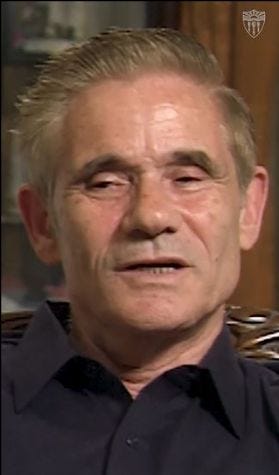
Former soccer player and coach Max Wozniak.
At nine, according to the Southern California Jewish Sports Hall of Fame, he joined the Jewish club, Hakoah Koln, where during and after the games he encountered antisemitism. In Cologne, Max attended a Jewish school, completing seven grades. After Kristallnacht in 1938, Wozniak’s father, a tailor, was deported. In 1939, the family fled Germany, and to escape the advancing German army, sought safety in Soviet-controlled areas. In 1942, Max worked in a Soviet factory, while also playing for the company’s football team. After the war, Wozniak was a goalkeeper on two Polish teams. After moving to Israel, he played for Maccabi Jaffa, and Hapoel Kfar Saba,, and one match on the Israel National Team. “It was a very big thing to prove that we can compete with any other nation,” said Wozniak during a USC Shoah Foundation interview. After immigrating to the United States in 1964, Max settled in Los Angeles. He played alongside other European refugees in ethnic oriented leagues. His experience as goalkeeper gave him the experience to mentor younger players, and made him a student of the game’s strategy. In 1967, he was hired as head coach for the Los Angeles Torros, LA’s first professional team. During the season, after the team’s goalkeeper was injured, he even played in one game. After the League folded, Wozniak, continuing his career as a coach, led the UCLA varsity team to the 1970 title in the major division of the Greater Los Angeles League. In ’73, he returned to Europe, coaching the U.S. National All-Star Team that toured there and in Bermuda. He wrapped-up his coaching career in 1977-78 with the American Soccer League’s Los Angeles Skyhawks. According to the USC Shoah Foundation, Max helped to develop the American Youth Soccer Organization (AYSO), one of the two key organizations in youth soccer the United States. Throughout Wozniak’s coaching career, his ability to speak six foreign languages translated into success.
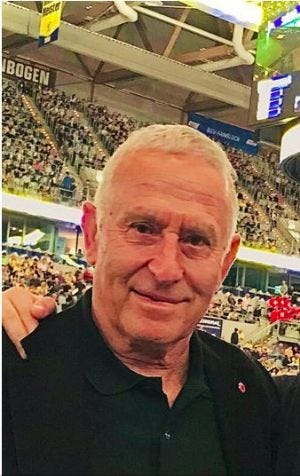
Former soccer player Ze’ev Zeltser.
On the Torros polyglot team with players from 11 different countries, speaking six different languages, Wozniak’s applied his linguistic abilities at team meetings. “First I say it all in English,” he told the LA Times in 1967. “Then I say it all over in Russian,” he continued, “next, I speak in German.” For the Spanish speaking players, the trainer, who was from Argentina took over translation duties. Yet, for one player, Ze’ev Zeltser, who was from Israel, another language was most useful. Though Zeltser spoke English, “When I want to yell at him in a game,” said Wozniak, “I yell at him in Hebrew. No one else can understand us,” he said.
////\/\\\\
////\/\\\\
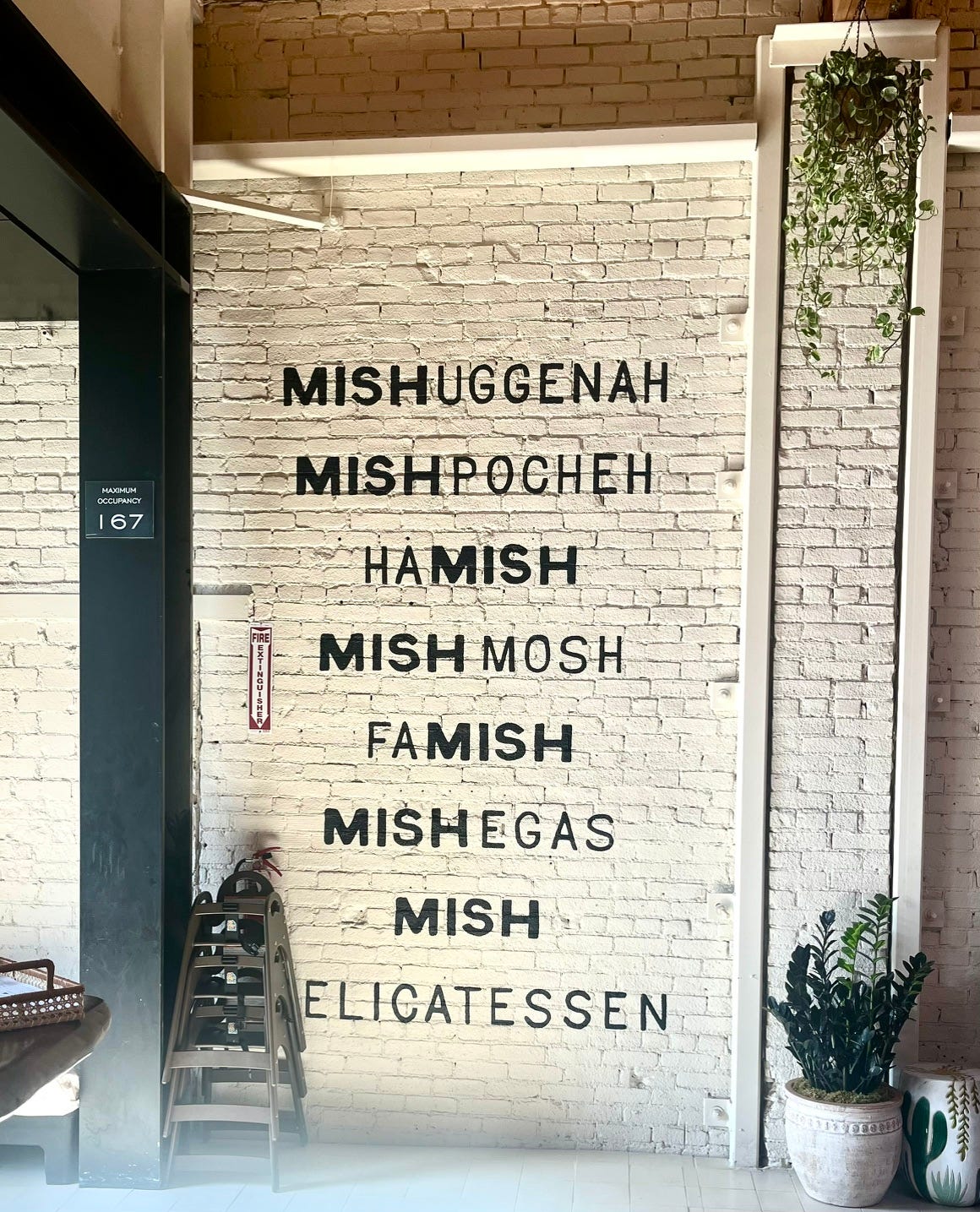
Edmon J. Rodman Described as “chef Eric Greenspan’s long-held love letter to the deli,” Mish Delicatessen, which opened recently on La Brea, is also a text message that says “Save the Deli.” The future of Jewish delicatessens is a subject covered in the press, documentaries, and even in a museum show: Can they survive in a low-fat, low-salt, gluten-free, and Jewish identity-lite American culinary landscape? A visit to Mish indicates that the answer is leaning “Yes.” Upon entering, one sees how the deli’s name was derived from a list of Yiddish, Hebrew, and English words that contain the syllable “mish,” painted on the restaurant’s wall. By highlighting the words “mishuggenah,” “hamish,” “mishpocheh,” and “mishmash,” the diner is introduced to an environment and cuisine that connects with the past and projects into a Jewish future. Beginning with “mishmash,” the restaurant is a collection, of sights, smells, and flavors of a traditional Jewish deli. As you walk by a glass bakery case on the way to the order counter, black and whites, babka, and hamantashen, act as a kind of The order board is hamish: simple lettering, evocative, reassuring, but challenging you to try something new. You can just order a bagel, or a plate of eggs, any way you want them. Or, you can taste a fantasy, a slice of babka French toast, lemon blintz, or fried kreplach with Jewish Chili Crunch. Connecting with “mishpocheh,” the open-concept dining area has a giant communal table running its entire length. The Jewish deli, has historically been a place for Jews to meet, converse, and kibbitz. Sitting in the space, even at a table for two, the diner feels part of one long, generation-bridging extended family conversation. As for “mishuggenah” that is, someone who is crazy, foolish, or irrational, here it must relate to a nervy someone like Greenspan with something to say, show and serve. Yes, mishuggenah will do just fine for a person who at a time, in a country, that seems to have it’s fill of Jews, wants to show that Jewish culinary traditions, and ways of thinking about family, memory, and
////\/\\\\
Edmon J. Rodman
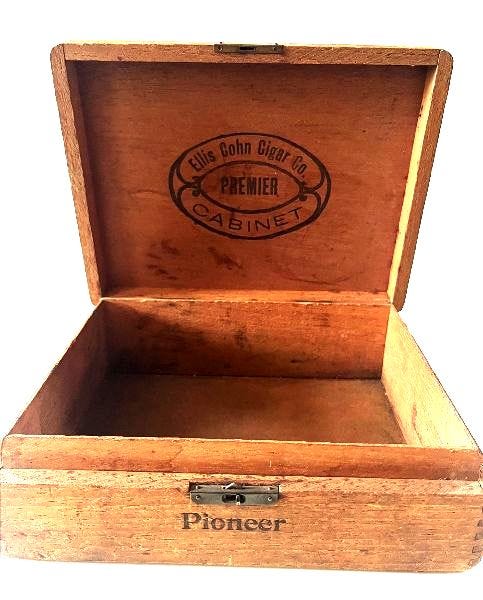
Ignoring the risk of undermining public trust, or the potential for market manipulation, voters are betting on the outcomes of U.S. elections, an activity Angelenos have been engaged in for over one hundred years. Today, people buy contracts on who will win the November mayoral and gubernatorial elections on prediction markets like Kalshi, or Polymarket. But in early 20th century Los Angeles, if you wanted to place a bet on the winner of an election, legal at the time, you went to a cigar stand. Ellis Cohn (see cigar box above), a seller and maker of cigars, was the well-known owner of one such location on Spring Street. On the evening of December 5, 1904, the night when the votes of the city’s municipal election were being counted, Cohn was a busy man. “As a result of the election over $170,000 is said to have changed hands in betting circles one-half of which was handled by Ellis Cohn “Throngs of excited men crowded around Cohn’s ‘ring’ until late last evening, and a large number of bets on the pluralities were placed up to a late hour last night,” continued the piece. Cohn even obliged the reporter with a quote, adding, “The better informed citizens on municipal affairs placed bets on the result of the school board fight. I recorded a number of heavy bets on this contest.” Though the article doesn’t mention it, those who bet on the winners must have taken a few victory puffs on their five-cent cigars.
*The Rodman Archive of Los Angeles Jewish History is a collection of approximately 2000 objects, photos, clothing, art, books, recordings, and ephemera relating to the lives and endeavors of Jewish Angelenos between 1850 and 1980.
////\/\\\\
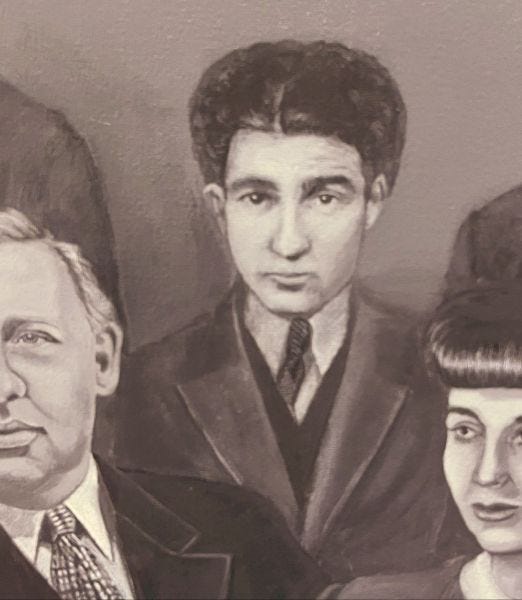
In 1932, David Alfaro Siqueiros (1896-1974), famous Mexican muralist, was commissioned to paint a safe tropical scene on a second story exterior wall on Olvera Street. Instead, he painted “América Tropical,” a monumental mural depicting a crucified Indian peasant with an American eagle overhead. The mural was painted over, but uncovered and restored in 2012. Today, on Olvera Street at the On the opening night of the mural, this being LA, there was a party attended by many celebrities and supporters of the arts including several Jewish attendees. Though he was hardly a celebrity at the time, Zeitlin came to LA in 1925, and his first job was at the B’nai B’rith Messenger. He opened his first bookshop in 1928 on Hope St. near 6th St. Over the years, he moved his shop several times, with its final location on La Cienega being a converted barn.
////\/\\\\
Comments
Nothing yet. Say the first thing.
Sign in to join the conversation.