

A New Scroll of LA Jewish News
Folks,
Ever since Isaias Hellman’s first investment in LA’s early railway systems in 1874, Jewish Angelenos have benefited from the development of area’s transportation.The opening on May 8 of the LA Metro’s three new stations on the D Line which runs though the Miracle Mile continues that story. Riders who exit at the Wilshire/Fairfax station, though they will not at first encounter any imagery that has direct Jewish cultural connections (see story below), they will have easier access to LACMA, an institution Jewish museum-goers have supported since its earliest days. They will also (via the Metro bus 217 line) have better access to the Fairfax area’s Jewish book and thrift stores, synagogues, kosher market, senior services, and Holocaust museum. If riders are 62+, they can even apply for greatly reduced fares. (See how to apply HERE.)
…With all that money you will saving on gas and fare, please consider becoming a PAID subscriber to MegilLA. Stop ducking the fare, and get on the train to a creative and history-rich perspective to LA Jewish news today.
Shabbat Shalom.
Edmon J. Rodman
////\/\\\\
////\/\\\\
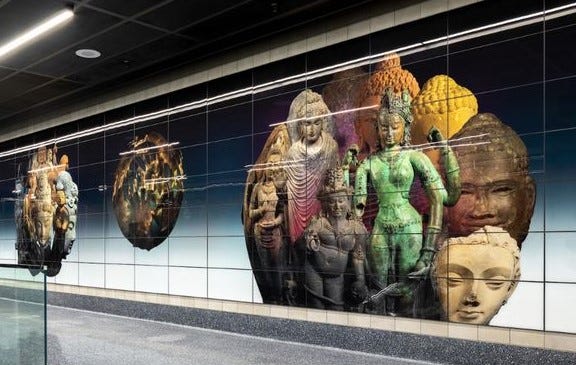
Wilshire/Fairfax station art by Ken Gonzales-Day, LA Metro
Edmon J. Rodman
When Metro’s extension to the D Line opens the Wilshire/Fairfax station May 8, its design will include no reference to the area’s historic, or current Jewish population.
While the engaging, and well-executed artwork inside the station conceptually welcomes the traveler to the neighborhood’s art, film, craft, and automotive museums, based on the publicly available photos, and accompanying Metro text, the station fails to tell the story of the area’s Jewish residents, many of whom where immigrants, including Holocaust survivors, who lived, shopped, dined, and ran businesses in the Fairfax area.
Just a little excavation will show that The Miracle Mile was a very Yiddishe place. Within walking distance from the station’s location there once were synagogues, delis, bakeries and markets used and owned by residents of the local Jewish community.
It was a place where, this reporter recalls, the women who worked the counter at Brown’s bakery gave free cookies to the kids. Where if you went into J. Loeb kosher butcher, you left with a cardboard box full of bargains.
Today, nearby there continues to be a sizable Jewish population and representative institutions including a Jewish Center, a synagogue, a Jewish agency that offers services to the area’s elderly, a Holocaust museum, an Orthodox high school, and the offices of the city’s Jewish Federation.
According to Metro’s policy, the agency sees itself as “L.A. County’s cultural connector providing increased and equitable access to arts and culture for Metro’s diverse ridership through programs that add vibrancy, identity and a sense of place.” Station artwork should “celebrate connections to diverse local arts and cultural destinations.”
Fulfilling this policy, many stations in the Metro system have design and artwork that includes references to nearby ethnic communities past and present. The D Line’s Wilshire/Normandie station features a large mural depicting multi-ethnic cultural traditions including Korean, African, and Brazilian influences.
Union Station has work honoring the area’s Chinese community. The K Line, which runs through the Crenshaw district, has several stations showing the Black History of the area well as its culture.
To create a local Jewish theme for the Wilshire/Fairfax station, Metro managers, designers, and artists would have not needed to look further than the corner of Fairfax and Wilshire for inspiration.
On the northeast corner of the intersection, in 1939, was the May Company department store owned by the May Family who were Jewish and very involved civically, and with the Jewish community.
Today, home of the Academy Museum of Motion Pictures, its distinctive streamline modern features were created by Jewish architect Samuel Marx.
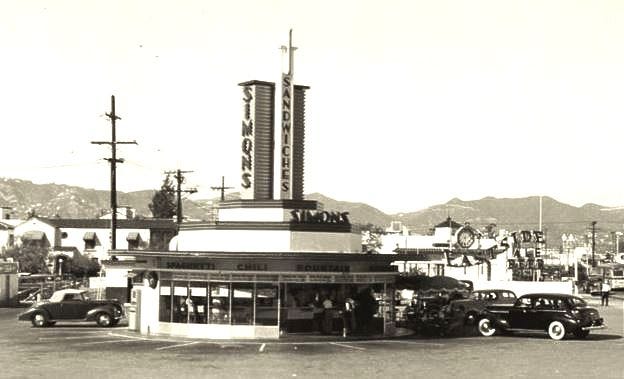
Simon’s Drive-In corner of Wilshire and Fairfax 1939. DWP Archive
On the northwest corner, in the 1940s and 50s, was the iconic Simon’s Drive-In. Part of a chain of drive-ins, the company was founded by Jacob “Pop” Simon, a Jewish entrepreneur, who understood the importance of the city’s car culture.
With more than 20 locations, Simon used his wealth to help, through the Jewish Home for Wayfarers, new immigrants to the city who needed aid.
Immediately south of Simon’s were two businesses also owned by Jews: Krandill Mortgage and Investment Co, founded by Herman Kranz and Richard Diller, who did much to build the area, and Royal Complete Market Center started by Sam Gold, who was the father of Dave Gold founder of the 99 Cents Stores.
On the southeast corner, from 1965-1986, the building that now is home to the Peterson Automotive Museum, housed Orbach’s, a department store opened by New Yorker, Jerome Orbach, and founded by his father Nathan, that specialized in high fashion for women.
More recently, housed in the multistory building on the southwest corner of Wilshire and Fairfax was the office of Variety from around 1988-2008.
The publication which publishes the news of Hollywood was owned by Norman Cahners, who was Jewish and lived in the Boston area. While at Harvard, Cahners, qualified to join the 1936 US Olympic team, but boycotted the games because there were held in Nazi Germany.
Though the station’s artwork reveals nothing of the area’s Jewish past, its eye-catching artwork, influenced by the area’s museums, does serve as an unplanned introduction to the area’ Jewish present.
LACMA’s new building is named after David Geffen, who grew up in Brooklyn, and the La Brea Tar Pit Museum, once its renovation is completed will have a new Samuel Oschin Global Center for Ice Age Research, named after a local Jewish philanthropist.
Not to be forgotten on the Miracle Mile’s Museum Row is the former Craft & Folk Art Museum, renamed Craft Contemporary, which over its existence has shown the work of artists from all over the world. Opened in the early 1970s, the museum was started by Edith Robinson Wyle whose parents were of Russian-Jewish descent.
////\/\\\\
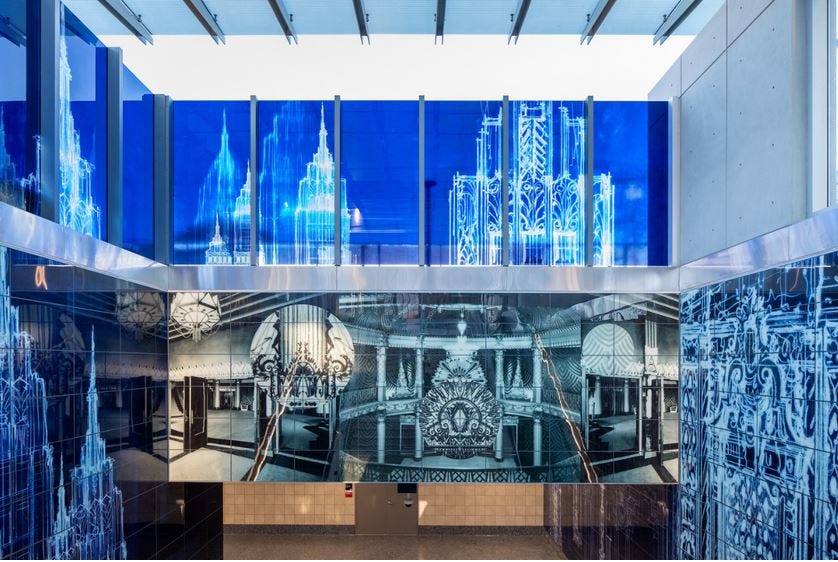
Wilshire/La Cienega station art by Todd Gray LA Metro
One stop west of the Metro Wilshire/Fairfax station, Metro riders will encounter an environment with a Jewish connection. No, there are not giant ceramic bagels hanging from the ceiling. But the station does have a visually satisfying sort of art based on the nearby work of a Jewish architect.
A short walk from the station is the Saban Theatre. Originally called the Fox Wilshire Theatre, the Art Deco building was designed by S. Charles Lee.
The station’s artwork by Todd Gray, according to Metro Art, “Juxtaposes archival architectural drawings by S. Charles Lee and historic photographs of the nearby Saban Theatre with a multicultural selection of iconic textile patterns.”
“I was mesmerized by the Saban Theatre,” said Gray in an interview with Metro Los Angeles. “Architecture really helps shape the conversation of the community, and shapes the culture,” he said.
S. Charles Lee, designed many movie theaters on the West Coast, including in Los Angeles the Tower and Bruin theatres. His attention-drawing style of towers, spires, and dramatic entrances is best summed up in the title of his biography “The Show Starts on the Sidewalk.”
Born Simon Charles Levi in Chicago in 1899, the young architect moved to LA in 1922. He soon began work on the downtown Tower Theatre which today houses an Apple Store.
During his career he designed over 400 theaters, including approximately 250 in the Los Angeles area.
In addition to movie palaces, in 1939, Lee designed a new addition to Mount Sinai Hospital. In 1948, he partnered with architect Samuel Lunden to design Temple Israel of Hollywood.
When the film “Exodus” was released in the early 1960s, the theater was the site of several Jewish fundraisers. In 1962, it also served as a location for Temple Isaiah’s High Holy Day services.
Today, the Saban Theatre (named for Haim and Cheryl Saban) is a concert venue, and the home of the Temple of the Arts of Beverly Hills.
////\/\\\\
Edmon J. Rodman
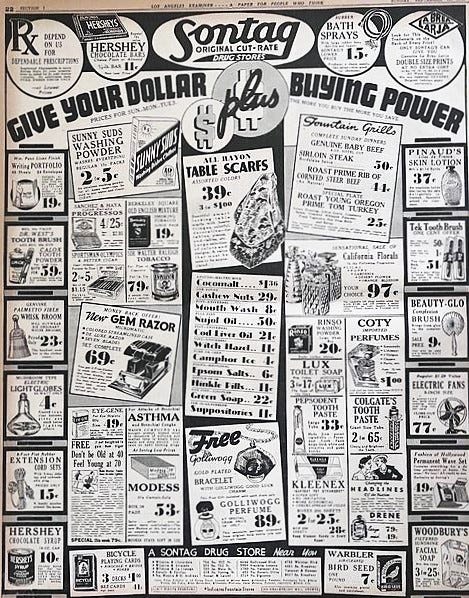
Even during the lean years of the Great Depression, Angelenos, as indicated by the above full-page ad, still wanted chocolate, perfume and playing cards. For those needs and more, Sontag Drug Store, located on the Miracle Mile at the northwest corner of Wilshire and Cloverdale, was well-stocked.
The Sontag Drug Store chain was founded in 1929, at the outset of the Great Depression by Jewish businessman Morris Sontag. Looking for a niche in the drug store business, Sontag chose the “Cut Rate” route; offering lower prices to out-of-work Angelenos.
The chain quickly grew eventually employing 1300 people with 16 stores in LA out of a total of 48 in California.
The Art Deco style building that housed the Wilshire Boulevard location until the 1940s, with 70 feet of frontage on Wilshire, was designed to fit into the auto- friendly scheme of the Miracle Mile.
The store, announced a Sontag executive in the L.A Times, would have “an entire frontage and side with a continuous expanse of brightly illuminated show windows. There would be a “spacious mezzanine,” and “complete air conditioning.”
A 1937 ad for “Sontag Original Cut-Rate Drug Stores” in the Los Angeles Examiner promoted Sunny Suds Washing Powder two for 5¢, Hershey Chocolate Syrup, 10¢ a can, Golliwogg Perfume, 89¢, table scarfs, electric fans, and whisk brooms.
To keep up with the competition, beginning in 1935, Sontag Drug Stores began adding lunch counters and soda fountains to their locations. According to the ad, the Miracle Mile location offered “Genuine Baby Beef,” sirloin steak, and prime tom turkey.
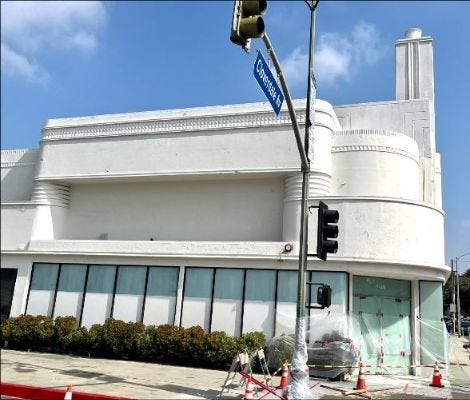
The former Sontag Drug Store.
Profits and dividends to shareholders continued throughout the 1930s, and in 1944 the chain, which was headquartered at 827 N. La Brea, was sold to Owl Drug.
Morris’ wife, Minnie, was very active in the Jewish community. Her involvement included the Jewish Welfare Board, Jewish Community Council, Jewish National Fund, and Congregation Beth Israel on Beverly Boulevard. Much of her energy was spent raising funds for Cedars of Lebanon Hospital, where she organized the institution’s Helping Hand store.
Morris Sontag was born in Dorohoi, Rumania in April, 1888. After arriving in the U.S., one of his early jobs was selling automobiles in Pennsylvania. By 1922, after he had moved to Los Angeles, he opened a cigar and tobacco store.
Morris, who died in Orange, California in 1983, was also involved with charitable work. He told the Los Angeles Times while endorsing the work of the Community Chest: “We all definitely accept the principle that deserving poor and needy are to be helped in every enlightened community.”
*The Rodman Archive of Los Angeles Jewish History is a collection of approximately 2000 objects, photos, clothing, art, books, recordings, and ephemera relating to the lives and endeavors of Jewish Angelenos between 1850 and 1980.
////\/\\\\
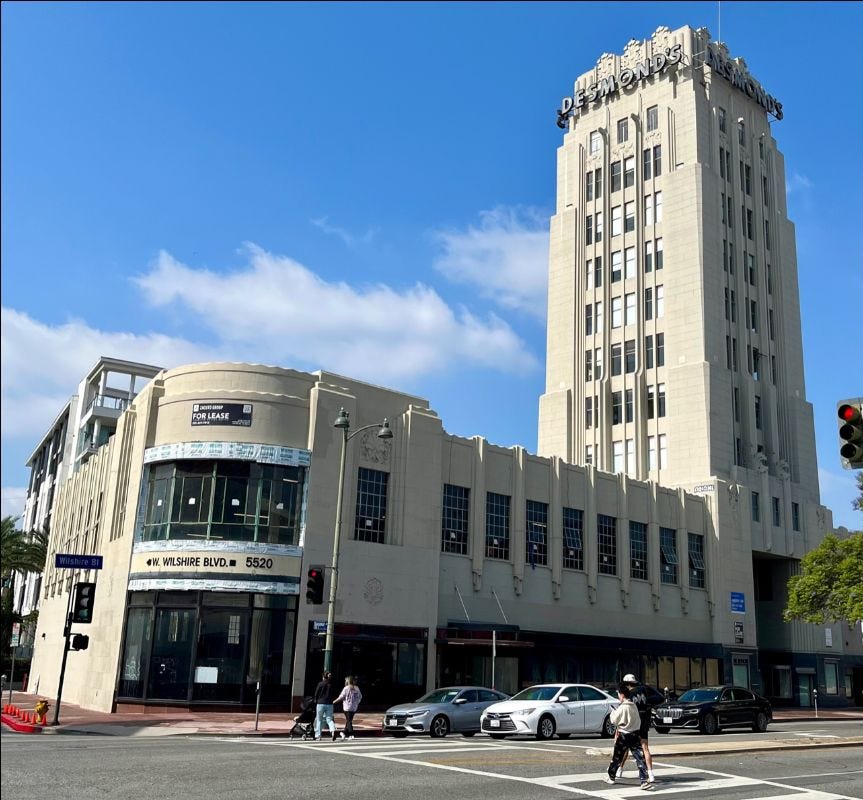
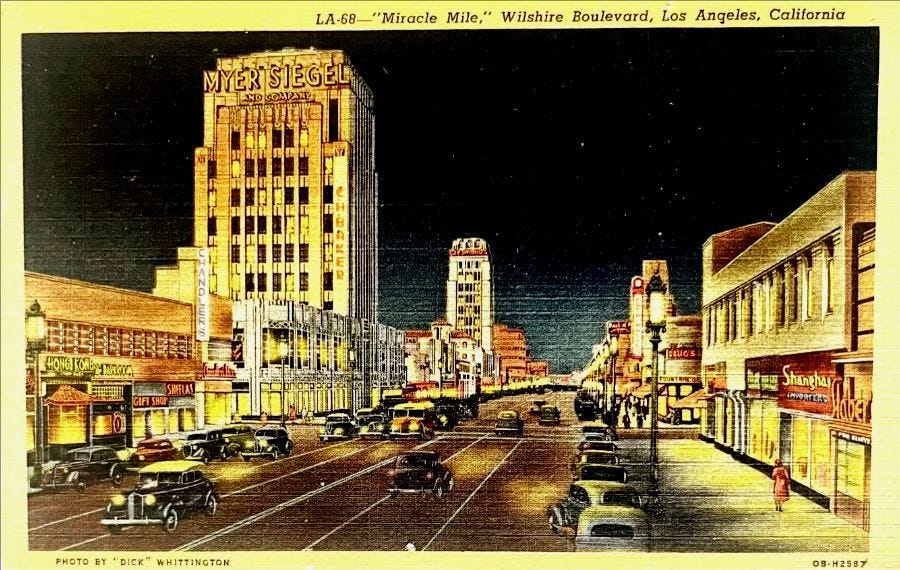
If you were shopping for stylish, contemporary women’s clothing on Wilshire Boulevard’s Miracle Mile, Meyer Siegel was the place to go. The premier women’s fashion department store occupied the ground and second floors of the Dominguez-Wilshire building (Note the store sign atop the building in this issue’s opening photo) from 1931 until the early 1950s. Like the other buildings on Wilshire Boulevards’ Miracle Mile, the store’s large ground floor windows were designed to capture the eye of a motorist going about 30 mph. Siegel opened his first store in LA, Siegel the Hatter, around 1886. He married Flora Magnin, daughter of Isaac Magnin (I. Magnin founder) in 1896, and her experience and connections figured into the couple’s success. Eventually, the couple had stores at five Southland locations. Siegel was a member of Hillcrest Country Club. He also was a member of B’nai B’rith, where he served on the organization’s committee that battled antisemitism.
////\/\\\\
Comments
Nothing yet. Say the first thing.
Sign in to join the conversation.