

A New Scroll of LA Jewish News
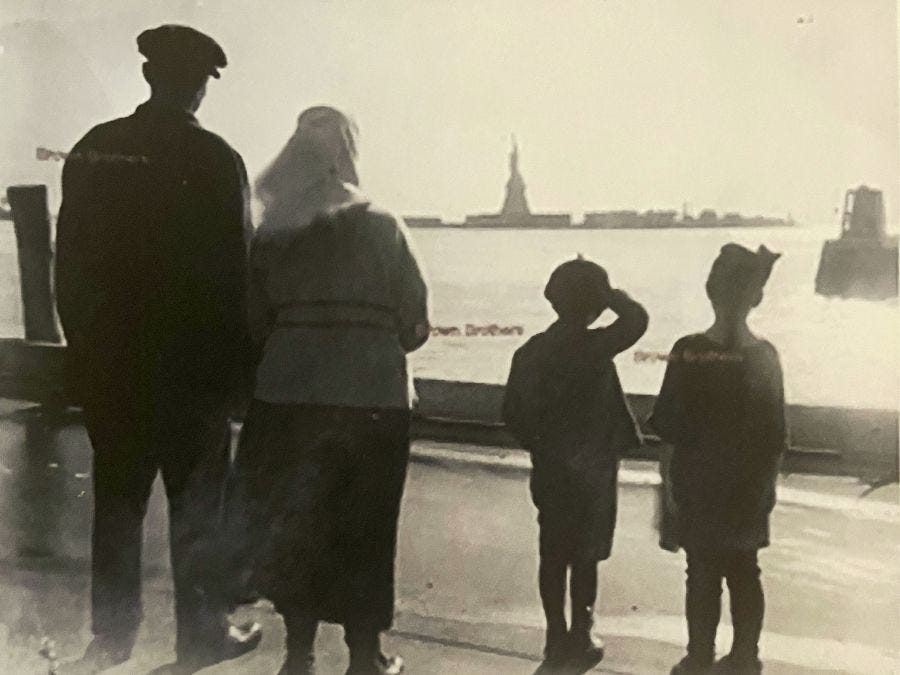
Photo by Brown Brothers, Rodman Archive
Folks,
As a musical theme to this classic photo, taken at the shore of Ellis Island, one can almost hear the chords of “Coming to America.” For most Jewish Americans, Neil Diamond’s song is a fitting soundtrack, especially as we celebrate America’s 250th anniversary. My grandparents, like many of yours, came here from Europe in the early decades of the 20th century to be free from oppression, to practice their religion in peace, and to partake in America’s promise. Members of our families have gone to war, lived through economic depression and boom. As many of the columns in MegilLA have described, we have contributed to the building of this city, this nation, and Israel. Yet, the battles and fireworks continue over our Jewish identity, and our acceptance in America’s civic discussion. Hundreds of years after George Washington’s famous letter to “the Children of the Stock of Abraham,” that sent his biblical-inspired assurance that “there shall be none to make him afraid,” we continue to struggle with the fears and foment of antisemitism. In response, here in LA, over the next few nights, while the fireworks are flying, through all the smoke and booms, let us remember what our own sparks bring. It’s our anniversary too. Make
////\/\\\\
////\/\\\\
Edmon J. Rodman
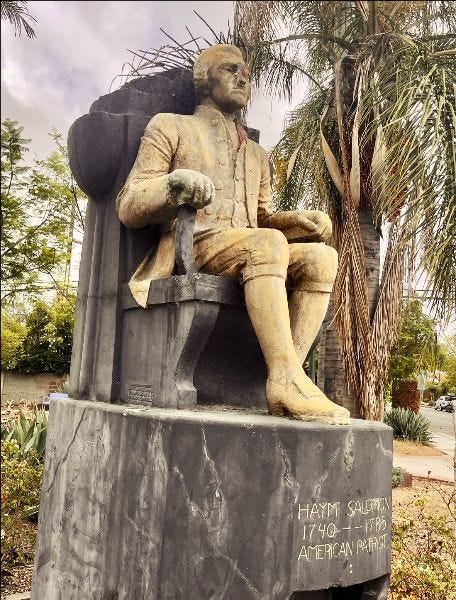
EJR: Today, we are in Pan Pacific Park for a live interview with American Revolutionary War hero Hayim Salomon. Do you prefer Hayim? Or just Hy?
HS: Hayim is fine. That’s the way they said it back in Poland where I’m from. Not like “l’chayim.” Though some hard cider would be nice about now.
EJR: Seems like you’ve been sitting on that chair forever. Does it ever get boring?
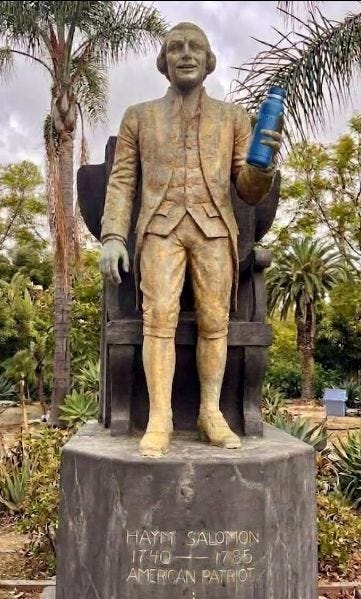
HS: You think? Mostly its endless hours of passing horseless carriages, and people walking dogs. At my first location, Hollenbeck Park, the view was greener, same for the second location spot, MacArthur Park. They stuck me here to be close to the Jewish community. But come Shabbat, do you think anybody brings me challah?
EJR: A lot of historians refer to you as the Financier of the Revolution. How does that sit?
HS: Suits me well enough. I did a lot of brokering of bills of exchange. The money was used to fund the war.
EJR: How did that work?
HS: The bills were credit notes, sort of like an international post-dated check. Issued by the Continental Congress, the notes directed a foreign bank or benefactor to pay a set sum to the holder of the bill at a future date. When the war was going badly, they were hard to move. But I was able to convince patriotic, wealthy merchants, some of them Jews, to buy them.
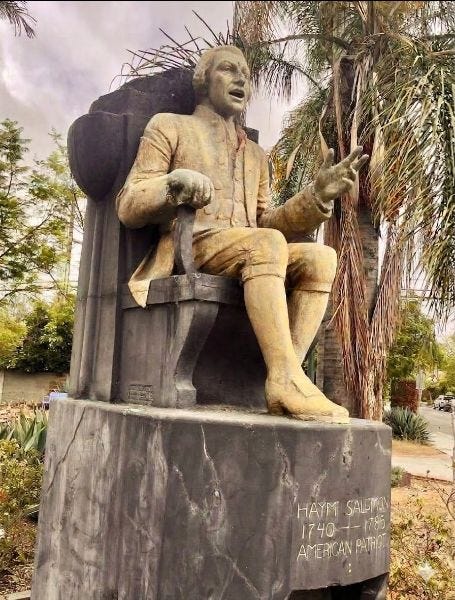
EJR: Is it true that you were a slaveholder?
HS: I thought we agreed not to talk about that… Yes, I owned one slave. He ran away.
EJR: And you occasionally acted as a slave broker?
HS: Yes…What can I say? I was a man of my time. No better, or worse than Jefferson, or Washington. And if this part of my life knocks me off my cement seat, then so be it. I’m tired of sitting here, anyway.
EJR: You were a spy too?
HS: Yes, while I was a shopkeeper in New York. I was arrested as a spy by the British, and sentenced to death. They stuck me on a prison ship, and because I could speak French and German, forced me to serve as a translator for the Hessian troops and French captives. But I also helped prisoners to escape. Once the British caught on, I escaped too.
EJR: Where did you go?
HS: To Philadelphia where I met Jefferson, Madison, and was introduced to the country’s first finance minister Robert Morris. It wasn’t easy to be a Jew there.
EJR: How So?
HS: The Independent Gazetteer in 1784 ran a letter from a citizen targeting Jewish brokers like me as charging extremely high and unusual interest.
EJR: How did you respond?
HS: That it was an indiscriminate attack on the Jews of Philadelphia for the faults of a few.
EJR: You also wrote that “I am a Jew; it is my own nation; I do not despair that we shall obtain every other privilege that we aspire to enjoy along with our fellow-citizens.”
HS: Yes. I wasn’t going to apologize for my heritage. And I expected Jews to have the same rights as every other citizen.
EJR: During those years where did you daven?
HS: In Philadelphia,Congregation Mikveh Israel, which people later started calling “Synagogue of the American Revolution.” Nice shul, I gave a lot towards their first building. Before that in New York, Congregation Shearith Israel. It was Sephardic, like me. Ladino was one of my languages.
EJR: Were you ever repaid for the loans you made during the Revolutionary War?
HS: That’s a sore spot. I gave hard currency, credit, and interest-free cash loans to the Continental Congress, and no, I was never repaid the over $350,000 I was owed. I also made personal loans to Madison and some of the other delegates at the Continental Congress who were broke at the time. I made those loans never expecting repayment.
EJR: And the story about the Star of David on the back of the dollar bill being placed there by Washington as a tribute to your work?
HS: Flim-flam! The star didn’t appear on the bills until 1935, and it’s just a pattern so the 13 stars fit. If I had a buck for every time I’ve heard that story, you can bet your lucky stars, I wouldn’t be sitting here.
EJR; Well, thanks for your time.
HS: Hey, Catch you later. Without that government payback, I’ve got to do a gig for a store opening at the Grove.
////\/\\\\
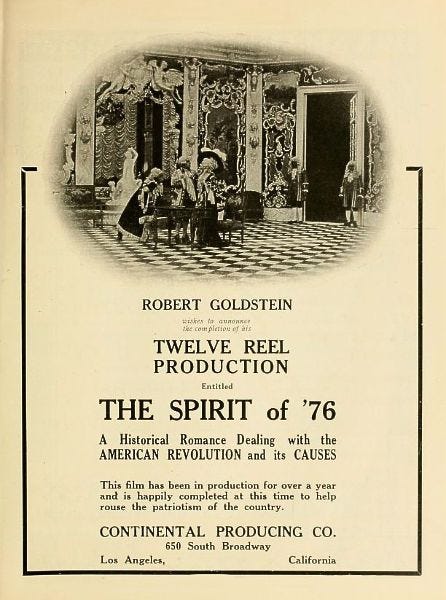
Edmon J. Rodman Over one hundred years before the 250th anniversary of our freedom as a country, freedom of speech was put to the test in Los Angeles by a Jewish silent film producer who made a movie about the Revolutionary War. In 1918, the making of a film titled “The Spirit of ‘76,” landed its producer Robert Goldstein, whose father was German-Jewish, in Federal prison. Goldstein, who ran a downtown theatrical costume company, began his career in movie-making working on D.W. Griffith’s controversial and highly profitable film “Birth of a Nation.” The film, which included elaborate set and costumes, financed by the $250,000 Goldstein had raised, opened in Los Angeles at Clunes auditorium in 1917. Promoted in the LA Herald as a “historical photo-spectacle,” it visualized “for the first time a new and startling chapter of the intrigue what was partly responsible for our Revolutionary War.” Screening after the U.S. entered WWI, the film immediately ran amok of the Espionage Act of 1917. In an act of U.S. government censorship, the screenings were halted, and copies of the film were confiscated. In an indictment that reverberates loudly today, Goldstein was accused of “aiding and abetting the German enemy.” At the center of the controversy was a scene depicting a historically-based attack in Cherry Valley New York, where British soldiers and Hessian troops were shown assaulting a woman and bayoneting a baby; aspects that were deemed offensive to our new ally, the British. In the trial held in an LA federal courtroom, Goldstein’s German and Jewish background in a time of wartime hysteria, xenophobia, and antisemitism, did not aide his defense. W. L. Brock, the historian who worked on the film testified that Goldstein “wanted to show the American people how cruel the British soldiers were in the war of ’76 compared to the Germans in the present war.” When Brock also warned Goldstein that because of the bayonet scene, the film would not be passed by the censors. Goldstein’s response was “I can’t take all the life out of the film. I must have action,” said Brock. The U.S. prosecutor argued that the war effort demanded total Allied support, and Goldstein’s film was seditious on its face. Goldstein was convicted and sentenced to 10 years in prison. The conviction was later upheld on appeal. At that time, his lawyers could not make a case for freedom of speech, because in 1915 the Supreme Court had ruled that movies lacked First Amendment protection. Others, including Jewish activists, were swept up in the crackdown on freedom of speech and press resulting from the Espionage Act. Mollie Steimer: A Russian-Jewish immigrant was arrested for distributing Yiddish anti-war leaflets in New York, and Emma Goldman’s publication, Goldstein’s sentence was later commuted to three years by President Wilson, but the damage was done. His career was shattered. No copies of “The Spirit of ‘76” have been found.
////\/\\\\
////\/\\\\
Edmon J. Rodman
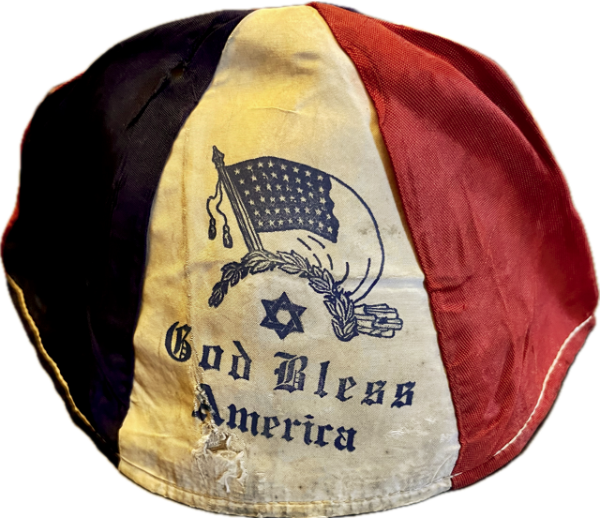
What better way to top off the 4th of July this Shabbat, than with a red white, and blue kippah? This example, circa 1938-40, dates to a time when Kate Smith premiered a rendition of Irving Berlin’s “God Bless America,” in November of 1938. Though the song was written in 1918, its impact was not felt nationally until it was performed during a live CBS radio broadcast of “The Kate Smith Hour With the invasion of Poland by Germany in 1939, there was a rise in patriotism in the US, and American Jews, sensing the danger, were part of that surge. Wearing a flag-waving kippah in time of prayer, or community meeting, fit the spirit of the moment.
*The Rodman Archive of Los Angeles Jewish History is a collection of approximately 2000 objects, photos, clothing, art, books, recordings, and ephemera relating to the lives and endeavors of Jewish Angelenos between 1850 and 1980.
////\/\\\\
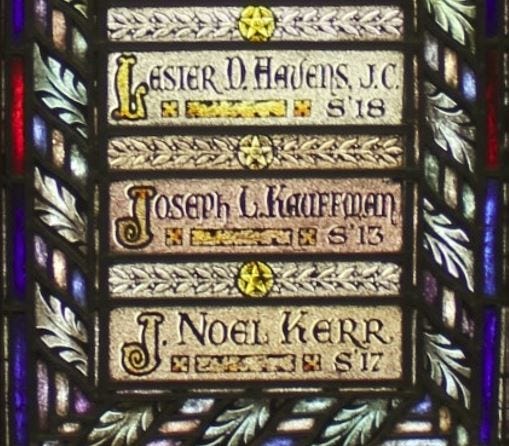
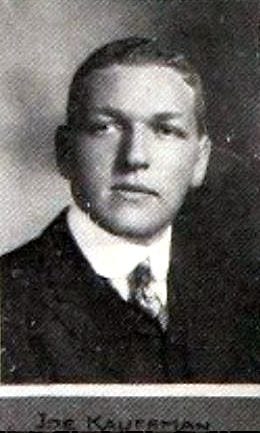
A celebration of the 250th anniversary of the signing of the Declaration of Independence would feel hauntingly unfinished without remembering the people who died defending it. Sergeant Joseph L. Kauffman was one of those people. Years ago, while sitting in the reading room of the Memorial Library on Olympic, across the street from Los Angeles High School. I discovered, in an artfully feigned stained-glass window, Kauffman’s name listed with the other graduates of LA High who had died in the service during WWI. The son of Isaac and Ernestine Kauffman, Joseph was born in Los Angeles in 1895. At Congregation B’nai B’rith, he attended Sunday school and was Confirmed by Rabbi Sigmund Hecht. On his draft registration card, Kauffman described himself as having blue eyes, brown hair, and being tall and stout. Before being drafted into the Army for duty in the American Expeditionary Force, he attended the University of California (now UC Berkeley) and “then returned to this city, where he engaged in the real estate business with his brother, Milton Kauffman,” said an article in the LA Times. “When he was drafted, he joyfully accepted the call, even hastening his departure by exchanging places with a married man,” the Times said. “We are camping close to the front. The shells are whizzing over our heads all the time,” Kauffman wrote in his last letter to his parents. On the morning of September 26, 1918, he died in a barrage of artillery fire in the Argonne Forest in France. As a Jewish soldier, he was not alone. “About 250,000 Jewish soldiers served in the United States military during World War I, 40,000 of whom volunteered,” said a report issued by the American Jewish Committee in 1921. “About 3,500 Jews were killed in action or died of wounds.” At a memorial service Rabbi Hecht sadly memorialized the fallen soldier. “I have known Joseph Kauffman from the time he was a little boy, he said. A memorial plaque proclaimed he “fell in the defense of democracy.” At this time when we remember how our freedom came to be, we say ”May his memory be for a blessing.”
////\/\\\\
Comments
Nothing yet. Say the first thing.
Sign in to join the conversation.