
Author: Daniel Koss
Reviewed by: Babyfolio, Alasdair Mann
Compute demand is absolutely exploding RIGHT NOW. Frontier labs, hyperscalers, neoclouds, and the entire AI industry are massively supply-constrained. Everyone is building as fast as they can, but they simply cannot build data centers fast enough to meet demand.
The key bottleneck today is not just building data centers. It is getting permission to build them amid a massive wave of local and politically motivated pushback.
Data centers are extremely unpopular. A lot of the backlash is driven by misinformation, but there are also legitimate concerns around water usage, noise, air pollution, and rising electricity prices.
The obvious win-win, and in my view the most likely future, is for data center developers to bring their own power.
And there is only one solution that works behind the meter, does not require air permits, uses essentially zero water, produces virtually no noise, is modular, stackable, scalable, and is not completely sold out into 2030+: fuel cells.
And there is only one major provider that is not already hopelessly sold out into 2028-2029: FuelCell Energy ($FCEL).
That makes the setup for $FCEL potentially absurdly bullish. The company could go from operating below scale and losing money to selling out roughly 5x its current capacity, at higher prices, with dramatically improved unit economics and most likely customer prepayments. If that happens, economies of scale could completely transform its margin profile.
$BE investors should be extremely excited too. Bloom can potentially remain booked out for even longer, improve revenue visibility further, and sustain even stronger margins.
And even all of this combined is nowhere near enough to satisfy the growth in demand.
Which means this dynamic is likely to intensify, not ease, over the coming years.
Over the last two weeks, I spoke with people working directly in data center construction, as well as people at companies across the power and energy industry, including fuel cells, solar, and other technologies.
And one thing became extremely clear:
Fuel cells are the absolute hero right now.
They are saving data center projects that were at risk of being delayed or even cancelled.
The most recent example is Nebius’ ($NBIS) Vineland data center, which finally received approval for its Phase 2, 300 MW buildout for Microsoft after switching from gas turbines to Bloom Energy ($BE) fuel cells. In my view, that switch was likely critical to getting the project approved.
But the most interesting thing I learned concerns Bloom itself.
Publicly, Bloom emphasizes that manufacturing capacity should not become its bottleneck and that it can continue expanding production rapidly.
What I am hearing behind the scenes paints a somewhat different picture of the current demand environment.
The issue is not that Bloom has stopped expanding. Quite the opposite. Bloom is already expanding as aggressively as it reasonably can, and demand still appears to exceed what it can supply.
According to people I spoke with, Bloom has reached the point where it is rejecting multi-hundred-megawatt opportunities because the opportunity cost of accepting the wrong project is simply too high.
In other words, Bloom increasingly gets to choose its customers.
And if you are capacity-constrained, maximizing volume is no longer the optimal strategy. You maximize the quality and economics of every megawatt you sell.
That means prioritizing customers willing to pay higher prices, provide substantial prepayments, place very large orders, and offer simple, attractive projects that are easier for Bloom to execute.
The negotiating leverage appears to sit overwhelmingly with Bloom, not with the customer.
I am also hearing that Bloom keeps some capacity available rather than committing absolutely everything years in advance, allowing it to serve desperate customers that suddenly need power NOW at significantly better economics.
The analogy here is Nebius. Nebius has publicly explained that it could sell capacity years in advance at roughly $20M-$25M per MW, but instead keeps some available for customers willing to pay $40M-$50M per MW or more for immediate access.
What I am hearing suggests Bloom is benefiting from a similar scarcity dynamic in power.
So while Bloom publicly argues that manufacturing capacity will not constrain its growth, my takeaway from these conversations is more nuanced:
Bloom can continue increasing capacity, but it still cannot come remotely close to satisfying all of the demand currently coming its way.
That is an extremely powerful position to be in. Instead of simply asking, How much can we sell?, Bloom can increasingly ask, Which deals maximize the economics of the capacity we have?
And that has a very direct second-order implication for FuelCell Energy ($FCEL).
FuelCell Energy is currently expanding annual manufacturing capacity from roughly 100 MW to as much as 500 MW per year by mid-2028.
Based on everything I am seeing and hearing about the amount of unmet demand in this market, I have virtually no doubt that $FCEL can sell that entire 500 MW of annual capacity.
More importantly, I think the market may be dramatically underestimating the economics at which FuelCell Energy will be able to sell it.
If Bloom is already in a position to prioritize customers based on pricing, prepayments, order size, and execution simplicity, then an additional 500 MW per year of commercially viable fuel-cell capacity entering an extraordinarily supply-constrained market should be extremely valuable.
My expectation is that $FCEL will not merely sell substantially more product. It will likely sell it at higher prices, with better contract structures, potentially substantial customer prepayments, and dramatically better manufacturing utilization.
For a company currently operating far below its potential scale, that combination could completely transform the economics of FuelCell Energy.
Data center opposition is exploding.
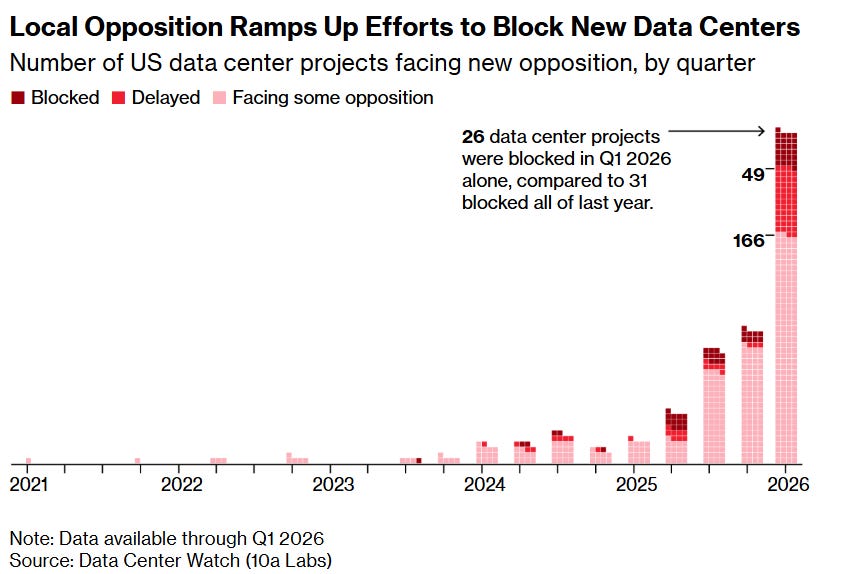
In Q1 2026 alone, 26 U.S. data center projects were blocked, compared with just 31 during all of 2025. Another 49 were delayed, while 166 faced some form of opposition.
Building more data centers is not a construction problem! It is now a permitting and community-acceptance problem.
And the objections are almost always the same: power prices, water usage, noise, air pollution, and strain on local infrastructure.
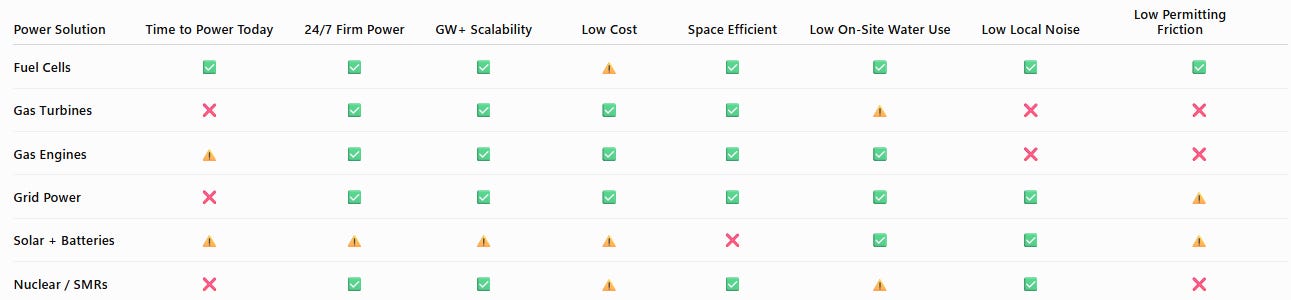
What makes fuel cells stand out is not that they are the cheapest or theoretically best power source on every individual metric.
It is that they are the only solution without a major weakness across the constraints that actually matter for data centers today.
Gas turbines are efficient and cheap, but increasingly unavailable and difficult to permit. Nuclear is phenomenal at scale, but years away. Grid power is cheap, but often unavailable for years. Solar and batteries are clean, but struggle with firm 24/7 power and land requirements.
Fuel cells uniquely combine speed, firm power, scalability, density, minimal water use, low noise, and low permitting friction.
And right now, when the biggest problem is simply getting large amounts of power online fast enough to build the data center at all, that combination is incredibly valuable.
The setup for FuelCell Energy ($FCEL) is almost absurdly favorable.
The demand is there. The technology is real and proven. The market desperately needs additional fuel-cell capacity. And FuelCell Energy is now expanding annual manufacturing capacity from roughly 100 MW to as much as 500 MW by mid-2028.
If the demand environment I described above persists, I have virtually no doubt that this capacity will be sold out quickly.
And the opportunity is much bigger than simply selling 5x more product.
Higher utilization, stronger pricing, larger orders, potential customer prepayments, and dramatically better fixed-cost absorption could completely transform FuelCell Energy’s revenue and margin profile.
The single biggest risk is therefore very simple:
Execution.
Everything around FuelCell Energy is lining up. The market is there. The need is there. The technology works. Now management has to execute and capture what may be a once-in-a-lifetime opportunity.
One small sidenote: I would not rule out M&A either.
This is not my base case. But if the current team proves unable to fully monetize the opportunity, FuelCell Energy’s technology and IP could become extremely valuable to a hyperscaler or major energy company. At a market capitalization of only around $1.6B, the entire company is small enough to be a realistic strategic acquisition.
This article reflects our personal opinions and is provided for informational and educational purposes only. It does not constitute financial, investment, legal, or tax advice, nor a recommendation to buy, sell, or hold any security. We may hold positions in companies mentioned and may change these positions at any time without notice. Past performance is not indicative of future results, and investing involves risk, including the possible loss of principal. Always do your own research and make your own independent investment decisions.
No posts
Comments
Nothing yet. Say the first thing.
Sign in to join the conversation.