
Author: Alasdair Mann
Reviewed by: Daniel Koss, Babyfolio
Amtech Systems ($ASYS) is a leading provider of thermal processing equipment for semiconductor manufacturing.
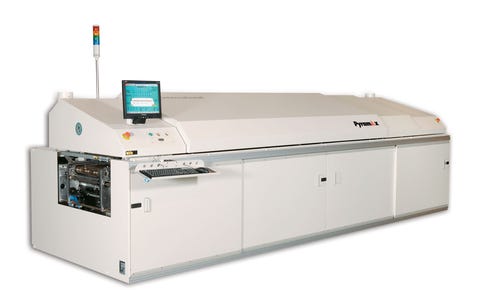
Their lineup includes reflow ovens that melt solder to fix chips onto circuit boards, high-temperature diffusion furnaces, and wafer-polishing consumables, sold largely under its BTU International brand (Source).
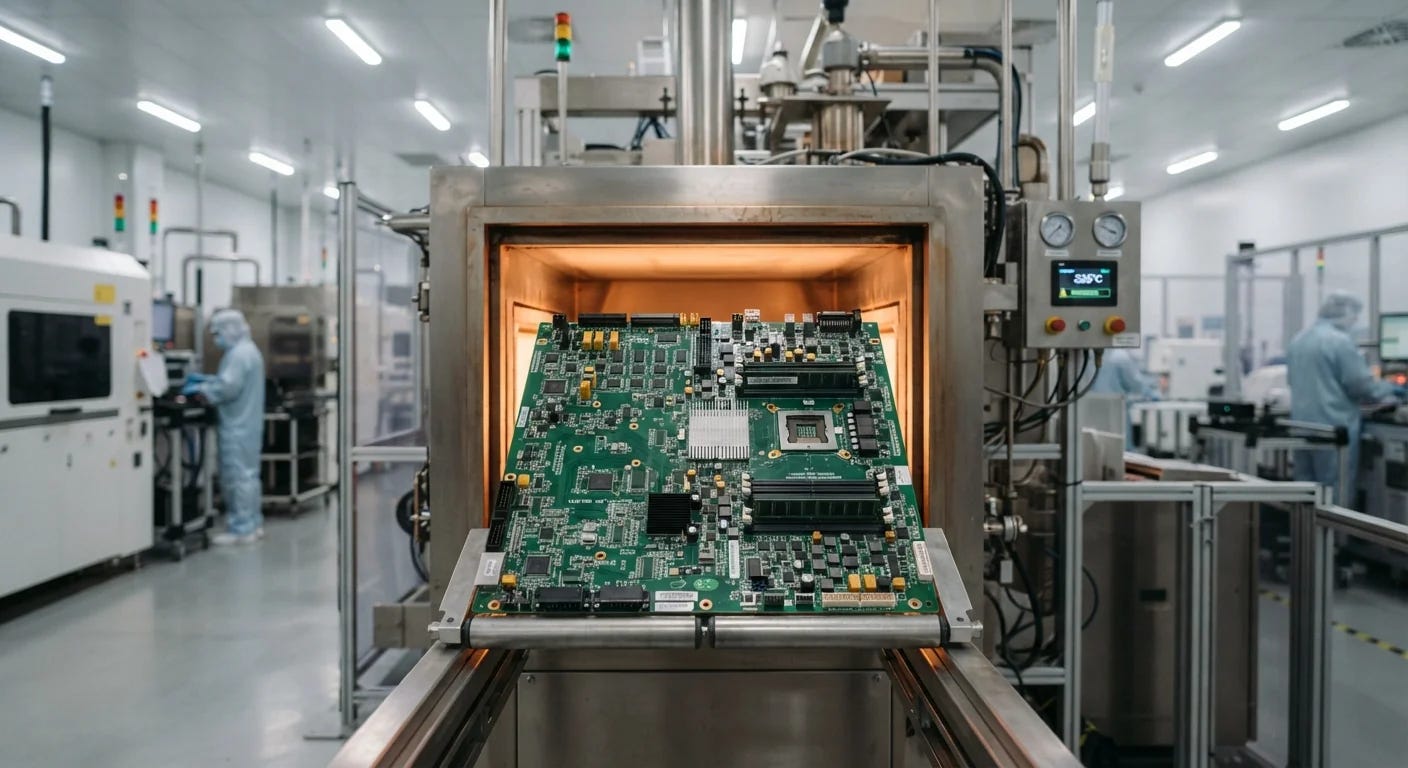
Every AI accelerator package and every AI server board passes through a machine like that on its way out of the factory, and the heavier and denser those assemblies become, the more precise the thermal control has to be.
Executive chairman Bob Daigle leads Amtech. Before joining Amtech, he spent thirty years one layer up the supply chain that Amtech now sells equipment into (Source). He took the chief executive role in August 2023 and rebuilt the business over the following 18 months, returning it to profitability.
We are covering Amtech because this month’s earnings report showed a clear AI inflection in the business, yet shares have not recovered from July’s semiconductor selloff.
Foundries are doing everything they can to keep up with the exponentially increasing compute demand.
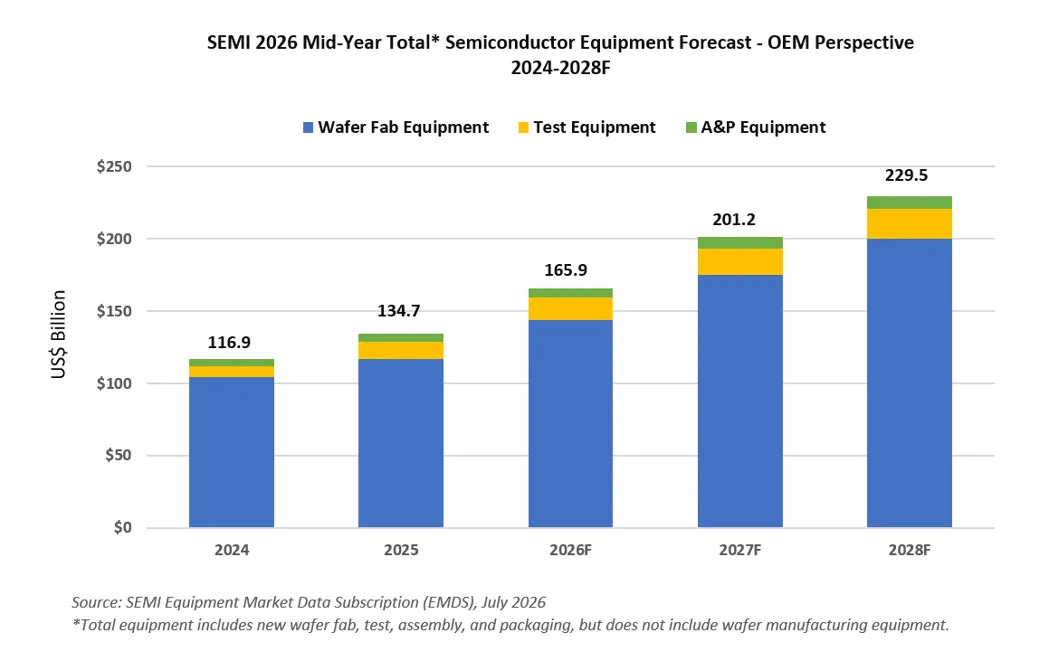
SEMI forecasts global semiconductor manufacturing equipment sales of $165.9 billion in 2026, up 23.2%, rising to $229.5 billion by 2028 across five consecutive record years (Source). SEMI projects Amtech’s corner of that market, assembly and packaging equipment, to hit $6.7 billion in sales in 2026, and then $8.6 billion by 2028. Because existing infrastructure cannot satisfy chip demand, semiconductor manufacturers are making multi-year capital commitments to install new manufacturing lines rather than relying on legacy equipment.
Not all equipment can make next-generation hardware, too. The thermal step is getting harder:
Next-generation AI server boards feature massive thermal design power (>1,000W TDP) and thick copper layers that absorb immense heat, requiring multi-zone reflow ovens with precise thermal profile management to prevent solder voiding and board warping.
Advanced 2.5D and 3D packaging further complicates manufacturing, because micro-bumps at fine pitch leave almost no room for thermal expansion variance.
The industry’s move from round 300mm wafers to large rectangular panels adds another layer of complexity.
Amtech’s answer is the Aurora 200N75, with up to sixteen heating zones and oxygen held below 30 parts per million to protect solder wetting and limit panel warpage (Source).
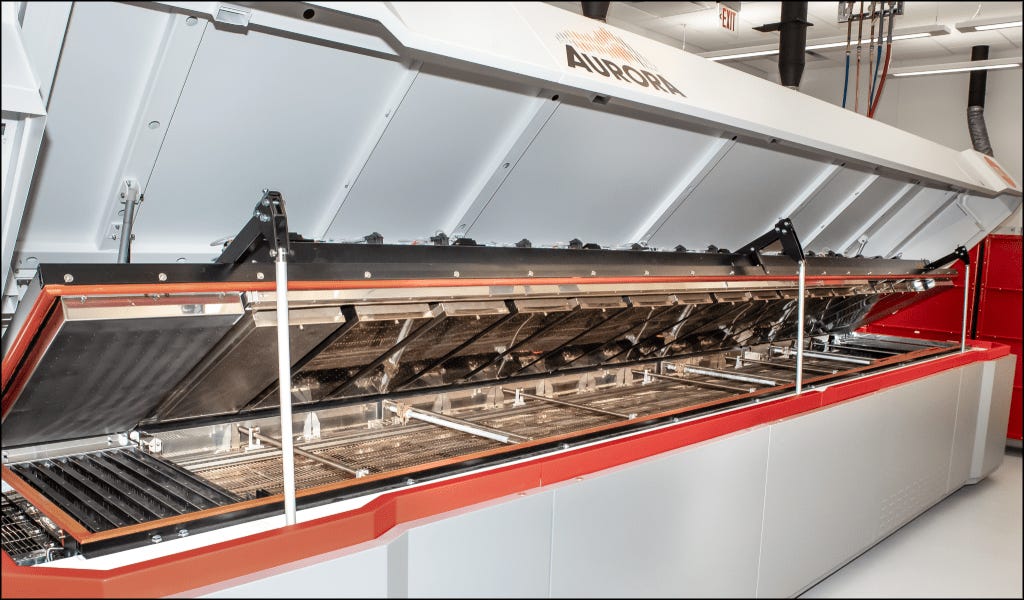
Aurora, announced in February, is also coming at a moment when delivery time has become the competitive attribute. Major back-end advanced packaging and assembly equipment suppliers face severe backlogs, stretching lead times out to six to twelve months (Source). In contrast, Amtech maintains fast delivery times of just 6 to 8 weeks. In such a competitive market, vendors that can offer quick delivery are more likely to get qualified. As a result, Amtech can gain market share during peak cycles and retain it afterward, as thermal profiles are qualified for each production line and customer, creating significant switching costs for clients.
In just the past three months, three significant developments have transformed Amtech’s narrative regarding its AI expansion:
May 2026: Amtech rebuilt its executive team around semiconductor capital equipment. Guy Shechter joined in May 2026 as president and chief operating officer and became chief executive on August 13, 2026. He brought 25 years of experience in semiconductor capital equipment (Source). Thomas Sabol joined as chief financial officer in the same month. Daigle stayed on as executive chairman with a remit covering capital allocation and acquisitions.
June 3, 2026: Amtech raised $60 million in an oversubscribed share offering, lifting cash to $83.1 million against no material debt (Source). Management has said the money is there “in anticipation of opportunities to supplement organic growth with synergistic acquisitions” (Source).
August 5, 2026: Amtech reported AI-related revenue up approximately 120% year on year. Thermal Processing Solutions revenue growth is accelerating, with total backlog closed at $28.7 million, up from $21.2 million a year earlier (Source).
Additionally, there are three major catalysts expected for the rest of the year:
SEMICON Taiwan, early September 2026. Amtech has said it will introduce new products addressing higher-density packaging requirements at the show. These serve applications the current product line does not reach.
Fiscal 2027 Expectations, expected December 2026. The full year lands with a new chief executive setting fiscal 2027 expectations for the first time. Amtech reported its fiscal 2025 year on December 10, 2025, which is the timing precedent.
A first acquisition, undated. Amtech has a stated acquisition mandate but has not announced a target for the $60 million in capital it raised.
In the coming months, Amtech will shift from being a mature equipment supplier recovering from a write-down to becoming an advanced-packaging vendor, with its AI line surpassing all other products it sells.
The following is our own scoring system, based on our own research, worldview, and biases.
Its primary purpose is to create an objective way of comparing companies across the factors that matter most to us.
A score of 5/5 means excellent. For quality factors, it means the company is elite. For risk factors, it means we see little to no risk.
A score of 1/5 means unacceptable. For quality factors, it means the company is weak or completely replaceable. For risk factors, it means the risk is so high that we would usually eliminate the stock before even considering it.
We rate Amtech’s moat 3/5.
Their main power is in switching costs. Thermal profiles are qualified per production line and per customer, and requalifying an oven mid-production costs downtime nobody spends without a reason. This is how one outsourced assembly and test customer came to take more than 300 cumulative units from Amtech (Source).
Amtech also has some processing power. Maintaining a repeatable thermal profile across a substrate at production throughput is application engineering accumulated over decades, and it lets the company sell equipment that is “generally more expensive than our competitors” while still holding “a high market share of advanced packaging and assembly applications” (Source).
The score is capped at 3/5 because four of Amtech’s five material patents cover the fabrication segment rather than the reflow line that generates the growth. So what Amtech owns is a qualification a competitor could eventually win. The 10-K describes those competitors as “larger and have substantially greater financial and other resources”.
We rate Amtech’s management 3/5.

Upon joining Amtech, then CEO Daigle took a business losing money at the operating line and rebuilt its cost structure over 18 months, turning it profitable. This year he recruited a chief executive with twenty-five years in semiconductor capital equipment, handed over the operating role in an orderly succession, and stayed as executive chairman rather than leaving.

Shechter’s background is a better fit for what Amtech is becoming than Daigle’s was. Shechter’s previous employers, Veeco and Yield Engineering Systems, are semiconductor equipment businesses. Daigle’s previous employer, Rogers Corporation, is a materials company. A board that recognizes the company has changed shape and hires accordingly is doing its job.
The impairments taken in fiscal 2025 run counter to this. The company reported $23 million of goodwill and intangible write-downs. This is a formal admission that the prior acquisition round was bought into an end market that then collapsed, and Daigle today still holds the acquisition mandate for the next round.
The score is capped at 3/5 because the new team has one quarter together and the chairman’s most recent large capital allocation was written down. Continued evidence of strong execution, or an acquisition that proves Daigle’s strategic ability, moves this score.
We rate Amtech’s alignment 4/5.
Chairman Daigle took his salary from $450,000 as chief executive to $300,000 as executive chairman, on a two-year term (Source). His equity at risk is 100,000 options struck at $5.09 in August 2025, worth roughly $1.1 million at the reference price (Source), plus the 50,000 restricted stock units granted on August 4, which come to about $0.8 million. Close to $1.9 million of his own outcome therefore rides on the share price against a $300,000 salary, a little over six times.
CEO Shechter came in on a $400,000 salary with a target bonus of $200,000, paid 60% in cash and 40% in restricted stock, and gated on EBITDA targets set by the board (Source). He was granted 50,000 options at $19.67 on arrival, vesting over three years (Source), plus 25,000 restricted stock units. Those options are struck 22.6% above the reference price, so the shares have to rise almost a quarter before they are worth anything to him.
The largest holder sits on the board. Robert Averick controls 2,986,341 shares through Kokino LLC’s family clients and his own holdings, 17.1% of the company (Source). In May 2025, he bought 67,649 of them on the open market for $235,776 of his own cash (Source), a position now worth roughly $1.1 million.
No insider sale appears anywhere in the Form 4 record since the June offering, and the sixty-day lock-up that followed it expired at the start of August without one.
The score is limited to a 4/5 because while the payment structures are sound, this is not a founder-led company with high ownership.
We rate Amtech’s execution risk 3/5.
Amtech has “migrated to a semi-fabless manufacturing model for the majority of our capital equipment business to improve our ability to scale production and reduce fixed costs” (Source).
The migration worked, as the company demonstrated operating leverage over the last four quarters. But shipping the exit run rate means roughly 39% more equipment out the door each quarter than June managed, and it increases reliance on third-party manufacturing and supply chains.
Amtech also has a scale disadvantage. They are a fraction of the size of the equipment makers it competes against in advanced packaging. If packaging technology evolves beyond Amtech’s current capabilities, Limited R&D resources could become a problem.
The delivery record is what puts this at a 3/5. The new-platform ramp is the piece the exit run rate leans on hardest and the only one with no track record behind it.
We rate Amtech’s financial risk 4/5.
There’s no solvency question. Amtech holds $83.1 million of cash against no material debt and shareholders’ equity of $115.6 million. They have generated operating cash in 11 consecutive quarters, and carry no covenants to breach, no maturities to refinance, and no going-concern language anywhere in its disclosure.
But they have recently diluted. Amtech registered a $50 million shelf on March 13 and had used all of it by June 1, when it registered another $10 million under the rule permitting a 20% top-up (Source). The offering was raised at $20.50, above today’s price, which in hindsight is accretive to shareholders. But it is holding an acquisition mandate with no announced target, so the odds of a further raise are not small.
The score is capped below 5 because a deal does not yet justify the last raise.
We rate Amtech’s technology risk 4/5.
What ships is proven. Reflow ovens and diffusion furnaces are mature equipment. Amtech is not asking a customer to bet on an unproven process, and lead times of six to eight weeks describe a product that ships rather than one still being engineered. The equipment is already running inside the AI supply chain at outsourced assembly and test providers, original equipment manufacturers, and hyperscaler-related assemblers.
The risk lies in how the sector develops. Higher-density packaging is not the same tool with a different setting. Panel-level formats and finer-pitch interconnects change what a thermal process must handle across a larger area, and the products meant to address them are still unannounced. Amtech spent $2.6 million on research and development in fiscal 2025, 3.3% of revenue and down 38% from the year before, which is a thin base from which to invent them.
We rate Amtech’s exogenous risk 4/5.
No customer reached 10% of revenue in either of the last two fiscal years, and the equipment is sold across outsourced assembly and test providers, original equipment manufacturers, and hyperscaler supply chains. Amtech does not depend on any single buildout, hyperscaler, or chip generation succeeding.
What keeps this off a 5/5 is geography. Chinese customers were 22% of fiscal 2025 revenue, and 148 of 264 employees work in Shanghai. Without diversifying that footprint, this score is limited to a 4/5.
Our price target is dated to the exit of fiscal 2027, the quarter ending September 30, 2027.
Consolidated revenue grew roughly 7% in fiscal 2026, from $79.4 million to $85.0 million. We’re modeling even faster growth in fiscal year 2027 for three reasons.
The AI Base Now Represents a Large Segment of Thermal Processing
AI equipment accounted for a quarter of Thermal Processing Solutions’ revenue and was growing at triple digits against a flat non-AI base. It now represents over 40% of the segment. Applying the same growth rate to this larger share results in a greater contribution, which is why blended growth accelerates even if the AI line doesn’t grow at a percentage point faster than it did previously. Thermal Processing Solutions grows roughly 12% in fiscal 2026. In our model, it grows roughly 37% in fiscal 2027
The order book already shows accelerating growth for 2027
Backlog closed the June quarter at $28.7 million against $21.2 million a year earlier, up 35.4%. Bookings rose 36.5% sequentially in the June quarter alone. With a six- to eight-week lead time, orders taken in the September quarter are revenue in the December quarter, and management has said this backlog converts primarily in the first quarter of fiscal 2027.
New products arrive mid-year.
BTU launched Aurora, its next-generation reflow platform, in February 2026, built around a factory-configurable heating and cooling architecture that lets a customer set thermal specifications to its own product mix (Source). Further products for higher-density packaging follow at SEMICON Taiwan in September, and management has indicated six to nine months before a new platform reaches a normal order rhythm, placing contribution in the second half of fiscal 2027.
Fiscal 2026 exits at roughly $23.25 million a quarter, or $93 million annualized, on the September guidance. Our fiscal 2027 exit assumes approximately $143 million.
Amtech discloses the AI share of Thermal Processing Solutions revenue in most quarters. It was above 30% in the September 2025 quarter, 35% in the December quarter, and above 40% in the June 2026 quarter. On our estimates for the two undisclosed quarters, the AI line exits fiscal 2026 at roughly $7.8 million a quarter.
Reaching $145 million means that line reaches about $20 million a quarter, while the non-AI thermal business holds flat at around $10 million and the fabrication segment recovers modestly to $5.5 million.
AI, September 2027 quarter: $7.8 million × 2.6 = $20.3 million
Non-AI thermal, held flat: $9.95 million
Semiconductor Fabrication Solutions: $5.50 million
September 2027 quarter: $35.75 million, an exit run rate of $143 million
This model rests on a demanding assumption: the AI line must grow about 160% over the year, faster than the approximately 120% it grew in the quarter just reported.
But it also conservatively assumes zero revenue for the products due at SEMICON Taiwan in September and the acquisition the cash is earmarked for.
Gross margin has expanded every quarter this year, from 44.8% in December to 47.7% in March and 50.0% in June (Source) (Source). Adjusted earnings before interest, tax, depreciation, and amortization ran at 14.7% of revenue in June, and the company has guided the September quarter to low-to-mid teens.
We assume approximately 23.1% adjusted EBITDA margin at the fiscal 2027 exit, mainly due to operating leverage. With gross margins already at 50%, $143 million of revenue produces $71.5 million of gross profit, and reaching this margin requires operating expenses of roughly $43.2 million against a $35.4 million run rate today.
$143 million × 50.0% gross margin = $71.5 million
Less roughly $43.2 million of operating expense, plus $4.8 million of depreciation and stock compensation
= $33.1 million of adjusted EBITDA run rate*, 23.1% of revenue*
We apply 20x the exit-adjusted EBITDA at the enterprise level.
Kulicke & Soffa, the closest listed comparable in back-end assembly and packaging equipment, trades at 30.17x trailing enterprise value to EBITDA. Camtek, the rerated advanced-packaging winner, trades at 172.73x. Amtech at 20x sits at a discount to the two.
Net cash is taken at $90 million against $83.1 million today; the difference is the cash the business generates over the five quarters to the target date, net of the working capital that growth consumes. No acquisition is modeled.
$33.1 million EBITDA × 20 = $662 million of enterprise value
$662 million + $90 million of net cash, no debt to deduct = $752 million of equity value
Fully diluted shares:
17,508,101 basic, outstanding as of June 30, 2026
Approximately 600,000 dilutive options and units; the difference between the basic and diluted weighted average share counts reported for the June 2026 quarter
90,000 units granted on August 4, 2026
A total of 18,198,101. The 45,000 options granted to the chief financial officer in May 2026 have an exercise price of $22.46 and are included in the 600,000 figure rather than added separately.
$752 million ÷ 18,198,101 shares = $41.32 per share at the exit of fiscal 2027, the quarter ending September 30, 2027.
$41.32 against the reference price at the time of publishing of $16.28 yields a return of +153.8% before adjusting for risks.
Our total Quality & Risk Score for Amtech Systems is 3.40/5, weighted as follows.
0.30(3) moat + 0.10(3) management + 0.20(4) alignment + 0.20(3) execution + 0.10(4) financial + 0.05(4) technology + 0.05(4) exogenous
= 0.90 + 0.30 + 0.80 + 0.60 + 0.40 + 0.20 + 0.20 = 3.40
To adjust the expected return for risk, we use the following formula:
Risk-adjusted return = implied upside × (quality & risk score / 5)²
+153.8% × (3.40/5)² = +71.1% risk-adjusted
Amtech looks attractive as both a long-term hold and, potentially, an even better short-term trade. Fundamentally, valuation remains compelling and the AI growth story is only beginning to inflect. Technically, the setup is equally attractive: the stock remains above a rising 200-day SMA, is sitting almost exactly on its 21-day EMA and near its 8-day EMA, while still trading far below its June highs. Most importantly, Amtech appears to have been largely forgotten in the broader AI recovery trade despite improving fundamentals and upcoming catalysts. That combination of attractive valuation, strong technical structure, and deeply depressed sentiment creates significant room for a rerating if investors begin paying attention again. We think Amtech is a good long-term hold and potentially a fantastic short-term trade.
This article reflects our personal opinions and is provided for informational and educational purposes only. It does not constitute financial, investment, legal, or tax advice, nor a recommendation to buy, sell, or hold any security. We may hold positions in companies mentioned and may change these positions at any time without notice. Past performance is not indicative of future results, and investing involves risk, including the possible loss of principal. Always do your own research and make your own independent investment decisions.
No posts
Comments
Nothing yet. Say the first thing.
Sign in to join the conversation.