

Author: Alasdair Mann
Reviewed by: Daniel Koss, Babyfolio
Open the news, and it seems as though the US is going to war against AI data centers.
14 July, the Governor of New York signed the first statewide moratorium on new data centers in US history.
3 August, the Governor of Texas halted grid connections for every new data center in the state pending an audit.
18 August, the Governor of Pennsylvania signed an order making local approval a legal precondition for state permits.
But I’ve spent hours in the past weeks watching the planning board footage for Nebius’s ($NBIS) 350 MW data center in Vineland, New Jersey. I listened to residents making every argument you would expect. Noise. Water. Emissions.
Yet the site plans were still approved. There is no war.
Politicians clearly want the investment that data centers bring to their state. They just can’t risk alienating their voters.
So they are forcing data centers to bring their own power that’s clean, low-noise, and uses minimal water. They forced Nebius to scrap their 32 natural gas engines.
Only 1 solution fits the bill: fuel cells. Once Nebius brought them on, Vineland was approved.
Others want to copy this decision to get their GPUs online.
But according to rumors, Bloom Energy, the most well-regarded supplier, might already be sold out into 2029 and 2030.
So if that’s the case, where will these halted data centers turn to?
In this article, we’ll explore:
The Political Game Theory of Data Centers
The Tailwinds Behind the Fuel Cell Demand Surge
The Economic Advantage of the Second Best Fuel Cell Supplier
The Valuation Model for FuelCell Energy ($FCEL)
Every politician attacking data centers was selling them a year ago.
Pennsylvania Governor Josh Shapiro personally promoted Amazon’s $20 billion investment. Texas Governor Greg Abbott personally backed Google’s $40 billion investment. They took victory laps and announced these investments with podiums and press releases.
But then something changed.
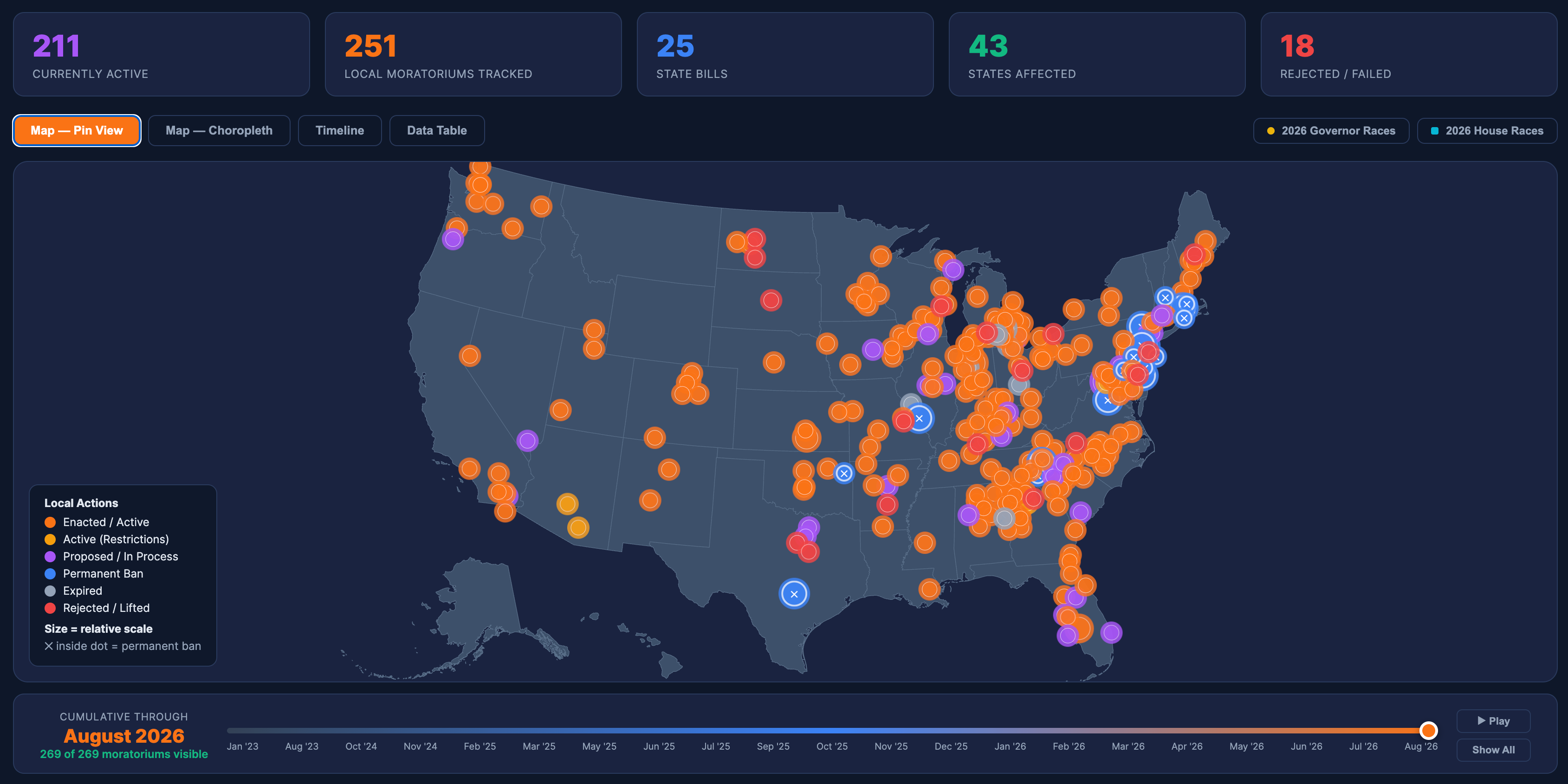
Over the next year, numbers came out painting a painful narrative:
On jobs: Brookings found that a county’s first large facility lifts data-processing employment 56% over a decade, but in a typical county that works out to roughly 100 to 200 permanent jobs.
On energy: PJM capacity auction clearing prices went from $28.92 per MW-day to $269.92 to $329.17 in three consecutive auctions. IEEFA attributes 63% of that increase to data centers, which added $9.3 billion in ratepayer costs in a single year. Pepco customers in Washington, DC saw bills rise by $21 a month. Ohio: roughly $16.
On sentiment: Gallup measured this for the first time in March 2026: 71% of Americans oppose AI data centers in their local area, 48% strongly. It is not partisan. Strong opposition runs 56% among Democrats and 39% among Republicans. Every party group is a majority against, and opposition is highest in the Midwest and South, exactly where the cheap land and cheap power are.
And in a few weeks, these governors are all on the ballot, with their jobs and, more importantly, their political power on the line.
39 governorships are up on 3 November 2026. This is a snippet of how the challengers are positioning their campaigns:
In Texas, Democrat Gina Hinojosa is running a television ad saying Abbott is “selling you out” to data center executives, aimed squarely at rural Republicans worried about water.
In Pennsylvania, Republican Stacy Garrity says Shapiro’s data center work “lit the fuse on the chaos we are seeing in community after community.”
In Wisconsin, the Republican nominee is running an ad calling his opponent “Data Center David Crowley.” The insult is that he is too friendly to them.
But none of them wants the money to leave. A single campus is a multi-billion dollar capital commitment, a multi-year construction payroll, and a permanent addition to the local tax base. And Brookings found that in hyperscale counties, tax incentives amount to only about 2% of construction investment, meaning states don’t even have to give much away to win the bid.
The incentive, then, is not to stop data centers, but to be seen stopping them.
That’s why all have come to a similar solution, allow only data centers that:
Avoid the city’s grid
Won’t impact the city’s water supply
Don’t decrease property values through noise or eyesores.
The technical solution is fuel cells.
The US is already running out of electricity.
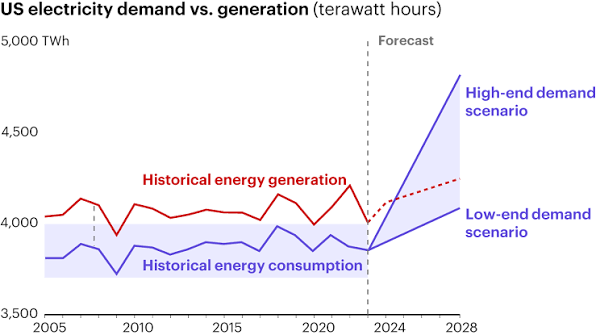
In February, Eric Schmidt stated that the US needs another 92 GW to sustain AI growth. This is why the ‘easy’ solutions like gas turbines sold out early.
But in cases like Nebius’ Vineland site, developers that have previously arranged a behind-the-meter gas turbine power solution are now having to switch to fuel cells.
This adds another tailwind for fuel cells on top of the overall surge in power demand.
But fuel cell suppliers don’t have enough capacity. Their solution has been unpopular for decades. Bloom was founded over 25 years ago.
Fuel cells are just newly popular because they don’t burn anything. They convert natural gas to electricity electrochemically.
Removing combustion also removes the entire political attack surface:
NOx emissions are orders of magnitude lower than those of gas turbines
Noise levels are lower than those of a hair dryer
No water is used during normal operation
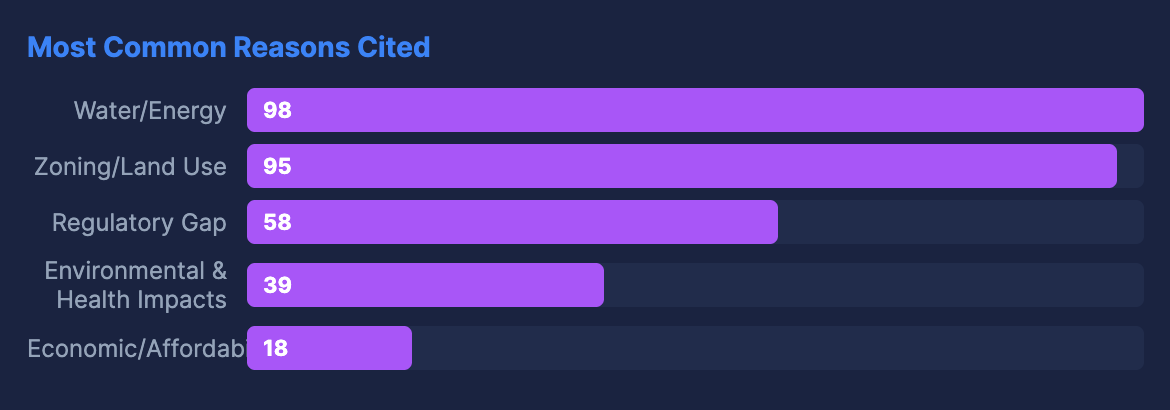
This is why migrated sites are now getting approved.
So when GPUs arrive ready for energization, and contracts start requiring on-demand compute, data center operators, out of desperation, turn to the only option that gets approval, even if costs are higher.
The opportunity cost of losing a contract or leaving GPUs idle is just too high.
Rumors are that Bloom Energy’s fuel cells are mostly sold out until 2030. The remaining sliver of capacity is sold at premium prices to the most urgent buyers.
So if Bloom is no longer an option, buyers will turn to the next-best option: FuelCell Energy.
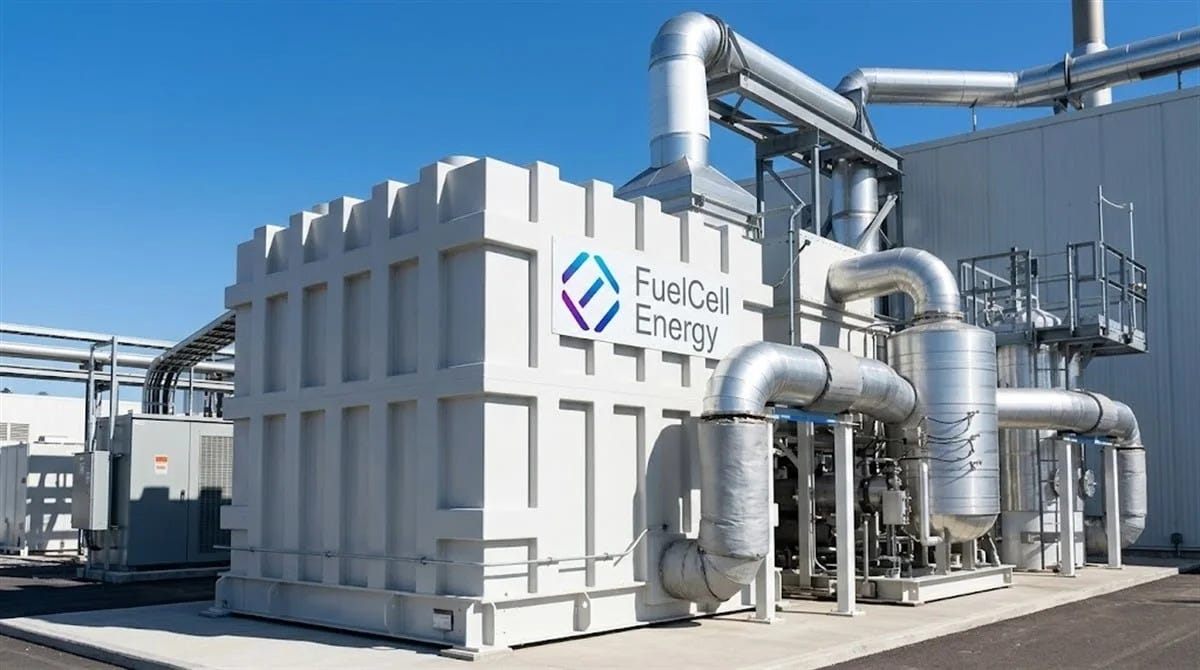
On paper, FuelCell Energy provides an inferior product. Bloom’s Server 6.5 is rated at 65% electrical efficiency at the beginning of life, degrading to 53% cumulative over the system’s life. FuelCell Energy’s carbonate platform claims above 60% electrical efficiency, and up to 80% combined when waste heat drives facility cooling, which is a real advantage for a building that has to cool itself anyway.
FuelCell also trails Bloom in power density (33 MW per acre vs. Bloom’s 50 W), installed base, and execution history.
But according to @edelbridgealpha‘s recent interview with FuelCell CFO Mike Bishop, FuelCell can still deliver in 90 days and is expanding capacity to 500 MW by mid-2028.
In this market, speed to power is more valuable than a superior product you cannot get until 2030.
FuelCell is already showing this pricing power. According to the CFO, FuelCell can currently charge approximately $2.75 million per MW sold. Initial investor estimates were often in the $1.5 to 2 million range.
This will only continue to increase. In Nebius’s recent shareholder letter, they reported that the average contract value started at >$10M / MW at the beginning of Q1. In Q3, they are seeing a pricing opportunity in the $40-50M / MW range.
As data center operator prices rise and margins expand, so will their willingness to pay more for energy. Supplier pricing is compared against idle silicon instead of other suppliers. Bloom’s high-urgency pricing becomes an anchor for FuelCell’s regular pricing.
This advantage is even more pronounced for FuelCell in cases like New York’s moratorium, which applies to facilities of 50 MW or more. In the CFO interview, Bishop said the goal is to provide for 12.5 to 25 MW local data centers near cities. The state that just froze $10 billion of hyperscale development left the entire sub-50 MW segment untouched, exactly the right size for FuelCell.
The market is currently pricing FuelCell as if it will only sell a small fraction of its capacity, as the option nobody wants because it has an inferior product to Bloom. But they are already contracting real megawatts:
Fit Energy: a signed strategic agreement for up to 380 MW, with a 30 MW firm order and deposit received.
Siemens: a memorandum of understanding covering 100+ MW.
SDCL: a letter of intent for up to 450 MW of financing capacity
Assuming FuelCell sells only 45% of 500 MW annualized capacity in 2028, and accounting for ramp-up timing, you get an annualized sold capacity of 225 MW.
At management’s $2.75 million per MW, this yields mid-2028 annualized revenue of $618.8 million, against FY25 revenue of $158.2 million.
FCEL currently has a market cap of $1.62 billion, and we know the market price per fuel cell MW is still rising.
Bloom trades at roughly 23 times sales. If we discount that to 12x for FuelCell for an inferior production footprint, weaker scale, weaker margins, and a poorer execution history, we get an implied Mid-2028E market cap of $7.425 billion. Assuming 93,000,000 diluted shares, this implies a share price of $80.
At today's share price of $18.36, that is a 336% implied return.
These are fairly conservative estimates considering pricing power is now improving, FuelCell will probably be able to get better terms with more prepayments to fund the buildout, they are an acquisition target, and they might even get better payment terms than Bloom, as Bloom sold their capacity in the past when prices were lower, and FuelCell will be able to sell their capacity at today’s much higher prices.
This article reflects our personal opinions and is provided for informational and educational purposes only. It does not constitute financial, investment, legal, or tax advice, nor a recommendation to buy, sell, or hold any security. We may hold positions in companies mentioned and may change these positions at any time without notice. Past performance is not indicative of future results, and investing involves risk, including the possible loss of principal. Always do your own research and make your own independent investment decisions.
No posts
Comments
Nothing yet. Say the first thing.
Sign in to join the conversation.