
I’ve spilled a lot of digital ink up here distinguishing between the overall economy, which is doing pretty well, though fragilities are piling up (the July jobs report, albeit one noisy data point, is the latest e.g.). But it seemed to me this split between Wall St. and Main St., between those who depend on investment portfolios and those who depend on paychecks, was brought into high relief last week.
—Abdul El-Sayed won his D senate primary in large part on the failure of status-quo politics to address the affordability crunch (I’ll have more to say about this race below).
—Last week’s productivity report showed that the compensation share of the nation’s aggregate income fell to its lowest point on record (see the figure here), implying that an increasing share of output has been flowing to profits. To be clear, this is an imperfect indicator of higher inequality—it can be buffeted about by taxes, redistribution within the labor share—but, in this case, I’m confident it’s telling us something important about the current economic split.
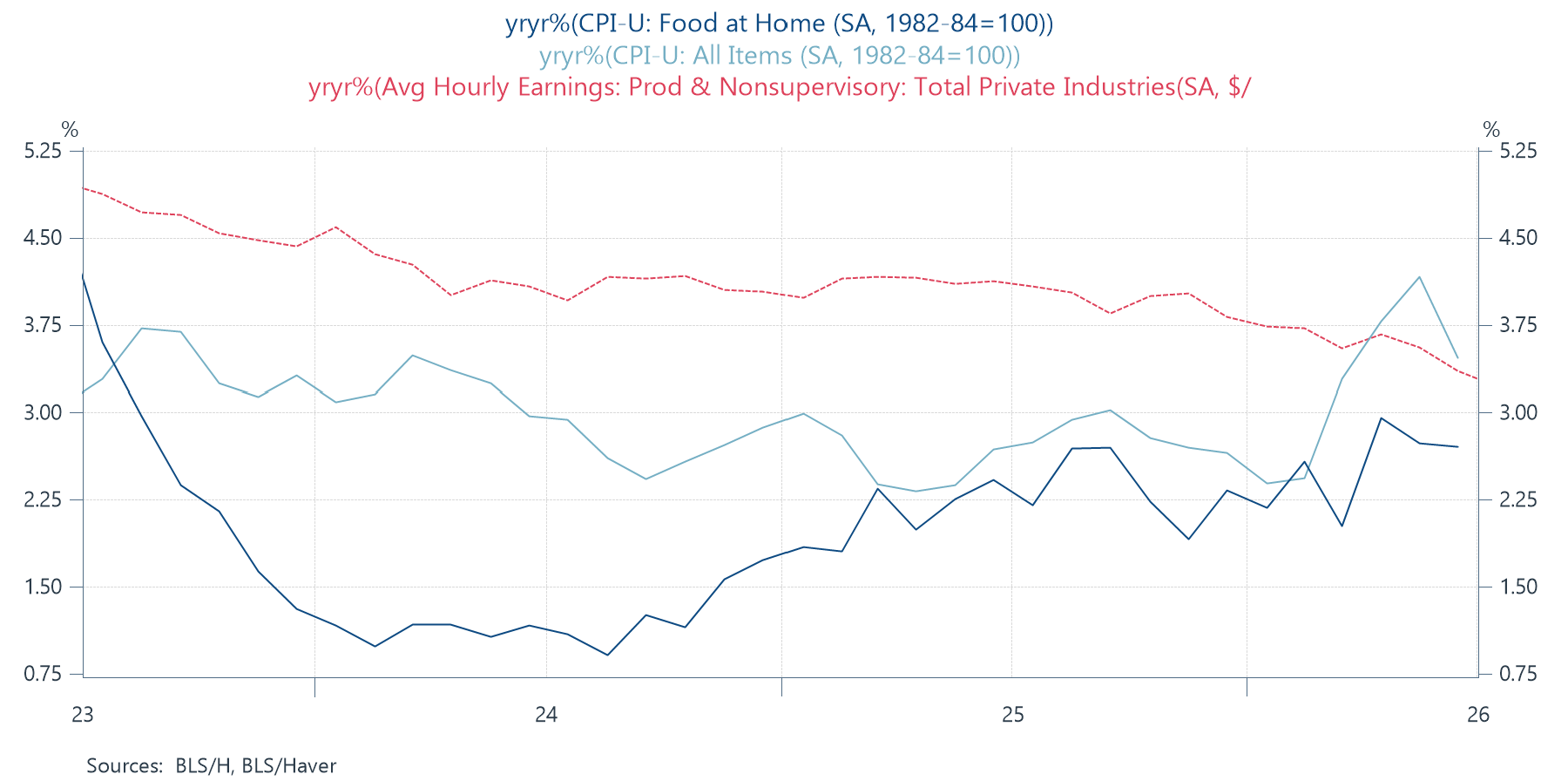
—The figure below plots yr/yr mid-level wage growth from last Friday’s jobs report. Its pace has been slowing for awhile, so I’m not leaning on one month’s data point. I’ve plotted overall inflation and grocery inflation. As you see, in recent months, nominal wage growth has lagged inflation, even with the sharp gas price decline in June, which reversed in July (and is falling again this month). Wage growth is beating grocery price growth, but note how much that gap has closed.
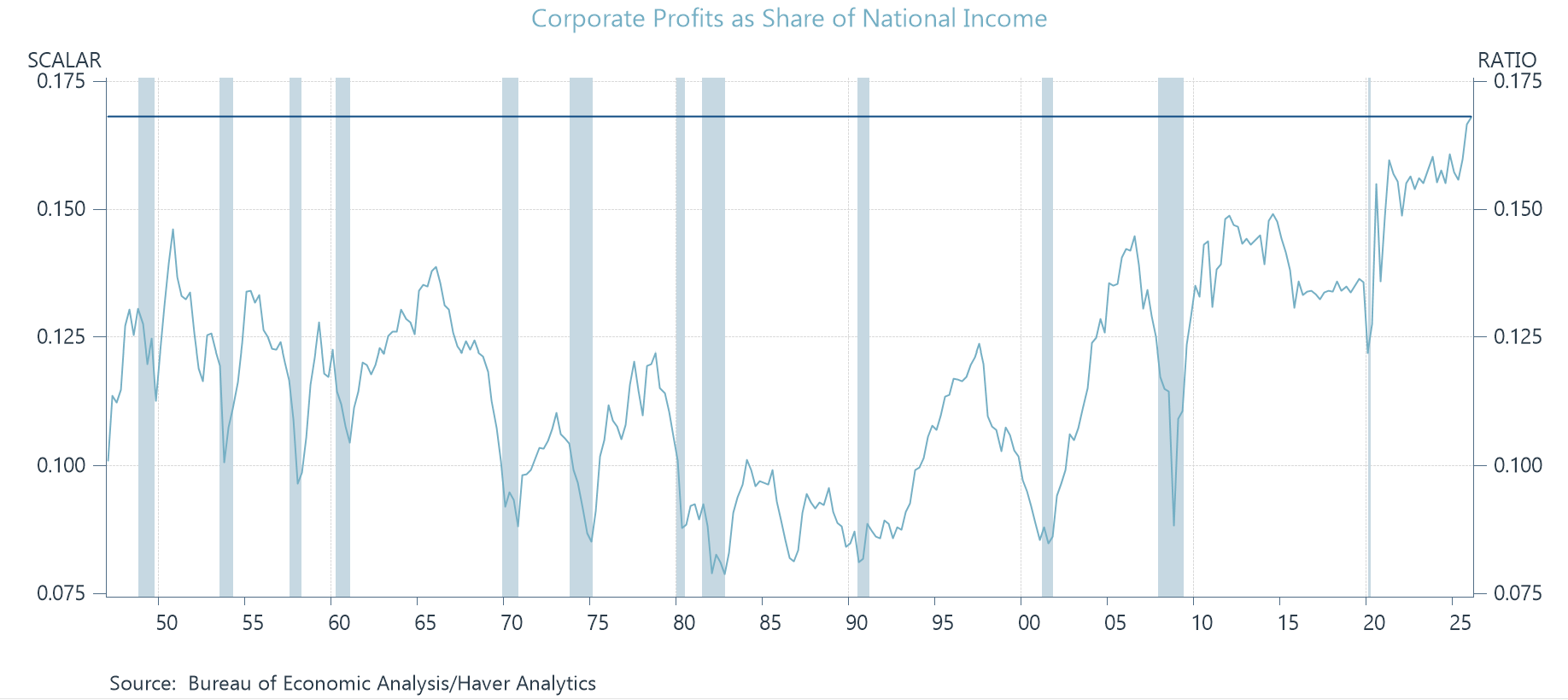
—Here’s a long-term take on the other side of the wage-share ledger, showing corporate profits as a share of total income, with a line at the latest value, a historical high with data back to the late 1940s. Relatedly, S&P earnings per share are also spiking, a dynamic that’s been supporting overall GDP growth through the wealth-effect channel: higher equity market returns raising high-end consumer spending.
Here’s the admin’s reaction last week to all the above:
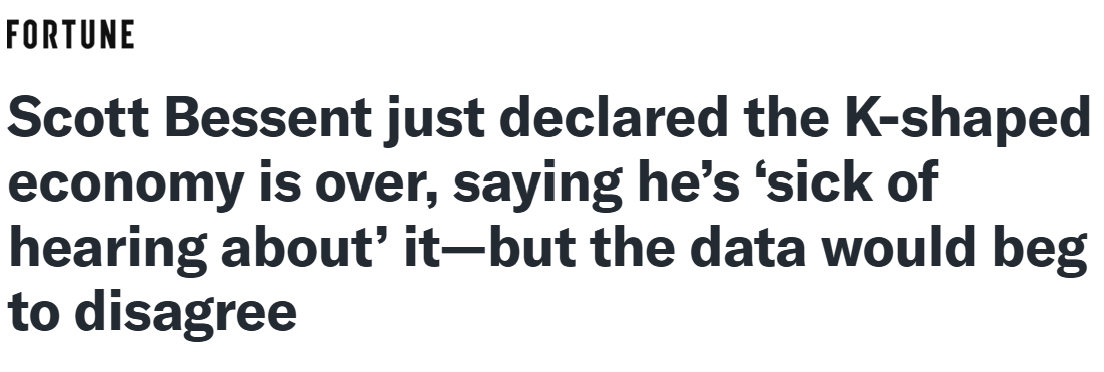
That’s about as close as you’ll get to “the king declares that he is no longer interested in hearing the peasants complain!”
The Trumpies could recognize the above data, all of which are a mouse-click away, and all of which are clearly reflected in the worse polling numbers this admin has even seen (“70% disapproved of [Trump’s] handling of the cost of living and inflation”). They could take action to ameliorate some of the damage, such as closing out the war, taking down tariffs, reversing cuts to health and nutritional coverage.
But instead, they’re doubling down as they always do. New tariffs persist, they’re making prescription drugs more expensive for seniors (ending a Biden-era Medicare part D subsidy), and going after Head Start. The damage from their SNAP cuts is coming into stark relief, with legit eligibles getting kicked off the rolls (totally predictable, and predicted), yet there’s no chance of corrective action.
Politics, just a few months out from the midterms, are of course responding to all this in ways I’ve increasingly been writing about, and last week’s Michigan D senate primary was ground zero for how the electorate is processing much of the above. I briefly turn to that now, before letting you get back to your Sunday.
The Dueling Tension of Fighting For Economic Justice While Not Losing Moderate Voters
I’ve written—quite convincingly (JK! sort of…like you, I find some of my arguments more convincing than others…)—that (non-MAGA) voters simply want to see candidates fighting for economic justice and affordability against the status quo that has failed to address these critical issues. A decisive swath of voters don’t care about labels, carefully calibrated left-right spectrum placements, and they give zero craps about the “fight for the soul of the Democratic party!” They need to know that you understand all those pictures above and will give all you’ve got to help reconnect their living standards to the overall growth of the economy and the markets.
That doesn’t mean they want policy details—though people need to hear your policy goals—but they have to trust that, unlike Trump, you’re not selling them snake oil (to the tune of a corruption-acquired $2+ billion in added personal wealth).
I strongly believe that’s true but it probably needs an amendment: there are a lot of moderate voters who don’t want to be alarmed. The NYT oped writer Michelle Goldberg worried about this re El-Sayed in a recent piece, arguing that the candidate has:
a blind spot, one endemic to his movement: an inability to grasp how and why people of good faith might see the world differently.
…
I would very much like to believe in the story El-Sayed is telling, because it would mean that progressives can win political power without making ideological sacrifices. But there isn’t much evidence of a candidate as left-wing as El-Sayed winning a purple state. And while one premise of his campaign was that he could speak to disaffected working-class voters, in the primary, he, like many progressive candidates before him, did best in more affluent and educated areas.
I wouldn’t over-torque on this, as I think the “show-me-your-fight” dynamic is more important. But I’m also sympathetic to the view that there’s an important electoral loss function that correlates with a set of views like defund the police, open the borders, etc. (defund Israel, however, is likely no longer part of this loss function). Smart candidates know this and don’t take those positions, but the Rs will relentlessly try to get voters to believe that they do.
There are elected pols (Spanberger, Sherrill) and candidates (James Talerico) who convincingly embrace the fight yet remain moderate, but that’s not El-Sayed, who is a proud progressive in ways that resonate strongly with me and I’m clearly not alone.
To be clear, I’m not at all sure Goldberg’s right about this blind spot. El-Sayed and his team know MI is not equal to NYC. It’s early days so let’s see how this evolves (though there’s not much time, given the lateness of the MI primary). And I assume—and hope—some high visibility, more moderate Ds will quickly line up behind the candidate, as Haley Stevens has so gracefully done already (I know you’re busy, President Obama, but you gotta get over there, right?? This might even require Michelle-level intervention!).
But this tension is real, and if honest, committed fighters like El-Sayed are going to get a chance to address the inequities I pictured above, they’ve got to win!
No posts
Comments
Nothing yet. Say the first thing.
Sign in to join the conversation.