
Suppose the population has two groups in it, young and old (Y and O). Let’s say 70% of people are Y and so 30% are O. Further assume that 80% of Y are in the labor force, meaning they’re working or looking for work; for the O, 40% are in the labor force. This implies a LFPR (labor force participation rate) of 68%: (.7*.8) + .3*.4). Now, let’s say this population ages, such that the only thing that changes are their shares of the population, which are now both 50%. With the same LFPR by each age group, the overall LFPR fall to 60% (.5*.8) + (.5*.4).
Is that a problem for this society? Does it imply that people are leaving an unwelcoming job market?
In one sense, it’s arguably a growth problem. The economy’s real growth rate is the sum of the productivity growth rate plus the growth rate of hours worked. In the 50/50 population, growth is slower because society is now comprised of more Os and fewer Ys, and the Os are half as likely to be in the labor force. But it’s not a sign that people are dropping out of the labor force versus they’re aging out of the labor force.
Here are a couple of recent Ernie Tedeschi figures showing both the actual and age-adjusted LFPR, and here’s a useful write-up of the issue by Preston Mui from Employ America.
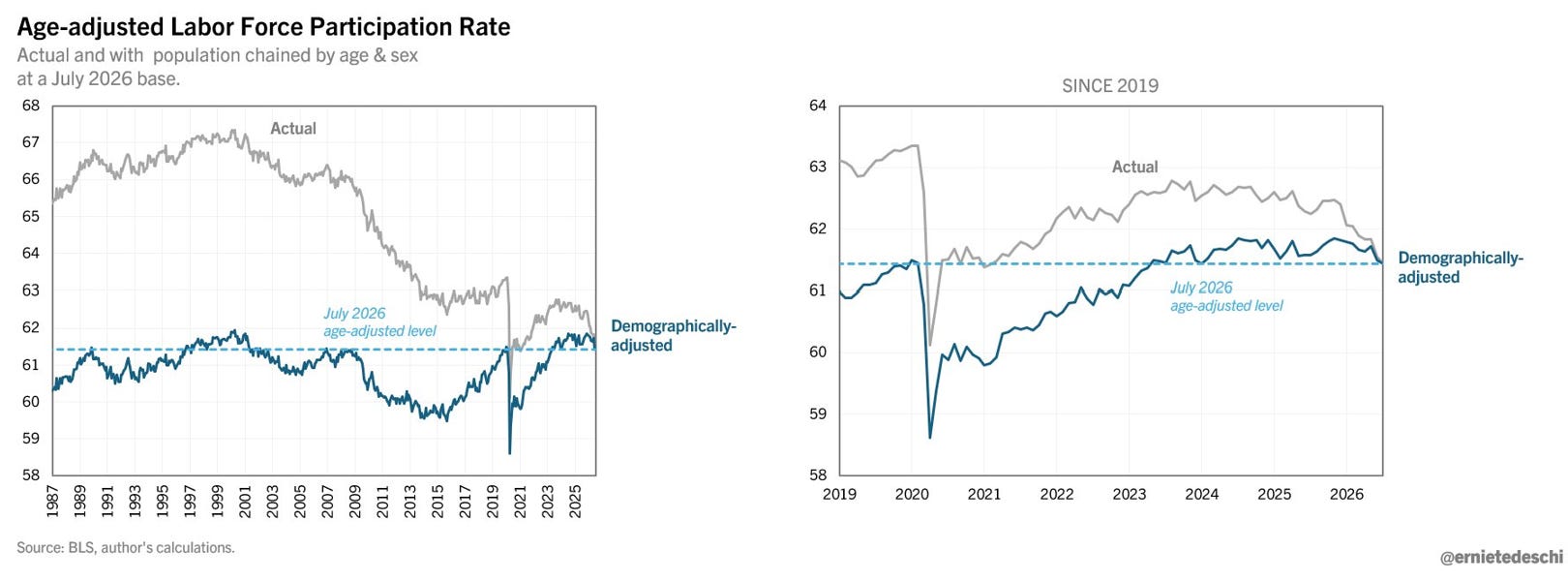
As you see, there’s a big difference between the actual and adjusted series. As the share of US O’s rise, the actual rate trends down, while the adjusted rate falls less and ends up back where is started at recent cyclical peak (put $0.25 in the jar, Ernie, for omitting recession bars).
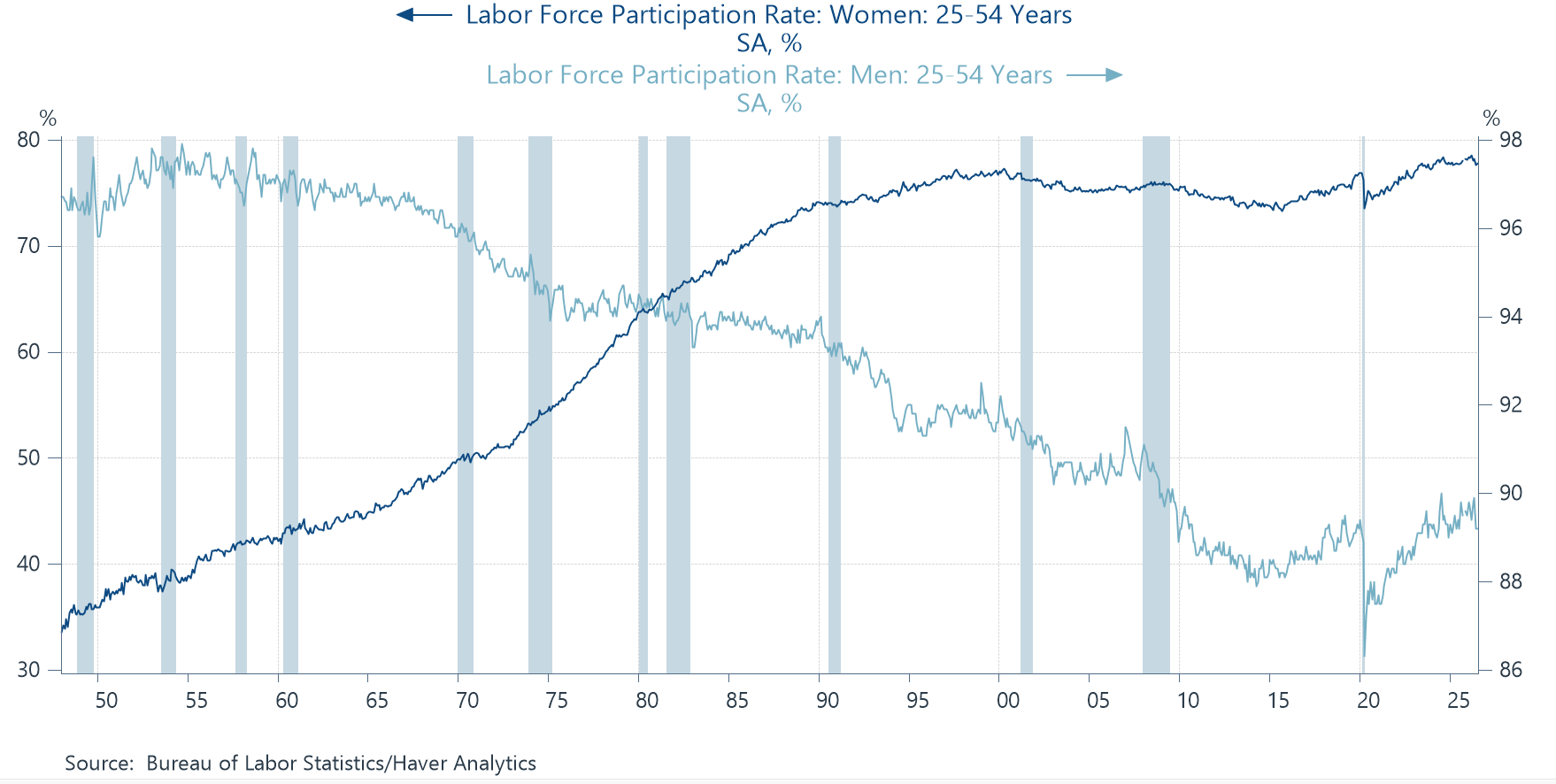
Perhaps an easier way to see this is to just restrict our sample to “prime-age” workers or 25-54 years old. This rate was last seen at being near historical highs—83.7%. (As you’d expect, the history of prime-age LFPRs is very different for men and women…see appendix figure.)
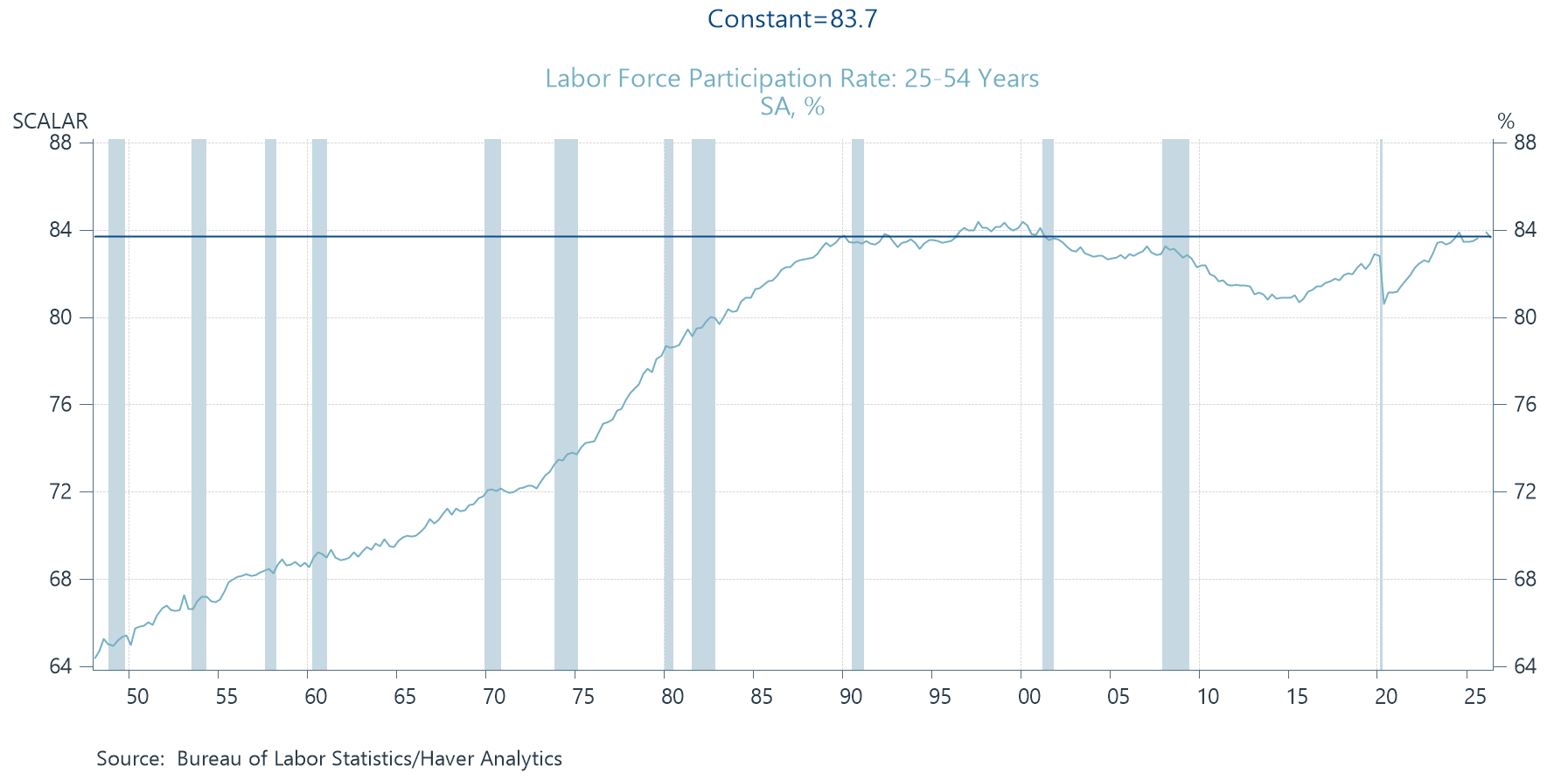
So, taking all this demographic adjusting into account, am I and others saying re the recent decline in the actual LFPR, “nothing to see here folks…move along?”
Nope. There are at least two things to see here.
First, the fact of growing O shares is in itself important. A society with shrinking LFPR due to aging will suffer slower growth, though weighed against that concern is the fact that basic, underlying welfare is more of a per-capita calculation, and if both hours worked and real GDP fall by the same percentage amount, per-capita income won’t fall.
A related problem is that in the US, social spending and, relatedly, political clout, is more concentrated with the elderly. Many analysts legitimately complain that too many public resources flow to the elderly relative to kids (though given sharp negative income impacts of retirement, this preference has at least some rationale, at least for low-income elderlies).
So, what are the policy implications of an aging workforce? One is that immigration can be an important source of labor force strength, and not just numbers but immigrant labor has long brought creative and innovative energy to the nation’s economy. To put it mildly, current politics are pushing hard in the other direction.
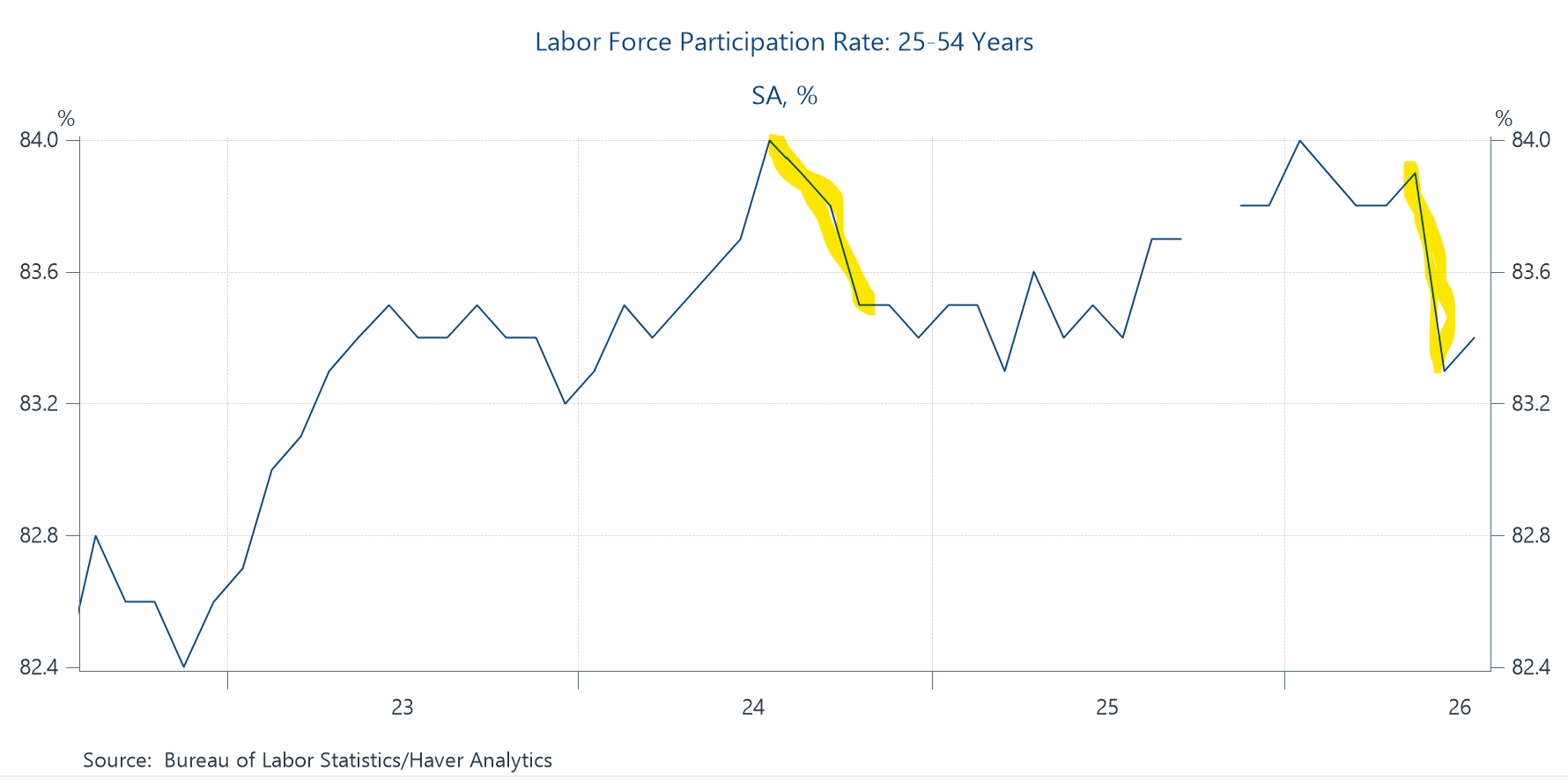
Second, and more high frequency, I think most recently, the weak LFPR may be telling us something about lagging labor demand. Job growth looks to have significantly weakened in recent months, but unemployment has stayed low in part because of the weak labor force dynamics shown above. Below, you see a sharp, recent drop off in prime-age LFPR, though I also show this also happened in ‘24, from which we subsequently recovered. As usual, we need more data!
My conclusion to all this on-the-one-hand-on-the-other is that our sagging overall LFPR isn’t as worrisome as it looks, but neither is it benign. Part of it is “just” aging, but an aging population is a hugely important political and economic fact about America today. And part if it—a lesser part, but still probably there—is telling us that our low-hire, low-fire labor market is a real fragility, one that is contributing to slower wage growth (which has recently lagged inflation), angst about AI’s impact on jobs, and persistent negative vibes about an economy that looks better from a macro perspective than it feels to most Americans.
Appendix figure: Prime-age LFPRs by gender
No posts
Comments
Nothing yet. Say the first thing.
Sign in to join the conversation.