

Growing up, I was that hardworking kid. My performance in school was very good. I actively participated in sports too. Whether it was college fests or extra activities, I was always doing something. And when I started my job, I was rewarded for my hard work as well.
But in the last few years, I’ve had the chance to speak with a few influential people. And after having conversations with them, I understood that these people focus more on thinking rather than just doing. Basically, we are told that if you work hard, hustle, grind, only then you’ll get success. But the actual decision-makers don’t approach things this way because they understand that working hard on the wrong things only wastes time and energy.
We live in a culture obsessed with the grind. From the moment we step into a classroom or accept our first entry-level job, we are fed a persistent, toxic lie: If you just put your head down and work harder than everyone else, you will win. So you wake up early, you skip meals, you ignore your deteriorating mental health, you sacrifice your weekends, and you wear your exhaustion like a badge of honor.
But have you ever looked at the people operating at the absolute peak of power, wealth, and influence?
They aren’t frantically grinding out 18-hour days in a state of chaotic panic. They aren’t sacrificing their sanity to clear a endless task list. In fact, if you sit down and talk to true high-performers, you realize something unsettling very quickly: They spend significantly more time thinking than they do “doing.”
While the average person is busy running as fast as possible on a hamster wheel that goes nowhere, elite decision-makers are stepping back to ask whether the wheel is even worth running on in the first place. They understand a fundamental truth that most people go their entire lives without realizing: Putting relentless hard work into the wrong things is just a high-effort way to destroy your time and energy.
The difference between grinding yourself into early burnout and achieving actual, explosive breakthroughs comes down to a single shifts: transitioning from a hustle-first mindset to a thinking-first mindset.
If you are tired of running on empty and getting mediocre results, here are four brutal, high-leverage mental techniques that will completely rewire how you operate, eliminate mental chaos, and help you direct your energy toward what actually yields results.
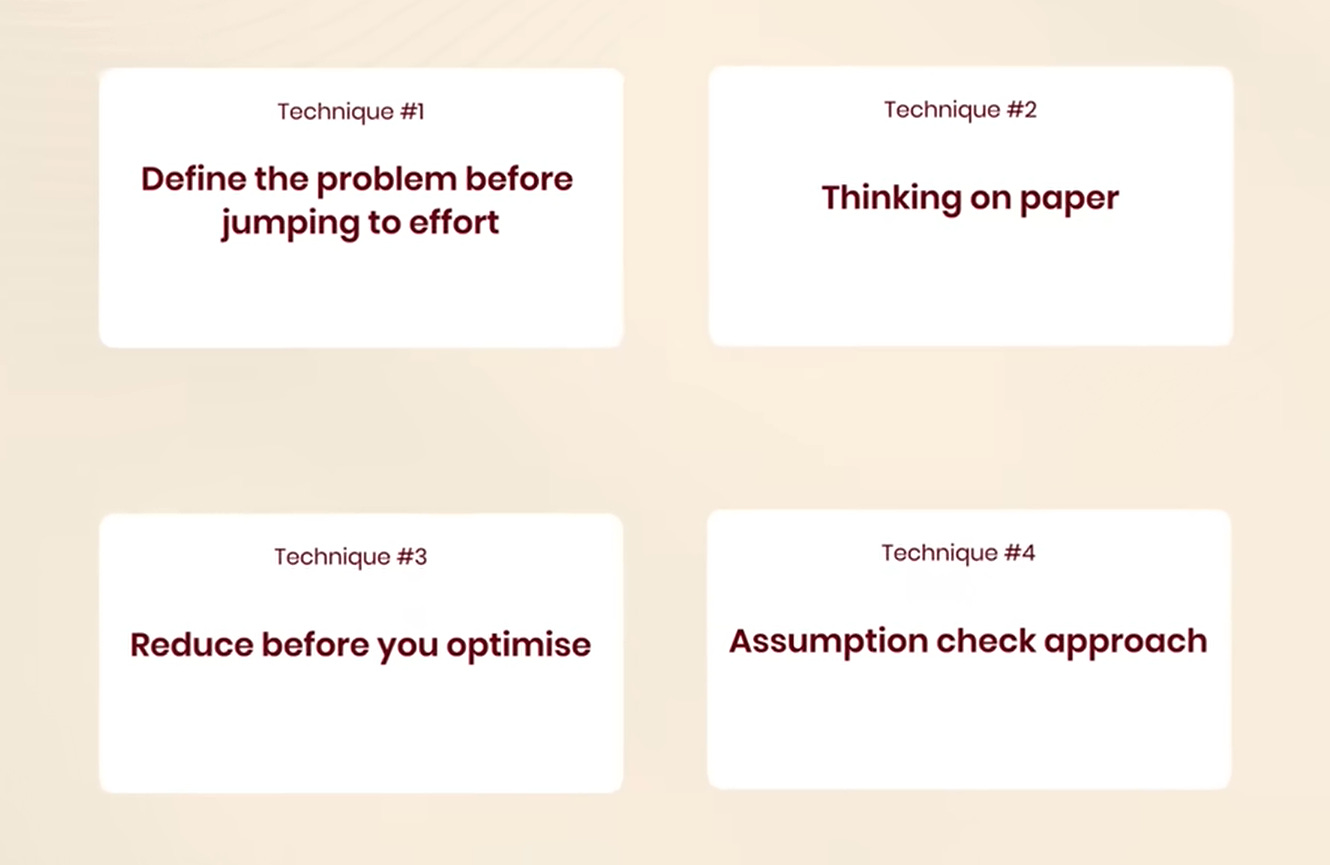
Watch how most people react when a new challenge hits their desk, their business, or their personal life.
An assignment is given? They start typing immediately.
A task lands in their inbox? They dive straight into execution.
An exam is tomorrow? They open the textbook and blindly read from page one.
There is zero pause. Zero strategic reflection. Just raw, unguided effort thrown wildly at a problem that hasn’t even been clearly diagnosed yet.
High-level thinkers do the exact opposite. Before they spend a single calorie of energy executing, they pause, step back, and ask one deceptively simple question:
”What exact problem am I actually trying to solve here?”
This sounds embarrassingly obvious. Yet, almost nobody does it.
The second you force yourself to define the actual problem with laser precision, more than half of your confusion vanishes. You stop asking, ”How many more hours can I force myself to sit here to finish this?” and you start asking, ”What is the single most high-impact lever I need to pull right now?”
Consider the classic Pareto Principle: 80% of your results will consistently come from 20% of your efforts. Instead of trying to memorize an entire 500-page textbook, a strategic thinker identifies the 20% of core concepts most likely to dominate the exam. Instead of trying to fix every minor detail in an underperforming business, they pinpoint the one underlying bottleneck that is stalling growth.
Working hard is cheap; knowing *where* to direct that hard work is priceless.
Furthermore, true execution efficiency isn’t just about task management—it’s built on personal capacity. When you ignore the basic operational details of your own body and mind, your efficiency drops to zero. How often do you ask yourself:
Am I actually sleeping enough to function at a high cognitive level?
Am I eating real food, or am I constantly running on cheap caffeine and skipped meals?
Am I engaging in stimulating conversations that spark new ideas, or am I isolated in my own echo chamber?
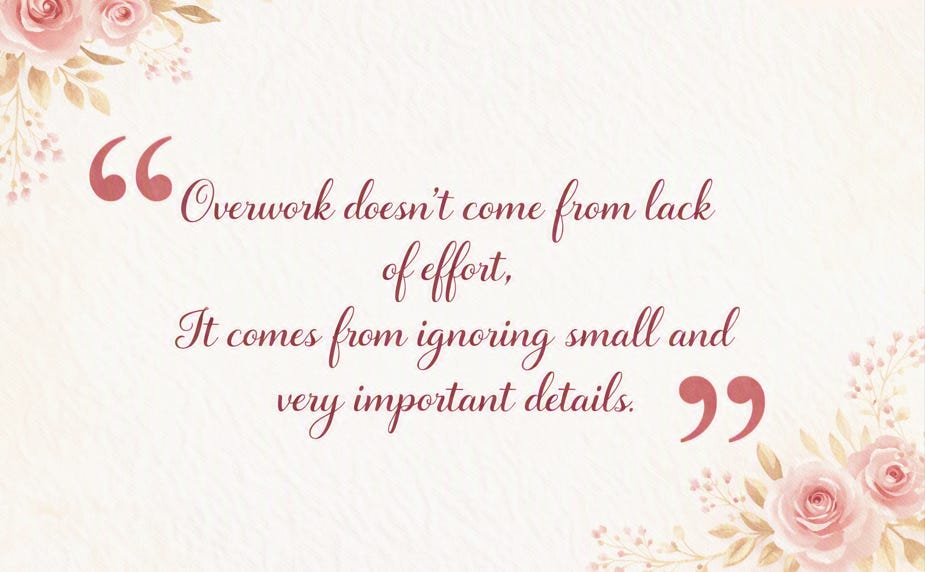
Overwork almost never stems from a lack of effort. I used to skip lunch and breakfast just to give more hours to work. But I realized this was actually reducing my productivity. Overwork doesn’t come from lack of effort—it comes from ignoring these small but important details that keep you productive.
It stems from ignoring the foundational habits that sustain sharp thinking, leading to wasted hours spent producing sub-par output. Stop treating execution as a substitute for clarity.
Your brain is an incredible tool for processing ideas, making connections, and solving complex equations. It is, however, a completely terrible place to store them.
When you attempt to solve complex problems entirely inside your head, your thoughts remain vague, disorganized, and half-formed. You bounce rapidly from one anxious thought to another, mistaking mental agitation for strategic deliberation. This is where severe overthinking, paralysis by analysis, and unnecessary stress are born. You cannot achieve crystal-clear strategic thinking in a state of internal chaos.
The moment you pick up a pen and force yourself to externalize your thoughts on paper, your entire cognitive architecture changes.
Writing slows down your thinking process to a deliberate, manageable pace. The hand-eye coordination required to put words onto a blank page forces your mind to organize chaotic feelings into structured, logical sequences. It separates you from the mental noise and places your ideas directly in front of you where you can analyze them objectively.
There is a reason every high-stakes boardroom, warfare strategy session, and elite innovation lab is covered in whiteboards, markers, and sticky notes. Leaders do not keep strategy trapped inside their skulls; they map it out where it can be critiqued, refined, and executed.
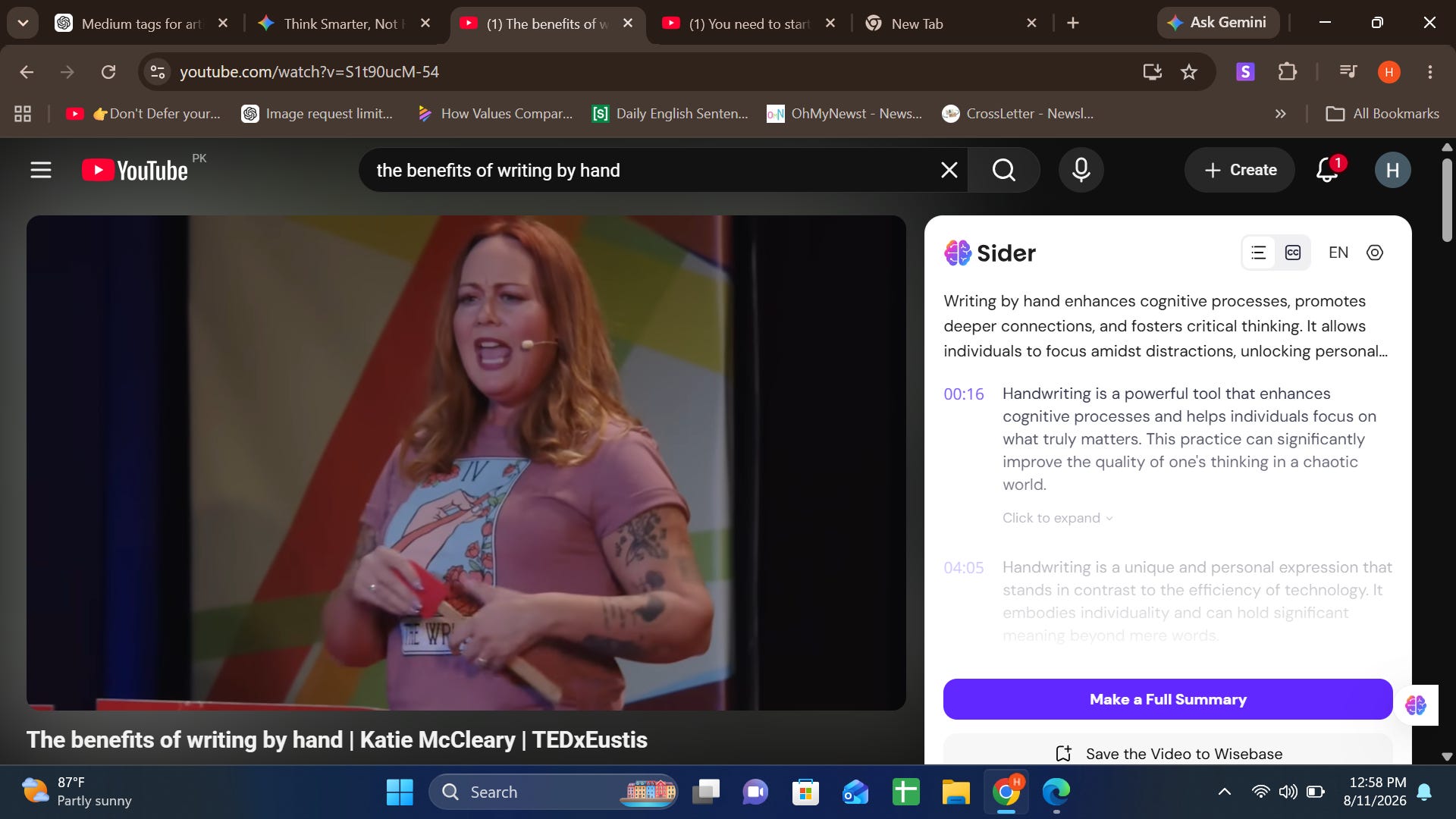
I was watching a TEDx video that explained how writing down your problems or thoughts helps you figure out solutions faster compared to just thinking about them mentally. That’s why in boardrooms or meetings, you’ll always see whiteboards, markers, notebooks, sticky notes—so that ideas don’t just stay in the mind but are written down.
There is a brilliant old saying: ”Goals that are not written down are simply wishes.”
“Thinking on paper” isn’t limited to writing daily journal entries or emotional brain dumps. It is an operational framework that applies to every vertical of your life:
Financial Calculations: Stop guessing where your money goes; map out exact budgets, cash flows, and investments on paper.
Career & Personal Goals: Break down multi-year visions into visual mind maps, detailed flowcharts, and actionable quarterly milestones.
Problem Solving: Write the core challenge at the top of a page, draw a line down the center, and list every actionable solution on one side and potential risks on the other.
Whenever you feel overwhelmed, stuck, or mentally drained, do not try to think harder inside your head. Get a physical notebook, sit down in a quiet room, and start dumping your thoughts onto the page until your mind feels weightless again.
I write down my financial calculations, my manifestations, my career goals, and even personal problems. It helps a lot to think better. I highly recommend adding “thinking on paper” to your routine. Write down your budget, your goals, or even notes from this video. Try it for yourself—it will truly change the way you think.
Thanks for reading Growth in Echoes! Share it with Your Friends & Family who need to Read This!
When things aren’t working out—when a business strategy stalls, a relationship gets rocky, or personal productivity hits a wall—our default human instinct is additive. We assume we need to *do* more, *add* more habits, *attend* more meetings, or *buy* more tools.
We are conditioned from childhood to believe that if something isn’t giving us the desired output, we just need to stack more effort on top of it.
Real strategic mastery, however, is not about addition.
It is about aggressive, ruthless subtraction.
Before you try to optimize a chaotic schedule, ask yourself this critical question: ”What unnecessary clutter can I completely eliminate right now?”
Think about it logically: If you want to introduce powerful new habits, high-value projects, or fresh creative ideas into your life, you first have to clear out the junk taking up space. You cannot build a clean, modern architecture on top of a pile of old rubble.
This applies far beyond physical or digital clutter:
Low-Value Meetings & Events: How many social gatherings, routine calls, or business meetings do you attend every month purely out of obligation, even though your presence changes absolutely nothing?
Busywork Tasks: How many administrative tasks, endless email re-readings, and superficial metrics are you tracking that do not move the needle on your actual goals?
Toxic Mental Habits: What outdated beliefs, unnecessary commitments, or distraction-heavy routines are draining your finite daily reserve of mental bandwidth?
When you make subtraction your default priority, you are establishing hard boundaries around your time and attention. You stop showing up to events that drain you. You stop pursuing secondary goals that distract from your primary focus. You purge the noise so that your mind finally has the silence and space required to produce deep, high-level work.
Of all the cognitive tools available to high performers, this final technique is easily the most transformative. It is the ultimate antidote to self-sabotage and irrational fear.
Whenever you find yourself hesitating, procrastinating, or pulling back from a bold decision, pause immediately and ask yourself:
”Is this an objective, verifiable fact... or is this just an assumption my mind is creating?”
The vast majority of human potential is not crushed by real-world obstacles, hard facts, or absolute failures. It is crushed by imaginary horror stories crafted by our own brains to protect us from temporary discomfort.
Consider a common scenario: You want to start putting your work out into the public domain—launching a project, publishing content, or starting a business. But weeks pass, and you haven’t taken a single step. Why? Because a voice inside your head whispers, ”Everyone will judge you. People will leave mean comments. You will look stupid.”
Stop right there and run the Assumption Check:
Is it a proven fact that people will judge you? No.
Is there direct, empirical evidence that your launch will fail? No.
Or is your survival-oriented brain simply fabricating a worst-case scenario so you stay safe inside your comfortable, predictable bubble?
Our brains are hardwired for survival, not for extraordinary success. They are exceptionally talented at generating vivid, terrifying fiction to prevent us from taking risks.
And here is the fascinating reality: This dynamic never truly goes away, no matter how successful you become.
The most confident executives, world-class athletes, top creators, and industry leaders feel the exact same baseline anxiety you do. They experience self-doubt before major launches. They get nervous before speaking to massive audiences. They worry about failure.
The only difference? They do not blindly believe the internal stories their minds create.
Instead of letting irrational assumptions drive their actions, they ruthlessly separate subjective fear from objective reality. They ask: What is the actual, verifiable evidence here? What is the absolute worst realistic outcome, and can I handle it?
Once you learn to strip away unsubstantiated assumptions and make decisions based purely on hard facts, your actions will no longer be driven by fear, defensiveness, or emotional reactivity. They will stem from pure intention, absolute clarity, and unshakeable purpose.
If you want to escape the trap of endless, exhausting hustle and start achieving real leverage in your work and life, stop glorifying the grind and start prioritizing the quality of your thinking.
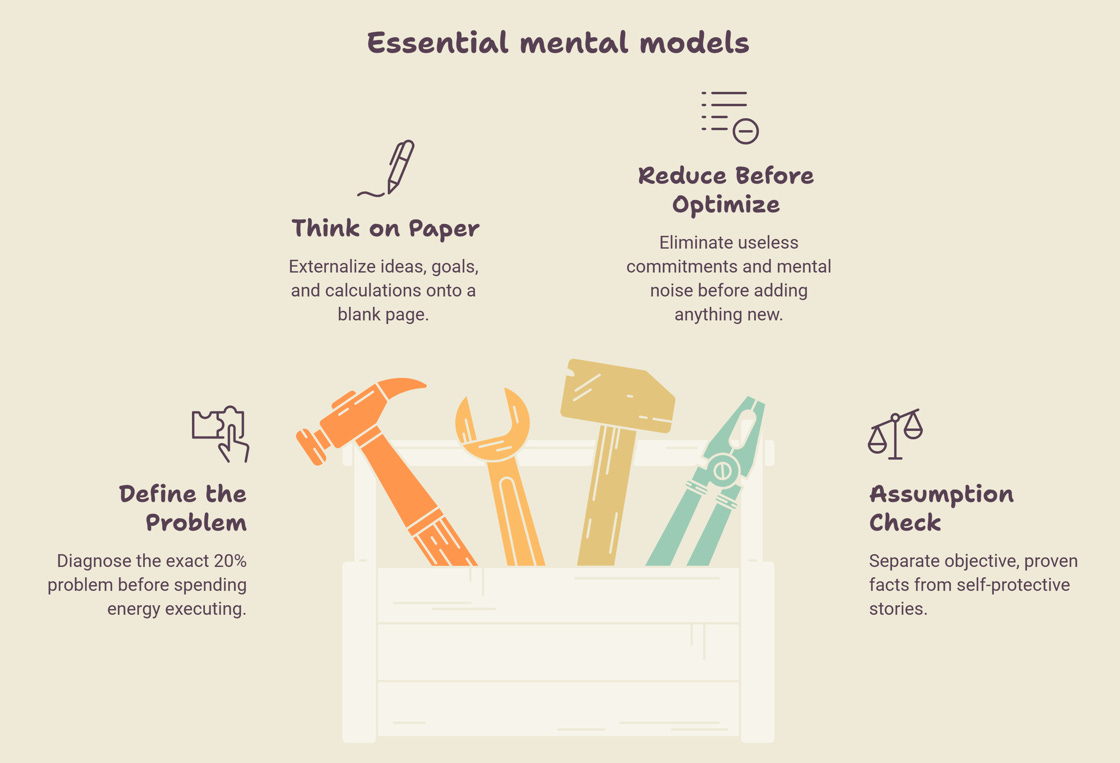
Recap these four essential mental models and put them to work immediately:
The next time you feel overwhelmed by an endless to-do list, don’t double down on longer hours. Close your laptop, step away from the desk, grab a notebook, and start thinking. It will completely redefine the trajectory of your life.
If you’ve been enjoying my writing, consider becoming a paid subscriber to my publication. Your support helps me keep creating deeper, more thoughtful work.
And there’s something special coming next. 👀
My next post is a collaboration with Tortured Poets , inspired by Things I Was Worst At — an honest, personal look at the things we weren’t naturally good at, the lessons they taught us, and how those weaknesses shaped us.
If you want to read it when it drops, become a paid subscriber and stay close. ❤️
No posts
Comments
Nothing yet. Say the first thing.
Sign in to join the conversation.