
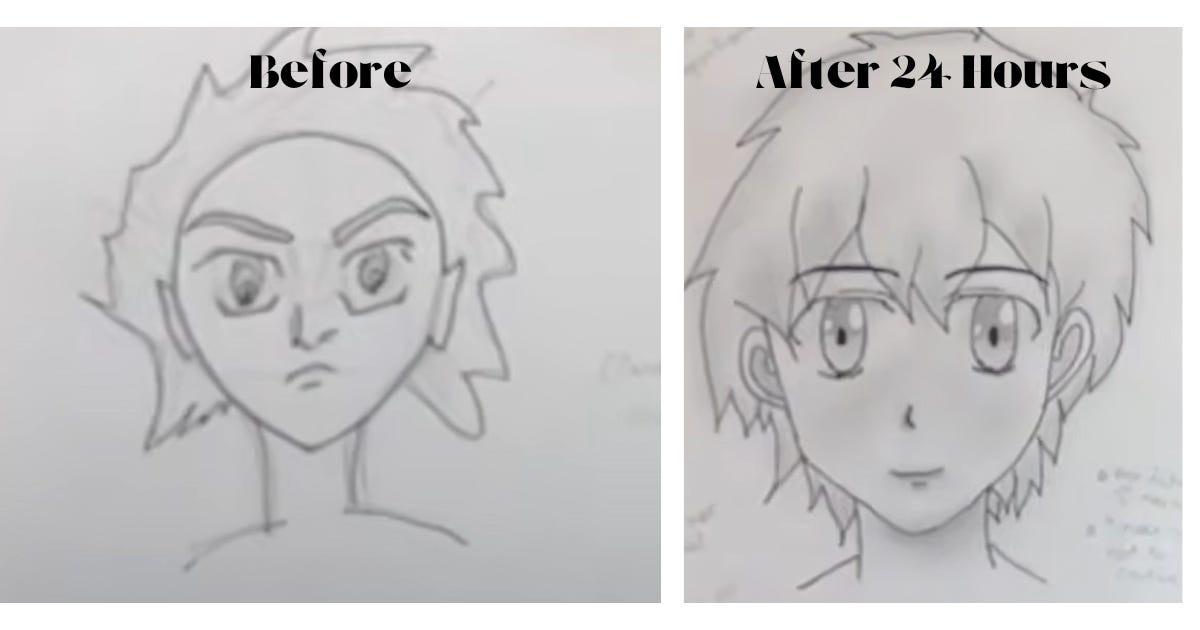
If you looked at my sketch right now, you would see two sketches side-by-side.
The first one is painful. It’s an attempt at drawing an anime character—specifically Tanjiro. Honestly? Calling it a “sketch” feels like an insult to art itself. It looks like a deformed potato with eyes. I looked at it, felt a wave of absolute embarrassment, and thought: “I am utterly hopeless at this. I should never touch a pencil again.”
Then I forced myself to sit down the very next day and try again using a proper reference image.
The second sketch actually looked like Tanjiro.
What changed in 24 hours? Did I magically inherit generational artistic talent overnight? No.
I just didn’t let the initial shock of being terrible stop me from trying one more time. Here is the uncomfortable truth nobody tells you about adult life:
You are going to be shockingly bad at almost everything you try for the first time.
When you step into the real world, school stops mattering. Suddenly, you’re thrown into deep waters where you need to master communication, fitness, public speaking, networking, and money management.
And at first? You will feel like an absolute fraud. You will look in the mirror and think, “What a loser.”
Stop right there.
Every single confident, capable, high-performing person you admire today started as a confused, awkward beginner who looked stupid, made embarrassing mistakes, and felt like quitting. The only difference between them and the people who fail?
They stayed in the game long enough to surprise themselves.
If you are currently struggling with a new skill, feeling stuck, or terrified of looking foolish, here are four brutal mindset shifts that will rewire your brain and make you unstoppable.
If you’ve ever felt embarrassed by being bad at something you desperately wanted to be good at, you’re in the right place.
Growth in Echoes is where I explore those uncomfortable moments—the ones where we’re forced to confront our ego, rebuild our confidence, and become beginners again.
Subscribe for free.
Let me tell you a story about a massive mistake I made.
A while back, I decided I wanted to learn kickboxing. At the time, I weighed roughly 44 kg—extremely underweight for my height and completely out of shape. But I was impatient. I walked up to the gym staff and demanded to know if they could teach me kickboxing in 30 days.
They looked at me and said, “You need to build baseline strength and flexibility first before you even touch a heavy bag.”
I didn’t listen. I had zero fitness knowledge, but I had maximum ego. I insisted we start immediately.
Five minutes into the warm-up, my lungs were on fire, my legs felt like jelly, and I realized I was in way over my head. We had to postpone the kickboxing classes immediately and switch to basic strength training.
My trainer handed me 1 kg dumbbells. 1 kg.
As I struggled through three agonizing repetitions with those tiny pink weights, I looked over and saw guys half my age easily curling 15 kg dumbbells. The embarrassment was overwhelming. I built an immediate, toxic belief in my head: “I am physically too weak for this. My body just isn’t built for physical activity. I should quit.”
That’s when my trainer told me something that changed my entire life:
“Your brain will never update your self-image based on wishful thinking. It needs real, physical proof.”
Your current beliefs about what you can or cannot do are built on old, outdated evidence. If you believe you’re bad at public speaking, lazy, or terrible with money, it’s because your brain is referencing past failures.
To rewrite that identity, you don’t need toxic positivity or fake affirmations. You need to collect new evidence.
Every time you complete a brutal workout, every time you sit through an awkward conversation, every time you choose to stay in the room instead of running away, you drop a vote into the “proof bucket.”
Eventually, the weight of that evidence forces your brain to switch its baseline narrative from “I can’t handle this” to “Hell yes, we just did that.”
Whenever people see someone jumping from one hobby or skill to another, the critics instantly show up in the comments:
“Why bother learning that if you aren’t going to master it?”
“Are you making money from this?”
“You’re just doing this to look cool for five minutes.”
They are missing the entire point.
The actual skill you learn—whether it’s playing an instrument, martial arts, or crafting—is usually far less valuable than the psychological traits it secretly builds inside you.
Look at what happens behind the scenes when you force yourself to learn radically different disciplines:
Drums, Rubik’s Cubes, and Crochet: They don’t just pass the time; they force your brain to build rapid hand-eye coordination, extreme patience, and deep muscle memory.
Stand-up Comedy and Magic Tricks: They aren’t just about entertaining a room; they teach you presence under extreme pressure, stage command, and how to think fast on your feet when things go wrong.
Archery, Dance, and Kickboxing: They teach you body spatial awareness, discipline, and the deep, visceral confidence that comes from knowing your physical body can adapt to stress.
None of these require world-class mastery to transform you. You can remain a beginner at all of them and still reap 90% of the mental rewards.
Think about how hiring works in the real world. When top executives and business owners look at candidates, they rarely care about a candidate who only has perfect test scores on paper. They look for people who have played competitive sports, organized community events, or picked up complex hobbies.
Why? Because those activities secretly condition your brain for resilience, teamwork, emotional control, and raw discipline.
When you learn something new, stop asking, “How can I monetize this?” Start asking, “What kind of person is this struggle turning me into?”
We have a terrifying habit of turning tactical failures into personal identities:
“I drew a terrible picture” becomes “I’m not creative.”
“I choked during a presentation” becomes “I have social anxiety and can’t speak in public.”
“I missed three days at the gym” becomes “I am lazy and undisciplined.”
“I failed a test” becomes “I am stupid.”
This is complete nonsense.
Failing at something isn’t a permanent verdict on your soul; it is simply neutral, useful data.
If your drawing looks wrong, it doesn’t mean you lack an “artistic soul.” It means your understanding of visual proportions or shading techniques is off. That’s a technical fix, not a personality flaw.
If you struggle with public speaking, you don’t lack charisma—you just haven’t learned how to structure your thoughts under adrenaline.
If you aren’t consistent at the gym, you aren’t inherently lazy—your current routine is completely unrealistic for your daily energy levels.
When you remove your ego from the equation, a mistake stops feeling like a tragedy and starts looking like a map.
You Don’t Need More Advice. You Need a Way to Apply It. It’s easy to read an essay about growth, nod along, and then forget everything tomorrow.
The harder part is sitting down with your own failures and figuring out what they’re actually trying to teach you.
So I made something to help with that.
A practical workbook for turning your mistakes, weaknesses, and frustrating setbacks into useful information.
Instead of asking:
“Why am I so bad at this?”
you’ll work through the experience, separate the facts from the story you’re telling yourself, identify what actually went wrong, and decide what you’re going to do differently next time.
You don’t need to be good at something before you start. You just need to be willing to learn from what happens next.
Reading about failure is easy. Changing how you respond to it is harder. So I created a short “Failure as Data” worksheet that walks you through:
Get the worksheet free when you subscribe to Growth in Echoes.
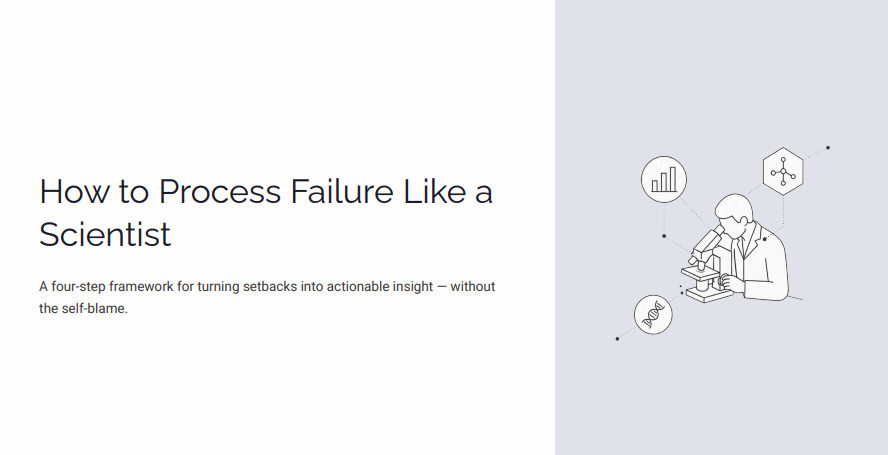
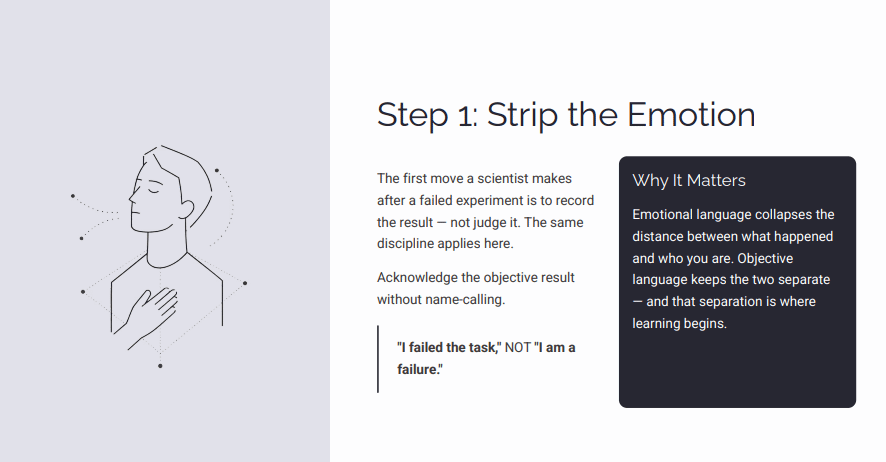
Stop searching for instant answers or drowning in endless search results every time you hit a wall. Sit down with your own raw thoughts, write out the problem step-by-step, and treat your weaknesses as puzzles waiting to be solved.
When we finish school or college, we secretly lie to ourselves. We think, “Thank goodness, the learning phase is over. No more textbooks, no more studying, no more being graded.”
The reality? Real life demands vastly more skills than any academic institution ever will.
Every new stage of life will force you back to square one, whether you like it or not:
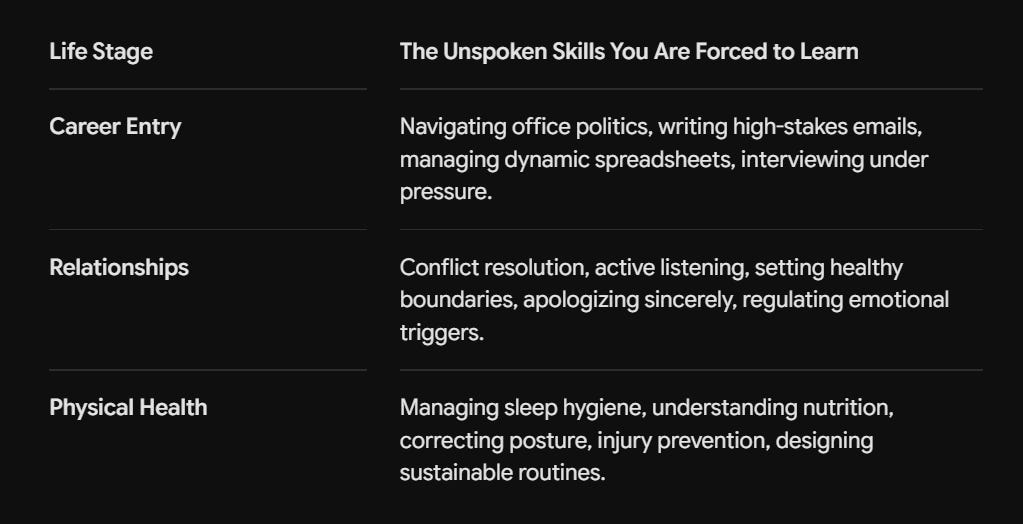
The problem isn’t that life keeps demanding new skills. The problem is that our egos hate being beginners.
We hate the awkwardness of slow progress. We hate asking “dumb” questions. We hate making visible mistakes in front of peers. So, to protect our fragile self-esteem, we retreat into our safe, comfortable little bubbles where we already know how everything works.
And as a result, our lives become predictable, small, and remarkably boring.
Have you ever wondered why some 80-year-olds in places like Okinawa, Japan seem endlessly energetic and mentally sharp? It’s because they never stop learning. They farm, build, study, and stay curious well into their final decades. They don’t tie their self-worth to being “perfect.” They remain fluid, adaptable, and perpetually open to starting over.
Growth isn’t about accumulating titles or proving you know everything.
Growth is simply how many times you give yourself permission to restart.
Being terrible at something new isn’t a source of shame. It is the mandatory entry fee for becoming a formidable human being.
The next time you try a new skill, enter a new environment, or attempt something difficult, expect to be bad at it. Welcome the awkwardness. Collect the data. Feed your brain the proof it needs.
Before you close this email, ask yourself one question:
What is the one skill you’ve been avoiding simply because you’re terrified of looking stupid at the start?
Hit reply and tell me what it is. I read every single response.
Now go out there, make some embarrassing mistakes, and start collecting your proof.
No posts
Comments
Nothing yet. Say the first thing.
Sign in to join the conversation.