
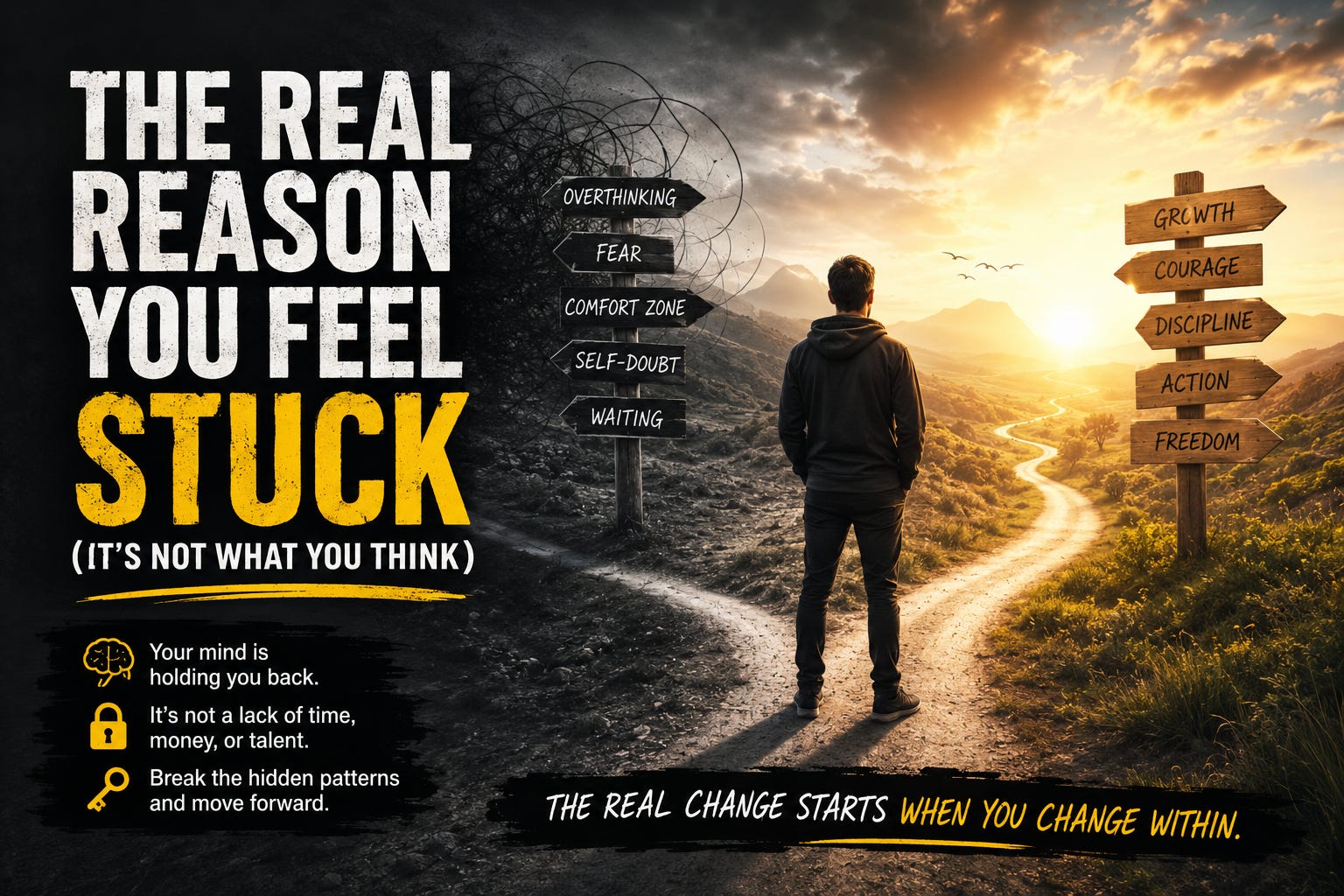
Most people think they’re waiting for the right opportunity. In reality, they’re waiting for permission they’ll never receive.
There was a moment that stayed with me longer than I expected.
A few months ago, I found myself scrolling through social media late at night. You know the feeling. One video turns into another. One success story leads to the next. Someone had built a million-dollar business. Another person had quit their job to travel the world. A creator celebrated reaching a million subscribers. A writer shared that their newsletter had changed their life.
I remember putting my phone down and asking myself a simple question:
“Why does it always feel like everyone else is moving forward while I’m standing still?”
Maybe you’ve asked yourself the same thing. Not because you’re lazy or you don’t care.
But because no matter how much effort you put in, your life somehow looks the same.
You read books. You watch videos. You save inspiring quotes. You make plans on Sunday night.
And then Monday arrives, and somehow nothing really changes.
For years, I believed the problem was motivation. I thought if I could just become more disciplined, wake up earlier, find the perfect morning routine, or discover one magical productivity trick, everything would finally click.
I couldn’t have been more wrong.
Most people think they’re stuck because they don’t have enough time.
Or enough money.
Or enough knowledge.
Or enough confidence.
Those things matter. But they’re rarely the real reason. The uncomfortable truth is this:
Many of us aren’t trapped by our circumstances. We’re trapped by the identity we’ve quietly accepted.
That realization changed the way I looked at almost everything.
Imagine someone who has spent ten years telling themselves:
“I’m just not a confident person.”
Eventually, confidence stops feeling like a skill they can build. It becomes part of who they believe they are.
Now every opportunity is filtered through that identity. Speaking in public?
“That’s not me.”
Starting a business?
“I’m not the entrepreneurial type.”
Writing online?
“There are already people better than me.”
The prison isn’t made of steel. It’s made of stories. Stories repeated so many times they begin to sound like facts.
Author and speaker Mel Robbins has often shared an idea that resonates with millions of people:
Action usually comes before confidence, not after.
Most of us wait until we feel ready. But readiness is often an illusion. Confidence grows because you act—not the other way around. That simple shift explains why some people seem fearless.
They’re usually not. They’ve simply learned to move before fear disappears.
Years ago, a young man imagined that success would finally make him feel worthy.
He spent years collecting achievements.
Degrees. Certificates. Promotions. Compliments.
Every accomplishment gave him relief. But only for a few days. Soon another mountain appeared. Another goal. Another finish line.
One evening, after celebrating a major career milestone with friends, he returned home expecting to feel fulfilled. Instead, the silence in his apartment felt louder than ever.
For the first time, he realized something painful.
He wasn’t chasing success anymore. He was chasing proof that he was enough.
No achievement could satisfy a question that had never been answered inside. The problem had never been ambition.
It had been identity.
Whether you’re building a business, writing online, changing careers, or trying to become healthier, the same pattern quietly follows you.
Until you change the story you believe about yourself, every achievement feels temporary.
In Atomic Habits, James Clear makes a point that deserves more attention than it usually receives.
Real transformation doesn’t begin with outcomes. It begins with identity.
Don’t ask: “How do I lose weight?”
Ask: “What would a healthy person do?”
Don’t ask: “How do I write a book?”
Ask: “What would a writer do today?”
The difference seems small. It isn’t.
One focuses on results. The other changes who you become. And who you become eventually determines the results.
Thanks for reading Growth in Echoes! Share It with Your Friends & Family who Need To Read This
People often imagine the comfort zone as a pleasant place. It’s usually not.
Sometimes the comfort zone feels frustrating. Sometimes it feels exhausting. Sometimes it even feels miserable.
But it’s familiar.
And familiarity is powerful.
Think about how many people stay in jobs they dislike. Relationships that drain them. Cities they no longer enjoy. Dreams they’ve quietly abandoned.
Not because they’re happy.
Because they’re familiar.
The human brain often prefers predictable discomfort over uncertain possibility. That’s why feeling stuck can last for years. Not because change is impossible.
Because familiarity whispers,
“At least you know what this feels like.”
What if your comfort isn’t protecting your life anymore?
What if it’s quietly shrinking it?
Think about the thing you’ve been postponing. The skill you keep saying you’ll learn. The decision you’ve been avoiding.
Now ask yourself:
What is staying comfortable costing me?
Maybe it’s an opportunity. Maybe it’s simply another year wondering what could have happened.
That’s exactly why I created something for this article.

It’s designed to help you recognize the places where comfort might be quietly keeping you from growing.
Inside, I break down:
Why comfort creates an illusion of stability
Why the brain naturally prefers familiar patterns
The hidden cost of staying comfortable
How avoiding discomfort can erode confidence
The Fear → Action → Learning → Confidence cycle
Small discomforts that can create surprisingly big results
Why choosing growth compounds over time
And there’s one idea I especially want you to remember:
The greatest losses are often invisible. They come from opportunities never pursued, not the ones that failed.
Take 10 minutes. Read through it slowly. Then find one area of your life where you’re choosing familiarity over growth.
Start with one small discomfort. Learn something you’ve been avoiding.
Speak up and ask for feedback. Start the imperfect project.
Have the conversation.
Because confidence isn’t always something you find before taking action. Sometimes you build it by taking the action you’re afraid to take.
Entrepreneur and investor Naval Ravikant has spoken about how leverage, long-term thinking, and taking responsibility separate exceptional lives from ordinary ones.
But hidden beneath those ideas is another lesson.
The people who build remarkable lives become surprisingly comfortable looking inexperienced.
Every expert was once a beginner. Every successful creator once published something that almost nobody noticed. Every entrepreneur once had an idea people doubted.
The fear isn’t failure.
It’s embarrassment. It’s the thought that someone might see us trying before we’re good enough.
Ironically, avoiding embarrassment often guarantees staying exactly where we are.
Here’s something I’ve noticed in conversations with friends and readers. When people say,
“I’m waiting for the right time,”
they’re often protecting themselves from disappointment.
If they never truly try, they never have to discover what might happen. Failure hurts. But uncertainty feels safer. Until years pass.
One day becomes one month. One month becomes one year. And suddenly we’re not asking,
“Can I do this?”
We’re asking,
“Why didn’t I start sooner?”
The saddest part isn’t failing. It’s watching time quietly do what fear could never do. Convince us that our dreams belonged to a younger version of ourselves. If there’s one idea I hope you carry with you after reading this far, it’s this:
Feeling stuck is rarely about lacking ability. More often, it’s about protecting an identity that no longer serves you.
The hardest step isn’t learning a new skill. It’s becoming willing to see yourself as someone capable of using it. And that shift changes everything. The more I thought about it, the more I realized something surprising.
Life rarely changes because of one dramatic decision. It changes because of dozens of quiet ones. A conversation you almost didn’t have. A project you almost didn’t start. A book you almost didn’t open. A message you almost didn’t send.
Looking back, most turning points don’t feel like turning points while you’re living them. They look ordinary. Sometimes they’re even uncomfortable.
Only later do you realize they changed everything.
It’s trying to keep you alive.
That sounds obvious, but it explains so much.
Our brains evolved to value safety over possibility. Thousands of years ago, taking unnecessary risks could cost your life. Today, posting your first article online isn’t dangerous—but your brain often reacts as if it is.
That’s why your heart races before speaking in front of people. Why you hesitate before launching a business. Why you overthink sending an email. Why you keep editing instead of publishing.
The brain confuses unfamiliar with unsafe.
Once you understand that, something changes. You stop treating fear as a stop sign. You start treating it as a compass.
Sometimes the things that scare us the most are pointing directly toward the life we want.
Imagine a man in his forties who had spent nearly twenty years working the same office job.
He wasn’t unhappy enough to quit. But he wasn’t happy enough to stay.
Every morning looked the same. Wake up. Drive to work. Come home. Watch television.
Sleep. Repeat.
One weekend, his daughter asked him a question that caught him completely off guard.
“Dad, what did you always want to do?”
He smiled. Then he went quiet. Because he honestly couldn’t remember. Somewhere between responsibilities, routines, and expectations, he’d stopped asking himself what excited him.
That evening, he found an old notebook buried in a drawer. Inside were pages filled with business ideas, travel plans, and goals he’d written in his twenties.
He laughed.
Not because the ideas were bad. Because he’d forgotten the person who wrote them.
Over the next year, nothing extraordinary happened. He didn’t become famous. He didn’t make millions.
He simply started again. One online course. One side project. One hour every evening. One small promise kept to himself.
His life didn’t change because of one bold leap. It changed because he stopped believing it was too late. I think many of us need that reminder. Not that success is guaranteed. But that reinvention is always possible.
We spend so much of life waiting. Waiting until we have more money. Waiting until we feel confident. Waiting until people support us. Waiting until the timing feels perfect.
But perfect timing has a strange habit. It never arrives.
Author Seth Godin has often written that shipping your work matters more than endlessly polishing it.
Done reaches people.
Perfect usually stays hidden in a draft folder.
I wonder how many incredible ideas have disappeared because someone convinced themselves they weren’t ready. A book never written. A business never launched. An apology never spoken. A dream postponed one year too many.
Not because people lacked ability. Because they kept waiting for certainty.
I’ve become convinced that progress has less to do with intensity and more to do with consistency.
Most transformations are surprisingly ordinary. One walk becomes a healthier lifestyle. One article becomes a writing habit. One client becomes a business. One conversation becomes a friendship. One decision becomes a different future.
The internet often celebrates overnight success.
Real life usually doesn’t work that way. Behind almost every visible success are years of invisible effort. Hours nobody applauded. Failures nobody noticed.
Moments when quitting would have been easier. That’s the part we rarely see.
When we feel stuck, we usually ask questions like:
“Why can’t I succeed?”
“What’s wrong with me?”
“Why is everyone else ahead?”
Those questions keep us trapped. Try different ones instead.
“What story about myself am I still believing?”
“What am I avoiding because it feels uncomfortable?”
“If fear wasn’t making this decision, what would I do?”
“Who could I become if I stopped trying to protect the person I’ve always been?”
Sometimes a single honest question can accomplish more than months of searching for motivation.
One idea has stayed with me for a long time.
The person capable of creating your future probably doesn’t think exactly like the person reading these words today. That isn’t criticism.
It’s possibility.
Five years ago, you knew things you don’t think about anymore. You’ve grown. You’ve changed.
The next version of you will do the same. But growth asks for something in return. It asks you to let go of identities that once kept you safe. To stop saying:
“I’m just not disciplined.”
“I’m not creative.”
“I’m too old.”
“I’m too young.”
“I’m not lucky.”
“I’m not the kind of person who succeeds.”
Those aren’t facts. They’re conclusions. And conclusions can be rewritten.
I’d like to leave you with one final thought.
Imagine waking up one year from today. Nothing magical has happened. You didn’t win the lottery. No one handed you an opportunity.
But you kept one promise to yourself every single day. You wrote. You learned. You exercised. You built. You showed up.
Do you think you’d still feel stuck?
Probably not.
Not because life suddenly became easy. But because movement creates momentum. Momentum creates belief. And belief changes identity.
That’s how people transform.
Not all at once. One ordinary day at a time. The real reason you feel stuck isn’t that you’re incapable.
It isn’t that you’re behind. It isn’t that life forgot about you.
More often than not, you’re carrying an old story into a future that requires a new one. So maybe today isn’t about finding more motivation.
Maybe it’s about choosing a different story. One where you’re allowed to begin before you feel ready. One where mistakes are part of the journey instead of proof you should quit. One where progress matters more than perfection.
Because the life you want isn’t waiting for a better version of you. It’s waiting for the version of you that’s willing to take the first step.
No posts
Comments
Nothing yet. Say the first thing.
Sign in to join the conversation.