
Earthweek’s deadline passed early Friday just as the biggest environmental story of the weekend, and its political repercussions, were beginning to intensify.
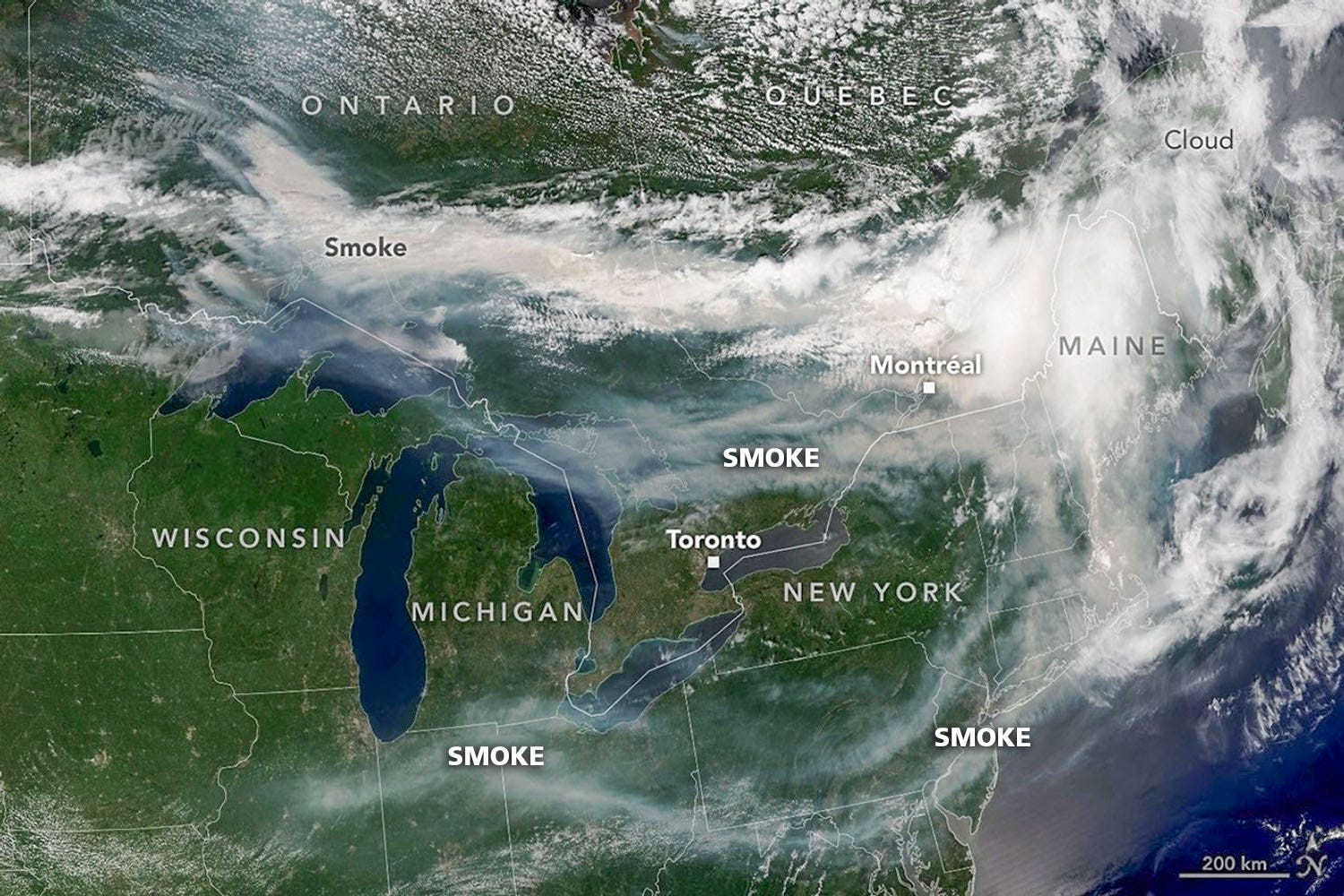
Thick smoke from hundreds of Canadian wildfires spread across a vast swath of the United States, darkening skies, reducing visibility and exposing tens of millions of people from the Midwest to the East Coast to unhealthy air.
President Donald Trump blamed Canada for failing to manage its forests and threatened to add the economic cost of the pollution to tariffs on Canadian imports. Republican lawmakers demanded that Canadian authorities do more to prevent smoke from crossing the border.
The haze even intruded on preparations for Sunday’s World Cup final between Spain and Argentina in East Rutherford, New Jersey. Smoke had pushed air quality in the region to unhealthy levels before thunderstorms began clearing the skies ahead of the match.
But neither the smoke nor its journey across the border was unprecedented.
Earthweek described an eerily similar event nearly a quarter-century ago.
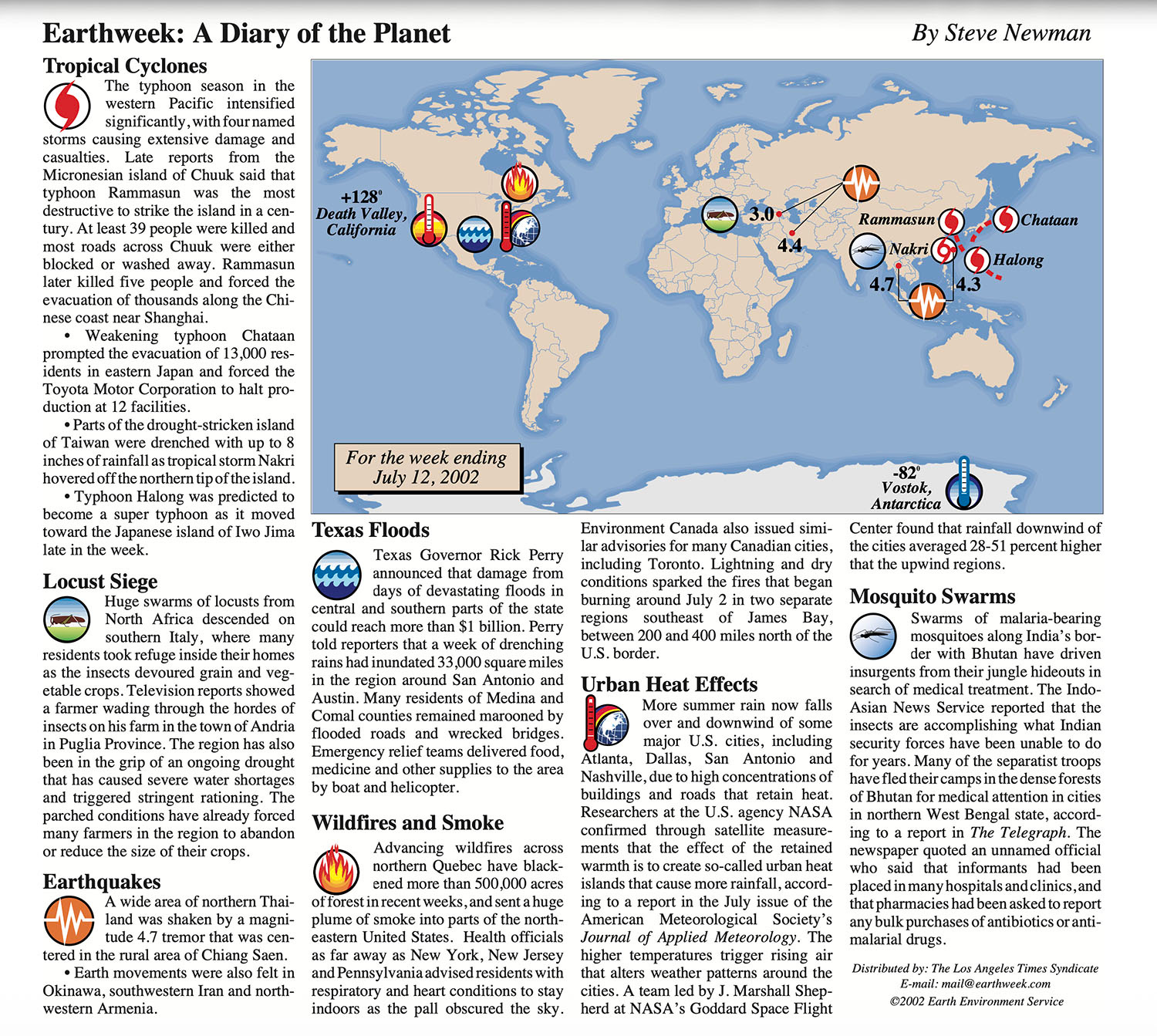
In the issue for the week ending July 12, 2002, advancing wildfires across northern Quebec had burned more than 500,000 acres (202,000 hectares) and sent “a huge plume of smoke” into the northeastern United States.
Health officials in New York, New Jersey and Pennsylvania advised people with heart and respiratory conditions to remain indoors as smoke obscured the sky. Environment Canada issued similar warnings for Toronto and other Canadian cities.
Lightning and dry conditions had ignited the fires in remote forests around James Bay, between 200 and 400 miles (320 and 640 km) north of the U.S. border.
Seven years earlier, Earthweek reported that Quebec’s worst forest fires in four decades had forced about 500 people from their homes and sent smoke as far south as Maine.
Canadian wildfire smoke crossing into the United States is therefore not new.
What is changing is the enormous scale, persistence and frequency of the fires—and what scientists now understand about the danger carried within their smoke.
Nearly 900 wildfires were burning across Canada by the weekend, with many of the most destructive blazes concentrated in Ontario. Additional fires were burning across northern Minnesota.
Smoke traveled more than 1,000 miles (1,600 km), triggering air-quality alerts across roughly 20 states and exposing an estimated 115 million people to unhealthy conditions.
Detroit experienced some of the worst air quality among major cities worldwide. Chicago’s skyscrapers disappeared behind a pungent gray haze, while parts of Minnesota were placed under hazardous-air warnings.
In New York City, smoke tinted the morning sky orange and yellow and partly obscured Manhattan’s skyline. Schools, parks and other agencies moved activities indoors, while tens of thousands of protective masks were distributed at transit hubs and other public locations.
Many of the blazes may burn until autumn rains or winter snow finally extinguish them. That is because Canada’s vast boreal forests cannot be managed like a suburban park or a small woodland near a populated community.
Many fires burn hundreds of miles from roads, towns or firefighting bases. Some erupt as towering crown fires that race through treetops with such intensity that aircraft and ground crews cannot safely approach them.
The smoke may travel much farther than the flames, and the particles that travel farthest are also among the most dangerous.
Larger pieces of ash usually fall near a fire. But microscopic particles known as PM2.5 can remain airborne for days or weeks, crossing states, countries and even oceans.
Those particles are small enough to evade many of the body’s natural defenses, penetrate deep into the lungs and enter the bloodstream.
Wildfire smoke is not composed only of burned trees. It can contain the combustion products of houses, vehicles, plastics, fuel tanks and industrial materials. Researchers have identified at least 1,000 toxins in the smoke, including formaldehyde and volatile organic compounds.
The particles trigger inflammation as the immune system responds to the intrusion. Within hours, ambulance calls and emergency-room visits can rise for asthma, coughing, chest tightness and breathing difficulties.
Within a day or two, hospitals may see more heart attacks, strokes and other cardiovascular emergencies.
Research increasingly connects wildfire smoke with damage throughout the body, including the brain and skin. Prolonged exposure has been associated with some cancers, dementia and other neurological diseases.
Pregnant women exposed to smoke face higher risks of premature birth and low birth-weight babies. People older than 60 are more vulnerable to stroke, while children, people with asthma and those with existing heart or lung disease face some of the greatest immediate risks.
A recent study estimated that long-term exposure to wildfire particles contributed to an average of about 24,100 deaths each year in the continental United States between 2006 and 2020.
Earthweek warned in May that wildfire smoke, worsening heat, longer pollen seasons and mold are combining to reverse decades of progress against respiratory illness.
An Earthweek report in January also described how gases released by fires can chemically transform in the atmosphere into additional fine particles, allowing the health threat to linger long after the flames have passed.
Trump portrayed the smoke as the result of Canadian negligence.
He accused Canada of refusing to conduct “basic forest management and debris removal” and said the United States was being “invaded” by unhealthy air.
He threatened to incorporate the financial cost of the smoke into tariffs already imposed on Canadian imports, although he offered no explanation of how such a penalty would be calculated or administered.
Ontario Premier Doug Ford called the accusation “absolutely unacceptable.” Canadian officials noted that their country has expanded firefighting operations and regularly assists the United States when American communities face fires, hurricanes and other disasters.
Fire is part of the natural cycle of the northern forest. The harder reality is that rising temperatures under human-caused climate change are drying vegetation more rapidly, extending fire seasons and making flames more intense and difficult to control.
Canada is warming about twice as quickly as the global average, while the Canadian Arctic is warming at nearly four times the global rate.
Even modest increases in temperature can produce far larger changes in the number and intensity of fires. Hotter air draws more moisture from soils and vegetation, leaving forests increasingly primed to burn when lightning arrives.
The United States is experiencing the same trend. The average area burned across the country annually during the 2020s is now more than twice what it was 30 years ago.
Canada has experienced several record or near-record fire seasons during this decade. Europe set a record for burned land last year, while Arctic fires have released unprecedented amounts of smoke and carbon into the atmosphere.
The political demand that Canada simply remove more brush or extinguish every fire obscures the central reason so many forests are becoming dangerously combustible.
Humanity is continuing to burn the coal, oil and natural gas that heat the atmosphere, dry the land and load the climate system in favor of increasingly destructive fires.
A landmark 2023 study traced a substantial portion of the increased wildfire danger in western North America to emissions produced by 88 of the world’s largest fossil-fuel companies.
Yet the American politicians threatening Canada with tariffs made no mention of fossil fuels or climate change.
That omission transforms a planetary crisis into a foreign grievance. Smoke does not recognize national borders, and neither does the warming that helps create it.
The fires burning in Canada are Canadian emergencies. The smoke drifting into Chicago, Detroit, New York and New Jersey is an American emergency.
But the forces driving both are global.
Asked what would ultimately stop the worsening cycle, University of Michigan climate scientist Jonathan Overpeck offered a prescription far more direct than tariffs or political blame.
“Just stop burning fossil fuels.”
Steve Newman
©MMXXVI Earth Environment Service
No posts
Comments
Nothing yet. Say the first thing.
Sign in to join the conversation.