
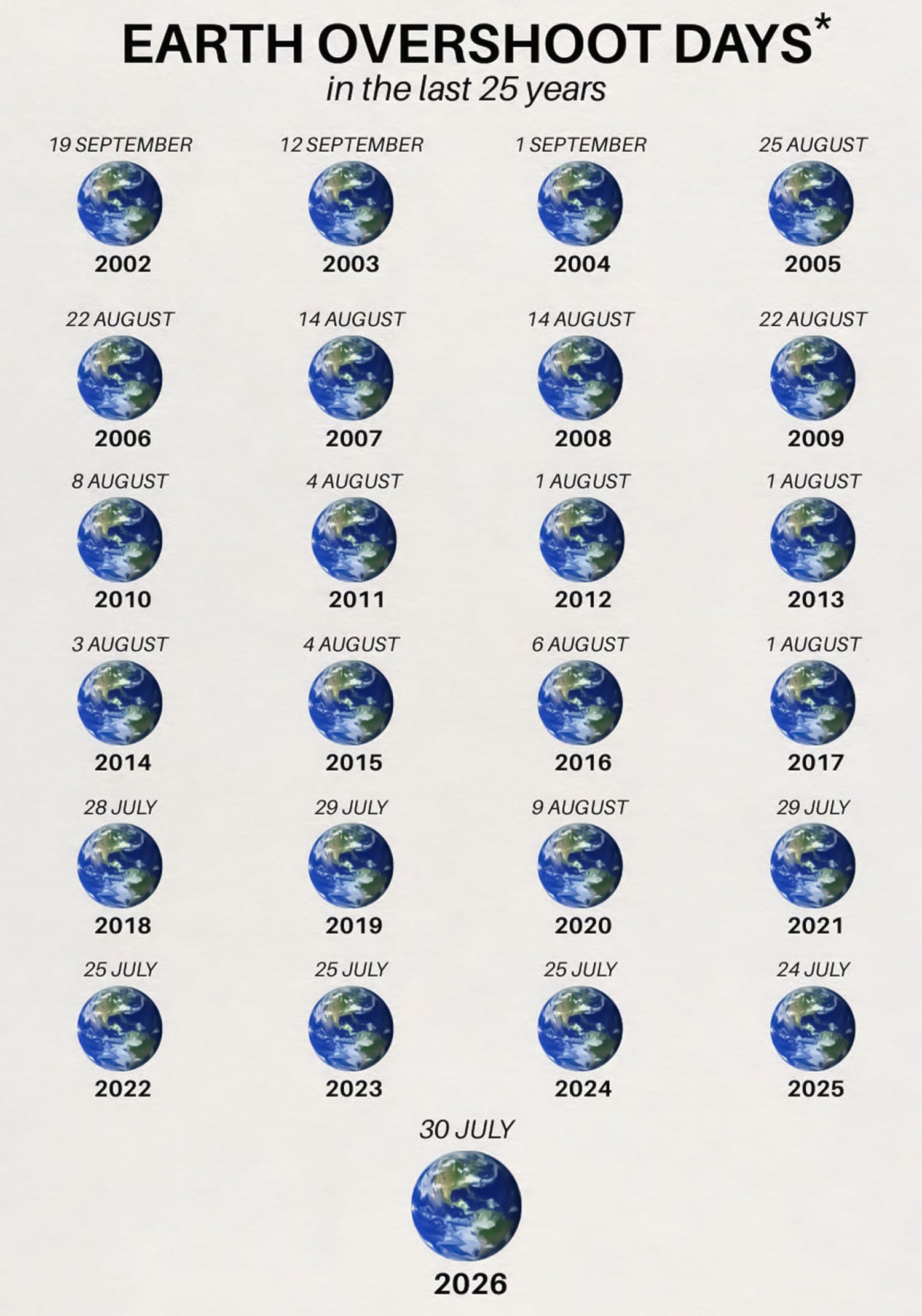
Imagine spending your entire annual income by last Thursday, July 30. For the remaining five months, every meal, utility bill and tank of gasoline would have to be paid for by borrowing, selling assets or leaving the debt to someone else.
That is the idea behind Earth Overshoot Day. It marks the point in the year when humanity’s demand on nature exceeds what the planet can regenerate during the entire year.
The consequences do not arrive as an invoice. They appear in forests cut faster than they can regrow, fisheries depleted faster than they can recover, soils losing their fertility and carbon dioxide accumulating in the atmosphere. The debt is passed along through a hotter climate, damaged ecosystems and fewer natural resources for future generations.
This year’s Earth Overshoot Day fell on July 30. The Global Footprint Network estimates that humanity is using nature about 73 percent faster than Earth can replenish it—the equivalent of requiring 1.73 planets to sustain our present level of consumption.
Who keeps the books?
The Global Footprint Network is an international nonprofit research organization founded in 2003. It promotes and calculates the “ecological footprint,” a measurement comparing human consumption with the ability of forests, croplands, fisheries and other ecosystems to regenerate resources and absorb waste.
The organization is not part of the United Nations or a government agency. Its annual Overshoot Day is intended as an easily understandable warning rather than a literal date when the world suddenly runs out of resources.
This year’s date arrived six days later than the one announced for 2025, seemingly suggesting that the planet’s ecological finances had improved. But the difference was largely caused by revised estimates of how much carbon dioxide the oceans absorb.
Those revisions moved the date eight days later. Meanwhile, rising human demand moved it two days earlier. Without the accounting change, Overshoot Day would have arrived sooner than last year.
Borrowing from people we will never meet
That debt is not abstract. It is passed to people in other countries, other generations, other circumstances — people who had no say in today's decisions.
Earth Overshoot Day combines many kinds of environmental pressure into a single estimate, and its calculations inevitably contain uncertainties. But its central message is difficult to dismiss: a society cannot indefinitely consume natural wealth faster than the planet can restore it.
Carbon emissions from burning fossil fuels account for an estimated 61% of humanity’s ecological footprint. The Global Footprint Network calculates that cutting those emissions in half could move Overshoot Day nearly three months later.
Reducing food waste, conserving energy, designing less resource-intensive cities and restoring forests and other ecosystems would also help.
Those changes would mean more than adjusting a date on the calendar. They would leave cleaner air, healthier landscapes and a more stable climate to people who had no voice in creating today’s debt.
Living within the planet’s means is not merely an exercise in environmental accounting. It is a question of what kind of world we choose to pass on to our children, and how much of the bill we expect future generations to pay.
Steve Newman
©MMXXVI Earth Environment Service
No posts
Comments
Nothing yet. Say the first thing.
Sign in to join the conversation.