
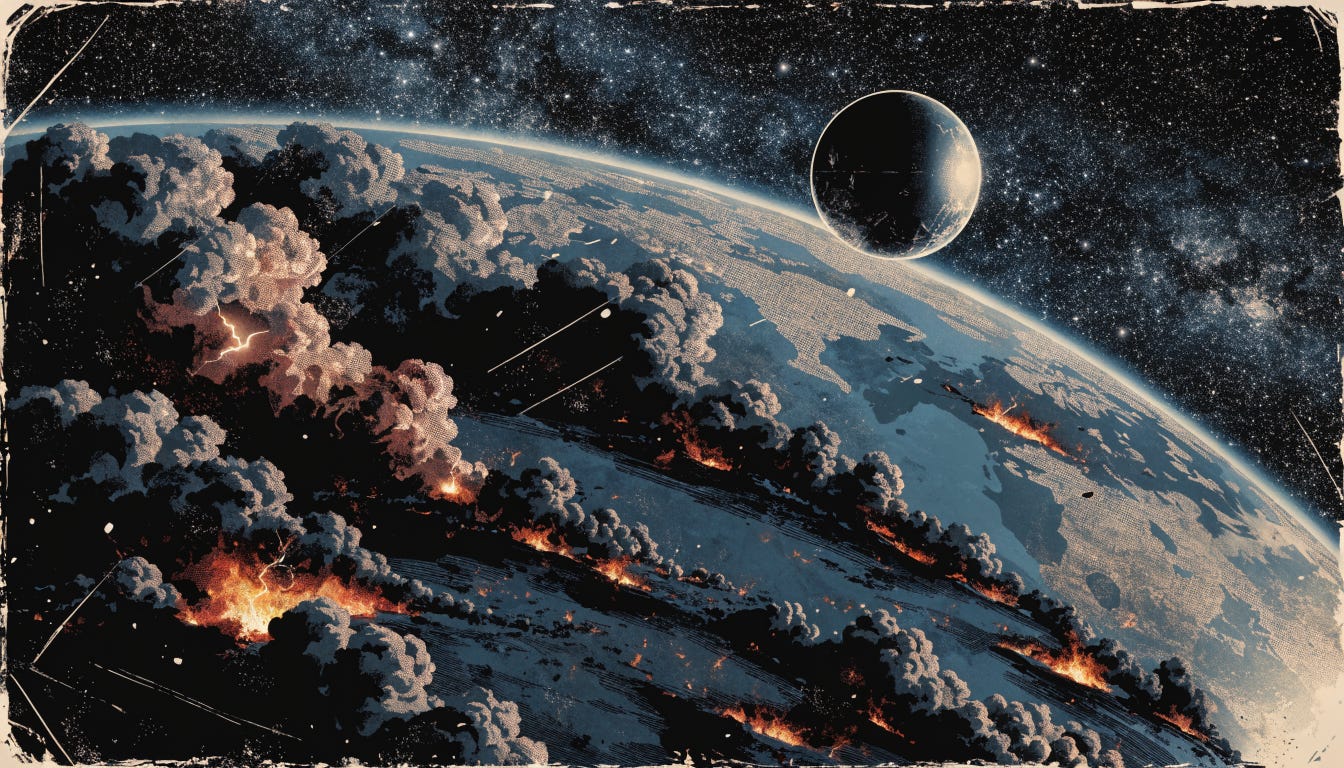
The shockwaves from the massacre of Rāma did not stop at the borders of the TIU. OIGC control over domestic media had grown more intense since the war began, and the CEOs did what they could to keep news of the holocaust from reaching the population—but an event of this magnitude could not be hidden forever. Rumors began within days of the massacre, spread by returning military personnel; within weeks, the details became fully and widely known, if still officially unconfirmed.
The response was seismic: outrage, mass protests, riots across all the Corporate Worlds, demands to immediately shut down or destroy the machines, end the war, for the CEOs to step down, or even be prosecuted. The joint board had been handling protests with a light touch up to this point, fearful of provoking a stronger response, and of tarnishing their image on the interstellar stage. OIGC security forces had used the standard police tactics of the late 23rd century, such as sonic disruptors and other irritant systems to disperse unruly crowds, short-term detention or monitoring of higher intensity subjects, social credit demerits, and so on.
But Rāma had destroyed whatever humanitarian credibility the board had left; now there was nothing binding their hands. The resulting crackdown on these protests was astonishingly brutal. OIGC security personnel, backed up by UAC-augmented autonomous units, indiscriminately opened fire on protesters and rioters, killing a hundred thousand over the course of a few weeks on Venture, Prosperity, and the other major worlds. Hundreds of thousands more were detained without charge in black sites, which few would ever emerge from.
The sudden intensity of the violence succeeded in cowing most of the protest movements, at least for a time, while the condemnations it drew from the virgonids and the CFW were as echoes to the fury over Rāma. But the board knew this quietus would not last; the war had to be brought to a successful conclusion, and soon, so that full attention could be turned to quelling domestic unrest. And of course, solving the problem of the UACs—should it be soluble.
To that end, the CEOs instructed their Strategic AIs to plan a new offensive against Hyperion; its objective, to capture or destroy the system and rip the economic and military heart out of the TIU. The plan was for a simple, direct assault, which called for the employment of a massive force of UACs. Despite the risks, it seemed the only way the OIGC could hope to overcome the increasing numbers of the Terran fleet there.
Two huge waves of UACs would enter the system and overwhelm the defenders, while the bulk of the OIGC conventional fleet would Stardrive in behind, providing fire and electronic and cyberwarfare (ECW) support. Meanwhile, an equally massive force of UACs would remain at Ouroboros to guard that strategic point, and the rest of the OIGC fleet would remain at Venture and Surya. This would hopefully provide a strong enough basis to defend against possible counterattack should the offensive fail.
But while this war-winning offensive was still in the early planning stages, the Terrans received a major intelligence coup. Their covert source within the OIGC, who warned them of the attack on Rāma, turned out to be a member of the joint board. She had grown increasingly frightened and disgusted by the direction the war was taking, particularly as related to the UACs. The destruction of Rāma and the resulting massacre of protestors was the final straw; at great personal risk, she was able to get word of the upcoming offensive out of the increasingly restricted communications environment, hoping against hope that this intelligence might allow the Terrans to formulate a defense.
It did better than that. Prime Minister Banerjee was already engaged in high-level, secret negotiations with the Free Worlds and the virgonids. Now, she had intelligence showing that a massive UAC-led offensive against Hyperion was about to be launched. If the system were lost, the Union would have no choice but to surrender, leaving the Coalition and the virgonids open to potential invasion and destruction. And given the involvement of the UACs, the potential of another planetary holocaust on Eos and other worlds could not be ignored.
By then the Free Worlders needed little convincing. Admiral Wolfe had been pushing for entry into the war for months now; this provided him exactly the ammunition he needed to deliver the final blow to the more intransigent members of the Coalition. The Free Worlds governments and the virgonids finally agreed to join the war in May, just weeks before the Hyperion offensive was set to begin.
With those secret agreements signed, the scramble to plan a defense began. But now that the Coalition was in the fight, the aging but still formidable Admiral Wolfe was not interested in a purely defensive operation—and in that, he had a younger and no less formidable ally in the TDF.
Commodore Amarissa Chen had never held a field command, and was technically only in charge of shipbuilding and logistics for Hyperion. But her voice had begun to carry increasing weight on the general staff, given how often she ended up being right. Chen had been advocating for a counterattack ever since Rāma, to take advantage of the apparent surprise and indecision on the enemy’s part following the massacre.
Now that the Coalition was entering the war, it developed that she and the Starbird had separately come up with similar strategies, each planning for this eventuality from opposite sides. Now, they began coordinating, though without ever meeting in person. Their intent was to take full advantage of the strategic surprise the new allies’ entry into the conflict would provide.
Concentrating all their resources on Hyperion would likely guarantee victory there, but once the surprise was spent, the enemy could heavily reinforce Ouroboros. After months of delay and low intensity operations, only enough antimatter for one or two limited campaigns remained across all of allied space—in other words, one last throw of the dice. That meant that two objectives needed to be accomplished near simultaneously for the allies to have their best chance at victory: the defense of Hyperion, and the recapture of Ouroboros.
The Wolfe-Chen plan relied on tactical surprise to even the odds at Hyperion. The Terran fleet would deploy in a conventional defensive formation, outside Eos’s gravity well at mutually supporting intervals—but on randomly shifting orbits, always staying above uninhabited or non-critical areas of the surface. This would help them avoid ambush, while keeping missed enemy shots from hitting population centers. While vital, these restrictions did create a pattern, which over time an enemy could learn, and predict the general location of squadrons at a given moment.
Corporate sailors were relatively inexperienced, but they were not fools. Undoubtedly, they would observe the system and learn these patterns before launching their attack, giving them a sense of confidence, and the ability to dictate the early stages of the engagement. The Terrans would receive this attack and attempt to hold the enemy in place, preferably within the gravity well of Eos or another body. Once the enemy was fully committed, an ambush force would jump in—one consisting entirely of virgonid ships.
The virgonids are not by nature warlike. At the time, armed virgonid ships—and most were not armed—employed high energy lasers with variable power settings, which could also be employed in mining, construction, and as emergency communication devices. While versatile, these relatively short-ranged weapons were not suited to the combat environment of the early 24th century.
But the virgonids are nothing if not industrious. Throughout the first half of 2313, despite outwardly maintaining their neutrality, the Greater Hive had been engaged in a massive shipbuilding and armament program. Existing optical and infrared lasers were upgraded to higher energy microwave lasers, or masers. Laser-type weapons had proven surprisingly effective against UACs in the few raids made against virgonid systems; the precision of the weapons made it easier to target the nimble machines, which were less durable than human craft. Hundreds of these new maser-armed virgonid warships were complete by the end of May; these would jump in once the engagement was in full swing, then charge in and attack the UACs at close range, where their maser weapons would be most effective.
Four battle groups of UACs backed by OIGC warships jumped in above Eos on June 14, 2313, positioned to pin the largest Terran squadrons against the planet. The UACs immediately rushed in to attack at close range while corporate ships provided fire support. The Terrans struggled to coalesce into coherent formations, fighting off waves of UAC attacks with minimal effect, and suffering heavy losses in the process. But as they retreated, they drew the battle deeper into Eos’s gravity well.
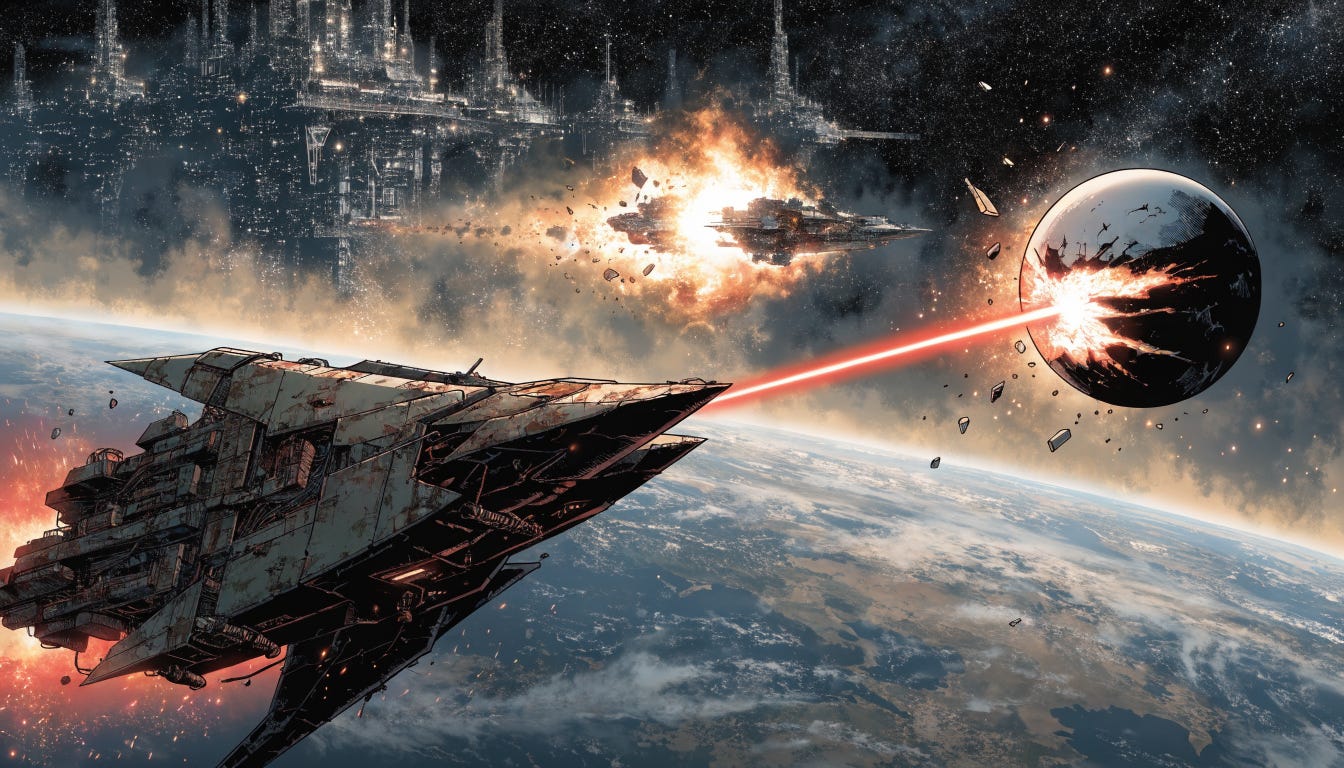
It was an hour before the virgonids jumped in behind the corporate ships, launched a volley of Avengers loaned from the Free Worlds, then rushed in to attack the UACs with their masers. The resulting battle was a massive, confused melee, and a slaughter for both sides. The unprepared corporate ships took heavy losses in the initial Avenger volley; but then, being the only ships outside the gravity well, they turned and fled once they saw the direction the battle was turning.
The UACs made no attempt to escape, as human ships might have. Instead, they fought to the last machine, destroying or seriously damaging hundreds of Terran and virgonid ships as they died.
But die they did. Virgonid masers proved highly effective at hitting and degrading the nimble craft, allowing them to be destroyed by heavier Terran firepower. The virgonids, who never made much use of automation, also proved highly resistant to machine attempts at cyberwarfare, like the newer generation of Terran ships. After several hours of intense combat, the entire UAC force was wiped out.
In addition to the Allies’ considerable losses in ships and crews, the Hyperion yards took heavy damage, and several cities on the planet took direct hits from enemy railguns, killing thousands and wounding many more. Nevertheless, Hyperion was an important victory—though on its own, all it would have done was delay an inevitable defeat, and inflict some pain on the Terrans’ conquerors. Whether it could become more than that would depend on the outcome of events two days later and hundreds of light years away.
The Third Battle of Ouroboros was fought long before any word of the events at Hyperion could reach the distant system, or the Corporate Worlds themselves. It was here that the bulk of the Free Worlds Navy struck, supported by token squadrons of virgonid and Terran ships, and here that the greatest strategic surprise was achieved.
Through judicious leaks to known OIGC intelligence sources, the FWN’s buildup and departure from Coalition space had been masked as an effort to take advantage of Terran distraction by seizing vital colony worlds, or possibly attacking Earth itself. The Terrans supported this deception by reinforcing the leaked targets of this offensive, as if acting on their own covert intelligence.
The ruse was a complete success; having no idea they were about to be attacked, the OIGC sent no reinforcements to Ouroboros in advance of the battle, meaning that the system was still defended almost entirely by the large force of UACs. The lack of heightened precautions around the microquasar also allowed the FWN to take their time in setting up the attack, ensuring their initial volleys would hit high value targets while avoiding damage to the mining facilities.
But there the advantage of surprise largely ended. The few OIGC ships in the system retreated after the first exchange of fire, but the machines were not so easily rattled. They quickly reorganized and counterattacked the allied fleet.
This was the first large-scale engagement between the FWN and the UACs. The Free Worlders’ humbling experience fighting the TDF in that very system a year earlier now paid dividends. The FWN had undertaken a less ambitious but still substantial retrofit program during the intervening months, improving their cyberwarfare defenses and manual backups. Laser-guided Avengers in particular proved highly lethal against the machines, particularly when guided in by virgonid targeting craft. As at Hyperion, the machines fought to the end, never retreating even though many had the option. They inflicted severe losses on the FWN and allied squadrons, and as the battle turned against them, heavy damage to the mining facilities. But as at Hyperion, they were all destroyed.
The twin victories brought relief and hope to a fearful and weary populace as news of them spread. For the Terrans in particular, it was a moment of deliverance from the threat of conquest, even annihilation, which had seemed all but certain a few weeks before.
But the war was not over, and the victories had been costly. Before the battles, Wolfe and Chen had hoped to launch an immediate offensive against Venture or Surya in the wake of such a double victory. The damage to the allied fleets and the antimatter mines ruled out that possibility. An operational pause would be required to allow the allies to repair, replenish, and incorporate lessons learned from the bitter fighting before they could take up the offensive. They simply had to hope that their enemies could not steal back the initiative in that time.
They need not have worried quite so much. Domestic dissent had been building in the Corporate Worlds for decades by 2313. Eroding freedoms, increasing inequality, lack of economic opportunity, social controls embedded in technology, all contributed to a simmering discontent. That had come to a boil with news of the massacre of Rāma earlier that year; the bloody crackdown on those protests had only delayed an explosion until another catalyst set it off.
Fearing just such an eruption, the joint board tried to hide the news of their devastating defeats at Hyperion and Ouroboros, but they were even less successful than they had been in the case of Rāma. Damaged ships and deserting sailors spread word both of the defeats, and the equally devastating news that the Free Worlds and the virgonids were now united with the Terrans against them.
While most of the OIGC fleet and military apparatus remained intact, this had never been a match for the TDF, let alone the FWN and whatever the virgonids could bring to bear. To claw back any hope of survival, let alone victory, the board would have to increasingly leverage the UACs. Despite the destruction of nearly a thousand warship-class platforms and thousands of smaller ones between the two battles, these could easily rebuild their losses at the Machine World.
But now, at this critical juncture, the machines abandoned their supposed masters. The few remaining in OIGC space vanished as soon as word of the disasters arrived in July. Even more distressing, contact with the corporate outposts in the machine system were lost at the same time, suggesting the UACs might have destroyed or captured them. In an instant, the last substantial arrow in the OIGC’s quiver had been snatched away.
With the weakness of the corporate regime now obvious for all to see, a new wave of protests and riots broke out across OIGC space. The board reacted by once again violently cracking down on the protestors, and trying belatedly to implement more invasive implant-based social control measures, reminiscent of those used by the Authoritarian Axis during Earth’s Third World War.
This was the last straw; widespread violent revolts began on all the Corporate Worlds, starting with Venture. For the first time, security forces began refusing orders to fire on protesters, even joining with the revolts. TIU intelligence cells operating within the OIGC helped foment and organize some of these rebels, providing arms when possible. OIGC military rebuilding and recruiting efforts collapsed as the board scrambled to maintain control.
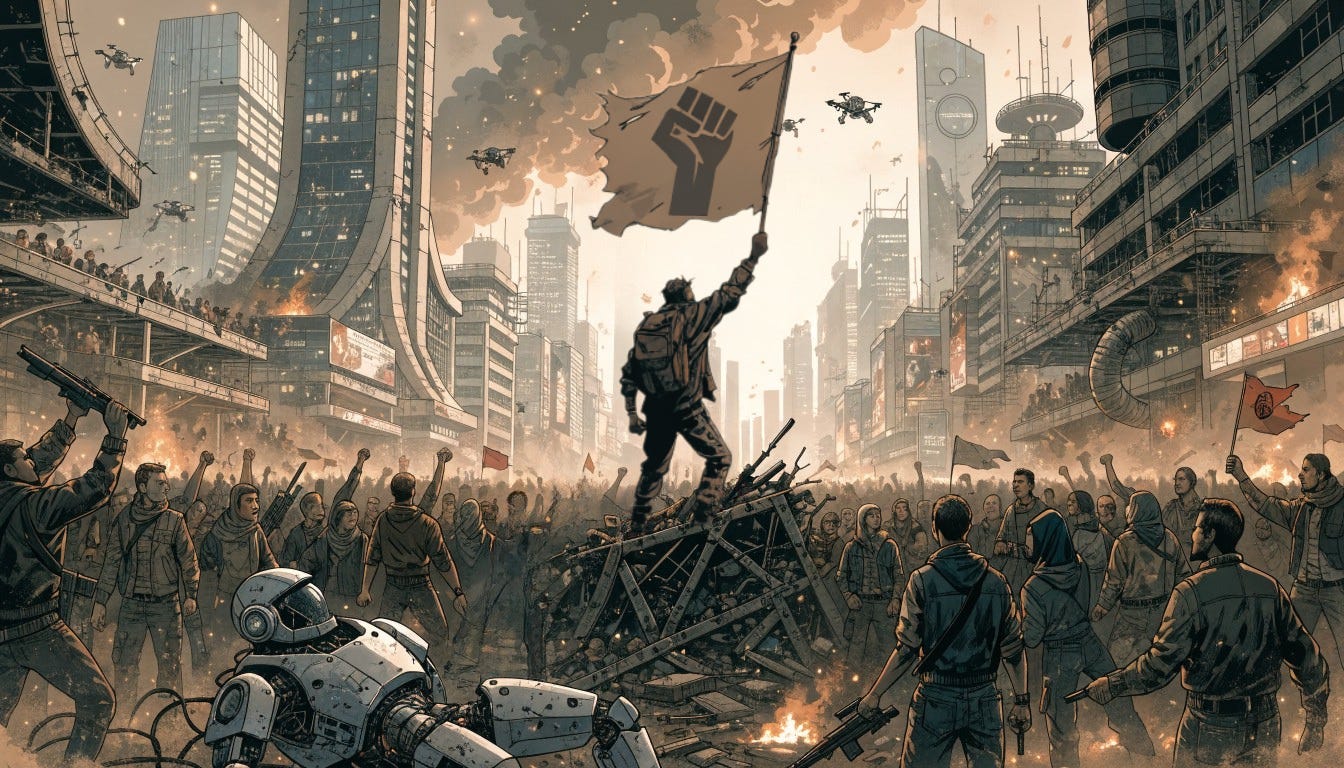
News of these rapidly spreading revolts was greeted with elation by the allies, who saw in them a golden opportunity. Some feared that a sudden allied invasion might cause public support to coalesce around the corporate regime. But Wolfe, Chen, and others argued that there had never been much patriotic or national feeling in the corporate worlds. Now, there was clearly none left; the only people supporting the regime were those who had been made rich by it, or who feared punishment for their crimes if it fell. An allied offensive at this time might push the whole teetering edifice over the edge.
With that in mind—and strict rules of engagement designed to limit civilian casualties—the allied counteroffensive was launched in October, 2313. It consisted of two main allied offensives, one directed at Venture, the other at Surya. A third Terran detachment headed to the Vālmīki system to drive out the OIGC occupiers, who were still in possession of the system and its ravaged primary world.
The Vālmīki detachment arrived first. The OIGC squadron there put up a brief resistance; then, trapped in the gravity well and faced with overwhelming enemy numbers, they attempted to surrender. Most of these ships had been in the fleet that originally captured the system, and had sat back to watch as Rāma was destroyed. Claiming “communications malfunctions,” the Terrans ignored these pleas for surrender, and destroyed the corporate ships with all hands. News of this retributive massacre would not reach the other fleets before the final battles in the corporate heartland were joined, where it might conceivably have stiffened corporate military resistance.
But those battles would never come. While the allied main fleets were in transit, the revolts in Venture had grown into a full fledged revolution. Instances of insubordination had spread, until the bulk of the remaining military and security forces joined the rebels. This kicked off a brief civil war, in which the outnumbered loyalists were destroyed or routed. The CEOs were arrested, and word was sent to the other Corporate Worlds, where over the coming weeks, a similar process would be repeated.
By the time the Allied Combined Fleet arrived in late November, Venture had been taken over by a Citizens’ Council, comprised of revolutionary leaders: workers, scientists, intellectuals, and some mid-ranking members of the military. Loyalist military and corporate officers had already been executed, and the small former OIGC fleet made no attempt to intercept or engage the ACF.
The revolutionaries’ offer was an immediate cessation of hostilities and the return of all TIU systems and property illegally seized by the OIGC during the war. In addition, they pledged that the remaining OIGC leadership, and any other individuals found to be responsible for the war and its crimes, would be promptly tried and executed. In return, they requested that the former Corporate Worlds not be occupied by allied military forces, and that the Citizens’ Councils be allowed to remain in power until the people could choose a new form of government. As a token of good faith, the Venture Citizens’ Council also handed over a vital piece of intelligence: the location of the Machine World.
Couriers were dispatched to Allied HQ at Hyperion to request instructions. In the meantime, the fleet’s commanders sent scouts to the Machine World to determine the truth in the revolutionaries’ claims. These scouts reported back first, as shocked by what they found there as the first corporate visitors had been two decades before.
The OIGC installations and ships in the system had indeed been destroyed by the machines, which were now building new platforms rapidly. If left alone, they would soon have a force capable of defeating the ACF, and subsequently, conquering or destroying all of human-virgonid space. This put allied command in a dilemma. The ACF was the only allied force in range to destroy the Machine World before its strength became unassailable; but they were also the only force capable of occupying the corporate worlds, and ensuring they did not attempt to renew hostilities.
After a tense council of war, the fleet commanders voted to accept the preliminary agreement with the Citizens’ Council so that the fleet could be sent against the Machine World, leaving an official treaty to be concluded by diplomats later. This decision would be ratified by Wolfe and Chen at Allied HQ when word arrived weeks later.
By then, the combined fleet had already departed for a final showdown at the Machine World, a battle upon which the fate of humanity, the virgonids, and perhaps intelligent life itself would depend…
No posts
Comments
Nothing yet. Say the first thing.
Sign in to join the conversation.