
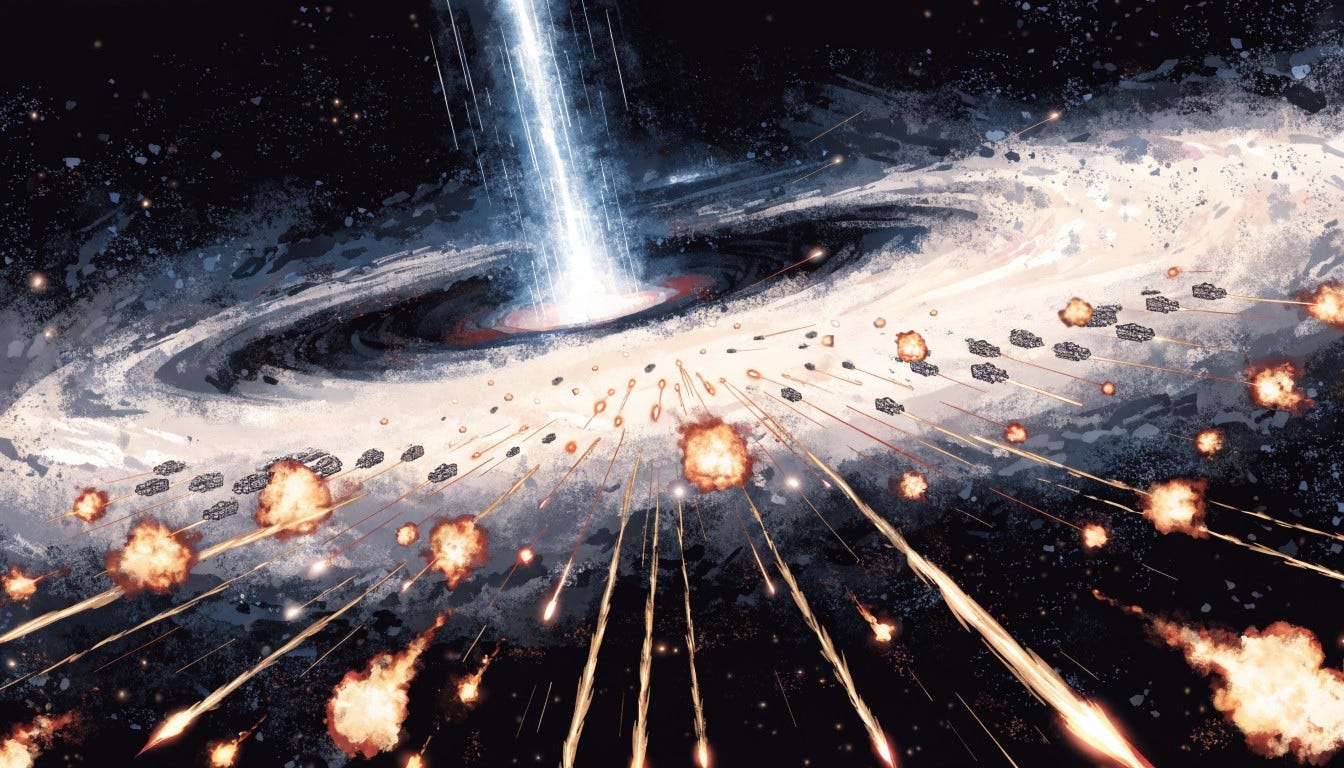
The Second Battle of Ouroboros in May, 2312, was a shock to the Terran Interstellar Union. Widespread outrage at the unprovoked OIGC attack lent broad public support to the declaration of war later that month. The outcome of the battle—a defeat which once again placed the galaxy’s only major source of antimatter in the hands of an enemy—was the major driver for that declaration. Officially declaring war gave the government broad powers over economic mobilization that it would need if the Union was to survive the crises to come.
But it was the tactical details of the battle that most worried Terran military leaders and observers. Indeed, they were so unsettling that some military thinkers questioned whether a declaration of surrender might have been more appropriate.
The Terran Defense Force (TDF) fleet defending Ouroboros had consisted of fifty crewed ships and two hundred drone craft, exclusive of the fleet’s complement of autonomous weapons. Studying the Free Worlders’ wars with the Kyrans had loosened, but not removed, the grip the cult of the gun had once held over Terran doctrine. Terran fleets still made heavy use of railguns as their primary armaments; but the doctrines around these weapons now focused on close-to-mid range rather than long to very-long range engagements.
Further, mass accelerators were now only a part of integrated weapon systems. Given the tensions between the CFW and the TIU, the Terrans were not able to purchase older blocks of Avenger missiles or their designs from the Free Worlders, as the Corporate Worlds had. Besides which, the Terrans still doubted the effectiveness of these weapons against enemies other than the Kyrans, who they would not have to fight.
The TDF had relied heavily on automation throughout its existence, and this tendency only increased in the first decade of the 24th century. By 2312, most Terran fleets included large numbers of conventional and nuclear payload missiles, and even larger numbers of drones and autonomous weapon platforms. TDF drones were employed in swarms of small suicide and jamming vehicles. Larger drones were armed either with nuclear payloads, or single-use high powered railguns.
These latter weapons, called Hornets, were similar in concept to the Avenger: able to get closer to the target and maneuver for an ideal shot before firing. Their ammunition expended, the Hornets would then rush in for a suicide charge, either ramming the target at high speed, or at the very least occupying some of its valuable point defence capacity so other weapons could strike home.
The TDF placed a great deal of hope on these new autonomous systems and weapons, in particular the Hornets, relying on them to offset the Terran navy’s weakness in combat experience. The Free Worlders had long viewed these developments in their rival’s navy with scorn; jibes about the Terrans letting robots do their fighting for them were common.
The lopsided engagement between the FWN and the TDF at WZ Sagittae in September, 2311, seemed to justify this scorn. But the TDF squadron at Sagittae had been composed mostly of older, more traditionally armed ships, since the Terrans had never intended to precipitate an engagement, but merely to observe and intimidate the Free Worlders. Similarly, the FWN was easily able to chase off the outnumbered defenders of Ouroboros in October of that year.
But at the First Battle of Ouroboros in November, it was the Free Worlders’ turn to be unpleasantly surprised. While they were still able to defeat and drive off the larger TDF fleet’s counterattack, they took significant losses in so doing—and not just to the surprisingly effective Hornets and other autonomous weapons.
The FWN’s superiority in experience and weaponry had papered over a major vulnerability: cyberwarfare. Four decades of fighting the Kyrans—whose cyber capabilities were laughable in comparison—had led the Free Worlders to allow their own capabilities in that domain to atrophy. In the brief, surprise engagement at WZ Sagittae, the Terrans had been unable to press the advantage this provided them. But at First Ouroboros, they planned to make the best use of it they could.
Terran warships and drone swarms used sensor ghosts implanted directly into FWN computer systems to confuse enemy targeting, diverting Avenger launches and railgun barrages. Even worse, they were able to shut down critical FWN systems in the middle of battle, and in several cases gain control of weapons or smaller craft for a brief period of time.
To their credit, Free Worlds sailors adapted to the unexpected vulnerability, de-networking critical systems on the fly and going to manual control wherever possible—even switching Avenger missiles to manual laser guidance in several launches. This improvisation allowed them to win the battle against their inexperienced foes. But the significant losses they suffered—20% of their ships destroyed, a further 20% badly damaged—meant that they were ultimately forced to abandon Ouroboros after sustained raids over the next three months.
The result of the campaign, the lessons learned from the battle, and their massive advantage in numbers convinced the TDF that they had found a winning strategy. Even once the UAC raids began, and the OIGC’s involvement became clear, most Terrans were bullish about their prospects of victory. Indeed, the initial exposure of the Corporate Worlds’ treachery dispelled much of the fear that early UAC raids had produced, since they now seemed to be a corporate trick, not an alien invasion.
Such optimism was not entirely unjustifiable. The OIGC navy, such as it was, largely made use of similar weapons and tech to the TDF, of roughly the same quality, but in much smaller numbers. The corporate navy also employed older-block Avenger missiles purchased from the Free Worlds, but since the TDF had apparently figured out how to deal with the real thing, they felt they had little to fear from the imitation—particularly in the hands of corporate “salary sailors” rather than the Free Worlders’ professional officers and highly motivated citizen soldiers.
But perhaps the TDF’s leadership should have studied the results of the battle at Ouroboros and the UAC raids more closely. Certainly, that was the position of one of the TDF’s most controversial strategists, Captain Amarissa Chen.
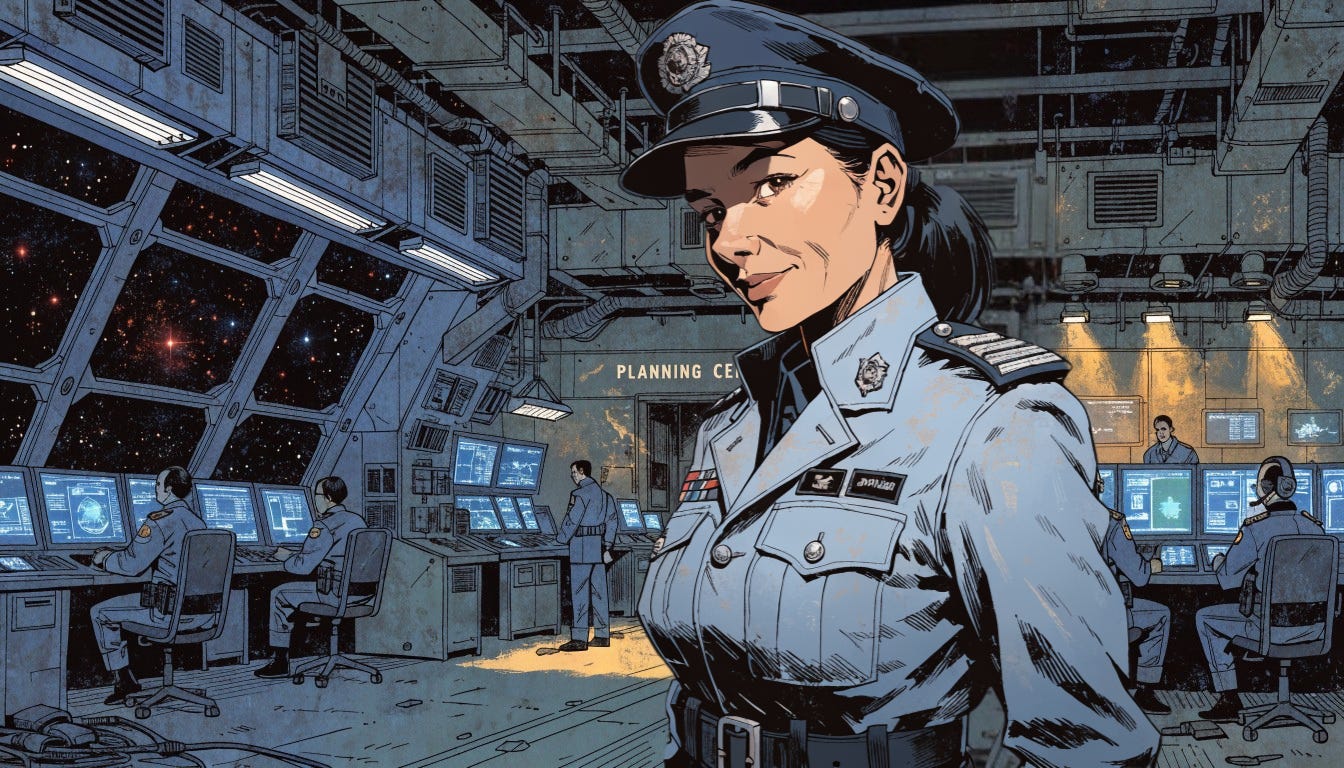
Captain Chen was a junior officer on the naval general staff. While undeniably brilliant, she had an established history of bucking trends and received wisdom—to the point of playing devil’s advocate, her critics argued, going some way to explain her failure to rise above captain’s rank.
Chen argued that the very success of Terran cyberwarfare at Ouroboros exposed a massive weakness in their own doctrine. The FWN’s most highly automated systems and weapons had proved the most vulnerable to compromise by Terran cyberwarfare. The Free Worlders had compensated only by devolving capabilities and decision making onto human operators. The resulting sacrifice of speed and precision proved acceptable next to the risk of deactivation or outright co-option by the enemy.
Terran tactics had worked well against the FWN, with their relatively anemic cyber capabilities. But the OIGC were known to have AIs at least as good as the Terrans’, if not better. And early UAC raids also showed some startling characteristics. Small numbers of the spheroid or oblong craft were able to surprise and destroy TDF and FWN ships and ground installations while taking minimal damage in return. While only armed with conventional MACs and laser weapons, the UACs were incredibly fast and maneuverable. Worse, these craft had already displayed some advanced cyberwarfare capabilities, masking themselves from Terran sensors and shutting down critical systems at critical points.
If the OIGC and their alien machines had been able to leapfrog Terran cyberwarfare capability, then unlike their FWN enemies, TDF ships had virtually no manual fallback capability. Given the massive reliance on automation—not just in the navy, but throughout the Terran economy—most ships staffed minimal crews, often with insufficient training on ships’ systems. That was if they had crews at all; most craft were entirely automated.
But in the glow of victory after reclaiming Ouroboros, and rage at the OIGC’s perfidy, Chen’s concerns were brushed aside—until Second Ouroboros.
The OIGC fleet that attacked in May was composed of about half corporate standard ships, and half UACs. The TDF fleet defending the crucial system outnumbered the attackers in total craft by about 30%. But this was not nearly enough; indeed, the battle might better have been characterized as a slaughter, if the total number of human casualties in the Terran fleet—around three hundred dead—were not so low.
Within minutes of the first shots being fired, entire squadrons of Terran autonomous weapons and ships went offline, or turned against their former masters. Terran warships began to suffer critical systems failures, which most lacked the crew depth and experience to compensate for. These compromised vessels were simply blown from space by leisurely enemy railgun shots.
Some of the TDF fleet’s older ships, with larger and more experienced crews, tried to go manual and fight as the FWN had against them a few months before. But despite their undeniable courage, they lacked the systems and weapons that had allowed their Free Worlder opponents to claw victory from defeat under similar circumstances. The UACs in particular flew literal rings around the weakened Terran ships, dodging nearly everything thrown at them, while nearly every one of their own shots found a target.
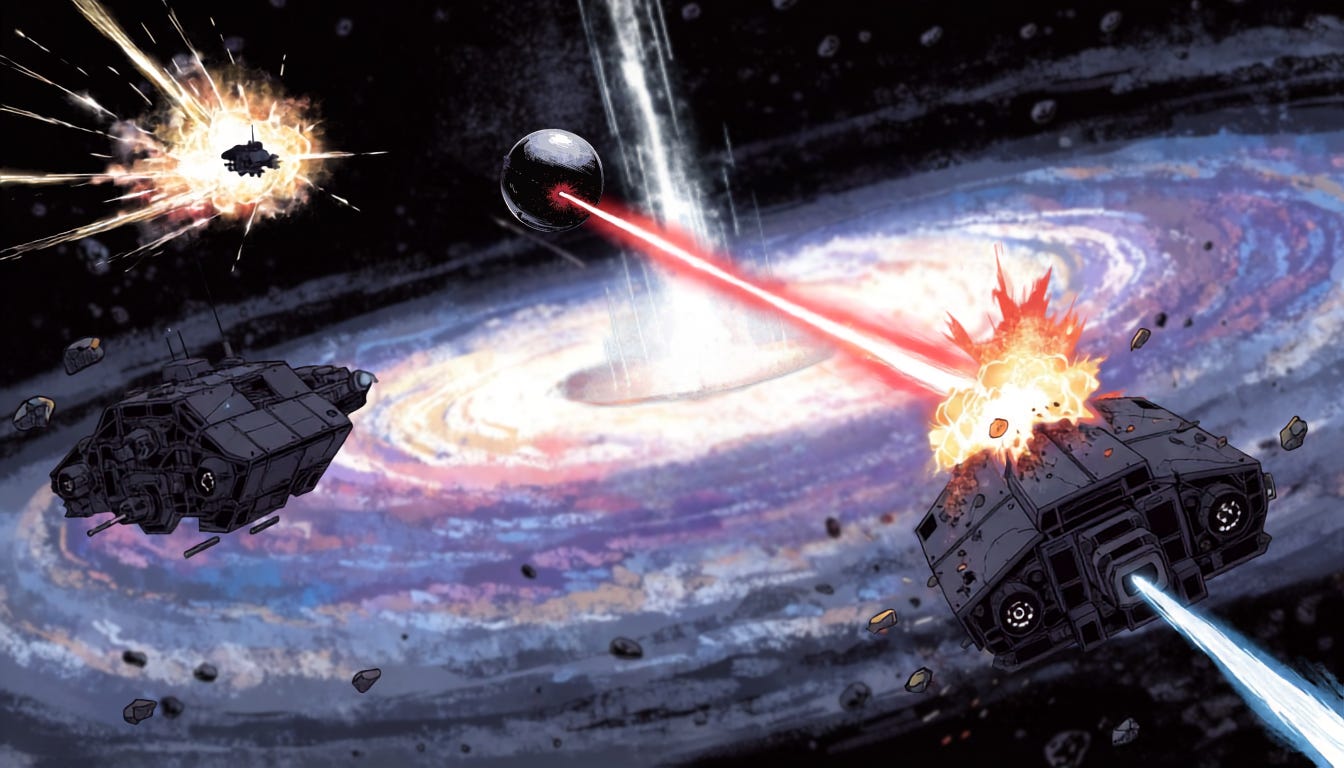
Sometimes, it seemed the corporate ships were simply sitting back and watching the show rather than actually fighting. A few crewed vessels were able to pull back to Stardrive distance and escape, but most of the fleet was destroyed or commandeered by the OIGC, along with the antimatter mines and related facilities.
The defeat sent shockwaves of anger and panic through the TIU; each fueled support for the declaration of war, in the hopes that this might unlock the vast economic and human potential of the Union, and clamp down on secessionist sentiment at the worst possible moment for such a crisis to erupt. Those who understood the military ramifications of the battle feared an immediate OIGC attack on Hyperion, the economic heart of the Union, where most of its military shipbuilding capacity was concentrated. Or, on Earth itself, which in the immediate aftermath of Second Ouroboros the TDF would have been all but powerless to defend.
But days, and then weeks passed, and such a potentially fatal body blow did not materialize. It developed that the OIGC had not been prepared for the overwhelming nature of their victory at Ouroboros. While some of the more sanguine on the joint board clamored for an immediate attack on Earth, the rest demurred; humanity’s homeworld had long been considered off limits in any potential interstellar conflict between humans, and a strike there might well draw the CFW or even the virgonids into the war.
Hyperion posed a more attractive target, given its strategic and economic significance. But here, too, the corporate leadership held back, despite urging from the military’s state-of-the-art strategic AIs. Instead, the CEOs elected to wait, as the Terrans and Free Worlders before them had—to keep their stranglehold on the galaxy’s supply of antimatter, and wait for the Terrans to come to their senses and surrender.
The Terrans, however, proved annoyingly reluctant to capitulate, even in the face of continuing UAC raids and depleting antimatter stocks. Instead, under the War Powers Act, Prime Minister Banerjee authorized a number of sweeping measures, including strict antimatter rationing; restrictions on civilian and merchant traffic to the use of older, fusion-powered drives; the repurposing of industry to war production; clampdowns on secessionist media in the colonies; and massive recruitment drives. All of this while TDF command planned a new offensive to retake Ouroboros for the second time.
But retake it with what ships? The Prime Minister had also authorized a massive shipbuilding program; but Second Ouroboros had decisively shown the massive weaknesses in current Terran doctrine. Before a new fleet could be constructed, a solution to that problem would have to be found, lest industrial potential be wasted on automated craft that would do little more than add to the enemy’s strength.
To that end, the shipbuilding program was placed under the command of the newly promoted Commodore Amarissa Chen. Her warnings finally vindicated, Chen knew that decades of TDF doctrine could not be completely changed overnight. But crucial tweaks could be made, with the existential crisis allowing for much more radical shifts than would have been possible in peacetime.
For one, the TDF needed more ships with larger, better trained crews; more manual overrides, more human-AI teaming rather than fully automated systems and weapons—at least until Terran cyber could catch up to whatever the OIGC had done to theirs. More backup fusion reactors to reduce consumption of antimatter, more of the weapons that had worked, fewer of the ones that hadn’t.
Hyperion shipyards began churning out dozens, then hundreds of these new model ships in the months after the battle. Meanwhile, the PM and her team were engaged in furious diplomacy to secure a formal peace treaty with the CFW—or even, given revelations about the UAC attacks, an alliance against the OIGC. While the Free Worlders officially declined both offers, Admiral Wolfe gave his personal assurances as military chief that the FWN would launch no attacks against Terran ships or possessions, unless first attacked.
That went some way to easing Terran fears of a two-front war. As 2312 drew to a close, the OIGC was growing impatient, even worried. The Terran buildup was gaining pace; their new fusion powered ships had shorter range and lower speed, but with interior lines this mattered less. And using fusion power allowed the Terrans to stretch their antimatter reserves far beyond early estimates.
Meanwhile, internal opposition to the war in the Corporate Worlds was growing with each passing week. Demonstrations were increasingly frequent, and while they remained largely peaceful, the jittery CEOs began to fear some kind of revolt should they be allowed to continue. Finally, they caved to the advice of their strategic AIs and planned a new offensive, intended to deliver another major blow to the Terran economy, and to finally convince the enemy that victory was impossible.
The planet Rāma was the third major colony established during the early Scramble for the Stars in 2165. Founded in the Vālmīki system, largely by colonists from India, the colony was named after the king and avatar of the god Vishnu, protagonist of the Hindu religious text the Ramayana. By 2313, it had grown into a culturally vibrant and economically dynamic society, second only to Eos among the Union’s colony worlds.
Rāma was also second only to Eos in the strength of its secessionist movement. While many Rāmans still had familial, cultural, and religious ties to the homeworld, they also saw themselves as a distinct society, born of a synthesis between the original colonists and the successive waves of immigration from across human space over the last century and a half. The difference between the Rāman and Eosian separatist movements was that the Rāman was more cultural, the Eosian more political; thus while it was less fervent, it also might prove more difficult to resolve, even if the Earth-based government made the concessions colonials had been asking for.
It was for these reasons that Vālmīki was chosen as the target of the OIGC offensive. The CEOs hoped that by detaching the prosperous colony from the Union, they might inflict both an economic and a political blow, particularly if they could position themselves as the liberators of the oppressed secessionists in the other colonies. That might finally convince the Terrans to surrender before the entire Union crumbled.
The attack was to be launched at the beginning of 2313, and employed a significant portion of the OIGC main fleet, though the bulk of the invasion force were UACs. But just before the fleet departed, a source within the OIGC managed to get word of the attack out to TIU intelligence. That gave military planners a terrible decision to make: concentrate forces at Rāma in hopes of repelling the attack, thus giving away the vital intel source; or allow the attack to go ahead, and lose a major colony world in the process.
TDF Command decided on a middle course. Several squadrons would be sent to each of the major colony worlds after the OIGC fleet was scheduled to depart; that might make the redeployment look like a response to unspecific intelligence, which would preserve the integrity of the source in OIGC command. The hope was that the additional squadrons at Vālmīki might be able to hold off the attacking force long enough for reinforcements to arrive from nearby Hyperion.
The corporate invasion fleet arrived in February 2313, and immediately engaged the defending squadrons. It quickly became apparent that despite their updated doctrines and capabilities, the TDF had no chance of keeping the massive enemy force occupied long enough for reinforcements to arrive. Instead, commanders on-scene decided to fight a delaying action, buying time for civilians to escape, and taking heavy losses in the process.
That fight went on for several hours, until the surviving TDF ships were either destroyed or forced to retreat. The battle won, the corporate fleet moved into orbit of Rāma, intending to make a broadcast to the civilian government insisting that the OIGC meant them no harm—and indeed, had every intention of allowing them to set up an independent government as soon as the war was over.
No sooner had the broadcast begun, however, than the UACs began bombarding the planet.
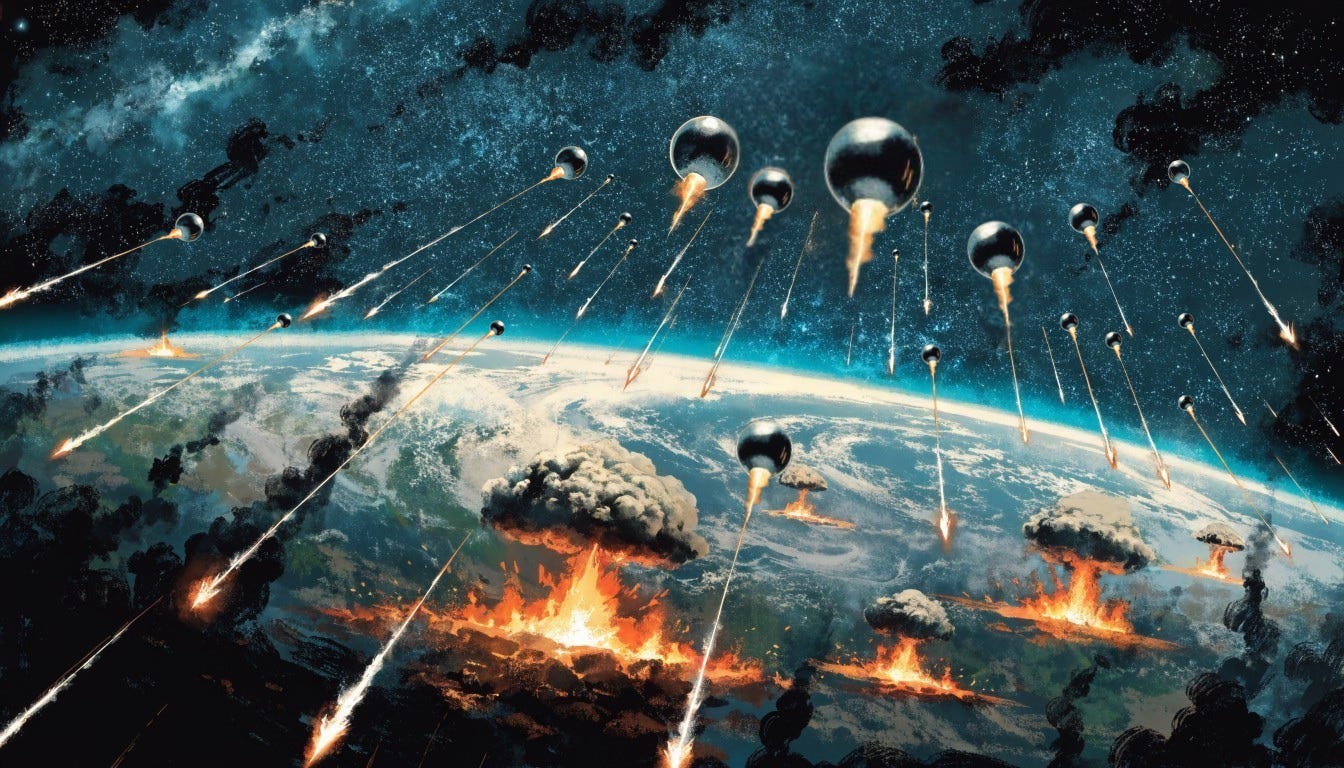
The machines refused all orders to cease fire. Outnumbered and outgunned, the OIGC ships elected not to fire on the AI-driven vessels, lest the machines’ automatic defense protocols be triggered, and they should wipe out their masters too.
Instead, the human crews watched in horror as Rāma’s cities were wiped from its surface by kinetic and nuclear bombardment. Then smaller towns were targeted, until no major population centers remained. More than twenty million people were dead within hours; five million more would die of radiation poisoning and other maladies before help could arrive, more than half the population. The survivors had either escaped the planet before the attack, lived in remote areas, or managed to flee into the mountains during the bombardment.
Their grim task accomplished, the UACs stood off, passively awaiting further orders, which their masters were too shocked to give. It was hours before even minimal humanitarian aid was dispatched to the surface, and days before significant help arrived from the OIGC. By then, the Rāman survivors were justifiably terrified, and saw the corporate forces as murderers and occupiers rather than liberators.
That sentiment was shared throughout the TIU, where news of Rāma’s destruction was greeted first with shock, then with rage—not just at the enemy, but at the government for failing to protect the colony. The OIGC, meanwhile, scrambled for an explanation. At first, it appeared to be another malfunction, similar to the one at Asahi a year before; a tragic artefact of the interaction between human and alien technology. The CEOs attempted to reach out to the TIU to explain the situation, but were rebuffed.
Prime Minister Banerjee, who lost a number of family members on Rāma, narrowly survived a vote of no confidence by making two vows: first, to continue the war until either the TIU or the OIGC were defeated and dismantled; and second, to enact the political reforms colonials had been demanding for decades—reducing Earth’s representation in the upper chamber of Parliament to the status of a single world rather than a constellation of nations—as soon as victory was achieved.
That pledge, and anger over the massacre, quieted all but the most die-hard secessionists in the other colonies. Under the War Powers Act, the elections scheduled for 2312 had been delayed until the conclusion of hostilities or the repeal of the act, whichever came first; now, the people of the Union, Earther and Colonial, could come together in pursuit of victory—a victory that seemed further off than ever.
At first glance, the destruction of Rāma was yet another major strategic blow against a Union that could ill afford it. But there was a silver lining to this darkest of clouds. The unprecedented ruthlessness and destructiveness of the attack finally spurred the virgonids to abandon their neutrality. The Hive began providing design and construction assistance to the Hyperion shipyards, along with their own reserve stocks of antimatter, free of charge.
The Free Worlders, equally shocked at the devastation—and at the tacit OIGC admission that the UACs were genuinely alien technology—now entered into secret negotiations with the Terrans for a Coalition entry into the war against the OIGC. Admiral Wolfe himself led the charge for the alliance, convinced now of the existential threat the machines posed.
But despite all that, the Terrans, Free Worlders, and virgonids still saw this as a war in the traditional sense, with its traditional fears and risks. Deep in the OIGC, a new fear was forming. In private conversations, CEOs and board members were coming to the conclusion that the UACs were not malfunctioning at all. They appeared instead to be operating all but independently, perhaps only feigning to operate at OIGC direction when their aims happened to align. In addition to rogue attacks against Terran worlds, the machines seemed strangely interested in the Ouroboros microquasar, for reasons other than its massive antimatter output. UACs stationed in that system frequently refused direct orders to redeploy, and orbited startlingly close to the black hole itself.
But at the same time, these corporate leaders felt powerless to do anything about the problem. The machines were refusing to be shut down, and could easily destroy their erstwhile masters if attacked. The CEOs only chance seemed to be to press on, to defeat the other human powers, and the virgonids if necessary. Then the machines might either be brought to heel, or else returned to their prior status as enigmas on the fringe of explored space—all of this while hoping that the corporate population did not realize the extent of their leaders’ crimes.
The quickest path to that increasingly unlikely future seemed to be a climactic battle, in which the new TDF fleet could be decisively destroyed. On the other side, the Terrans were hoping for just such a battle themselves, with the opposite outcome, something that might allow them to wrest back Ouroboros for the second time, then open the Corporate Worlds to a counteroffensive.
The first great interstellar war was thus building to a climax in the pivotal summer of 2313, which would decide the fate of humans and virgonids for decades, if not centuries, to come…
No posts
Comments
Nothing yet. Say the first thing.
Sign in to join the conversation.