
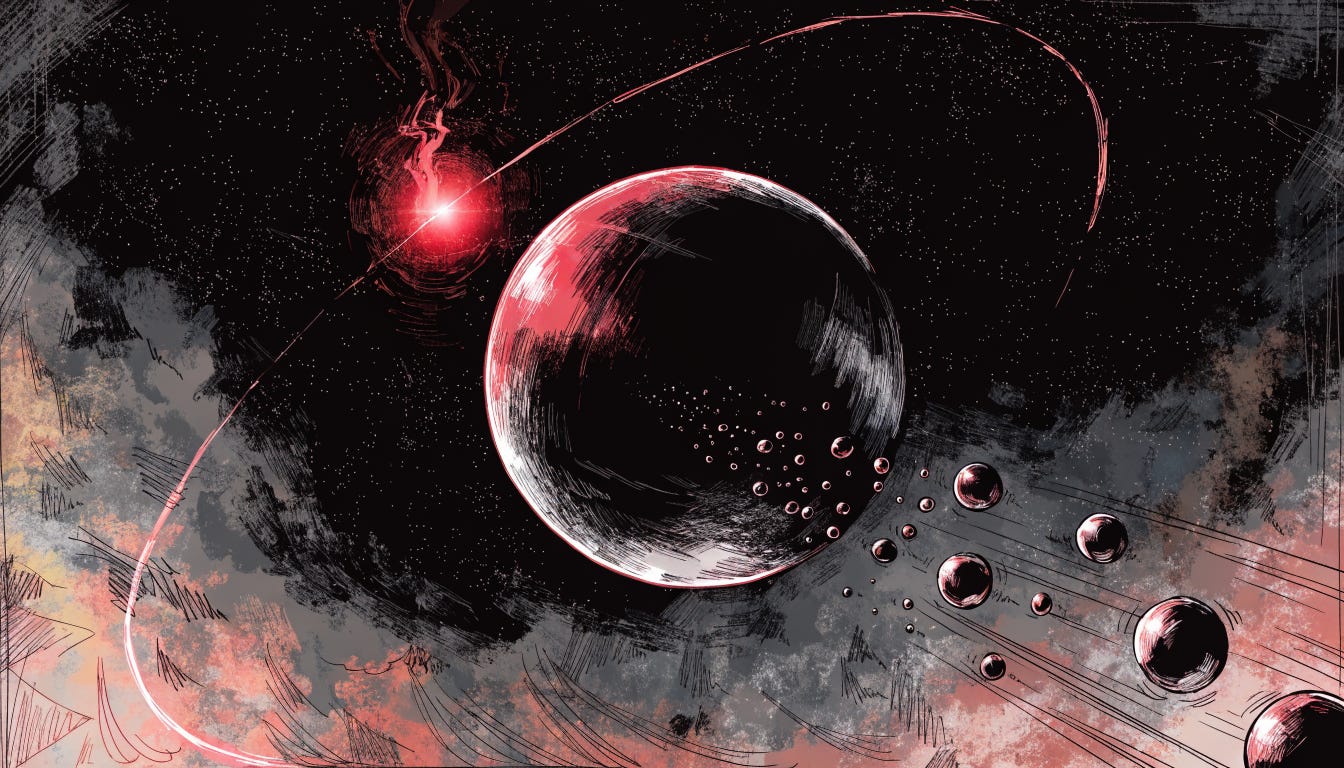
Stories of signs in the sky are as old as civilization. Early humans watched the stars in their courses, saw comets and meteors streak across the sky and unfathomably distant supernovae blossom in the night. With no way of knowing what they were, we saw in them portents, warnings, promises of victory or good harvests. They were nothing of the kind; but prophecies often have a way of fulfilling themselves.
As long as those signs have been seen, there have been stories about visitors from the heavens: human-like deities on winged horses or chariots, angelic or demonic beings, and sometimes, less distinct entities. These stories often formed the core of early human religions. But after the Enlightenment and the Scientific Revolution, these phenomena were seen as totally separate. In one case, humans without scientific knowledge misinterpreted natural, physical phenomena as supernatural; in the other, we attempted to assign order to a chaotic world by applying our natural talent for storytelling, inventing human-like beings to govern the universe, and placing them in the only place mortals could not reach: the heavens.
In most cases, this interpretation was correct. Despite a long tradition of fringe theories regarding alien visitors bringing the secrets of the universe to early humans—even building great monuments like the pyramids—no hard evidence has ever been discovered to support claims of alien influence on pre-modern humans.
But beginning around the end of the 21st century, scientists began considering a new possibility: perhaps not all of the things early humans had seen in the skies had been natural after all.
Advances in sensor technology and an expanded human presence in space during the Third World War proved beyond doubt the presence of Unidentified Aerospace Craft (UACs) in Earth’s skies, oceans, and orbit. Once it was proven that these craft were not part of an Allied or Axis black project, only one conclusion remained.
Those craft with a more “conventional” appearance—triangle, wedge, or pyramid shaped, with identifiable engines—proved to be virgonid in origin. But the virgonids only began visiting Earth in the mid-20th century TSD. Other craft—metallic spheres, ovoids, and shapes with no discernible engines or power sources—could not be identified, even after First Contact. Furthermore, the data on these craft eerily matched descriptions dating back to the late 19th century, if not earlier—and were identical to craft the virgonids had been seeing in their own system for over two thousand years.
Many of the species humans came into contact with over the succeeding two centuries—the melakeen, the uthal, the yu-nee and oromites—had similar stories about similar craft going back centuries or more. And the enigmatic ara’ were, at the least, not surprised to be asked the question.
The only conclusion that could be drawn was that the UACs were the products of an advanced, and as yet undiscovered, alien civilization, its motives and capabilities unknown. Why had they visited Earth? How far back did these visits go—how many of the signs in early man’s skies had been machines rather than comets? And what did they portend?
Explorers from the Corporate Worlds thought they had found the answers to some of these questions when they discovered the Machine World. But the gradual realization that the machines had their own agenda—which apparently included the destruction of whole human planets—threw everything they thought they knew into question.
It would be left up to other researchers to find answers—if they ever got the chance. First, a battle would have to be fought over that strange, transformed world. If there was anything left of it when the dust settled, scientists would have the chance to sift through it. Should there be any scientists left to sift.
If the machines were aware that the Allied Combined Fleet was coming, they made no effort to preempt it. Allied scouts reported that the machines were literally waiting for the attack to come—their platforms spread out in a massive sphere around their world, almost like a Dyson swarm, constantly reinforced by new constructions flying out of the planet itself.
As such, there was little need for subtlety in the attack, no attempt at ambush, no concern for hitting civilians or valuable targets on the planet with missed shots. The fleet would split into two wings, one composed of TDF and virgonid ships, the other of virgonids and the FWN. In each case, the virgonids would provide support to the human contingents, a tactic that had worked well at both Hyperion and Ouroboros.
The ACF used light-distance reconnaissance to ensure the machines had not altered their deployment before making the final jump in. Seeing the situation had not changed, each wing chose an approach vector within mutual support range of the other, and attacked.
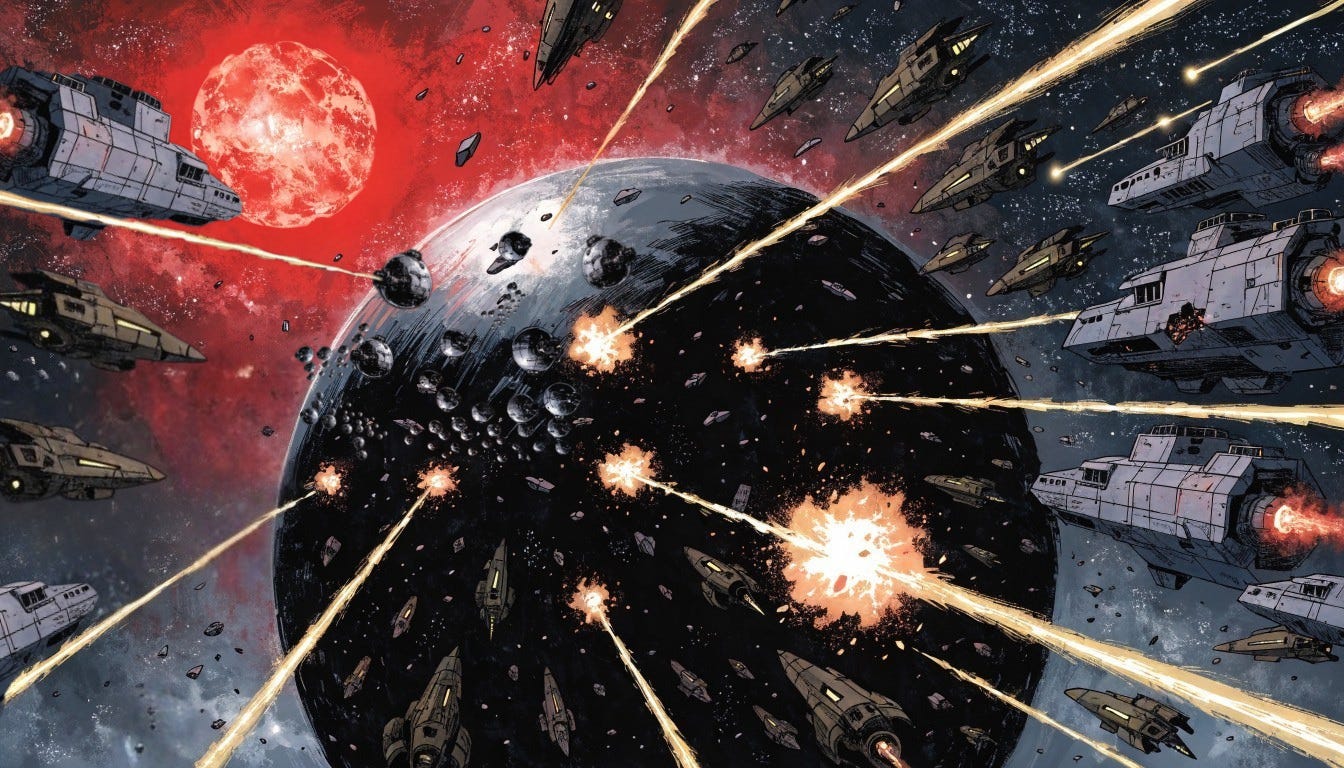
The machines split their forces evenly to oppose the two wings, rather than attempting to focus on one and leaving blocking forces to deal with the other. It became apparent that the machines had learned since their last battle, despite none having escaped Ouroboros or Hyperion; their targeting prioritized virgonid ships whenever possible, necessitating allied redeployment to cover the virgonids with FWN and TDF squadrons.
The machines were now employing a form of visual camouflage, complicating efforts to laser-target Avengers and other weapons. Many of the newly constructed platforms were also employing some kind of particle beam weapon to devastating effect, destroying Allied ships with single, precise shots from long range, and inflicting severe structural and radiation damage even with glancing hits.
The combination of these tactics and weapons made the FWN less effective than they had been at Ouroboros, and both they and the virgonids suffered heavy losses. For a time, it seemed their wing might be overwhelmed and forced to withdraw. If that happened, the battle would likely be lost, and nothing would be able to stop the machines from outproducing their human enemies.
But after a brutal, bloody slog, the combined TDF/virgonid wing finally gained the upper hand. Terran cruisers made good use of a new class of close-range magnetic accelerator ammunition; called “canister” in reference to a form of ancient Earth artillery shell, these apparently solid rounds would fragment as they neared their targets. The resulting hail of armor-piercing flechettes had a much greater chance of hitting a jinking UAC, particularly when fired in volleys programmed to create overlapping fields of fire. Combined with masers and swarms of human and virgonid-on-the-loop drones to offset machine numbers, the weight of fire told.
With the Terran/virgonid wing now able to support the FWN, the machines were soon on the defensive. But the battle was not over; the Machine World had continued producing UACs throughout the battle, and showed no signs of slowing. All attempts to communicate with the machines continued to fail. At the present rate, the conflict would continue until the allies were out of ammunition, overwhelmed, and forced to retreat.
ACF command made the decision to bombard the planet until its processes stopped. This required a titanic expenditure of nuclear munitions and railgun rounds, effectively depleting the fleet’s ammunition. After hours of continuous fire, the rain of thermonuclear destruction finally had an effect. The processes on the planet slowed, then stopped—but only once the entire surface had been obliterated.
A badly denuded allied fleet now orbited a dead, metallic world. The alien machines had, apparently, been destroyed; the Corporate Worlds had collapsed. And the war was over.
But the victors were exhausted. Allied fleets had suffered massive casualties, exceeding 50% of overall strength before the Battle of Hyperion. Hundreds of thousands of sailors had been killed, tens of millions were dead on Rāma, with more across other assaulted worlds. Even with military production ramped up to unprecedented levels, it would take months to replenish the losses in ships, munitions, and personnel. During this time, the allies would be vulnerable, should the destruction of the machines not prove as total as it seemed.
After withdrawing the most badly damaged ships for repair, Allied command elected to leave the remainder of the Combined Fleet in orbit of the Machine World to watch for signs of reawakening. In the short term, this overwatch force was resupplied with munitions commandeered from or donated by the former corporate worlds, in the interests of mutual survival. Token forces remained in Venture and Surya to ensure compliance with the armistice, along with a larger force at Ouroboros.
Aside from the mutual exhaustion, the situation remained tense. The CFW and TIU had been shooting at one another as recently as seven months ago. Secessionist movements in the Terran colonies, particularly Eos, had died down during the war; but that tranquility was contingent upon as-yet unfulfilled promises of political reform. And neither the Terrans nor the Free Worlders were certain they could trust the new “governments” of the former Corporate Worlds. A formal peace needed to be concluded with these entities to ensure the war would not begin anew.
By May, 2314, Citizens’ Councils had been set up in each of the corporate systems. These agreed to negotiate with the allies as one, paving the way for future integration. But many Terrans, bitter over the destruction of Rāma, were angered by the Combined Fleet’s decision to conclude the armistice, sparing the remnants of the OIGC from occupation and retribution. Absent that coercion, there were fears that the seemingly compliant Councils would soon rearm and become a threat.
But the Citizens had no appetite for war, and made no demands or requests beyond those the allies had acceded to already. Even so, the unprecedented negotiations took weeks. In the final peace agreement, signed in June, 2314, the Allies formally agreed to limit their occupation to small space forces, which would be withdrawn following elections scheduled for next year. The Councils honored their agreement to immediately return all captured territory. In return for a mutual defense agreement with the allies—restricted to the specific event that the machines should reawaken and attack—the Councils further agreed to limit their military to a purely defensive and constabulary force.
Concurrent negotiations between the TIU and the CFW resulted in both a formal peace treaty, and a mutual defense pact. Each agreed to come to the aid of the other with military force should they be attacked by the machines, or an as-yet undiscovered alien species. To the chagrin of some in the Free Worlds, the agreement did not fully cover the Kyrans, instead being limited to an agreement that the TIU would provide “material aid” in the event of a large-scale Kyran invasion. In return for this concession, the Terrans had to commit that they would not use military force to prevent a seceded colony from joining the Coalition.
After ratifying the Treaty of Taranis—Admiral Wolfe’s birthplace in the TIU, where the negotiations were held—the Union Parliament finally voted to follow through on its wartime pledge: the legislature would be reorganized to give the colonies equal standing with Earth in the upper chamber, beginning with the next scheduled elections in 2316. While its massive population meant that Earth would still have an advantage in the lower house, this created the balance that the colonies had long been seeking. Indeed, given the disparity in population growth between Earth and her colonies, it meant that within a century, the homeworld would lose that advantage too, becoming one of many worlds, rather than the center of human affairs.
All that was in the future, though. The signing of the treaties of Venture and Taranis brought the war formally to a close, and gave the belligerents a chance to rebuild. After their peace agreement was signed, the Councils set to work drafting a new constitution and preparing to hold elections. The document included laws prohibiting the expansion of military industry beyond a certain percentage of GDP, and its use for anything other than defensive purposes. It also enshrined protections for a broad range of groups who had been disadvantaged during corporate rule, and established a massive social spending and wealth redistribution program.
In January 2315, the former Corporate Worlds held planetary and intersystem elections. The polls served as a referendum on the interim government and its proposed constitution. Some observers in the Free Worlds expressed concern over the lack of a coordinated opposition, with many CC candidates running unopposed. But most were pleased at the prospects, as were the Terrans and virgonids. The constitution, if adopted, would protect the democratic process, and the limitations on military power meant the new state was not likely to become a threat as its predecessor had, at least in the foreseeable future.
The Citizens’ Councils won in a landslide, officially voting to ratify the new constitution on day one. The former OIGC officially became the United Citizens’ Councils, whose second act was to normalize relations with the TIU, the VGH, and the CFW. This officially brought the war to an end, and began the next era of human-virgonid history.
But in truth, most human and virgonid eyes were fixed elsewhere throughout this process. All through 2314, scientists, engineers, and military personnel from the allied powers pored over the remains of the Machine World for clues as to the UACs’ motivations and origins. In the course of that year, they found just enough to begin to put a vague picture together.
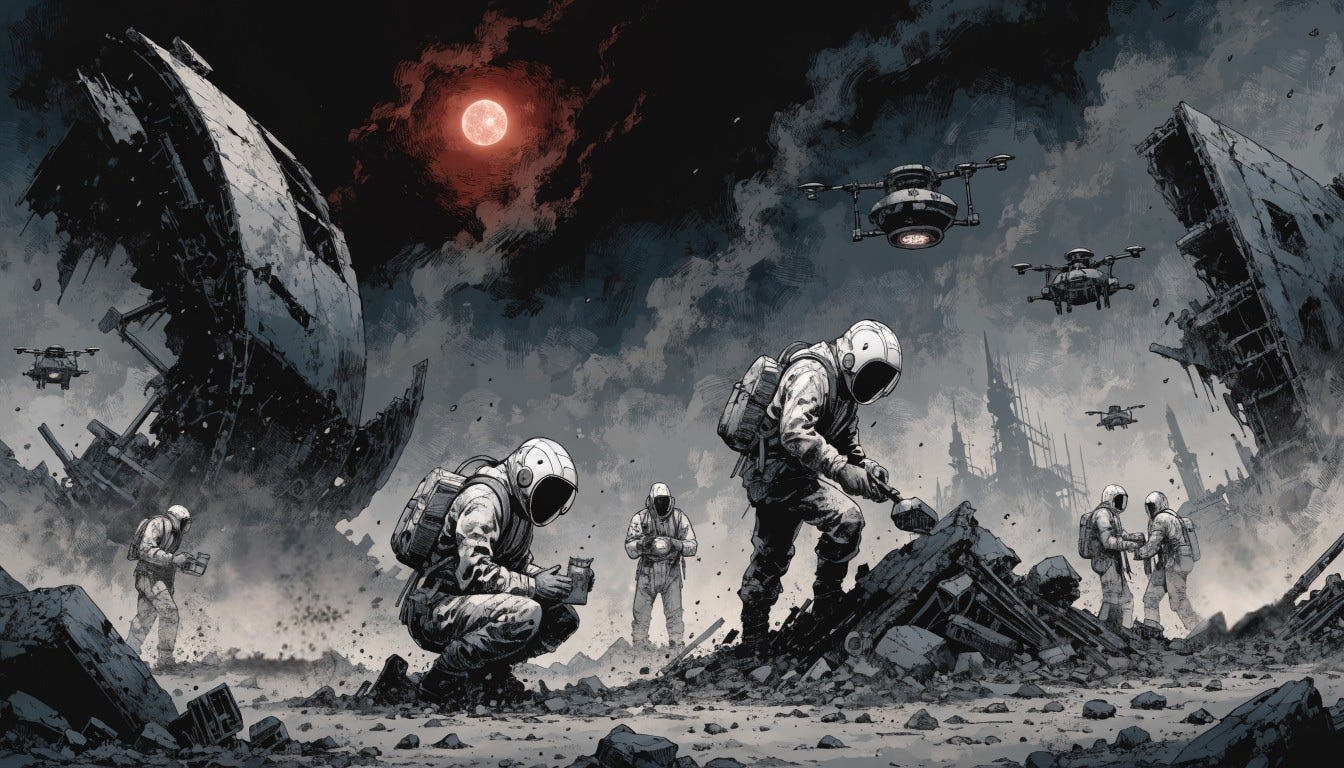
During the war, some allied naval personnel had begun referring to the machines as ‘Ciphers,’ due to their refusal to communicate, and their preternatural ability with codebreaking and cyberwarfare. Researchers on the Machine World now picked up the name, adding the mysterious motivations and methods of the machines to the definition. The name quickly spread throughout human-virgonid space, and in the absence of any alternative from the machines themselves, it has stuck ever since.
These ‘Ciphers’ appeared to have no command structure, no social order, no culture. They apparently preferred edgeless forms such as spheres and ovoids, but seemed to be capable of constructing platforms of any shape and size. Even a close inspection of the ruins and remains of ships in orbit could not determine several fundamental characteristics. For instance, they clearly possessed a highly sophisticated intelligence, but the exact nature of Cipher consciousness could not be determined. Indeed, it has still not been determined to this day.
It is unclear, for example, whether each Cipher platform is individually conscious, a hive of multiple consciousnesses, a node for a single collective consciousness, or only semi-autonomous. It is also not understood what the mechanism or origin of their consciousness is; were they programmed with it, like human and virgonid-designed AIs, or did it evolve naturally out of an unconscious system?
Part of the problem was that allied scientists could not discover any concrete evidence pointing to an origin for the machines. Clearly, the story they told the OIGC had been fabricated, but that did not necessarily mean the machines had not originally been designed for a similar purpose by an organic race.
One thing, however, did become clear: the Ciphers did originate on the Machine World. Geologists quickly established that the machines had only begun building on the planet roughly two hundred years earlier, around the same time that Venturestar and Surya Offworld colonized nearby systems. This proved it could not be the Cipher homeworld, which raised many troubling questions.
On the engineering front, the Ciphers were highly advanced, employing many technologies humans had yet to master, from self-repairing and replicating nano-fluids, to gravity and mass manipulation of a precision beyond even the best the Compact has to offer today. But allied military engineers determined that some of the older surviving sections of construction, deep beneath the surface, showed a level of sophistication greater than that observed on the surface. This implied a technological regression after establishment on the world, rather than progression. Again, whether this was intentional could not be determined.
Hopes that virgonid computer engineers might uncover more were soon dashed. Only a handful of intact data devices were recovered, and even once these were finally broken into, they provided little useful information. The Cipher “language,” such as it was, could not be deciphered. Even later efforts with greater context would ultimately come to naught, since the Ciphers can apparently alter their fundamental coding language at will.
All these scraps of data could do was confirm what the engineers’ findings had already suggested: the Ciphers had arrived on the Machine World relatively recently. That, and they were far more sophisticated than the OIGC had originally believed. Consensus opinion was that the Ciphers had most likely been manipulating the Corporate Worlds the entire time they had been in contact, perhaps to create the conditions for the war.
As for why, no-one could tell. At the end of the investigation, more questions remained than answers: why had the Ciphers started the war, then failed to use all their technological capabilities to win it? If their goal was to destroy or conquer humanity and the virgonids, why had they not done it centuries or millennia earlier, when they had advanced spaceflight and we did not? Why had they observed us peacefully for so long, only to strike now? Why did they refuse to communicate?
Where did they come from?
In light of these stark questions, in December 2314 the TIU, VGH, and CFW signed another agreement, of which the Councils would later become a signatory. It stipulated that the three powers would form a joint study and reconnaissance group whose objective was to search the stars for evidence of the Ciphers, hopefully locating their point of origin—or at least another of their worlds—before they struck again.
No posts
Comments
Nothing yet. Say the first thing.
Sign in to join the conversation.