
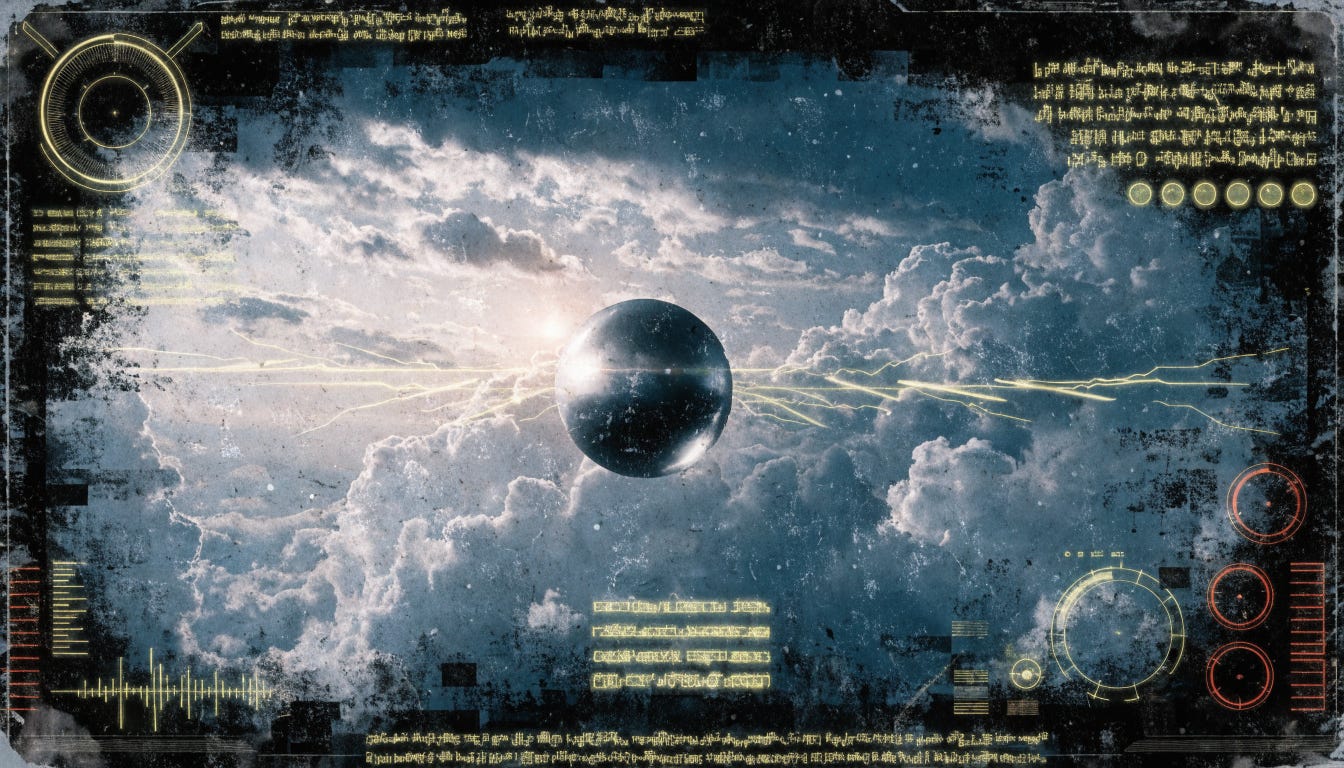
The years of peace which followed the Corporate Worlds War (2311 - 2314) did not rest easily. The wartime allies—the TIU, VGH, and CFW—were committed to finding the Ciphers before they struck again. By the end of 2315, the allies had already brought their former enemies in the Corporate Worlds, now re-branded the United Citizens’ Councils (UCC), on as associates in this hunt.
Should the effort to find the Ciphers fail, the allies also committed to building a joint defensive framework. That meant keeping military spending and production at a relatively high level, even in the UCC; but given the existential threat the Ciphers posed, allied publics were willing to bear the burden. At least, for now.
In the years that followed the war, diplomatic overtures were made to other known sapient organic species—those capable of spaceflight, at least. In 2316, the xirān agreed to exchange any information they acquired about the Ciphers, but stopped short of signing a mutual defense pact. In the same year, the enigmatic ara’ responded to the Allies’ request by turning over a huge quantity of information they had collected on the the machines, detailing by-then typical visits by Cipher craft to the ara’ home system.
On deeper analysis, this information proved to be thousands of years old. The ara’ did not specify if this was all the information they had, and did not agree to turn over new information in the future. Nor did they agree to a mutual defense pact. Indeed, the ara’ remained almost as much of an enigma as the Ciphers themselves. The amphibianoids had shown no aggression towards any other powers, but possessed incredibly advanced technology, at least on the level of the Ciphers.
And perhaps even greater than that. The data they provided on the machines displayed advanced knowledge of Cipher metallurgy, molecular composition, code language, and sub-molecular quantum structure and interactions—this despite the fact that all of it had been derived from remote observation. At the time, Allied scientists could only speculate how such data could have been obtained from a distance, possibly through the use of quantum entanglement interference or some sort of transdimensional gravitic sensors.
The data also confirmed the level of technological retrograde the Ciphers had apparently conducted before interacting with the Corporate Worlds. The metallurgy and sub-molecular structures observed in the ara’ data, thousands of years old at least, was notably more advanced than that observed in Cipher platforms and the Machine World during the war, including the ability to restructure itself moment to moment at the sub-molecular level. But with the ara’ clammed back up, and no more Ciphers discovered, further investigation reached a dead-end.
History, however, did not stop. In 2317, virgonid explorers discovered the planet Pyria, home to a mammalianoid sentient species. Given the pyrians’ early industrial level of development, the virgonids placed the planet under the protective category of the Helvetios Accords, which the UCC had since signed on to. The virgonids would observe the world from afar, but not approach or make contact with the natives unless they passed into another stage of development—or, unless the Ciphers appeared in their skies, too.
After long negotiations in 2318, the melakeen made a similar agreement with the Allies as the xirān had, with an additional understanding that mutual defense in the event of a Ciper attack would be “beneficial.” While this understanding stopped short of a true defensive alliance, this was sufficient for the melakeen to be considered associate members.
Meanwhile, new flare ups in the Coalition’s systems near Kyran space distracted the Free Worlders’ attention for some time. In 2320, responding to the Kyran and Cipher threats, a referendum was held across the Free Worlds on whether the Coalition should be further formalized as a closer political and economic union. The question passed with supermajority support, and in August, 2320, the governing council voted to declare itself a federal republic. Rance Wolfe was elected as the Free Worlds Republic’s first president; he would go on to serve two 5-year terms before retiring in 2330, aged 92.
In the meantime, a new technological advance sparked the next interstellar flashpoint. In 2321, a joint TIU-Virgonid team at the Martian Interstellar Labs developed the Mark IV Stardrive. A combination of new navigation AIs and improved Higgs/Graviton Exclusion Field (HGEF) efficiency—based in part on recovered Cipher technology—dramatically increased both the maximum relative velocity and range of superluminal travel.
At first, though, the TIU was reluctant to rapidly develop this technology, let alone to share it with the other allied powers—in particular, with the Free Worlds Republic. Despite years of successful cooperation on the Ciphers, and the resolution of the secession crisis, tensions between the two powers remained high on certain subjects. Left-wing parties in the Terran Parliament had grown increasingly concerned over the Republic’s wars with the Kyrans, suggesting that not all of them could be justified as self defense. There was concern that the new Stardrive might make it easier for the Free Worlders to wage an aggressive war against the Kyrans, who were increasingly technologically backward compared to the allied powers.
But while the centrist and right-wing parties cared little for the Kyran question, there was cross-partisan concern over the same issue that had led to the foundation of the Free Worlds in the first place: unrestricted colonization.
Since the late 22nd century, human colonial expansion had slowed, then virtually stopped. This was in part due to the centralization of power in the Coalition, the Union, and the OIGC, and in part to the fact that most habitable systems within easy range of the Mk II and III Stardrives had already been colonized. Terraforming was still too difficult and expensive a prospect to be worthwhile, particularly given the plethora of available land and resources on sparsely settled worlds.
Now, a whole new tranche of tens of thousands of stars had been brought into range, meaning hundreds of new habitable planets humans could settle on, or on which new alien civilizations might be discovered. As before, the TIU wanted to restrict the process as much as possible—only now, the well-established existing colonies, with their equal status in the legislature, were onside with Earth on the issue. Parliament voted in favor of restrictions on new colonies, and passed a ban on unlicensed civilian missions beyond existing frontiers. The young UCC supported similar measures, though with slightly different justifications, the Councils fearing that newly discovered alien civilizations might be exploited by rapacious colonizers.
In the FWR—with the Kyrans on one flank, and the Ciphers still out there somewhere—the leadership understood the potential dangers now better than they once had. But they also saw the opportunity, and up until now, restrictions on civilian colonization missions had been minimal. After a lengthy internal debate in the TDF and in Parliament, the Union decided to share the Mk IV Stardrive with the FWR—but only if the Free Worlders agreed to certain restrictions on civilian use for long range missions, including colonization.
The offer kicked off a mirrored debate within the Free Worlds Congress. Member states were reluctant to change their policy, but the military and economic advantages of the new Stardrive were too great to ignore. Ultimately, President Wolfe broke the deadlock in congress, and agreed to require government oversight of any civilian missions beyond a radius of one hundred light years from existing borders.
Though this was less restrictive than TIU’s licensing program, Parliament found the regime acceptable, and the Stardrive was shared. After the compromise, the UCC were offered the same deal, and readily agreed—in fact, virtually copying the TIU’s licensing scheme. Over the next century, some wildcat colonists from each of the three powers would slip through the cracks, launching missions toward stars hundreds or even thousands of light years away. Most would never be heard from again; most of the rest would eventually be incorporated into one or the other human governments as their own colonial realms increased.
But most new colonies were founded with official sanction, and the rate of expansion was slower and more deliberate than it had been during the Scramble for the Stars. Over the next few decades, the Mark IV allowed a massive increase in the size and development of existing human extrasolar colonies, including the re-founding of the colony on Rāma in 2325. Exploration and reconnaissance could also range over a much greater area. Over the 2320’s and 30’s a number of new sapient species would be discovered. Several which had spaceflight technology were contacted, those without were put under observation.
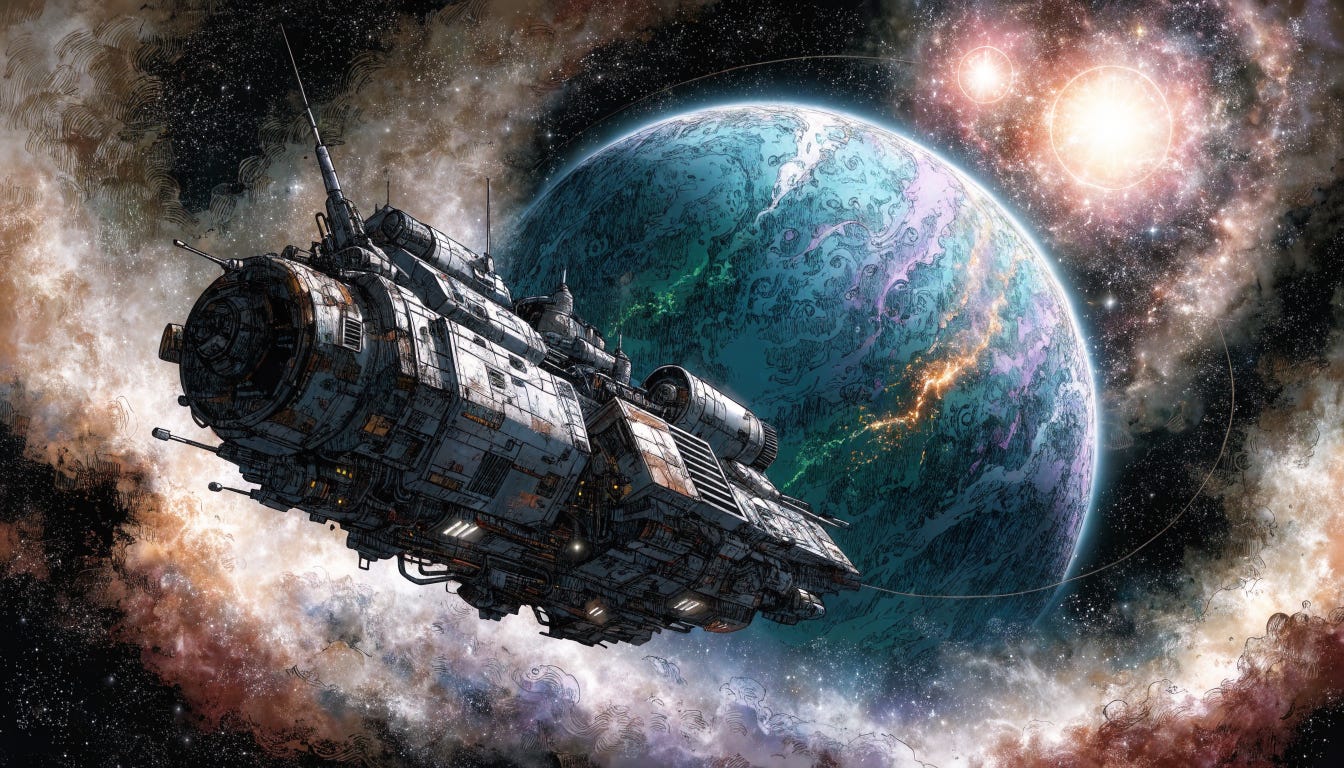
The Mk IV also helped facilitate the implementation of a major lesson learned from the war: one strategic source of antimatter clearly would not suffice. To that end, each of the allied powers developed their own sources of antimatter after the proliferation of the Mk IV: the Free Worlds returned to WZ Sagittae and completed their planned mine; the UCC developed a source at ASASSN-14dx; and the cataclysmic variable at EX Hydrae was developed as a joint Allied facility. This created greater strategic resilience, and gave each power a source they could control in the event the alliance broke down again, which went some way toward easing tensions over resources.
Meanwhile, human militaries continued to innovate based on lessons learned from the war. The FWN in particular improved their ECW, Avenger performance, drone capabilities, and stealth. These advances were put to good use against the Kyrans, easily defeating raids throughout the 2330’s, and destroying a number of high profile Kyran bases in counterattacks. The growing imbalance between the two sides became great enough during this time that many in the FWN, supported by hawks in congress, advocated for a full-scale invasion of Kyran space, in an effort to end the threat once and for all.
But popular war-wariness lingered after the devastating losses suffered in 2313 and ‘14; there was not enough support for the plan to get it past congress—particularly when the venerable, but retired, President Wolfe refused to speak in support. Even the discussions, however, had important ramifications. The congressional debate prompted a vigorous denunciation from the UCC, and a matching response from the Republic. Tensions between the two allies were already high, owing to the wide variance in their governing philosophies, and Free Worlder complaints that the UCC were not living up to their military commitments to the alliance.
That tension came to a head in 2339. A sanctioned FWR colonization mission to the Tannhauser system encountered a UCC survey mission. The UCC team claimed rights to the system, although not to colonize it. Rather, the Citizens intended to use it for outer system resource extraction and scientific research only, leaving the habitable world untouched. The dispute between the two civilian missions escalated when a compromise could not be reached, with a fistfight breaking out during a particularly tense conference. Each side called home for assistance.
Both governments seized on the minor dispute as an outlet for their building frustrations. Each blamed the other for overreaching, and dispatched small naval squadrons to protect their citizens while high-level negotiations began. The Terrans and virgonids offered to serve as joint impartial mediators, but at the outset, both sides rejected mediation. The UCC’s initial position was that the planet was ineligible for colonization under the Helvetios Accords since it was already inhabited… by a species of slug the UCC claimed was pre-sentient. The Free Worlds responded that this was ridiculous, and presented their own scientific evidence to refute the UCC’s.
With no agreed neutral system for delegates to meet in, ships had to travel back and forth between Freedom and Unity Prime carrying messages—a journey of more than 550 light years. Even with the Mk IV Stardrive each trip took weeks, which meant that the petty debate dragged on for months. All that time, the two naval squadrons faced each other across the planet’s orbit day in and day out, tension slowly ratcheting up. Until finally, it broke.
The order of events remains disputed to this day, but it seems likely that a UCC civilian ship was harassing the FWN squadron with close passes at the edge of their engagement zone, a standard tactic they had deployed over the preceding months. On this occasion, the ship got too close, and may have launched a cargo container at a FWN corvette. They claimed this was accidental, while the FWN maintained it was an improvised weapon.
The FWN attempted to board the vessel, which fled. The pursuing corvette shot out their engines; in response, the UCC squadron opened fire on the FWN, triggering a brief battle. All four UCC ships were disabled or destroyed, for the loss of one FWN corvette. At first, this seemed it might be a repeat of the WZ Sagittae incident, though lacking Cipher involvement, still triggering a slide into war.
Indeed, hawks on both sides called for just that in the heat of the afterglow. But outside of a few anti-Free Worlds hotheads and militant radicals, there was little appetite for war on the Councils, or in the general Citizen population. Realist councilors and those more committed to peace successfully argued that the UCC would have virtually no chance of winning a war against the Republic, even if one were desirable.
The greater risk was that the Republic would escalate; calls for some kind of military response in the Free Worlds Congress were far louder. For a time, it seemed they might win out—until President Wolfe, then aged 111, came out of retirement to urge restraint, arguing that whatever the difficulties and differences between them, humanity needed to stay united in the face of far greater threats.
With that, the two sides climbed down, and finally agreed to virgonid mediation. A summit was set up at Virgon, and through direct, real-time negotiations, a compromise was soon reached. The FWR agreed to apologize for the incident and pay reparations to the UCC for the ships and crews lost. This concession engendered some bitterness among the hawks in congress; but in return, the UCC agreed to renounce any claim to the Tannhauser system, allowing the Free Worlder colonization mission to go ahead—embittering UCC peace activists.
Most, though, were relieved war had been averted. The incident prompted a reevaluation of the UCCs military commitment and expenditures relative to their constitutional restrictions. The UCC’s demonstrated military weakness paradoxically resulted in a significant drawdown of already minimal spending over the next decade.
Partially in response to the Tannhauser Incident, the once-temporary wartime coalition was further formalized between 2340 - 2342. Now called the Alliance of Interstellar Civilizations, or colloquially the Organic Alliance, the new treaty included the original allies as full members, with the melakeen, the xirān, and the more recently discovered uthal as associates. All members agreed to share any information they acquired on the Ciphers, and to come to the defense or assistance of the others in the event of a large-scale Cipher attack. Full members additionally participated in joint military exercises and agreed to a joint military command structure in the event of a war.
This formalization did not end disputes between even the full members, however. Almost immediately, the FWR began to complain that the UCC were not fulfilling their military obligations to the Alliance, given their rerouting of previously earmarked military spending into social programs. The Councils offered numerous alternative contributions, enough to maintain membership in the Alliance, but their military reduction programs continued throughout the 2340s.
These disputes would not be resolved before the next round of crises befell the Allied powers. Beginning in the late 2340’s, three new sapient species were discovered by ever-expanding Allied explorers and reconnaissance missions: the ranakeen, discovered by the virgonids in 2348; the byasians by the TIU in 2349; and the embrites by the xirān in 2350. As all three appeared from a distance to be pre- or early industrial civilizations, they were placed under observation in keeping with the Helvetios Accords.
As this long-distance observation went on, it gradually became clear that the first impressions were a form of illusion. Two of the three worlds, Byas and Embra, showed signs of unusually slow development. Light-delay reconnaissance indicated that each of these species had spent centuries making virtually no technological progress, and undergoing few if any significant global cultural changes. On the other hand, data from Ranak suggested two abnormally rapid technological leaps over the past few decades.
Given that the three worlds were in relatively close proximity to one another, the possibility that their unusual development might be somehow linked could not be ruled out. But a more close-in reconnaissance would be required to answer these questions. Missions were launched to each of the worlds in late 2350. These missions returned, without having been detected, carrying shocking intelligence: the populations of all three worlds appeared to be under the control of a far more advanced alien civilization.
The abnormalities did not end there. These occupations were unlike anything seen before in human or interstellar history. There were no armies, no local proxies, no resource extraction, no forced labor. Some of the natives worshipped their overlords; others lived in terror of them. Monuments were built, wars were fought, gruesome scientific experiments were performed—all at the behest of glittering, featureless machines.
After thirty-five years of searching, humanity had finally rediscovered the Ciphers.
No posts
Comments
Nothing yet. Say the first thing.
Sign in to join the conversation.