
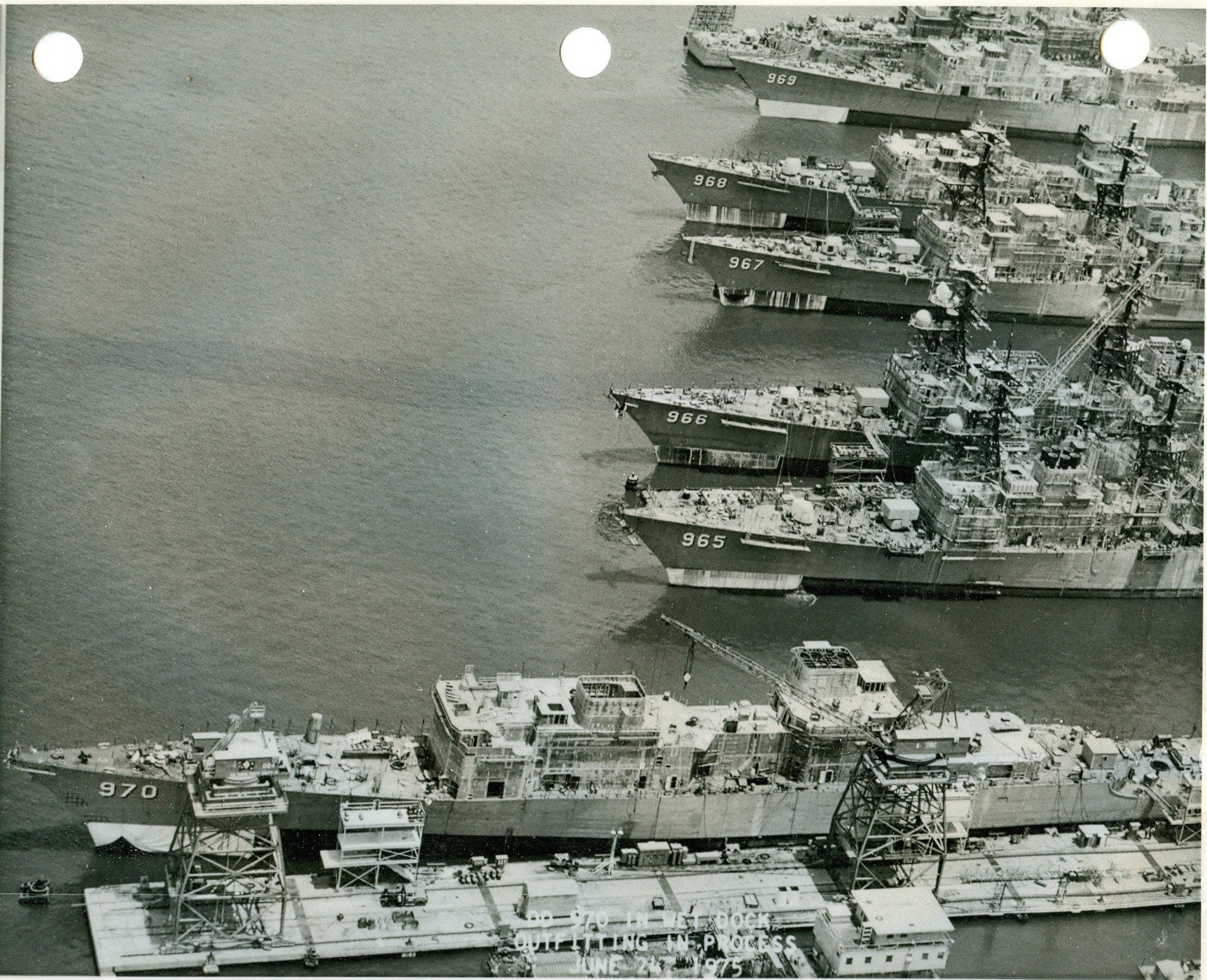
Six Spruance-class destroyers being built at Ingalls Shipbuilding, Pascagoula, Mississippi. 24 June 1975. From top to bottom: USS Peterson (DD-969), USS Arthur W. Radford (DD-968), USS Elliot (DD-967), USS Hewitt (DD-966), USS Kinkaid (DD-965) and USS Caron (DD-970) are visible. Really not that long ago but a different era.
I have been working on this portion of my article about the crisis in Naval shipbuilding for about five days now. This part deals with our shipbuilding industry. It is not a sexy or exciting subject but it is absolutely necessary to understand what is going on today. For they record, my last assignment as a Navy Chaplain was at Norfolk Naval shipyard where I came to understand the pressure on our government shipyards. I got to know the Naval officers, the administrators, the shipyard workers, and their Union representatives. The year and a half at the shipyard was a learning experience.
Everyone likes a winner, and in 1991 the United States was coming off outlasting the Soviets in the Cold War and assembling a massive multinational coalition to chase Iraq, out of Kuwait after Iraq invaded it because the U.S. Ambassador to Iraq. It should not have happened, but April Glaspie, the U.S. Ambassador to Iraq unintentionally gave Saddam Hussein the impression that disputes between our Arab allies were not our concern. That was a big oopsie.
Thanks for reading Dedicated to the Proposition that All Men are Created Equal! This post is public with no paywall, so feel free to read, to comment, or to share it by liking or restacking on Substack, or sharing on your favorite platform.
A week later Iraq invaded and conquered Kuwait creating a crisis that President George H.W. Bush responded to by sending U.S. troops to protect Saudi Arabia and then building a massive international coalition with the backing of the United Nations to drive the Iraqis out of Kuwait. But, the elder Bush succeeded because he was smart enough not to go to Baghdad and overthrow Saddam, unlike his shit for brains son who I voted for twice a mere 12 years later. The younger Bush launched a terribly costly and long war that helped severely weaken the U.S. military, especially the Navy, eliminated Iraq as a balance of power against Iran. Bad for us, good for Iran because they are now about to vanquish the Gilded Idiot in the White House and forever change the world as we knew it, but I digress.
In 1989 the United States was still a true maritime power. But then the big corporate defense conglomerates saw their opportunity, or rather sensed big profits even as the government and both major political parties tried to “save” money by cutting defense spending as part of the supposed “peace dividend.” Actually this supposed “dividend” had some advantages and savings, especially regarding ground forces, but since the United States was always primarily a maritime power until the challenge of the Soviet Union in Europe, the North Korean invasion of South Korea, and the perceived threat of Communist China and communism around the world when the Army and Air Force began chewing up the defense budget like it was a Thanksgiving dinner. The Navy was still important, and even when it proved its value in deterrence, it began to suffer, as hundreds of veteran warships were paid off or scrapped, and shipyards began to die off, especially those that produced merchant ships. Unfortunately, the loss in shipyard facilities, and the loss of our previously valuable merchant marine impacted more than most of the profiteers imagined. Shipyards, and the ship rights that they employ are invaluable to both our economy, maritime and national security.
In 1980 the United States had 8 public and 30 commercial shipyards capable of building large military or merchant ships, of which 12 could build naval vessels. Another 270 yards were capable of building smaller vessels. In 1990 that number had shrunk to 8 public and 18 private shipyards, not counting the small yards that specialize in small civilian vessels. By 2001 there were just 4 public shipyards, and 8 private shipyards that specialize in building naval warships and auxiliaries over 400 feet long. Those included Bath Iron Works, Electric Boat Corporation, Newport News Shipbuilding, and Kvaerner Philadelphia Shipyard, Huntington-Ingalls Industries, Halter Pascagoula, Norfolk Grumman, Pascagoula and Avondale, National Steel and Shipbuilding, San Diego. Likewise, there are a number of shipyards classified as “build ready” capable of producing these ships, but had not in at least 2 years.
Me in my hard hat.
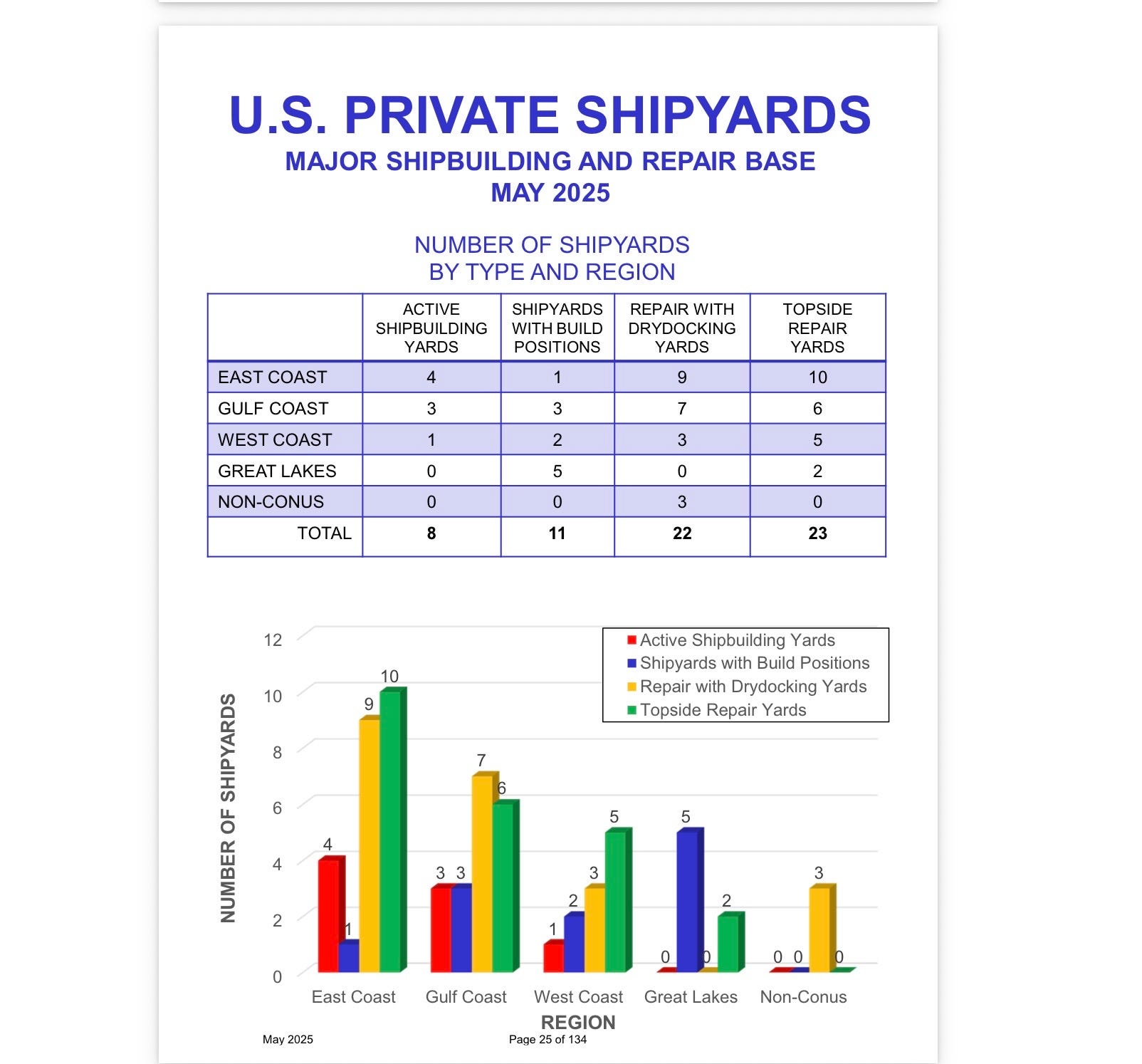
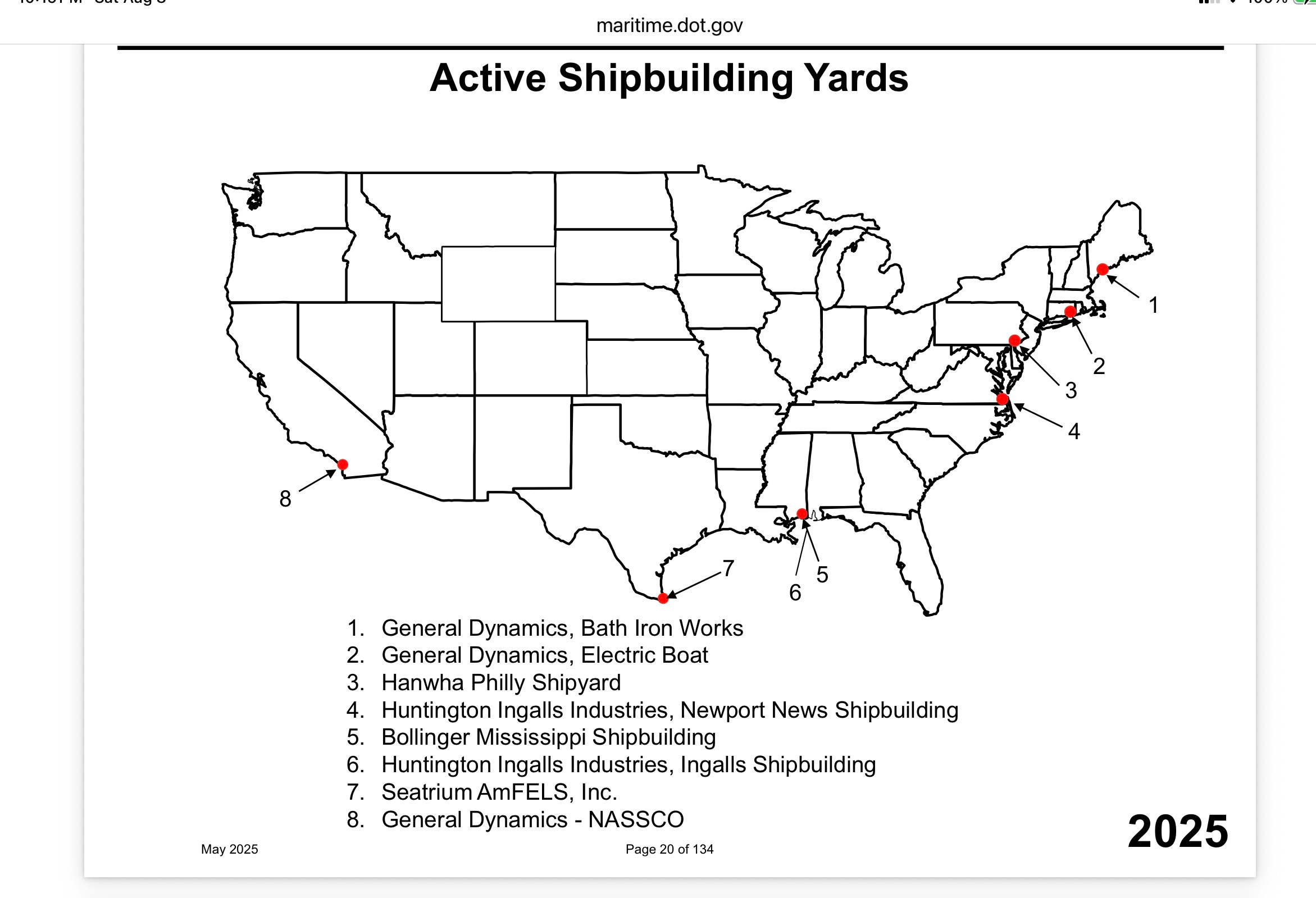
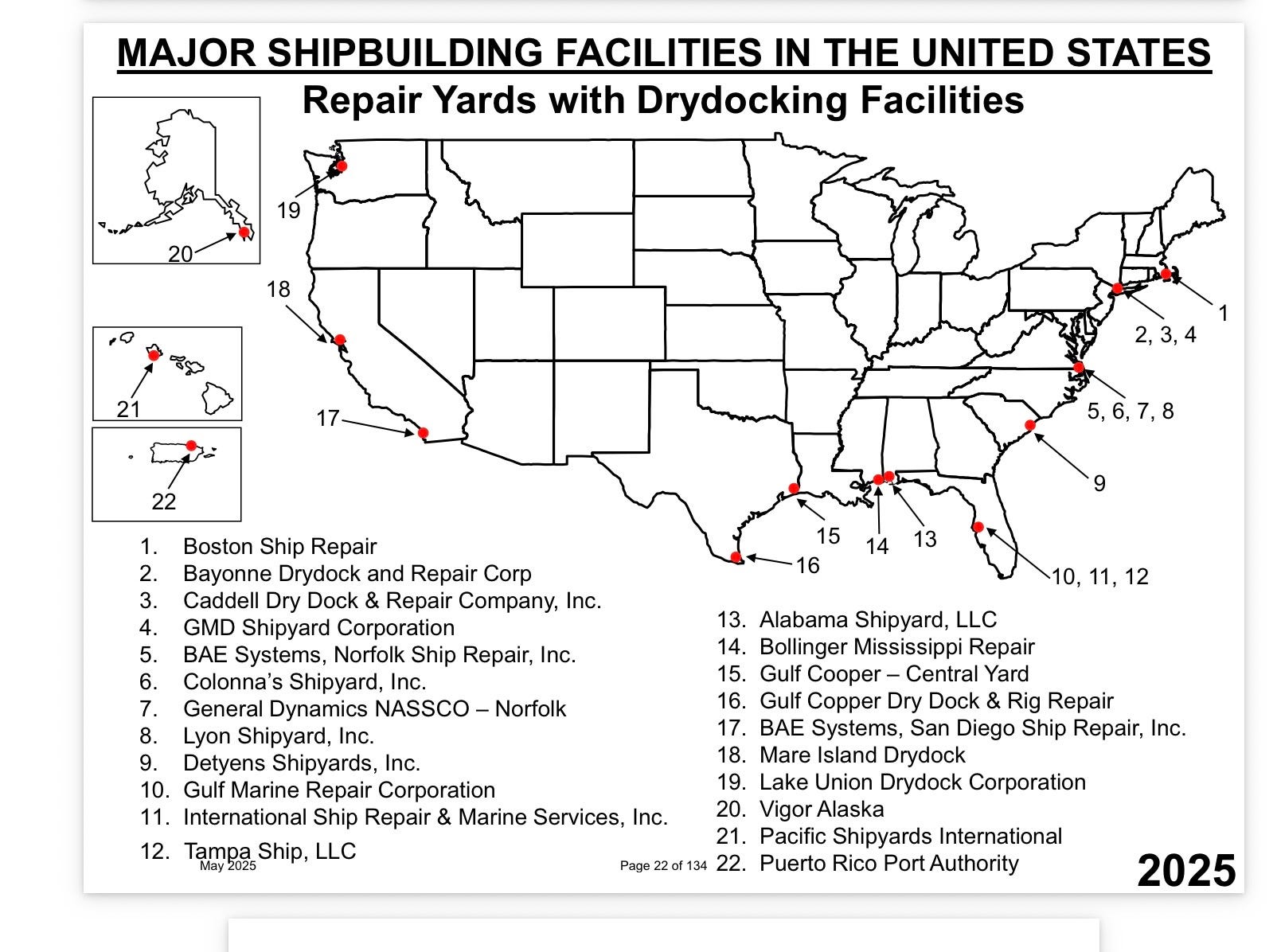
Today that number is smaller. We still have the remaining 4 public shipyards, with some debate on reactivating others. But the private shipyards capable of building submarines and surface ships, as well as maintaining them continued to decrease. Today the total number of shipyards capable of building or repairing large naval and merchant vessels is just 64. General Dynamics now controls Bath Iron Works and Electric Boat. Huntington-Ingalls now controls Newport News, while the Korean shipbuilding magnate Hanwah owns Philly. Then there are Bollinger, Mississippi, Huntington-Ingalls, and Seatrium AmFELs inc., on the Gulf Coast, and BEA Systems San Diego Ship Repair, the former NASCO yard. There are a number of shipyards across the country that are capable of building larger ships that are capable of building new ships.
There is another factor, very few private yards have dry-dock large enough to build or repair our nuclear aircraft carriers or the proposed “Trump” class Guided Missile Nuclear Battleships. There are four private yards capable of drydocking such massive ships, but there is only one at Newport News that can be used to build or begin the dismantling process of these ships. One drydock which is already behind schedule in building the Gerald Ford class carriers, and is facing the block decommissioning of the Nimitz class carriers, with Nimitz next year and Eisenhower in 2030, with the other eight ships following at two to to three year intervals. The planned Trump class will share the same dry-dock. Since the new carriers are facing two to three year delays in construction and it is taking a decade or more to “recycle” the nuclear carriers, one can only imagine the backlog in building the new ships and recycling the older ships. Basic arithmetic is involved. Six new Ford Class carriers, twenty-five new Trump class battleships, and disposing of 10 Nimitz class carriers over the same time period in the same dry dock. Building these ships in not like flipping burgers, each takes years in the dry dock, before it can be floated out for completion. We are still figuring out how long it takes for the disposal of the current nuclear carriers.
The shipyards are only a part of the larger problem, and that is the fact that the number of shipyard workers is at an all time low. In 1980 there were nearly 200,000 shipyard workers in the United States, now it’s under 50,000. Trained, well paid and motivated workers matter, and Hanwah in Philadelphia is sending Americans to South Korea for training and bringing trained specialists to Philadelphia. The South Koreans are also offering to build ships for the South Korean and U.S. Navy at that yard. That would actually be a good idea because the South Koreans are building some of the most successful class of surface ships, large amphibious ships, and modern non-nuclear submarines in the world today.
I live within a mile or two of most of the private shipyards on the East Coast capable of dry docking warships and making major repairs. Likewise, Norfolk Naval Shipyard was my last assignment in the Navy is just across the Western Branch of the Elizabeth River. Newport News is about 15 miles as the crow flies. I know people that work in the industry and watch the ships under repair.
This situation is the product of a government willing to sacrifice national security to corporate interests and profits.
If you really want to delve into this, go to the Maritime Administration at https://www.maritime.dot.gov/ports/national-maritime-resource-and-education-center/us-private-shipyards-%E2%80%93-major-shipbuilding-an-0
Here are some of the reasons why we are here today. One article noted that: “Regaining domestic shipbuilding capacity in the US means reckoning with a doom loop of interdependencies: labor, stable demand, competitive costs, scale, supply chain depth, and functional shipyards.”
The same article dealt with other uncomfortable facts:
“You can’t attract workers without stable demand: Shipbuilding apprenticeship completion rates sit below 35%. Even major shipyards, like Puget Sound, only begin with around 200 apprentices. The US Merchant Marine Academy, which offers a Marine Engineering and Shipyard Management major, was described by Transportation Secretary Sean Duffy as “dilapidated”. For those who make it into the shipbuilding industry, first-year attrition runs around 50-60% even at the most consistent shipyards. This attrition happens because there is no confidence in demand signals relative to more reliable industries, like oil and gas or construction. What’s more, around 27% of maritime workers are over the age of 55, meaning we’ll see a silver tsunami of retirements over the next decade.”
That article is important as it mentions more than I can write about tonight. The link is here:
https://arenamag.com/articles/shipyards-graveyards
The causes for this matter. I admit that the causes go back farther that I can write about here, but among the modern issues is that we won the Cold War and had no peer competitors. Then we gained a fair amount of hyper-super-confidence after Operation Desert Storm, after which the Bush, Clinton, and Bush II administrations first used the alleged “Peace Dividend” to decommission hundreds of ships before their projected wear out dates.
At the same time in the 1990s and 2000s a few massive corporations were allowed to swallow up dozens of shipyards that built naval and merchant ‘ships that sustained the U.S. economy, its seapower, and position in the world for nearly a century. The big corporate entities swallowed up those shipyards, parted them out for profit, and cut back the supply of trained shipyard workers and the pipeline to replace them. To save money after the Cold War we inactivated the Naval Shipyards at Mare Island and Long Beach, CA, Philadelphia, PA, and Charleston, SC. We previously had decommissioned the New York and Hunters Point Naval Shipyards. Now we cannot build enough ships to replace the ones that are aging out, or maintain the ones we have because we busted the infrastructure, in both pubic shipyards and private shipyards. Shipyard backlogs and shortages of well trained shipyard workers in both public (Navy owned) and private shipyards mean that surface ship and submarine maintenance periods and overhauls take far longer and further delay maintenance periods and overhauls for ships waiting for dry-docks.
There is also the shortage of trained shipyard workers. In 1980 the private shipyards in the United States employed 168,800 workers.
In 2021 the number was just over 100,000 workers, with many aged 55 or older and will be aging out of the workforce. New workers have high attrition rates, more than 20%.
The Navy, the Maritime Administration and private sources, including Jimmy Dimon note that the shipyards, both public and private will need around 200, 000-250,000 new shipyards workers over the coming decade. Those men and women will need to be trained and apprenticed and paid well. Unlike tech workers they will have to work in often abysmal conditions of high heat and humidity, cold and ice, and rain. No matter how much money they are paid, the attrition rate will remain high.
But then after the attacks of 11 September 2001, the beginning of Operation Enduring Freedom, followed by Bush II’s criminal war against Iraq. So in order to make the Navy look relevant in what had become a prolonged land war marked by a costly counterinsurgency campaign, Admiral Vern Clarke decided to retire 30 surface ships long before their designed lifespan, reduce the size of the Navy, and voluntarily give up 30,000 sailors to augment the Army in Iraq and Afghanistan. I know a lot about those things too, being someone that cannot stop reading or studying, and also because I was in the Navy at the time and ended up in Iraq supporting Army and Marine advisors the the Iraqi Army and Al Anbar Province. While there I ran into former shipmates supporting the Army in various roles in Iraq and Kuwait.
At that time the then Chief of Naval Operations, Admiral Vern Clark offered to gut the Navy to support land operations in Iraq and Afghanistan by decommissioning 30 ships well before their projected lifetimes, and reduce the Navy by 30,000 sailors while sending thousands of sailors to support land operations in the Middle East. This was done supposedly to “recapitalize” the fleet with new classes of ships, all of which promised much with untried technologies, all jammed together in new ship designs. The results were devastating to the Navy.
The “recapitalization” began with the DDX project which became the DDG-1000 or the Zumwalt Class. Thirty ships were planned, but costs rose exponentially and only three were built. Their weapons suites were designed for ship to shore naval gunfire support. Unfortunately, the primary system was a long range 155 mm gun, the ammunition for which cost just under 1 million dollars per round and was cancelled by the Army which developed it even before it could be deployed. The ship does not have the Aegis (SPY) radar that would allow it to be integrated into the fleet defense systems, and has no defense systems to protect itself against enemy forces. About a decade after the Zumwalt was commissioned, the Navy is still trying to find a use and weapons for these large and ungainly “stealth” platforms.
But I have to leave that for a final segment in the Navy’s complicity in the rot.
But for now I will leave you with this. We are in a mess. Multiple administrations, SECNAVS, CNOs, congresses, and corporate America have left us a huge pile of shit to deal with. China is producing over 1,000 ships a year, South Korea, 500, while our shipyards are delivering less than five a year. There is no way that the United States can ever catch up in the raw numbers. Thus new approaches are needed, partnering with allies like South Korea, Japan, and NATO countries, expanding our workforce, reactivating public shipyards, and putting the private yards that are able to produce back to work. This isn’t just for the Navy but for our civil Merchant Marine which is absolutely necessary for our economy and national security.
So until the next installment, have a great night and better tomorrow.
No posts
Comments
Nothing yet. Say the first thing.
Sign in to join the conversation.