
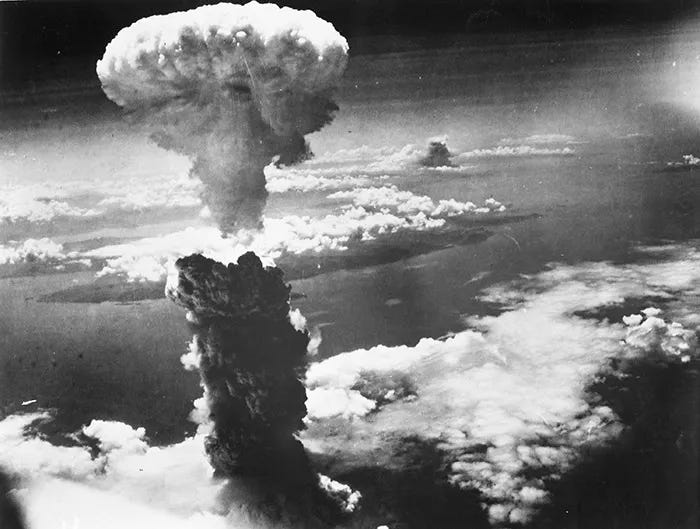
Viktor Frankl wrote: “Since Auschwitz we know what man is capable of. And since Hiroshima we know what is at stake.”
Those are chilling words. With only a few of the weapons available to the nuclear powers of today could kill millions more people in minutes than all the Jews killed by the Nazis killed in the Holocaust, or all the people killed during the Second World War, depending upon the target selection.
But tonight, I took a pause in my multipart article on the decline of the U.S. Navy and the United States Maritime, shipbuilding, and ship repair base. But tonight I will write about something that I am well acquainted with as a historian who taught military ethics at the Joint Forces Staff College between 2013 and 2017. It never failed that at least one student would deal with the ethics of the bombing of Hiroshima and Nagasaki, or the use of such weapons in the future. I can say that every single officer who presented these subjects were very circumspect and all had significant reservations about their use then or possible use today. The discussions were always interesting, especially about the historical use and how different members of the class fell on the historical use, as opposed to any use now. Opinions on the historical use were divided, with most thinking Hiroshima might have been defensible, but that Nagasaki was not.
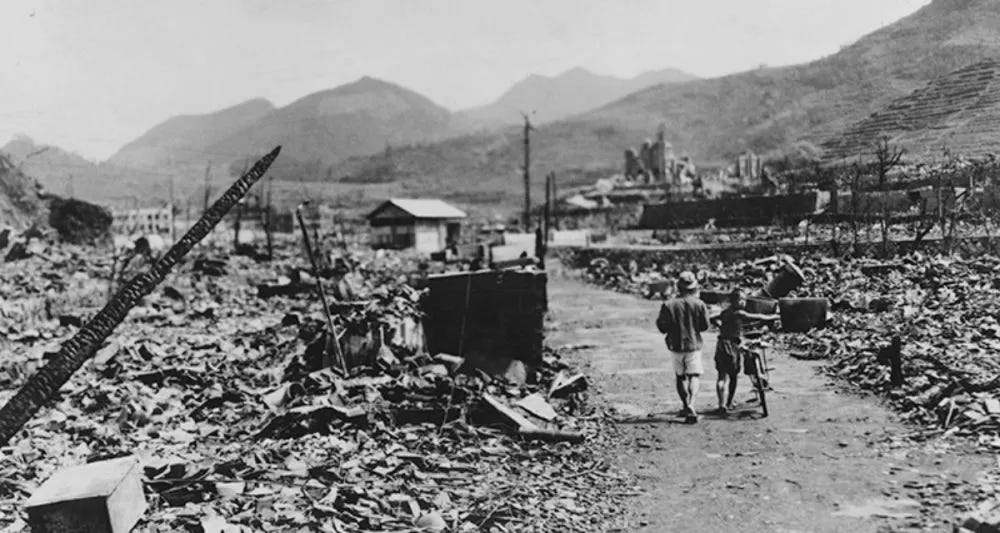
Kurt Vonnegut, the great author who wrote Slaughterhouse Five and many other works survived the allied terror bombing of Dresden as a POW of the Germans in 1945 wrote:
“The most racist, nastiest act by America, after human slavery, was the bombing of Nagasaki. Not of Hiroshima, which might have had some military significance. But Nagasaki was purely blowing away yellow men, women, and children. I’m glad I’m not a scientist because I’d feel so guilty now.”
Thanks for reading Dedicated to the Proposition that All Men are Created Equal! This post is public with no paywalls. So feel free to read, like, restack, or share it on any venue you like.
But I digress. The subject really matters today because President Trump has thought about using nuclear weapons since his first term, and threatened to use them on North Korea and Iran on numerous occasions. The difference today is that during his first term there were numerous high ranking officials and military officers who were committed to not using them except as a last resort. In his first term Trump was cautious when talking about the use of nuclear weapons of their further proliferation. That has changed during his second term, he has opened the door to help Saudi Arabia get nuclear weapons, and is backing off his demands for Iran to stop its nuclear program and has stated that he would not use nuclear weapons against Iran, despite threatening to destroy their civilization. One cannot destroy the Iranian civilization with the conventional weapons we have been using, especially since we are running out of them.
Things have changed since Trump’s first term. Trump has placed sycophants at the helm of the Defense Department, State Department, Homeland Security, and our Intelligence Agencies. His Defense Secretary has removed nearly forty, three and four star generals and admirals, including the Chairman of the Joint Chiefs of Staff, the Chief of Staff of the Army, the Commandant of the Coast Guard, the Chief of Naval Operations, and Admiral Alvin Holsey, the Commander of U.S. SOUTHCOM, and General Christopher Donohue, the Commander of U.S. Forces in Europe and Africa, two our Four Star Combatant Commanders.
Our current Combatant Commanders in the Middle East and South and Central have not rebelled at following criminal orders to commit War Crimes. Neither has Trump’s hand picked Chairman of the Joint Chiefs, General Dan Caine balked at those policies. While it is reported that Caine is trying to find a way out of Trump’s war against Iran because he knows that it cannot be won. Meanwhile, Fox News reported that unnamed officials in the Defense Department are exploring ways to loosen restrictions on the employment of tactical nuclear weapons to give the President additional options in a crisis.
That is the last thing that a madman like Trump needs. But once again I digress.
The fact is that even today the United States has not renounced the first use of nuclear weapons. It is hard for policy makers to oppose such a policy while endeavoring to build new and more efficient nuclear weapons. Author and filmmaker Greg Mitchell noted:
“After building first-strike weapons, and carefully devising scenarios for their use, the temptation (for any nuclear power) to eventually use them some day may be irresistible. We may not be able to imagine the circumstances under which America would “go first” but this much is certain: The Pentagon has a targeting scheme for every eventuality. The U.S., in fact, has threatened to use nuclear weapons several times since the 1960s—and every American president (except Eisenhower) has endorsed the two times we’ve already used the bomb.” (Atomic Cover-Up: Two U.S. Soldiers, Hiroshima & Nagasaki, and The Greatest Movie Never Made, 2020 and 2023.) Russia’s President Vladimir Putin and his underlings have repeated threatened the use of nuclear weapons against Ukraine and NATO nations.
This is exceptionally important today neither Trump, Hegseth, or anyone else in the regime seem to have any problem in committing war crimes. Now since Trump’s war of choice has gone off the rails with no way of winning it with the forces at hand in the Middle East, Europe, or the Indo-Pacific, and the fact we are running out the the munitions need to prosecute further attacks or to defend our troops in the region. The only off ramp left is for Trump to give up and agree to Iran’s growing list of conditions for reopening the Straits of Hormuz or calling of the Houthis who are blockading Saudi Arabia and and threatening the closure of the Bab El Mendeb and the Suez Canal.
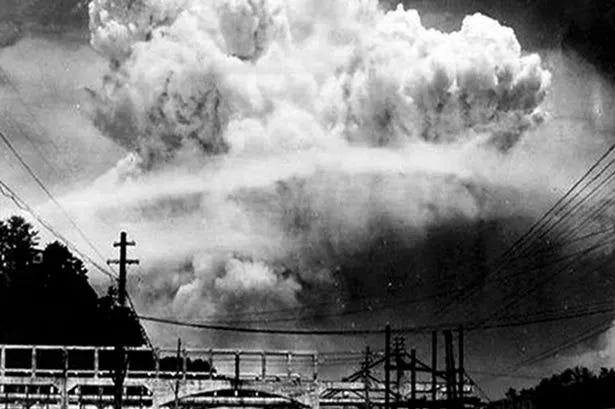
The other option is more terrifying because Trump has no way of spinning this war into a win and has talked about using nuclear weapons and destroying Iranian civilization. If he makes that decision when the United States is still not threatened militarily by Iran but was the aggressor that brought on this war, he will be going beyond even the reasons that President Truman used to unleash hell on Hiroshima and Nagasaki.
To President Truman, Secretary of War Stimson and some military leaders, especially General Curtis LeMay, they served a strategic purpose. However, many other reasonable American military Commanders including Admiral William Leahy, General Dwight Eisenhower, Admiral Chester Nimitz, and General Hap Arnold, all disagreed, as they believed Japan was close to surrender. Likewise, since Japan had no means of attacking the United States or even major military bases in the Pacific with anything close to the power of atomic bomb, all sense of the principle of proportionality was lost.
Proportionality is one of the tenants of what is called the Just War Theory first advanced by Thomas Aquinas and other Christian theologians like Hugo Grotius. In order to be just, the means must be proportional. In 1945 Japan no longer could inflict massive damage to the U.S. mainland or even our bases in the Pacific. Neither can Iran inflict the kind of damage on the United States, our forward bases, or our allies. Any nuclear strike would be out of proportion to anything Iran has done or could do to us. It would be a clear violation that we have indeed adopted a policy of no morality or honor.
John Hersey, the first American reporter to reach Hiroshima and write about it wrote something that anyone that considers using these weapons needs to consider:
“The crux of the matter is whether total war in its present form is justifiable, even when it serves a just purpose. Does it not have material and spiritual evil as its consequences which far exceed whatever good might result? When will our moralists give us an answer to this question?”
In July 1945, Harry Truman was fixated on revenge for Pearl Harbor and to intimidate the Soviet Union since the United States was the sole atomic power until 1949. But Truman’s decision was based on his, and many Americans view that the Japanese were barbaric animals and subhuman. There was a certain element of racism in his view of Asians which was little different than the Nazis views of they referred to as sub-human. The war between the Japanese and Americans in the Pacific was in large part a racial war. Please take the time to read John Dower’s book War Without Mercy: Race and Power in the Pacific War.
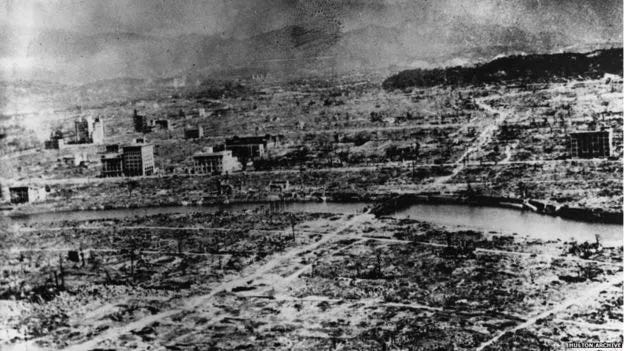
War is terrible, but in every war, every commander or soldier is called to make moral decisions. We tried Nazi commanders for war crimes for violating the laws of war which centuries of philosophers, ethicists, and military leaders sought to hone in order to minimize the chances of war, and to limit its devastation. We have since avoided the use of nuclear weapons, despite routinely violating the same kind of war crimes that we tried Nazi leaders.
Harry Truman was faced with the challenge of some American Christian leaders to his use of nuclear weapons against Japan.
Truman responded to a telegram from the Reverend Samuel McCrea Cavert,the General Secretary of the Federal Council of The Churches of Christ in America, the predecessor of the National Council of Churches. Reverend Cavert was a Presbyterian minister. Cavert’s telegram stated:
“Many Christians deeply disturbed over use of atomic bombs against Japanese cities because of their necessarily indiscriminate destructive efforts and because their use sets extremely dangerous precedent for future of mankind. Bishop Oxnam, President of the Council, and John Foster Dules, Chairman of its Commission on a just and durable peace are preparing statement for probable release tomorrow urging that atomic bombs be regarded as trust for humanity and that Japanese nation be given genuine opportunity and time to verify facts about new bomb and to accept surrender terms. Respectfully urge that ample opportunity be given Japan to reconsider ultimatum before any further devastation by atomic bomb is visited upon her people.”
Truman’s response to the telegram revealed the darker side of his decision to use the bomb.
My dear Mr. Cavert:
I appreciated very much your telegram of August ninth.
Nobody is more disturbed over the use of Atomic bombs than I am but I was greatly disturbed over the unwarranted attack by the Japanese on Pearl Harbor and their murder of our prisoners of war. The only language they seem to understand is the one we have been using to bombard them.
When you have to deal with a beast you have to treat him as a beast. It is most regrettable but nevertheless true.
Trump routinely uses such language to describe the Iranians. Racism is a part of the soul of Donald Trump. With that is a given what we Trump not do?
The President’s senior military advisors were certainly of a different point of view about the use of the weapons. Admiral William Leahy who served as Chief of Staff to the Commander in Chief and was the senior Naval Officer in service disagreed and told Stimson of his misgivings about using the atomic bomb at this particular point in the war. In his memoirs which were released in 1949 he wrote:
“It is my opinion that the use of this barbarous weapon at Hiroshima and Nagasaki was of no material assistance in our war against Japan. The Japanese were already defeated and ready to surrender because of the effective sea blockade and the successful bombing with conventional weapons… My own feeling was that in being the first to use it, we had adopted an ethical standard common to the barbarians of the Dark Ages. I was not taught to make wars in that fashion, and that wars cannot be won by destroying women and children.”
General Dwight D. Eisenhower disagreed with the use of the atomic bomb and recorded his interaction with Stimson:
“In 1945 Secretary of War Stimson, visiting my headquarters in Germany, informed me that our government was preparing to drop an atomic bomb on Japan. I was one of those who felt that there were a number of cogent reasons to question the wisdom of such an act. During his recitation of the relevant facts, I had been conscious of a feeling of depression and so I voiced to him my grave misgivings, first on the basis of my belief that Japan was already defeated and that dropping the bomb was completely unnecessary, and secondly because I thought that our country should avoid shocking world opinion by the use of a weapon whose employment was, I thought, no longer mandatory as a measure to save American lives.” He also wrote later words similar to Leahy:
“I was against it on two counts. First, the Japanese were ready to surrender, and it wasn’t necessary to hit them with that awful thing. Second, I hated to see our country be the first to use such a weapon.”
Admiral William Leahy wrote in his memoirs:
“Once it had been tested, President Truman faced the decision as to whether to use it. He did not like the idea, but he was persuaded that it would shorten the war against Japan and save American lives. It is my opinion that the use of this barbarous weapon at Hiroshima and Nagasaki was of no material assistance in our war against Japan. The Japanese were already defeated and ready to surrender because of the effective sea blockade and the successful bombing with conventional weapons… My own feeling was that in being the first to use it, we had adopted an ethical standard common to the barbarians of the Dark Ages. I was not taught to make wars in that fashion, and that wars cannot be won by destroying women and children.”
General Hap Arnold, the Commander of the Army Air Forces noted: “It always appeared to us that, atomic bomb or no atomic bomb, the Japanese were already on the verge of collapse.”
Those who questioned the decision would be vindicated by the U.S. Strategic Bombing Survey study published in 1946. That study laid out the facts in stark terms:
“Certainly prior to 31 December 1945, and in all probability prior to 1 November 1945, Japan would have surrendered even if the atomic bombs had not been dropped, even if Russia had not entered the war, and even if no invasion had been planned or contemplated.”
Later, Dr. J. Samuel Walker, the Chief Historian of the Nuclear Regulatory Commission wrote:
“Careful scholarly treatment of the records and manuscripts opened over the past few years has greatly enhanced our understanding of why Truman administration used atomic weapons against Japan. Experts continue to disagree on some issues, but critical questions have been answered. The consensus among scholars is the that the bomb was not needed to avoid an invasion of Japan. It is clear that alternatives to the bomb existed and that Truman and his advisers knew it.”
Thus the moral question remains and perhaps is best answered by the words of Dr. Leó Szilárd who first proposed building atomic weapons. In 1960 he noted to U.S. News and World Reports:
Suppose Germany had developed two bombs before we had any bombs. And suppose Germany had dropped one bomb, say, on Rochester and the other on Buffalo, and then having run out of bombs she would have lost the war. Can anyone doubt that we would then have defined the dropping of atomic bombs on cities as a war crime, and that we would have sentenced the Germans who were guilty of this crime to death at Nuremberg and hanged them?
But, again, don’t misunderstand me. The only conclusion we can draw is that governments acting in a crisis are guided by questions of expediency, and moral considerations are given very little weight, and that America is no different from any other nation in this respect.
Eisenhower, Leahy, Bradley, and Szilard were correct. The weapons have grown more deadly, the delivery systems, more accurate with greater range, speed, and maneuverability, and even their miniaturization, make their use more likely than not. If they are used it will be the beginning of the end.
Robert Oppenheimer told Truman that he “had blood on his hands” after Hiroshima and Nagasaki, but while he later opposed building the Hydrogen Bomb, but never backed off his Atomic weapons, and never indicated any other remorse for their use. As brilliant and complex as he was, Oppenheimer seemed to lose his ethics when the invention was his, and not Edward Teller’s.
Albert Einstein’s words which he penned after the bombing should serve as a warning to Americans for all time, while pointedly taking on America’s own racism toward American Blacks:
“America is a democracy and has no Hitler, but I am afraid for her future; there are hard times ahead for the American people, troubles will be coming from within and without. America cannot smile away their Negro problem nor Hiroshima and Nagasaki. There are cosmic laws.”
Nuclear weapons systems far exceed in number, and power than those of the 1940s and 1950s, with far more capable delivery systems. With the developments in Artificial Intelligence and hypersonic missiles, we may lose the chance of preventing nuclear war, perhaps sooner than we think.
The current war is unwinnable using the conventional weapons that we have been using, and are rapidly running out of. Iran understands this and keeps upping the ante for what Trump must do for a negotiated end to this war. Will Trump’s fragile ego allow him to accept a humiliating peace deal to try to save the midterms, or will he go for broke?
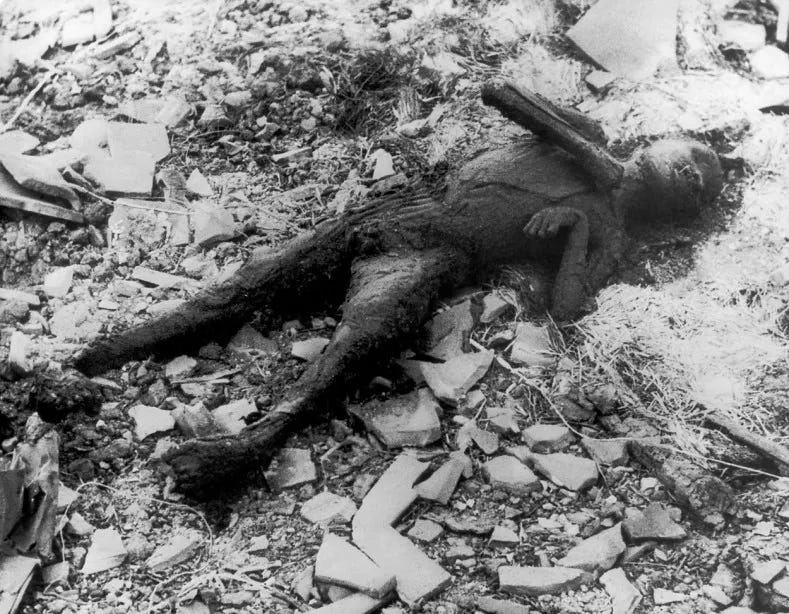
Indeed that is all a lot to consider and ponder. However, as a historian, a combat veteran, and student of these ghastly weapons, having been a nuclear, biological, and chemical defense officer in Germany in the Cold War, I cannot help but not to think about them. I know far too much and live in one of the biggest targets for our enemy’s nuclear weapons.
Until next time, have a good night, a better tomorrow and please watch your six.
No posts
Comments
Nothing yet. Say the first thing.
Sign in to join the conversation.