
By Dr. David Traster, DC, MS, DACNB
Co-owner, The Neurologic Wellness Institute
Boca Raton • Chicago • Waukesha • Wood Dale
www.neurologicwellnessinstitute.com
One of the oldest concepts in natural philosophy is the idea that matter is not truly static. Everything that appears solid is composed of smaller structures that are continuously moving, oscillating, rotating, interacting, exchanging energy, and responding to forces around them. Modern physics confirms an important part of this concept: atoms and molecules possess characteristic modes of motion, and biological molecules can absorb and release energy at particular frequencies.
This has led to a fascinating question that sits at the intersection of physics, biology, and medicine: Does every biological structure have its own unique vibrational frequency?
The answer depends on what we mean by “unique frequency.” If we mean that every cell, protein, organ, bacterium, virus, or tissue possesses one single frequency that uniquely identifies it, modern science has not established this. Biological systems are far too complex for that simple model. However, if we mean that biological structures possess characteristic collections of vibrational, mechanical, electrical, and electromagnetic frequencies, then the concept is firmly grounded in physics.
A protein does not have one frequency. It may have thousands of vibrational modes. A cell does not have one frequency either. Its membrane, cytoskeleton, organelles, proteins, electrical potentials, ion channels, and surrounding fluid can participate in different oscillatory processes occurring over dramatically different timescales.
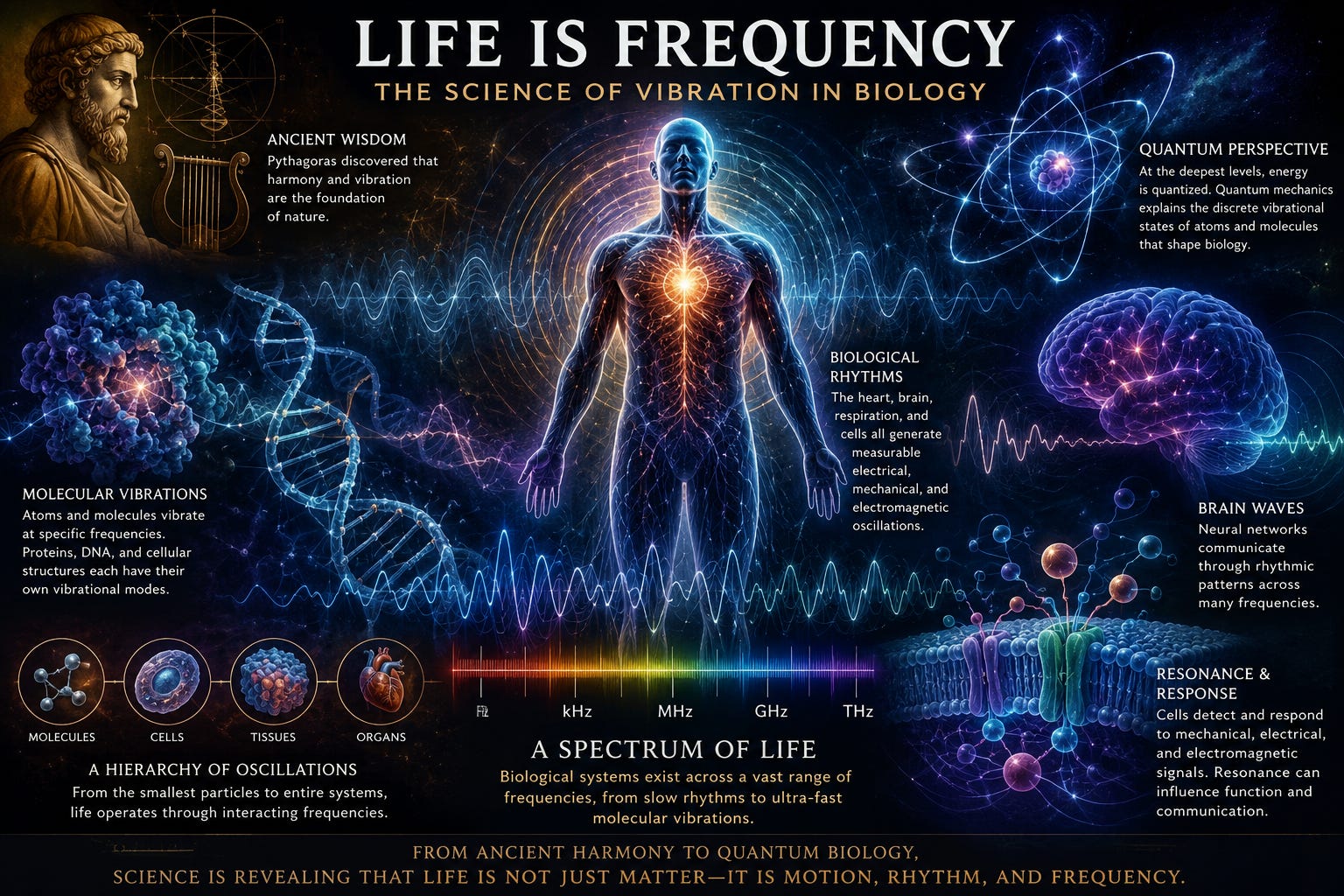
Perhaps it is therefore more accurate to think of biology not as having a single frequency, but as possessing a frequency spectrum.
The idea that nature could be understood through vibration and harmonic relationships is extraordinarily old. One of the earliest systematic Western traditions is associated with Pythagoras and the Pythagorean school during approximately the sixth and fifth centuries BCE.
The Pythagoreans discovered that musical harmony was related to mathematical relationships. When the length of a vibrating string was changed according to simple numerical ratios, predictable musical intervals appeared. This was profound because it suggested that something as seemingly subjective as musical harmony could arise from mathematical laws governing vibration.
From these observations emerged a much larger philosophical concept: perhaps nature itself was organized according to harmonic relationships.
This eventually became associated with the idea of the “harmony of the spheres,” in which the movements of celestial bodies were imagined as participating in a mathematical cosmic harmony.
The original writings of Pythagoras have not survived, so there is no single surviving Pythagorean book that can accurately be called the first written text stating that all biological matter possesses a vibrational frequency. Our knowledge comes largely through later writers and surviving fragments associated with early Pythagoreans such as Philolaus, as well as descriptions by Plato and Aristotle.
The distinction is important. Ancient thinkers developed sophisticated ideas about harmony, number, motion, and nature, but the modern statement that “every biological object has a unique resonant frequency” should not simply be attributed to Pythagoras.
Over the centuries, vibration gradually moved from philosophy into experimental physics. A fundamental principle emerged: physical systems can possess natural frequencies.
Imagine pushing someone on a swing. Randomly pushing at different times produces relatively little movement. Push at approximately the natural rhythm of the swing, however, and each push reinforces the previous movement. The amplitude becomes progressively larger.
This is resonance. The same fundamental principle occurs throughout physics. Strings resonate. Air columns resonate. Buildings resonate. Mechanical structures resonate. Electrical circuits resonate. Molecules have characteristic vibrational modes.
Biological structures are composed of physical matter, so they cannot somehow escape these principles. The much more difficult question is whether biology intentionally uses resonance as an information-processing or regulatory mechanism. That question remains an active and fascinating area of research.
At the molecular scale, biological matter is extraordinarily dynamic. Atoms within molecules can stretch, bend, twist, rotate, and oscillate relative to one another. Chemical bonds therefore should not be imagined as rigid sticks connecting stationary atoms. A molecule behaves more like an extraordinarily complicated three-dimensional system of interconnected oscillators.
Different molecular structures consequently possess different vibrational modes. This is one reason infrared and Raman spectroscopy can identify chemical substances. Electromagnetic radiation interacts with molecular vibrations differently depending upon molecular structure. The resulting spectrum can function somewhat like a molecular fingerprint.
Proteins are even more interesting. A protein may contain thousands of atoms arranged into a highly complex three-dimensional structure. Different regions can undergo local vibrations while the entire protein can participate in larger collective motions. These movements can influence protein folding, receptor binding, enzyme activity, and molecular interactions.
Therefore, biological function is not simply about molecular structure. It is also about molecular motion.
DNA is often pictured as a beautiful but stationary double helix. Inside a living cell, nothing could be further from reality. DNA undergoes twisting, bending, stretching, thermal fluctuations, conformational changes, and interactions with proteins, water, ions, and electromagnetic forces.
Different molecular motions occur at different frequencies. The same principle applies to RNA, cellular membranes, mitochondria, microtubules, collagen, receptors, enzymes, and essentially every other biological macromolecule.
The body is therefore not merely biochemical. It is biochemical, electrical, mechanical, and oscillatory simultaneously. These descriptions are not competing explanations. They are different ways of describing the same biological system.
Moving from molecules to entire cells makes the situation dramatically more complicated. A cell contains a membrane under mechanical tension, a cytoskeleton capable of transmitting forces, electrically charged molecules, ion gradients, organelles, proteins, water, and thousands of biochemical reactions occurring simultaneously.
Cells also experience mechanical forces from their environment. Research into mechanobiology has demonstrated that cells detect compression, tension, shear forces, substrate stiffness, and vibration. These mechanical signals can be converted into biochemical signals through mechanotransduction.
Mechanically sensitive ion channels can open. Calcium signaling can change. Cytoskeletal organization can change. Gene expression can change. The physical environment of the cell can therefore alter its biology. This is extraordinarily important because it demonstrates that cells do not communicate exclusively through traditional ligand-receptor chemistry. Mechanical and electrical information are also fundamental components of biological regulation.
This question has become experimentally testable. Researchers have investigated whether living cells exhibit measurable mechanical vibrational modes. A particularly interesting modern area of research uses extremely sensitive micro- and nanoscale mechanical detectors capable of measuring tiny cellular movements.
Recent experimental work has reported measurable vibrational modes associated with living human cells. These observations support the concept that cells can possess mechanical resonances. However, this does not mean that every cell has one magical frequency.
A cell is an extraordinarily complicated structure and may exhibit multiple modes that depend upon its size, shape, mechanical stiffness, cytoskeleton, membrane properties, surrounding medium, metabolic state, and other factors. Its vibrational signature can therefore change. This may ultimately be much more biologically interesting than having one permanent frequency.
If molecular structure, cellular stiffness, membrane composition, metabolism, electrical activity, and cytoskeletal organization influence oscillatory behavior, then disease could theoretically alter the measurable physical spectrum of biological tissue. Cancer cells, for example, frequently possess altered cellular mechanics. Diseased tissue can differ in stiffness from healthy tissue. Fibrosis dramatically changes extracellular matrix mechanics. Neurodegeneration changes proteins, membranes, cellular organization, and metabolism.
These differences create the possibility that physical measurements could someday become increasingly useful biomarkers of cellular health. This does not necessarily mean disease has a single “disease frequency.” Rather, disease changes the physical properties of biological systems, and those changes may alter how those systems vibrate, resonate, conduct electricity, absorb electromagnetic energy, or respond mechanically. That distinction is critical.
One of the most important twentieth-century scientists associated with biological vibration was physicist Herbert Fröhlich. During the 1960s and 1970s, Fröhlich proposed that metabolically active biological systems might generate coherent collective molecular oscillations, particularly within extremely high-frequency ranges.
His hypothesis was fascinating. Cells constantly consume metabolic energy. Instead of that energy simply becoming randomized thermal motion, Fröhlich proposed that under certain circumstances energy could become concentrated into collective vibrational modes.
This became known as Fröhlich coherence. The concept remains controversial and has not been established as a universal mechanism of biological organization. Nevertheless, it stimulated decades of research investigating whether collective molecular vibrations could contribute to biological communication and organization.
There is an enormous obstacle to many theories of biological resonance. The human body is mostly water. Biological molecules do not vibrate inside a vacuum. They exist inside warm, wet, chemically complicated environments filled with collisions and thermal noise. These interactions produce damping.
Imagine ringing a bell in air compared with attempting to ring the same bell underwater. The surrounding medium absorbs energy and suppresses sustained vibration. The same problem exists at microscopic scales.
Some theoretical studies have concluded that high-frequency molecular resonances inside biological environments would be strongly damped, making long-range communication through those vibrations difficult. This is one reason we must be careful when moving from the statement that biological molecules vibrate—which is unquestionably true—to the much stronger statement that cells communicate over meaningful distances by tuning themselves to unique frequencies—which remains largely hypothetical.
Quantum mechanics makes the discussion even more interesting, but also much more misunderstood. At atomic and molecular scales, vibrations cannot always possess arbitrary energies. Their energies can be quantized.
In simplified quantum models, molecular vibrations occupy discrete vibrational energy levels. A molecule can absorb electromagnetic energy when the incoming energy corresponds appropriately to transitions between these states. This is part of the physical foundation underlying vibrational spectroscopy.
Therefore, quantum mechanics absolutely supports the concept that molecular structure and vibrational behavior are intimately connected. But quantum mechanics does not automatically prove that every organism possesses one unique healing frequency or that exposing the body to that frequency will eliminate disease. Those are separate hypotheses requiring experimental evidence.
Quantum biology investigates whether biological systems exploit quantum phenomena in functionally important ways. Several areas have received serious scientific attention, including photosynthetic energy transfer, electron and proton tunneling in enzymes, radical-pair mechanisms potentially involved in animal magnetoreception, and quantum events involved in photoreception.
The remarkable feature of these systems is that biology may sometimes preserve or exploit quantum behavior despite existing in a warm, noisy environment.This has forced scientists to reconsider the older assumption that meaningful quantum effects disappear almost immediately inside living organisms.
However, the field remains specific rather than universal. Demonstrating quantum effects within photosynthesis does not establish that consciousness, organs, acupuncture points, pathogens, or diseases are controlled by unique quantum frequencies. Science has to investigate each proposed mechanism individually.
This is where different levels of biological organization must be separated. At the molecular level, quantum mechanics is unavoidable. At the cellular level, quantum chemistry interacts with classical mechanics, thermodynamics, electricity, fluid dynamics, and statistical physics. At the organ level, additional oscillations emerge.
The heart generates rhythmic electrical and mechanical activity. The respiratory system oscillates. Blood pressure fluctuates. Cerebral blood flow oscillates. Gastrointestinal smooth muscle produces electrical rhythms. Neurons generate electrical oscillations. Brain networks produce measurable frequency-dependent activity.
Biology therefore contains oscillations across an enormous spectrum of frequencies. The interesting possibility is that these different levels may sometimes interact. Molecular events influence cells. Cellular behavior influences tissues. Tissues influence organs. Organ rhythms influence neural networks. Neural and autonomic networks feed back onto organs. The human body may therefore be better conceptualized as a hierarchy of interacting oscillators rather than as one object vibrating at one frequency.
Another important misconception is that resonance itself is inherently quantum. It is not. A playground swing demonstrates resonance and requires no meaningful quantum explanation. The middle ear contains mechanical resonance. The cardiovascular system displays oscillatory dynamics. Neuronal networks generate frequency-dependent electrical activity.
Many biological resonance phenomena can be adequately described using classical physics. Quantum mechanics becomes essential as we move toward atomic interactions, molecular bonding, electron transfer, proton transfer, molecular vibration, and other microscopic phenomena. Therefore, calling something “quantum” does not automatically make a resonance theory more sophisticated or more correct. The correct model depends upon the scale being investigated.
Cells unquestionably generate electrical activity. Every living cell maintains electrical differences across its membrane. Ion gradients create membrane potentials. Charged molecules move. Electrical fields influence cellular behavior. The nervous system simply represents an extraordinarily specialized version of this basic biological principle.
Researchers have consequently investigated whether endogenous electromagnetic fields might participate in cellular communication beyond conventional chemical signaling. There is evidence that cells respond to electrical, magnetic, mechanical, and electromagnetic stimuli under particular conditions. But whether extremely weak internally generated electromagnetic signals function as a widespread communication network remains unsettled.
The possibility is scientifically legitimate. The universal conclusion is not yet scientifically justified.
Medicine already uses frequency-dependent physical interactions extensively. Ultrasound uses mechanical waves. MRI depends upon electromagnetic principles and nuclear magnetic resonance. Transcranial magnetic stimulation uses changing magnetic fields to induce electrical currents within neural tissue. Photobiomodulation uses specific wavelengths of light to interact with biological molecules. Electrical stimulation alters neural and muscular activity. Deep brain stimulation changes network dynamics through precisely delivered electrical pulses.
These technologies demonstrate an important principle: biological systems respond differently depending upon the physical characteristics of the energy delivered to them. Frequency can matter. Wavelength can matter. Amplitude can matter. Pulse duration can matter. Timing can matter. Dose can matter. But this is very different from assuming that finding one “correct frequency” will necessarily restore an unhealthy biological structure to health.
The concept of vibrational medicine becomes scientifically more useful when we stop imagining the body as having one mystical frequency and instead recognize that biological systems operate through enormous numbers of interacting oscillations. Molecules vibrate. Proteins change conformation. Membranes fluctuate. Ion channels oscillate between states. Cells generate electrical potentials. Calcium concentrations oscillate. Neurons fire rhythmically. Brain networks synchronize and desynchronize. The heart oscillates. Respiration oscillates. Blood pressure oscillates. Hormones follow rhythms. Sleep follows rhythms. The entire organism exists within overlapping temporal and frequency-dependent patterns. Health may therefore depend partly upon the appropriate coordination of these dynamics.
This concept becomes particularly interesting when applied to the nervous system. Neurons do not simply turn “on” and “off.” Neural networks communicate through patterns occurring across time. The timing of stimulation can profoundly influence plasticity.
Repetitive stimulation delivered at one frequency may produce a different neurological effect than the same number of stimuli delivered at another frequency. This principle can be seen in sensory stimulation, repetitive transcranial magnetic stimulation, electrical stimulation, neurofeedback, vestibular rehabilitation, and many forms of motor learning.
This suggests that neurological rehabilitation should not always ask only what structure are we stimulating?
We should also ask:
At what frequency? For how long? At what intensity? In what pattern? And relative to what other sensory or physiological signals?
The nervous system is fundamentally temporal.
One of the most exciting future possibilities may be the development of increasingly sophisticated biological spectroscopy. Instead of diagnosing disease exclusively through anatomy or chemistry, future technologies may increasingly examine the dynamic physical signatures of cells and tissues.
A healthy neuron and a metabolically compromised neuron may not behave identically. A healthy mitochondrion and a dysfunctional mitochondrion may not produce identical energetic dynamics. A healthy cell and malignant cell may differ mechanically, electrically, metabolically, and vibrationally.
If those differences can be reliably measured, physical signatures could potentially become biomarkers. The next question would be even more provocative: if abnormal dynamics can be measured, can they also be selectively modified? That possibility deserves serious investigation—but serious investigation requires measurement, reproducibility, appropriate controls, and biological outcomes rather than assumptions based solely upon the language of “frequency.”
The idea that every biological structure possesses one unique vibrational frequency is probably too simplistic. Modern physics presents something far more interesting.
Atoms possess characteristic motions. Molecules possess multiple vibrational modes. Proteins undergo enormous numbers of dynamic conformational changes. Cells exhibit mechanical and electrical behavior. Tissues transmit mechanical forces. Organs generate rhythms. Neural networks oscillate. The entire organism contains overlapping biological cycles ranging from fractions of a second to approximately twenty-four-hour circadian rhythms and beyond.
Life is therefore not one frequency. It is a spectrum of frequencies interacting across multiple levels of organization.
The Pythagoreans imagined nature through harmony. Modern spectroscopy demonstrates characteristic molecular vibrations. Quantum mechanics explains quantized molecular energy states. Mechanobiology demonstrates that physical forces change cellular signaling. Bioelectricity demonstrates that electrical fields are fundamental to physiology. Quantum biology is beginning to identify circumstances in which distinctly quantum phenomena may contribute to biological function.
Where science must remain cautious is the leap from these established principles to the claim that every disease, pathogen, organ, or person possesses one fixed frequency that can simply be identified and therapeutically cancelled or corrected.
That hypothesis remains unproven. But the broader concept—that life is dynamic, oscillatory, electrical, mechanical, electromagnetic, and ultimately quantum at its smallest scales—is not fringe science at all. Perhaps the more interesting question is no longer whether biology vibrates. It clearly does.
The question for the future is which biological oscillations matter, how different levels of oscillation communicate with one another, how those patterns change in disease, and whether precisely applied physical energy can intentionally shift those dynamics toward healthier biological function.
That is where an ancient idea about harmony may ultimately intersect with some of the most advanced questions in modern biology and physics.
Fröhlich H. Long-range coherence and energy storage in biological systems. Int J Quantum Chem. 1968;2(5):641-649.
Reimers JR, McKemmish LK, McKenzie RH, Mark AE, Hush NS. Weak, strong, and coherent regimes of Fröhlich condensation and their applications to terahertz medicine and quantum consciousness. Proc Natl Acad Sci U S A. 2009;106(11):4219-4224.
Turton DA, Senn HM, Harwood T, Lapthorn AJ, Ellis EM, Wynne K. Terahertz underdamped vibrational motion governs protein-ligand binding in solution. Nat Commun. 2014;5:3999.
Pokorný J, Jelínek F, Trkal V, et al. Vibrations in microtubules. J Biol Phys. 1997;23(3):171-179.
Davydov AS. Biology & Quantum Mechanics. Oxford, England: Pergamon Press; 1982.
No posts
Comments
Nothing yet. Say the first thing.
Sign in to join the conversation.