
By Dr. David Traster, DC, MS, DACNB
Co-owner, The Neurologic Wellness Institute
Boca Raton • Chicago • Waukesha • Wood Dale
www.neurologicwellnessinstitute.com
In the first three parts of this series, we explored the Vedic concept that the human body represents a microcosm of the larger universe. We examined Ayurveda, Jyotish, planetary symbolism, the Nakshatras, karma, samskaras, and the ancient belief that the moment of birth represents a particular expression of time and cosmic order. But understanding the Vedic view of human health requires us to move one level deeper. If consciousness exists before the physical body, as many Vedic traditions propose, how does consciousness interact with the nervous system? How does thought become movement? How can an emotional experience alter heart rate, digestion, breathing, immune function, and pain? And what connects the invisible world of consciousness with the physical world of neurons, muscles, organs, and tissues?
The Vedic answer is Prana.
Prana is one of the most important concepts in Ayurveda and Yoga, yet it is also one of the most difficult to translate into the language of modern medicine. It is frequently described simply as “life force” or “vital energy,” but those translations fail to capture the complexity of the concept. Prana represents movement, organization, communication, vitality, and the dynamic processes that distinguish a living organism from an inert collection of biological material.
Within the Vedic worldview, Prana serves as an intermediary between consciousness and physiology.
The Sanskrit word Prana is derived from roots associated with movement, breathing, and life. Although Prana is intimately connected with respiration, it is not simply oxygen.
A person can receive oxygen through mechanical ventilation, yet oxygen itself does not explain consciousness, cognition, emotion, intention, or the remarkable coordination required for life. Ancient Vedic thinkers therefore proposed the existence of an organizing principle that animates the body and coordinates its countless functions.
Prana was believed to govern breathing, circulation, digestion, sensory perception, movement, thought, elimination, and communication throughout the organism. From a modern perspective, there is no scientifically established substance or measurable energy field corresponding directly to Prana. It would therefore be inaccurate to simply equate Prana with the nervous system, electricity, oxygen, ATP, or the autonomic nervous system.
A more useful way to understand the concept is as an ancient model describing the dynamic organization of living physiology. Modern biology describes this organization through neural signaling, membrane potentials, neurotransmitters, hormones, blood flow, oxygen delivery, mitochondrial metabolism, immune signaling, mechanical forces, and cellular communication. Ayurveda condensed many of the observable manifestations of these processes into the broader concept of Prana.
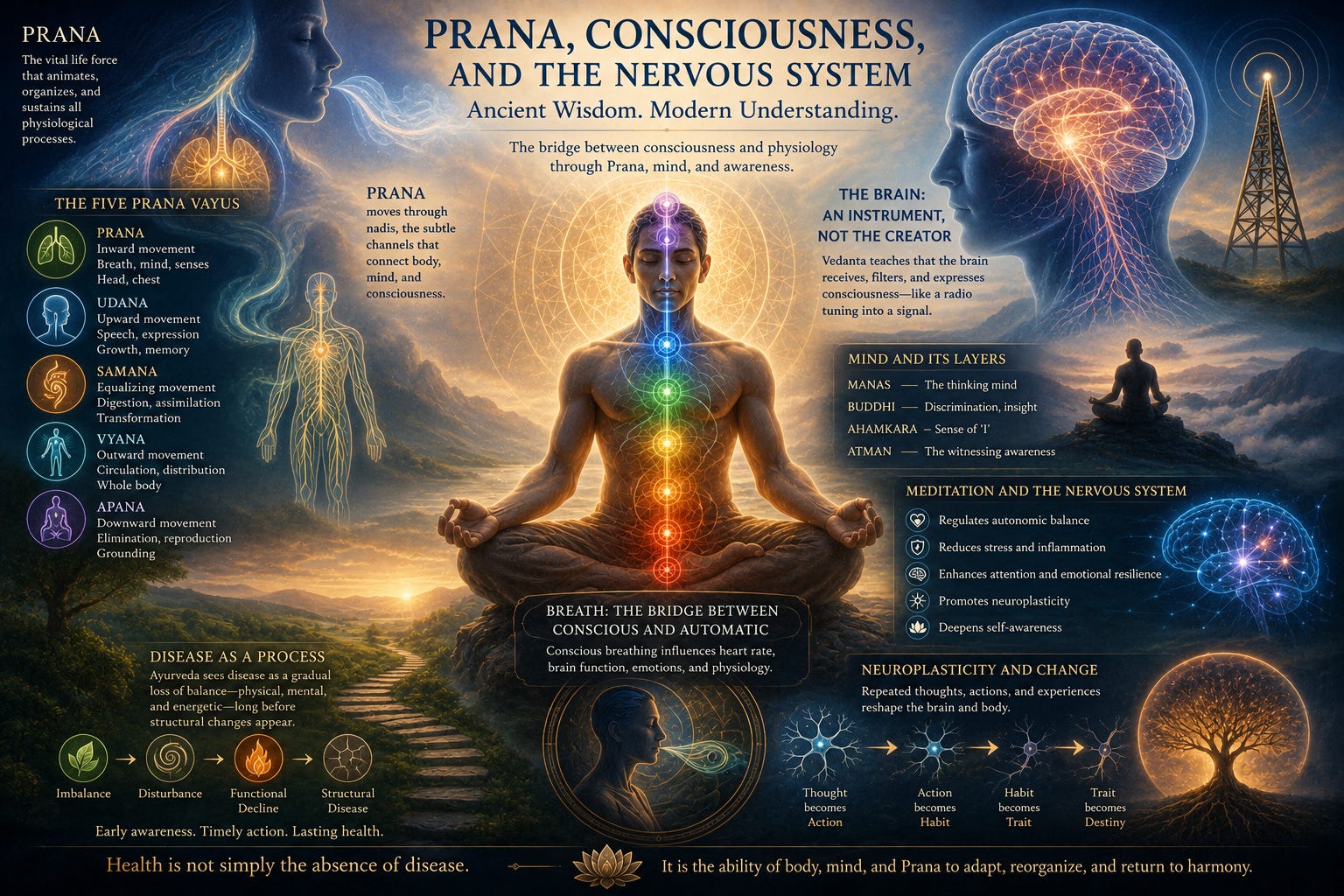
Ayurvedic physiology does not describe Prana as a single uniform force. It traditionally divides Prana into five major functional movements known as the Pancha Prana Vayus: Prana Vayu, Udana Vayu, Samana Vayu, Vyana Vayu, and Apana Vayu.
Prana Vayu is associated primarily with inward movement and the head, brain, sensory systems, respiration, and the reception of information. From a neurological perspective, we might loosely compare aspects of this concept with sensory processing, respiratory control, attention, and the integration of information entering the nervous system.
Udana Vayu represents upward movement and is traditionally associated with speech, expression, effort, memory, and higher mental function. Speech production alone requires extraordinary coordination among cortical language networks, basal ganglia, cerebellum, brainstem motor nuclei, respiratory muscles, laryngeal muscles, and sensory feedback.
Samana Vayu operates primarily around digestion and assimilation. It represents the body’s ability to transform external material into something useful. Modern physiology accomplishes this through digestion, absorption, metabolism, enteric nervous system activity, endocrine signaling, immune surveillance, and the microbiome.
Vyana Vayu represents distribution throughout the body. Circulation, peripheral movement, muscular coordination, and the distribution of nutrients and signals all resemble aspects traditionally assigned to Vyana.
Apana Vayu represents downward and outward movement. Elimination, urination, reproductive functions, childbirth, and other processes involving expulsion are traditionally associated with Apana.
These categories are not anatomical descriptions in the modern medical sense. They are functional patterns through which ancient physicians attempted to understand how movement and organization occur throughout the body.
Prana and Vata are closely related but are not identical concepts. Vata is one of Ayurveda’s three doshas and represents movement throughout physiology. Prana can be understood as the vital organizing principle whose movement is expressed through the Vayus. This is why neurological and autonomic disorders are frequently interpreted through disturbances of Vata.
The nervous system is fundamentally a system of movement and communication. Electrical potentials move along axons. Neurotransmitters cross synapses. Sensory information travels toward the brain. Motor commands travel toward muscles. Autonomic signals continuously modify the heart, blood vessels, lungs, gastrointestinal tract, pupils, glands, and other organs.
Even consciousness as we experience it depends upon dynamic communication among enormous networks of neurons. Nothing about the nervous system is truly static. From an Ayurvedic perspective, this continuous movement is the domain of Vata and Prana.
One of the greatest philosophical differences between modern neuroscience and Vedanta concerns the origin of consciousness.
The dominant neuroscientific model proposes that consciousness emerges from brain activity. Although scientists continue debating exactly how this occurs, damage to specific brain networks can dramatically alter awareness, memory, personality, perception, and behavior. Anesthesia can temporarily eliminate conscious experience. Neurodegenerative diseases can progressively alter cognition. Electrical stimulation of the brain can change perception and movement.
These observations provide powerful evidence that the brain is essential to our ordinary conscious experience. Vedanta, however, asks a different question. What if the brain does not create consciousness but instead allows consciousness to be expressed?
A common analogy is that of a radio. A radio receives and translates electromagnetic signals into sound. Damaging the radio changes the sound, but this does not mean the radio created the broadcast.
Similarly, some Vedantic traditions describe the brain and mind as instruments through which a more fundamental consciousness is expressed. Within this model, damage to the nervous system alters the expression of consciousness without necessarily destroying consciousness itself.
This remains a philosophical and metaphysical proposition rather than an established scientific conclusion. Nevertheless, it raises one of the deepest unanswered questions in neuroscience: why does neural activity produce subjective experience at all?
We can measure neuronal firing, cerebral blood flow, neurotransmitter concentrations, and electrical oscillations. We can observe which brain networks activate when someone recognizes a face, remembers childhood, experiences pain, or meditates. Yet explaining why these physical events are accompanied by the internal experience of seeing, remembering, hurting, or being aware remains extraordinarily difficult.
The Vedic tradition does not treat “the mind” as a single entity.
Manas represents the sensory and processing mind. It receives information, compares experiences, generates thoughts, and reacts to the environment.
Buddhi represents discrimination, judgment, insight, and higher intelligence. It allows us to evaluate information rather than simply react to it.
Ahamkara represents the sense of individual identity—the feeling of “I” and “mine.”
Beyond these processes lies Atman, the witnessing consciousness.
From a modern neurological perspective, there are interesting conceptual parallels. Sensory association networks integrate environmental information. Limbic circuits contribute to emotional salience. Prefrontal networks participate in judgment, inhibition, planning, and executive control. Large-scale brain networks contribute to self-referential thought and our continuous sense of identity.
These parallels should not be interpreted as evidence that ancient philosophers discovered specific neural networks thousands of years ago. The systems use different methods and describe reality at different conceptual levels. Nevertheless, both recognize that the mind contains multiple interacting processes rather than functioning as a single unified mechanism.
If consciousness, mind, Prana, and physiology interact continuously, then changing the state of the mind should influence the state of the body. This principle lies at the heart of meditation. For thousands of years, Vedic and Yogic traditions have used meditation not merely as relaxation but as a method for systematically altering attention, perception, emotional reactivity, and one’s relationship with thought.
Modern neuroscience has increasingly investigated these practices. Meditation can influence activity within brain networks involved in attention, emotional regulation, interoception, and self-referential processing. Research has reported changes involving regions such as the prefrontal cortex, anterior cingulate cortex, insula, hippocampus, amygdala, and networks commonly associated with internally directed thought.
Meditation may also influence autonomic physiology. Depending upon the technique, breathing pattern, experience of the practitioner, and experimental conditions, meditation can alter heart rate, respiratory rate, heart-rate variability, stress responses, and subjective anxiety.
The ancient explanation would describe these changes as calming the mind and regulating Prana. Modern neuroscience describes them through neuroplasticity, autonomic regulation, attentional networks, respiratory physiology, and brain-body communication. The languages are different, but the observation that mental training can influence physiology is increasingly difficult to dispute.
Breathing occupies a particularly interesting position in both Yoga and neuroscience because it exists under both voluntary and automatic control. You do not have to consciously remember to breathe. Brainstem respiratory networks automatically generate the rhythm required to sustain life. Yet at any moment, you can voluntarily change that rhythm.
You can breathe faster. You can breathe slower. You can hold your breath. You can extend expiration. You can deliberately alter respiratory depth. This makes breathing one of the most accessible bridges between conscious intention and autonomic physiology. Changing respiration alters carbon dioxide concentrations, blood pH, mechanical activity within the thorax, baroreceptor signaling, vagal influences, heart-rate variability, and cerebral vascular physiology.
Ancient Yogic traditions developed elaborate breathing practices known collectively as Pranayama. The term is often translated as “breath control,” although its deeper meaning relates to the regulation or expansion of Prana. The practitioners developing these techniques did not know about carbon dioxide chemoreceptors, the nucleus tractus solitarius, vagal afferents, respiratory sinus arrhythmia, or cerebral vasoreactivity. Yet through careful observation they recognized that altering breathing could profoundly change mental and physiological states.
The nervous system continuously receives enormous amounts of sensory information. Vision, vestibular input, proprioception, touch, hearing, smell, taste, visceral sensation, and internal chemical signals constantly inform the brain about the state of the body and environment. Most of this information never reaches conscious awareness.
The Vedic traditions recognized thousands of years ago that constant sensory stimulation could disturb the mind. Yoga therefore developed the concept of Pratyahara, commonly translated as withdrawal of the senses. Pratyahara does not necessarily mean eliminating sensory information. Rather, it describes reducing the mind’s compulsive attachment to incoming stimulation.
Modern life makes this concept particularly relevant. Phones, computers, artificial lighting, notifications, social media, television, traffic, occupational demands, and continuous information exposure create an environment dramatically different from that experienced throughout most of human evolution. The brain must continually decide which signals deserve attention and which should be ignored. Meditation and sensory reduction may provide opportunities for these attentional networks to disengage from continuous external demands.
Perhaps one of the strongest bridges between ancient Ayurvedic thinking and modern physiology is the recognition that the mind can alter the body. Fear does not remain inside the brain. Fear changes heart rate. It changes blood pressure. It changes respiration. It changes pupil diameter. It alters digestion. It modifies muscle tone. It influences immune signaling. It changes sleep. It can alter pain perception. It affects endocrine function.
A psychological event therefore becomes a neurological event, an autonomic event, an endocrine event, an immune event, and ultimately a whole-body physiological event. Ayurveda has emphasized this interconnectedness for centuries. Modern psychoneuroimmunology, neuroendocrinology, autonomic neuroscience, and systems biology increasingly describe the molecular and neurological mechanisms through which these interactions occur.
Ayurveda frequently conceptualizes disease as a process that develops progressively rather than appearing suddenly. Long before structural pathology becomes visible, functional imbalance may already be present. Sleep may deteriorate. Digestion may change. Energy may fluctuate. Emotional resilience may decline. Autonomic responses may become less adaptable. Pain sensitivity may increase. Only later may obvious structural pathology emerge.
Modern medicine increasingly recognizes similar patterns in certain diseases. Insulin resistance can precede diabetes by years. Amyloid and tau pathology may develop long before dementia becomes clinically obvious. Vascular dysfunction can precede cardiovascular events. Autoantibodies may appear before clinical autoimmune disease. Subtle neurological abnormalities may precede overt neurodegeneration.
Ayurveda interprets these transitions through disturbances of doshas, Agni, Prana, tissues, and channels. Modern medicine explains them through molecular and physiological mechanisms. Once again, the explanations are different, but both perspectives recognize that disease can evolve long before the final diagnosis becomes obvious.
One of the most important discoveries in modern neuroscience is that the nervous system is not fixed. The brain continuously changes in response to experience. Repeated movement modifies motor networks. Visual training alters visual processing. Vestibular rehabilitation can change sensory weighting. Learning strengthens and weakens synaptic connections. Meditation can alter functional patterns within attention and emotional networks. Exercise influences neurotrophic signaling and brain health.
This ability of the nervous system to reorganize is known as neuroplasticity. The Vedic tradition describes change through a different framework. Repeated experiences create Samskaras, or impressions. Those impressions influence future behavior. Repeated behaviors strengthen tendencies. Conscious awareness allows those tendencies to be observed and potentially changed.
There is an intriguing philosophical parallel here. Modern neuroscience tells us that repeated neural activation strengthens particular circuits. Vedic psychology tells us that repeated thoughts and actions strengthen Samskaras. Neither concept proves the other, but both emphasize an extraordinarily important principle: what we repeatedly do changes us.
Ayurveda therefore approaches healing as more than eliminating symptoms. The objective is to restore organization. Sleep must become rhythmic. Digestion must become efficient. Movement must become appropriate. The nervous system must become adaptable. Emotions must become less reactive. Breathing must support rather than destabilize physiology. The individual must learn to respond appropriately to environmental demands.
From a neurological perspective, health similarly depends upon adaptability. A healthy autonomic nervous system is not one that remains permanently parasympathetic or permanently relaxed. It is one capable of increasing sympathetic activity when necessary and reducing it when the challenge has passed. A healthy vestibular system adapts to changing environments. A healthy immune system activates when necessary and resolves inflammation when the threat disappears. A healthy brain learns, adapts, predicts, and recalibrates. Health is therefore not stillness. Health is adaptive organization.
Modern medicine has achieved extraordinary success by understanding the physical body. We can visualize the brain, sequence the genome, measure neurotransmitters, record neuronal activity, replace joints, transplant organs, and manipulate molecular pathways with remarkable precision. Yet consciousness remains mysterious.
We know an enormous amount about what happens in the brain when consciousness changes. We know far less about why subjective experience exists at all. The Vedic traditions approached this mystery from the opposite direction. Instead of beginning with the brain and searching for consciousness, they began with consciousness and attempted to explain how the mind and body emerged from it.
Neither framework should be forced into the language of the other. Prana is not simply the vagus nerve. Vata is not the autonomic nervous system. Brahman is not a quantum field. Meditation does not prove that consciousness exists independently of the brain. These comparisons can be useful as conceptual bridges, but they become misleading when metaphor is presented as scientific equivalence.
Perhaps the more interesting approach is to allow each tradition to ask its own questions. Neuroscience asks how the brain creates our experience of reality. Ayurveda asks how our state of mind influences the organization of the body. Yoga asks whether disciplined attention can change our experience of ourselves. Vedanta asks something even more fundamental:
Who is aware of all of these experiences?
This ultimately brings us back to the central question of Vedic philosophy. If thoughts change, but something observes those thoughts, what is the observer? If emotions change, but something recognizes those emotions, what recognizes them? If the body changes from childhood through adulthood and aging, yet we maintain a continuous sense that “I” am experiencing those changes, what constitutes that continuity?
Vedanta calls this witnessing awareness Atman. Advaita Vedanta takes the idea even further, proposing that Atman—the consciousness experienced as the deepest Self—is ultimately not separate from Brahman, the consciousness underlying reality itself. This leads to perhaps the most profound Vedic statement of all:
Atman is Brahman.
The consciousness within and the consciousness underlying the universe are not ultimately two different things. Whether this is interpreted literally, spiritually, philosophically, or metaphorically depends upon one’s worldview. It is not a proposition that modern neuroscience has established experimentally.
Yet it explains why Ayurveda never viewed health as merely the absence of disease. The body matters. The nervous system matters. Nutrition matters. Sleep matters. Movement matters. Breathing matters.
But within the Vedic tradition, these are ultimately instruments supporting something greater: the development of awareness and the realization of one’s true nature.
In the next part, we will bring these worlds together and examine where Ayurveda, Vedanta, Jyotish, neuroscience, chronobiology, epigenetics, systems biology, and modern medicine genuinely intersect—and equally importantly, where they do not. We will explore whether ancient Vedic concepts can provide useful frameworks for understanding modern health without confusing philosophical wisdom with scientific evidence, and what this ancient vision of an interconnected human being may still teach us about the future of medicine.
Lad, V. (2002). Textbook of Ayurveda: Fundamental principles (Vol. 1). The Ayurvedic Press.
Sharma, P. V. (Trans.). (1994). Charaka Samhita (Vols. 1–4). Chaukhambha Orientalia.
Feuerstein, G. (2001). The Yoga tradition: Its history, literature, philosophy, and practice. Hohm Press.
Tang, Y. Y., Hölzel, B. K., & Posner, M. I. (2015). The neuroscience of mindfulness meditation. Nature Reviews Neuroscience, 16(4), 213–225.
Zaccaro, A., Piarulli, A., Laurino, M., Garbella, E., Menicucci, D., Neri, B., & Gemignani, A. (2018). How breath-control can change your life: A systematic review on psychophysiological correlates of slow breathing. Frontiers in Human Neuroscience, 12, 353.
No posts
Comments
Nothing yet. Say the first thing.
Sign in to join the conversation.