
By Dr. David Traster, DC, MS, DACNB
Co-owner, The Neurologic Wellness Institute
Boca Raton • Chicago • Waukesha • Wood Dale
www.neurologicwellnessinstitute.com
When most people think about broccoli, cabbage, kale, or Brussels sprouts, they think about vitamins, minerals, fiber, and antioxidants. What is often overlooked is that these vegetables contain a sophisticated collection of biologically active compounds capable of interacting with human cellular signaling pathways. One of the most interesting of these compounds is 3,3′-diindolylmethane, better known as DIM.
DIM has become increasingly popular in functional and integrative medicine, particularly in conversations surrounding estrogen metabolism, hormonal balance, prostate health, breast health, cervical health, inflammation, and cellular detoxification. However, DIM is sometimes described too simply as an “estrogen blocker.” That description does not accurately represent its biochemistry. DIM appears to function more as a modulator of cellular signaling and hormone metabolism, influencing how certain hormones are metabolized and how cells respond to their chemical environment.
Understanding DIM therefore requires looking beyond hormones alone. Its biological activity potentially intersects with detoxification enzymes, inflammatory signaling, oxidative stress, androgen signaling, estrogen metabolism, cell-cycle regulation, apoptosis, and immune function.
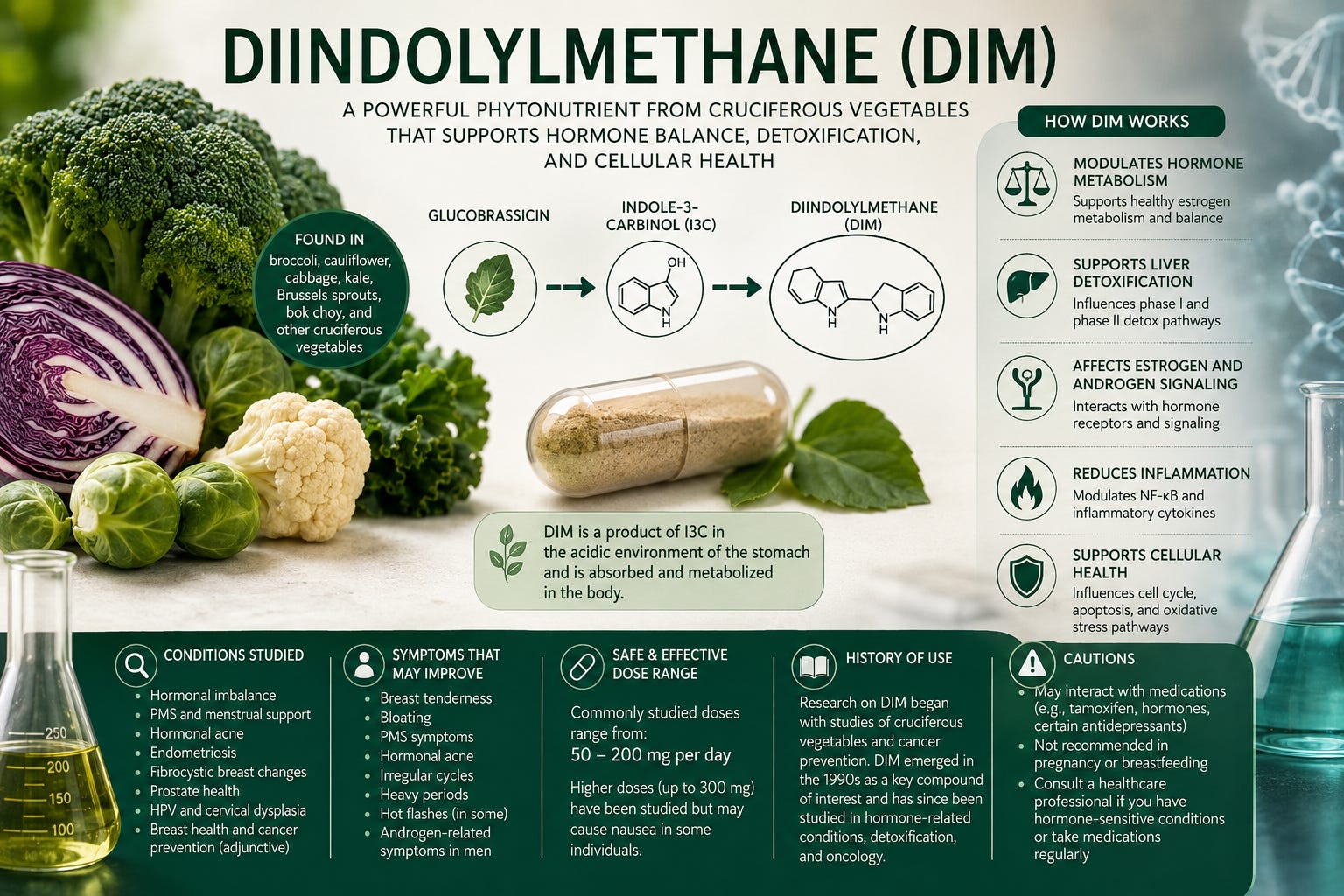
Diindolylmethane is an indole compound closely associated with cruciferous vegetables. Interestingly, vegetables do not necessarily provide large quantities of free DIM directly. Instead, cruciferous vegetables contain a glucosinolate known as glucobrassicin.
When vegetables such as broccoli or cabbage are chopped, chewed, or otherwise disrupted, glucobrassicin can be converted into indole-3-carbinol, commonly abbreviated I3C. Once I3C enters the acidic environment of the stomach, it undergoes chemical reactions that produce several compounds. One of the most biologically important products is DIM.
Two molecules derived from I3C essentially combine to form DIM. This means that eating cruciferous vegetables provides the biochemical precursors from which the body can generate DIM. Human pharmacokinetic research has also demonstrated that after consuming I3C, DIM becomes an important detectable circulating product.
DIM belongs to a larger family of phytochemicals that illustrates an important principle in nutritional biochemistry: food does not simply provide calories and vitamins. Food also provides chemical information capable of interacting with receptors, enzymes, transcription factors, and cellular signaling pathways.
The primary dietary source of DIM precursors is the Brassica family of cruciferous vegetables. These include broccoli, broccoli sprouts, Brussels sprouts, cabbage, cauliflower, kale, bok choy, collard greens, mustard greens, turnips, rutabaga, radishes, and related vegetables.
The pathway can be thought of approximately as:
Glucobrassicin → Indole-3-carbinol → DIM
This distinction is important because taking a DIM supplement is not metabolically identical to simply eating broccoli. Whole cruciferous vegetables contain fiber, minerals, vitamins, flavonoids, additional glucosinolates, sulforaphane precursors, and numerous other compounds that interact with human physiology. Supplemental DIM, in comparison, provides a substantially more concentrated and standardized exposure.
Commercial DIM is generally manufactured and formulated as a concentrated dietary supplement rather than obtained by simply extracting enough DIM from vegetables to fill a capsule.
One challenge with DIM is that crystalline DIM has relatively poor oral bioavailability. For this reason, some supplemental preparations use specialized delivery systems containing compounds such as phospholipids, vitamin E derivatives, starch-based microencapsulation, or other technologies designed to increase absorption.
This becomes important when comparing doses between products. One hundred milligrams listed on one DIM formulation may not necessarily create exactly the same blood exposure as 100 milligrams delivered through another formulation.
Therefore, clinical research involving an absorption-enhanced DIM preparation cannot automatically be extrapolated milligram-for-milligram to every DIM supplement on the market.
The modern scientific story of DIM grew primarily out of research into cruciferous vegetables and cancer biology. For decades, epidemiological and laboratory observations suggested that diets rich in cruciferous vegetables might be associated with beneficial effects on cellular health. Researchers began investigating the glucosinolates and indole compounds contained within these vegetables.
Much of the early research focused on indole-3-carbinol. Scientists subsequently discovered that I3C is unstable under acidic conditions and forms several condensation products in the stomach. DIM emerged as one of the most important of these compounds. This discovery shifted scientific interest toward DIM itself. Laboratory studies began examining DIM’s effects on estrogen metabolism, androgen signaling, cellular proliferation, apoptosis, inflammation, and carcinogenesis.
By the 2000s, researchers were conducting human pharmacokinetic and clinical studies with standardized and absorption-enhanced DIM formulations. These studies helped establish that DIM could be absorbed systemically and provided preliminary information regarding tolerability and dosing. Today, DIM occupies an interesting position between nutrition and pharmacology. It originates from the chemistry of vegetables, yet concentrated supplementation can produce exposures very different from those obtained through an ordinary diet.
One of the reasons DIM has generated so much scientific interest is that it does not appear to act through only one biochemical pathway. Instead, DIM interacts with several molecular signaling systems. One of the best-known areas involves estrogen metabolism.
Estrogens such as estradiol and estrone undergo extensive metabolism, particularly through hepatic cytochrome P450 pathways. Estrone, for example, can be metabolized into several hydroxylated metabolites, including 2-hydroxyestrone and 16α-hydroxyestrone.
DIM supplementation has been shown in some human studies to shift urinary estrogen metabolite patterns, including increasing the ratio of 2-hydroxylated to 16α-hydroxylated estrogen metabolites. This is where the popular idea that DIM “detoxifies estrogen” originated. That phrase, however, is overly simplistic. DIM does not merely remove estrogen from the body. Rather, it appears capable of modifying pathways through which estrogen is metabolized.
Estrogen physiology involves much more than how much estrogen exists in the bloodstream. The body must manufacture estrogen, transport it, bind it to receptors, metabolize it, conjugate its metabolites in the liver, transport those metabolites through bile or urine, and ultimately eliminate them. Different estrogen metabolites can possess different biological activities.
DIM appears capable of altering the balance among some of these metabolites. This is why DIM is frequently used in functional medicine when practitioners suspect that estrogen metabolism may be contributing to symptoms. Importantly, changing estrogen metabolites is not synonymous with lowering estrogen itself. A person can therefore potentially experience changes in estrogen-related physiology even without dramatic changes in total circulating estrogen.
Another reason DIM is commonly incorporated into functional medicine protocols involves hepatic biotransformation. The liver uses several enzyme systems to metabolize hormones, medications, environmental compounds, and endogenous chemicals. DIM and related indoles can influence certain cytochrome P450 enzymes as well as pathways involved in phase II metabolism. This creates both potential benefits and potential problems.
Modifying metabolic enzymes may help explain some of DIM’s physiological effects. However, the same mechanism means DIM could theoretically alter the metabolism of medications. This is particularly important with medications whose effectiveness depends upon precise hepatic metabolism. DIM therefore should not automatically be considered harmless simply because its precursor compounds originate in vegetables.
DIM may also influence estrogen signaling downstream from hormone metabolism. Laboratory research suggests interactions with estrogen receptor signaling, although these effects appear dependent upon the cell type, hormonal environment, concentration, and experimental model.
This is an important distinction. DIM is neither simply an estrogen nor simply an anti-estrogen. It is better conceptualized as a biologically active modulator of hormone-related signaling. The ultimate physiological effect may consequently differ between tissues.
DIM’s hormonal effects are not restricted to estrogen. Laboratory and preliminary clinical research has examined its influence on the androgen receptor, making DIM particularly interesting in prostate research. Androgens such as testosterone and dihydrotestosterone communicate with cells through androgen receptors. Excessive or abnormal androgen receptor signaling plays an important role in several prostate diseases, particularly prostate cancer.
Certain experimental studies suggest that DIM can interfere with aspects of androgen receptor signaling. This has led researchers to investigate DIM in prostate health and prostate cancer, although DIM should not be viewed as a replacement for established oncological treatments.
Another fascinating area of DIM research involves inflammation. Preclinical studies suggest that DIM can influence several inflammatory signaling pathways, including pathways associated with NF-κB, cytokine production, oxidative stress, and immune signaling.
NF-κB functions almost like a cellular inflammatory switchboard. When excessively activated, it can increase transcription of numerous inflammatory genes. DIM’s ability to influence these pathways may partially explain why its potential applications extend beyond hormone metabolism.
Chronic inflammation influences cardiovascular disease, metabolic dysfunction, neurodegeneration, autoimmune processes, cancer biology, and aging. A compound capable of modifying inflammatory signaling therefore has potentially broad physiological implications. However, much of the research in these areas remains preclinical rather than proof that DIM treats these diseases in humans.
DIM also interacts with cellular systems controlling oxidative stress. Reactive oxygen species are normal components of cellular metabolism and signaling. Problems develop when oxidant production overwhelms antioxidant defenses. DIM and related cruciferous compounds appear capable of influencing antioxidant-response and detoxification pathways.
The physiological significance may not simply involve directly “neutralizing free radicals.” Instead, phytochemicals frequently work by altering the body’s own cellular defense mechanisms. This represents a much more sophisticated relationship between nutrition and human physiology.
Perhaps the most intensively studied area of DIM biology involves cellular proliferation. Cells normally progress through tightly controlled stages of growth and division. Cancer cells partially escape these regulatory systems. Laboratory research suggests DIM can influence proteins responsible for controlling the cell cycle, including cyclin-dependent kinase pathways. Under certain experimental conditions, DIM can slow cellular proliferation.
DIM has also been shown in experimental cancer models to influence apoptosis, or programmed cell death. Apoptosis is one of the body’s fundamental protective mechanisms. Cells that become severely damaged or dysfunctional can activate internal pathways that cause the cell to dismantle itself.
Cancer cells frequently develop mechanisms that allow them to avoid apoptosis. The observation that DIM can influence apoptotic signaling is one reason it has received substantial attention in cancer-prevention research. This does not mean that DIM has been proven to prevent or cure cancer in humans. Laboratory anticancer activity and clinical cancer treatment are very different standards of evidence.
Functional medicine practitioners commonly use DIM for women experiencing symptoms believed to involve altered estrogen metabolism. These may include menstrual breast tenderness, cyclical bloating, menstrual irregularities, premenstrual symptoms, hormonal acne, and symptoms sometimes described clinically as “estrogen dominance.”
The term estrogen dominance is used extensively in functional medicine but is not a single standardized medical diagnosis. Symptoms attributed to estrogen dominance can arise from many different causes, including changes in progesterone, thyroid function, ovarian function, perimenopause, medications, body composition, stress physiology, and gynecological disease. For this reason, DIM should not automatically be prescribed simply because someone experiences breast tenderness, heavy periods, acne, or PMS. The underlying physiology should first be considered.
DIM is also sometimes used during perimenopause and menopause. The reasoning is generally not that DIM replaces estrogen. It does not. Instead, practitioners may use DIM with the goal of supporting estrogen metabolism when hormone production and metabolism become increasingly variable. However, menopausal symptoms such as hot flashes, insomnia, anxiety, vaginal dryness, mood changes, and cognitive symptoms can occur because estrogen is declining. In someone who already has low estrogen activity, aggressively modifying estrogen metabolism may not necessarily be beneficial. This illustrates why supplements should be selected based upon physiology rather than symptoms alone.
DIM has become popular as a supplement for hormonal acne, particularly acne that fluctuates with the menstrual cycle. The theoretical mechanisms involve both estrogen and androgen signaling. For some individuals, altered androgen activity contributes to sebaceous gland activity and acne development. Because DIM can interact with hormonal metabolism and androgen-related signaling, it has been proposed as a nutritional intervention for hormonally influenced acne. Clinical evidence specifically demonstrating that DIM reliably treats acne, however, remains limited. It should therefore be considered a possible adjunct rather than a proven acne medication.
DIM has received considerable scientific attention in prostate biology. Experimental research demonstrates effects on androgen receptors, proliferation, apoptosis, and other cellular signaling pathways relevant to prostate cancer. Small human studies have also investigated DIM in men with prostate disease, including prostate cancer.
The research is intriguing, but it remains preliminary. DIM should not replace PSA evaluation, imaging, biopsy when indicated, or established prostate cancer treatments. Its most appropriate future role may ultimately prove to be complementary rather than primary.
Another important area of research involves human papillomavirus and cervical intraepithelial neoplasia. Researchers became interested in DIM and I3C because of their effects on estrogen metabolism, cellular proliferation, apoptosis, and immune signaling.
Clinical studies investigating DIM for abnormal cervical cellular changes have produced mixed results. Some findings have been encouraging, while others have failed to demonstrate clear clinical benefit. Therefore, DIM should not replace Pap testing, HPV testing, colposcopy, biopsy, or established treatment of cervical dysplasia. Nevertheless, cervical health remains an important area of ongoing DIM research.
DIM has also been studied extensively in relation to breast tissue. Much of this interest comes from its effects on estrogen metabolism and experimental effects on cellular proliferation. Human studies have demonstrated that DIM can alter estrogen metabolite profiles. One randomized trial involving women taking tamoxifen found that DIM shifted estrogen metabolism toward a higher ratio of 2-hydroxyestrone to 16α-hydroxyestrone.
Interestingly, the same study raised an important caution: DIM also altered tamoxifen metabolites. This illustrates an essential concept in functional medicine. A supplement can produce a potentially beneficial biochemical effect while simultaneously creating an undesirable drug interaction. For women with breast cancer or those taking tamoxifen or other endocrine therapies, DIM supplementation should therefore be discussed with the treating oncologist rather than self-prescribed.
In clinical practice, DIM is commonly considered when symptoms appear to correlate with hormonal fluctuations or estrogen metabolism. These can include cyclical breast tenderness, menstrual bloating, PMS symptoms, hormonally influenced acne, menstrual discomfort, and certain perimenopausal symptoms. Some men use DIM in protocols directed toward prostate or androgen-related physiology.
However, there is an important distinction between conditions for which DIM has been scientifically studied and symptoms for which practitioners commonly use DIM clinically. Evidence supporting changes in estrogen metabolism is substantially stronger than evidence proving that DIM reliably eliminates any particular symptom.
Human clinical research has examined a surprisingly broad range of DIM exposures, and the formulation matters considerably. Supplemental doses commonly encountered in clinical practice are approximately 50 to 200 milligrams of DIM per day, although research protocols have sometimes used higher amounts or divided doses.
Human pharmacokinetic research with an absorption-enhanced DIM formulation studied single doses of 50, 100, 150, 200, and 300 milligrams. Single doses through 200 milligrams were generally well tolerated, while the 300-milligram dose produced nausea, headache, or vomiting in some participants.
Other research has examined repeated dosing. Absorption-enhanced DIM has been studied at doses of approximately 100 to 200 milligrams twice daily for several weeks in small phase I investigations, while another randomized study in women taking tamoxifen used 150 milligrams twice daily for an extended period.
These research doses should not automatically be interpreted as recommended doses for the general population. For general supplementation, a conservative strategy is often preferable, particularly because absorption-enhanced preparations can produce greater systemic exposure than ordinary crystalline DIM.
Not necessarily. DIM demonstrates nonlinear pharmacokinetics. In one human study, increasing an absorption-enhanced dose from 200 to 300 milligrams did not produce a proportional increase in peak blood concentration. This tells us something important about supplementation in general.
Biological systems are rarely linear. If 100 milligrams creates a certain effect, 200 milligrams does not necessarily create twice that effect, and 400 milligrams certainly cannot be assumed to create four times the benefit. The goal should be achieving the desired physiological response with the lowest reasonable effective exposure, not simply taking the largest tolerated dose.
Once absorbed, DIM itself undergoes significant metabolism. Modern human pharmacokinetic research has identified hydroxylated DIM metabolites as well as sulfate and glucuronide conjugates in blood and urine. This means that DIM is not simply absorbed, performs an action, and leaves the body unchanged.
The liver and other metabolic systems transform DIM into additional compounds that may possess their own biological properties. This discovery is important because some of the effects historically attributed exclusively to DIM itself may ultimately involve its metabolites as well. Our understanding of this area continues to evolve.
DIM is generally well tolerated in the doses most commonly studied, but side effects can occur. Reported reactions include nausea, gastrointestinal discomfort, gas, headache, vomiting, rash, changes in menstrual patterns, and potentially changes in hot flashes. Rare adverse events have also been described in case reports. Hormonal changes themselves may produce symptoms if DIM shifts physiology in a direction that is inappropriate for that individual. This is particularly relevant for people who already have low estrogen levels.
Pregnant or breastfeeding women should generally avoid concentrated DIM supplementation because adequate safety information is lacking and DIM can influence hormone-related pathways. Individuals using hormonal contraception should discuss DIM with a qualified healthcare professional. People receiving hormone replacement therapy, testosterone therapy, estrogen-blocking medications, or treatment for hormone-sensitive cancers should similarly avoid self-prescribing DIM.
Particular caution is appropriate with tamoxifen, because clinical research suggests DIM can alter tamoxifen metabolite concentrations. DIM can also influence enzymes and transporters involved in drug metabolism, creating the possibility of interactions with additional medications.
For the average healthy individual, one of the safest ways to interact with DIM biology is simply to regularly consume cruciferous vegetables. Broccoli, cauliflower, cabbage, Brussels sprouts, kale, bok choy, and related vegetables provide glucobrassicin and I3C precursors while simultaneously providing fiber, vitamins, minerals, polyphenols, and numerous additional phytochemicals.
Supplementation becomes fundamentally different. A capsule provides concentrated exposure and may use technology specifically designed to increase absorption. Food represents nutritional signaling. Concentrated supplementation begins moving closer toward nutritional pharmacology. Understanding that distinction is important.
DIM demonstrates both the potential and the challenge of functional medicine. A simplistic approach might identify a woman with PMS, acne, breast tenderness, or heavy menstrual cycles and immediately recommend DIM. A more sophisticated approach asks why those symptoms exist.
What are estradiol and progesterone doing? What is happening with ovarian function? Is the patient approaching perimenopause? What medications are being used? What is thyroid function? What is body composition? How healthy is hepatic metabolism? How effectively are metabolites being conjugated and eliminated? What is happening within the gastrointestinal microbiome and enterohepatic circulation? Is the patient taking hormonal contraception? Is hormone replacement therapy involved?
Only after understanding the physiological environment does it make sense to decide whether manipulating estrogen metabolism with a compound such as DIM is appropriate.
DIM is a fascinating example of the relationship between nutrition and human physiology. A molecule originating from the chemistry of cruciferous vegetables can interact with hormone metabolism, cellular receptors, inflammatory signaling, oxidative stress, detoxification enzymes, cellular proliferation, and programmed cell death. That does not make DIM a miracle supplement. It makes DIM a biologically active molecule. And biologically active molecules should be respected.
The emerging science surrounding DIM reinforces one of the central principles of personalized medicine: the goal should not simply be to suppress symptoms or take supplements because they are associated with a diagnosis. The goal should be to understand the physiology creating the symptoms and then determine which intervention best moves that physiology toward a healthier state.
Sometimes that intervention may involve DIM. Sometimes it may simply involve eating more cruciferous vegetables. And sometimes DIM may be exactly the wrong intervention. The difference comes from understanding the individual rather than treating the name of the condition.
Thomson CA, Chow HHS, Wertheim BC, et al. A randomized, placebo-controlled trial of diindolylmethane for breast cancer biomarker modulation in patients taking tamoxifen. Breast Cancer Res Treat. 2017;165(1):97-107.
Thomson CA, Ho E, Strom MB. Chemopreventive properties of 3,3′-diindolylmethane in breast cancer: evidence from experimental and human studies. Nutr Rev. 2016;74(7):432-443.
Dalessandri KM, Firestone GL, Fitch MD, Bradlow HL, Bjeldanes LF. Pilot study: effect of 3,3′-diindolylmethane supplements on urinary hormone metabolites in postmenopausal women with a history of early-stage breast cancer. Nutr Cancer. 2004;50(2):161-167.
Rajoria S, Suriano R, Parmar PS, et al. 3,3′-Diindolylmethane modulates estrogen metabolism in patients with thyroid proliferative disease: a pilot study. Thyroid. 2011;21(3):299-304.
Reed GA, Arneson DW, Putnam WC, et al. Single-dose pharmacokinetics and tolerability of absorption-enhanced 3,3′-diindolylmethane in healthy subjects. Cancer Epidemiol Biomarkers Prev. 2008;17(10):2619-2624.
Gee JR, Saltzstein DR, Kim K, Kolesar J, Huang W, Havighurst TC, Wollmer BW, Stublaski J, Downs TM, Mukhtar H, House MG, Parnes HL, Bailey HH. Phase Ib placebo-controlled, tissue biomarker trial of diindolylmethane (BR-DIMNG) in patients with prostate cancer who are undergoing prostatectomy. Eur J Cancer Prev. 2016;25(4):312-320.
Heath EI, Heilbrun LK, Li J, et al. A phase I dose-escalation study of oral BR-DIM in castrate-resistant, non-metastatic prostate cancer. Am J Transl Res. 2010;2(4):402-411.
Paltsev M, Kiselev V, Drukh V, et al. First results of the double-blind randomized placebo-controlled multicenter clinical trial of DIM-based therapy designed as personalized approach to reverse prostatic intraepithelial neoplasia. EPMA J. 2016;7:5.
Fujioka N, Ainslie-Waldman CE, Upadhyaya P, et al. Urinary 3,3′-diindolylmethane: a biomarker of glucobrassicin exposure and indole-3-carbinol uptake in humans. Cancer Epidemiol Biomarkers Prev. 2014;23(2):282-287.
Nguyen LP, Bradfield CA. The search for endogenous activators of the aryl hydrocarbon receptor. Chem Res Toxicol. 2008;21(1):102-116.
No posts
Comments
Nothing yet. Say the first thing.
Sign in to join the conversation.