
-Morgan McSweeney, PhD (@dr.noc)
I recently wrote about the twelve minutes you get with your doctor, and how easy it is to walk out feeling like you spent them badly.
Maybe “badly” is too strong of a word. But it sure is easy to feel like your precious few minutes speaking with your doctor were not very efficient.
One comment on that prior letter that caught my eye was from a reader named Chris, who mentioned he is a practicing primary care physician:

I am a practicing PCP. I am immediately trying to figure out the best way to share this post with my patients.
Today’s letter expands on that prior one to help you take advantage of your next visit.
My wife is a physician and many of our close friends are physicians, so I put the following question to a handful of them:

Interestingly, not a single answer came back about medical knowledge - Nobody texted me back to say they wished their patients had read more studies in advance of their visit. No one pined for a cracked textbook.
But several of them did wish their patients would address the scary item first.
Here are some of the things they told me.
Your visit is not a test of how informed or disciplined you are, and nobody is secretly giving you a grade. Several physicians underlined the importance of this.
Your doctor is a person trying to solve a problem with the information you give them, in about twelve minutes, and the plan they build can only be as good as that information.
They need accurate info.
Trust me, I’ve heard and seen it all, and I’m immune to even being a little bit judgemental. I just want accurate info so I can help them as best I can.
Some of the other suggestions below will feel a little embarrassing in the moment, but all of them are powerful precisely because you have dropped the subconscious performance of being the “informed patient who cares about their health.” When you do that, you are ready to start providing the information they need to make a well-informed decsion. And the sneaky thing here is that the performance of being an informed patient can happen subconsciously unless you make a direct mental effort to combat it in the minutes before your doctor comes in.
Last year, I personally had to switch primary care providers because my former one moved to an office that was 45 minutes further away.
(I had liked him quite a lot, but not enough for a 2h round trip).
When I next met with my replacement doctor, she asked me what I do for work, with a slightly suspicious aura that I have developed an innate ability to recognize over the years.
When I said that I work in biotech and that I do science communication, she said “I thought so! I follow you on Instagram!” Then, she never mentioned it again and went straight back to doctorly business. But, even though everything that followed was 100% professional and well-handled, I decided to switch doctors again to someone who did not know me as “a guy who talks about health and science.”
Not because of anything that my prior doctor did wrong, but because I knew that it would bias me - - subconsiously or otherwise — toward feeling like I should adopt the role of “the informed patient who cares about their health,” and I know how dangerous that can be.
So I switched. If you do not feel like you can be 100% transparent with your own doctor, I would encourage you to switch to another provider that you feel more comfortable sharing the nitty gritty accurate details with. Not everyone is a good fit with everyone else.
In a 2019 study of primary care visits, doctors invited the patient to lay out their full set of concerns only 36% of the time, and when a patient did start talking, the clinician redirected them after a median of eleven seconds. An earlier and now-famous study found patients got to finish their opening statement in fewer than one in four visits.
This is not really a knock on doctors. Eleven seconds is perhaps what we should expect to happen when you ask a busy, well-meaning person to fit six months or a year of your health counsel into twelve minutes: they start steering early because they have to, and because over the years they have developed a pattern recognition system that gives them an innate sense of where the conversation is headed. But it tells you exactly what to do.
Walk in and put the entire list on the table in the first dozen seconds, ranked, before anything drifts. Say how many items you have and open with the scary one:
“I have three questions today. Number is the big one, the chest tightness when I walk uphill. Number two is about my cholesterol medication, and number three is about my knee.”
If you start off with: “I have three questions,” they have made a mental note that you’ve got two more coming, even if the first question leads directly into discussion.
When I read that out loud it took me 9.5 seconds, and yet it makes sure that the scope is laid out for everyone to see.
You should write this opening statement down on a physical piece of paper or notebook and bring it with you into the room. A note on your phone is not sufficient.
Your memory, keen as it may be, is woefully vulnerable to distractions of the moment.
A physical notebook has no distractions and, more importantly, serves as a physical signal that you have something specific you want to cover. No matter how distracted you get in conversation about point #1, you’ll find yourself still holding the notebook that has #2 and #3 written right there.
Several of the doctors I asked described the doorknob effect: where the thing the patient actually came in for shows up in the last thirty seconds, when their hand is already on the doorknob. “Oh, by the way, I’ve been getting this chest pain.”
By then, the visit is basically over, so the concern that needed the most time gets the least. That’s why you put the scary one first, while there is still time to do something with it.
There is even research on the exact wording your doctor uses to get there.
Clinicians are taught that asking “Is there something else you’d like to address today?” surfaces far more of what a patient actually came in for than “Is there anything else?” and in one trial that slight wording change eliminated 78% of patients’ unmet concerns.
But you don’t have to wait and hope your doctor phrases the question the right way. Bring the “something else” in with you, scribbled on something physical, and say it at the beginning of the visit.
Last time I wrote about the illusion of explanatory depth, where being familiar with something feels exactly like understanding it, right up until you try to explain it and find nothing there.
Psychologists Leonid Rozenblit and Frank Keil ran a now-famous set of studies. They’d ask people to rate how well they understood something ordinary, a zipper, a flush toilet, how a helicopter flies, and people would rate their understanding fairly high. Then, they’d ask them to actually explain it, step by step.
Confidence levels plummeted.
Over and over, people discovered that what had felt like understanding was really just familiarity. They’d seen the thing a thousand times, so they assumed they understood it. When put to the test, they did not.
You probably feel like you have a general understanding of how a zipper works. But take a moment to be honest, how well do you think you could explain what happens inside the mystical magical Box of the Zipper? How does it hold together so nicely once zipped?

We fall under this illusion of explanatory depth constantly, and we cannot feel it… because that’s the whole nature of it.
In practice, this can happen:
Your doctor says “your A1c is creeping up and we’ll want to keep an eye on it”, and then of course you nod because it sounds reasonable and from the context of that statement, you intuitively understand that higher A1c is not a good thing and that you should measure it again later to make sure it didn’t go up more.
But then, somewhere between the check-out desk and the parking lot, you realize that, if pushed on it, you couldn’t say what your A1c reading actually was, how it’s trending, what it’s supposed to be, or what “keep an eye on it” means you should actually do (or not do?) over the next few months.
The good news is that there is a specific defense agains the illusion of explanatory depth called teach-back: after explaining something, a clinician asks you to repeat it back in your own words, because that is the fastest way to probe for an absence of explanatory depth. So, before you leave or move on to the next item on your list, say the plan back: “So I’m going to double the morning dose, and if my home readings are still over 140 after two weeks, I call you.”
If they say yes, write it down as a concise note (on that physical notebook you brought). If you can’t say it back, you didn’t really understand it, and that exact minute is the best time and place on earth to discover that.
The most useful sentence you can say in a doctor’s office is, “Can I say that back to you, to make sure I’ve got it right?” No one will be annoyed by that question.
Vague guidance is an ancient enemy of successful follow-through, just as much as my dog is the enemy of the squirrels that try to bury nuts in our backyard.

Franklin.
“We should watch that” is about as vague as it gets. For any number your doctor flags, ask three things:
what are we aiming for?
what reading would make you want to hear from me sooner?
when should I get it rechecked?
That means that a statment like
“Your A1c came back at 7.4, let’s work on that”
turns into a much more helpful:
“let’s aim to get it under 7, call me if you find you’re getting really thirsty, peeing a lot, or losing weight without trying, and let’s recheck in three or four months.”
The latter gives you something to really work with.
About half of people don’t take their long-term medications exactly as they were prescribed. Your doctor knows this is the case. They know that “take once daily with a meal” can easily turn into “I take it most days, when I remember.”
But it sure does help improve their decision making if they have a 100% accurate understanding of how you are actually taking your medicines, before they render decisions on dose adjustments or medication swaps.
Tell them the real number, because they are about to make a real decision with it.
If you say you take your blood pressure pill every day, when the truth is closer to four days a week, and your pressure reads high, then the logical next move might be a second drug, or a higher dose of the first, when in reality the problem might really just be those three missed days.
The accurate answer, even when it is “honestly, maybe half the time,” gets you a better plan and sometimes fewer pills.
You must resist the default (and very reasonable) temptation to sugarcoat reality when talking to your doctor. This applies to questions about drinks, exercise, vaping, sexual activity, supplements, all of it. Your doctor is working together a complex recommendation on a dose or a change, and a flattering input will lead them on a hunt for a wild goose in a room full of rabbits.
While you’re at it, bring the actual list of everything you take. Either bring the bottles in a bag, or a photo of every label on your phone, including the supplements and the over-the-counter things you don’t really quite think of as medications.
There is a health-literacy tool called Ask Me 3.
Ask Me 3 has three questions:
What is my main problem?
What do I need to do?
Why is it important for me to do this?
Don’t leave the room until you can answer all three, and then write the answers down before you step out of the door.
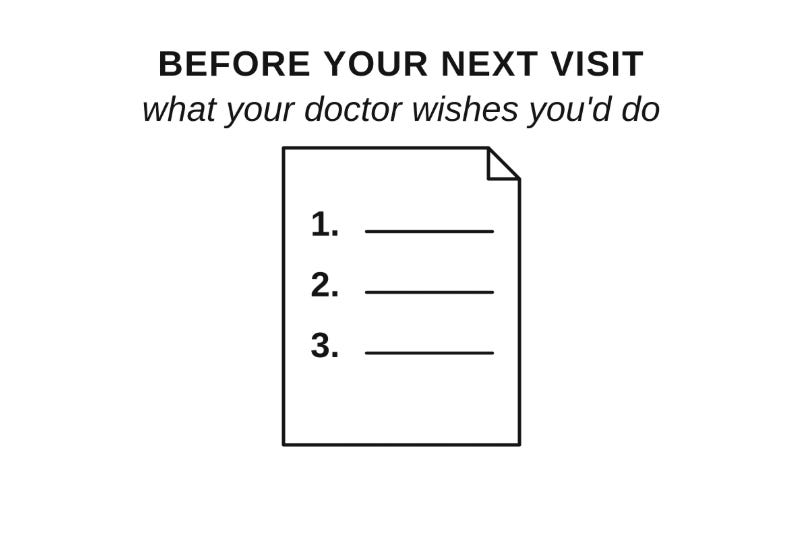
Your top three concerns, ranked, with the biggest one first.
The Ask Me 3 questions.
Every medication and supplement you take, and how often you actually take it.
“Repeat Back” the most important points to your doctor
Write down your Ask Me 3 answers.
At the checkout desk, get the date of your next visit, and put that date in your calendar right away.
This will take a few minutes of extra time and it will cost you a little bit of pride, but it can help turn your twelve minutes from a subconscious theatrical performance into a productive problem solving session.

This Saturday morning, expect a deep-dive article with a fun thought experiment: if money was no object, what could you buy to optimize your health? And, for each purchase category, what is the DIY (free, or at least much less expensive) way to achieve similar health benefits?
Best wishes,
Morgan
Morgan McSweeney, PhD (@dr.noc)
No posts
Comments
Nothing yet. Say the first thing.
Sign in to join the conversation.