
The richest one percent of American men outlive the poorest one percent by about 14.6 years. For women it is 10.1 years (Chetty et al., JAMA 2016).
Spend a minute looking at the below figure, which depicts that very same data.
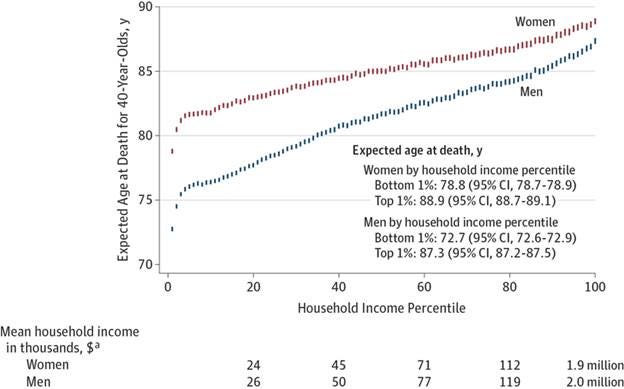
Upon a close inspection, you will find that there is something very different at the very bottom of the household income percentile curve, and that going from the bottom 1% of income to even just the bottom 3% of income is associated with a substantial improvement in longevity. But even if you start from that 3% mark and compare against the wealthy 99% values over on the right, it is clear that there is a “dose response” effect of household income on longevity for both men and women.
Of course, the grim reaper does not decide when to come a knocking after a careful review of your tax returns, brokerage account statements, or avocado toast receipts.
The easy interpretation is that rich people can buy things you simply cannot.
Some of that is true. For example, the wealthy typically do less physically dangerous work (they are less likely to work as a logger, commercial fisher, or roofer), they experience less stress from chronic financial panic, and they end up in better-staffed hospitals when something eventually goes wrong. The playing field is not level at any stage of the process, at least not in the United States.
But when you itemize many of the longevity-promoting factors that money can actually buy you, the tradeoff often works out to one of time, money, and convenience, and only rarely is it a hard barrier to access.
So today we will do a thought experiment:
Budget: unlimited.
Goal: Decrease risk for cardiac disease and cancer, decrease risk for dementia, and maintain muscle and bone health well into your 80s+.
I have identified a few categories of expenses that a wealthy family could make. For each, I will point out the biological health factor that the purchase is really affecting, and then briefly discuss how to achieve the same health effect for much less money (at the cost of your time).
To be very clear up front, I am a scientist and none of this is medical advice for your specific case, so run the details past your own doctor.
To this day, there are some things that money simply cannot buy… like a molecular pathway your body doesn’t already have. Jeff Bezos ages on the same cellular machinery you and I do.
No fortune has yet bought anyone an exemption from the woes and perils of being a mammal.
What money certainly can buy is friction removal. Willpower has very little to do with this discussion. What the money builds is a life where the healthy choice is the default, already scheduled, already sitting in the fridge when you walk in hungry at 6pm with four minutes on the clock before your child needs some help with their watercoloring activity.
Most of the below factors come down to buying back time and buying easy adherence. The biology is relatively straightforward and is the same for everyone. What money buys is the convenience of making it easier to do. And at the end of the day, that’s what counts, because it doesn’t matter what you know about i) what you should be eating, ii) how you should be training and sleeping, iii) what your blood pressure or cholesterol should be, or iv) the effects of your home air quality / PM2.5 - - what counts is what happens in the real world and what your body experiences on a daily basis.
Your private chef’s technical scope is to shop for ingredients and come into your house once per week to prepare 20 meals (10 each of two recipes).
The Cost: about $450-600 a week depending on where you live, plus groceries, so on the order of $25k-30k per year.
The fantasy interpretation of this purchase would be something akin to a longevity potion prepared with a mystical blend of elusive botanicals. In reality, the chef is actually plating more fiber, more plants, and resulting in a kitchen with less ultra-processed food to raid on a whim. Imagine opening your fridge door and finding neatly packed and labeled glass Tupperware, and the only “cooking” you have to do is choose which one of these to microwave:
Mediterranean Chickpea & Veggie Bowl with Herbed Couscous and Mixed Nuts
One Pan Mediterranean Fish with Roasted Zucchini and Orzo
Chicken and Lentil Curry with Mashed White Beans, Farro, and Roasted Carrots
This is all about reducing friction at the time you are making a decision, and making the pro-health option just about as easy as the packaged & convenient snack option.
The Benefits:
Dietary Fiber - The fiber number that your chef will help you hit every day is one of the more startlingly underappreciated stats in nutrition. (Unless you have read a few of my prior posts or know a registered dietitian, in which case you will never hear the end of the pro-fiber discourse).
In a large Lancet review, the people eating the most dietary fiber were 15 to 30 percent less likely to die early, from any cause and from heart disease, than those eating the least fiber. In raw counts, that’s about 13 fewer deaths for every 1,000 people, when comparing the highest fiber intakes to the lowest (Reynolds et al., Lancet 2019).
Your rough daily target should be to get at least 14g fiber per 1,000 calories, which works out to a daily target of ~25-35g+. Most Americans get about 15g, roughly half the target. What the chef really does is make hitting your daily 30+ grams effortless and delicious, so you actually hit it most days for decades, which is the timescale that counts.
Ultra-processed foods - The flip side of the chef’s cooking is what it crowds out. Higher intake of ultra-processed food tracks with a modestly higher risk of a long list of bad outcomes. A 2024 review pooling 45 analyses across roughly 10 million people linked it to higher rates of early death (a bit over 20 percent higher, comparing the most ultraprocessed intake to the least), heart disease, and depression, though the authors themselves rated most of that evidence low quality (Lane et al., BMJ 2024). A more concrete signal comes from the one tightly controlled feeding trial that I could find, where the NIH housed 20 people in a metabolic ward and provided them with ultra-processed food options matched for levels of sugar and fat and fiber against an unprocessed one. Each person spent 2 weeks with ultraprocessed options and with unprocessed options. On the ultra-processed weeks people ate an average of about 500 more calories a day. Over the 2 weeks, they gained an average of 2 pounds. And when people switched to the unprocessed diet for 2 weeks, they lost an average of 2 pounds (Hall et al., Cell Metabolism 2019). A small and short-duration study, but it provides evidence that the food itself drives some of the overeating, independent of who’s eating it.
Of course “Ultra-processed” is a rather crude designation that lumps soda and hot dogs in together with whole-grain bread and canned beans. When researchers pull it apart, the harm concentrates in a couple of usual suspects, sugar-sweetened drinks and processed meats, while ultra-processed breads and cereals come out roughly neutral (Cordova et al., Lancet Regional Health Europe 2023). Careful with that last part, though: those are subgroup findings from observational data, the slice where confounding bites hardest, so read them as “soda and deli meat are the clearest offenders,” not as proof that a packaged whole-grain loaf is health food. The practical takeaway is to cut the sugary drinks and processed meat first, and stop losing sleep over whether the bread came in a wrapper.
The “free” alternative? You already know how to save yourself the $30,000 chef, annoyingly: it comes at the cost of a couple hours of shopping and a few hours of batch cooking. Search for recipes that naturally incorporate lentils or beans and roast a couple sheet pan of your favorite vegetables, and portion them into grab-and-go containers. Make a jar of overnight oats or chia pudding for the week’s breakfasts in five or ten minutes. Keep cut fruit and plain yogurt at eye level in the fridge, and keep the things that you don’t want your future self to eat either out of the house or somehwere with a little more friction. Friction works both ways: you lower it on the pro-health meal and snack that’s already cooked or prepared, and you raise it on the snack you never brought home.
The next purchases are standing appointments with your trainer, a concierge doctor and an executive physical, a premium leafy, walkable neighborhood, and staff to buy back your time to make it all work in your schedule.
The playing field is NOT level (see the figure above). But each of these purchases is buying a specific, dull factor, and each has a free route below that trades time for money.
The personal trainer, who is really buying you four key things: bone density, muscle mass, aerobic fitness, and the scheduled calendar events to make sure you actually show up. Also, thoughts on adherence without the $20k price tag.
The concierge doctor, and how to rig it yourself with the exact numbers to walk into a normal 15-minute primary care visit asking for.
The right house, which is protecting your brain more than you’d think, and how to copy some of its active ingredients.
The household staff, and where they fit in with the other factors.
The Shopping List: in each category, what you can buy to engineer your own environment in favor of your health for a few $100’s, rather than a few $100k’s.
I run no ads, take no sponsorships, and use no affiliate links. That independence is the whole point. I would much rather you pay me directly for my time spent reading and translating the evidence, rather than to take money as a cut of sales from some product I recommend you buy. For example, you will notice that, below, I recommend you consider a HEPA filter for your home air quality. Though I mention specific brands and models I have bought, I have no financial relationships with those companies. When we talk about blood pressure monitors, I point you toward a list of validated machines, rather than choosing a device that would give me the biggest affiliate kick-back. When I wrote on the benefits of creatine monohydrate, I didn’t give you a link for any specific product. I think that’s the only way you can take any of this seriously.
A paid subscription also opens the archive and gives access to every deep-dive yet to come. If you’re ready to check out some prior letters, two popular ones are: i) The Truth: Is Alzheimer’s Preventable?, and ii) Creatine: What Works and What’s Hype.
The monthly option is $12/month and the $96 annual option works out to $8/month (which is about $1 per deep dive letter).
Onward, let’s start with the overview in grid format for each purchase, the health factors it is really modifying, and the outcomes that it affects.
Comments
Nothing yet. Say the first thing.
Sign in to join the conversation.